



Europe Vegetables And Fruits Market
시장 규모 (USD 10억)
연평균 성장률 :
% 
 USD
148.41 Billion
USD
285.04 Billion
2025
2033
USD
148.41 Billion
USD
285.04 Billion
2025
2033
 예측 기간 예측 기간 |
2026 –2033 |
 시장 규모(기준 연도) 시장 규모(기준 연도) |
USD 148.41 Billion |
 시장 규모(예측 연도) 시장 규모(예측 연도) |
USD 285.04 Billion |
 연평균 성장률 연평균 성장률 |
% |
| 주요 시장 플레이어 |
|
Europe Vegetables and Fruits Market Segmentation, By Product (Vegetable and Fruit), Type (Fresh, Canned, Frozen, Dried & Dehydrated, Purees and Paste, Concentrates, and Others), Category (Organic and Conventional), Packaging (Pouches, Tray, Bags, Cans, Jar, Boxes, and Others), End User (Retail/Household and Food Service), Distribution Channel (Store Based Retailers and Non-Store Based Retailers)- Industry Trends and Forecast to 2033
Europe Vegetables and Fruits Market Size
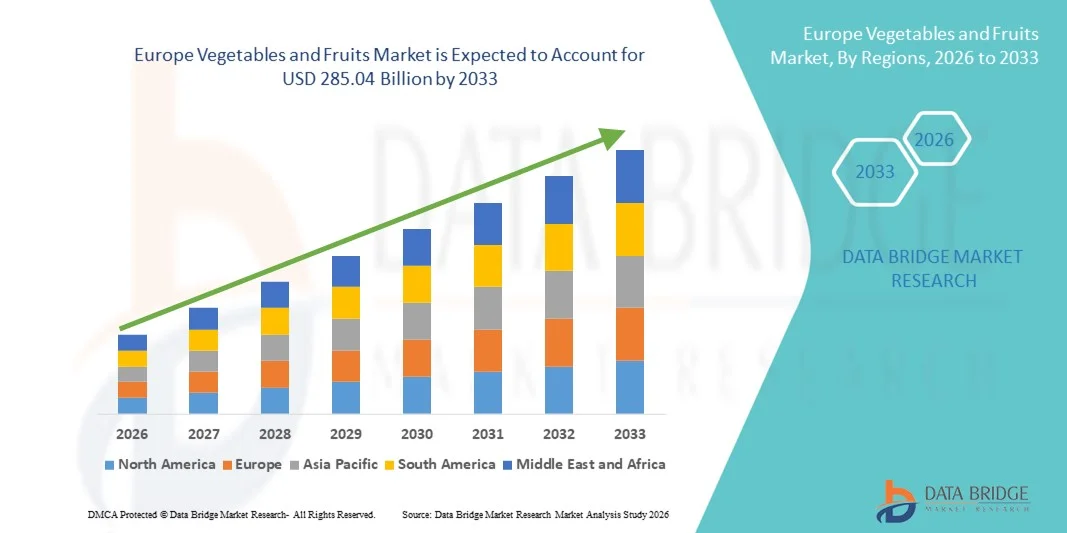
- The Europe vegetables and fruits market size was valued at USD 148.41 billion in 2025 and is expected to reach USD 285.04 billion by 2033, at a CAGR of 8.50% during the forecast period
- The market growth is largely fuelled by rising consumer awareness regarding the health benefits of fresh fruits and vegetables, including improved immunity, digestion, and overall wellness
- Increasing adoption of plant-based diets and changing dietary preferences toward natural and minimally processed foods are significantly supporting market expansion
Europe Vegetables and Fruits Market Analysis
- The market is witnessing steady expansion driven by strong demand across household, foodservice, and food processing applications, supported by consistent consumption patterns and daily dietary inclusion
- Growing emphasis on food quality, freshness, and traceability is encouraging producers and distributors to invest in improved farming practices, storage solutions, and supply chain optimisation
- Germany vegetables and fruits market captured the largest revenue share in 2025, driven by high per capita consumption and strong consumer awareness regarding nutrition and healthy eating habits
- U.K. is expected to witness the highest compound annual growth rate (CAGR) in the Europe vegetables and fruits market due to rising health consciousness, growing demand for fresh and convenience produce, expansion of online grocery platforms, and increasing adoption of ready-to-eat and pre-packaged vegetables and fruits
- The vegetables segment accounted for the largest market revenue share in 2025 driven by high daily consumption, wide availability across retail channels, and strong demand from food service operators. Vegetables are extensively used in household cooking and commercial food preparation, supporting their consistent market dominance across countries
Report Scope and Europe Vegetables and Fruits Market Segmentation
|
Attributes |
Europe Vegetables and Fruits Key Market Insights |
|
Segments Covered |
|
|
Countries Covered |
Europe
|
|
Key Market Players |
|
|
Market Opportunities |
|
|
Value Added Data Infosets |
In addition to the insights on market scenarios such as market value, growth rate, segmentation, geographical coverage, and major players, the market reports curated by the Data Bridge Market Research also include import export analysis, production capacity overview, production consumption analysis, price trend analysis, climate change scenario, supply chain analysis, value chain analysis, raw material/consumables overview, vendor selection criteria, PESTLE Analysis, Porter Analysis, and regulatory framework. |
Europe Vegetables and Fruits Market Trends
Rising Demand For Fresh, Healthy, And Naturally Sourced Produce
- The increasing focus on health, nutrition, and preventive wellness is significantly shaping the vegetables and fruits market, as consumers actively prefer fresh, natural, and minimally processed food products. Vegetables and fruits are gaining strong traction due to their essential vitamins, minerals, and antioxidants, which support immunity, digestion, and overall well-being. This trend is strengthening their consumption across households, foodservice outlets, and food processing industries, encouraging producers to enhance quality, freshness, and supply consistency
- Growing awareness around balanced diets, clean eating, and plant-forward lifestyles has accelerated the demand for fresh vegetables and fruits across daily meals, snacks, and beverages. Health-conscious consumers are increasingly incorporating fresh produce into their diets, driving demand from retail, hospitality, and institutional food channels. This shift is also encouraging food brands to develop value-added products such as fresh-cut, ready-to-eat, and minimally processed fruit and vegetable offerings
- Sustainability and food transparency trends are influencing purchasing decisions, with consumers prioritizing responsibly sourced, residue-free, and sustainably grown produce. Producers and distributors are focusing on improved farming practices, reduced chemical usage, and transparent supply chains to meet these expectations. These factors are helping brands differentiate offerings, build consumer trust, and enhance long-term loyalty in a competitive market
- For instance, in recent years, leading food brands and fresh produce suppliers expanded their portfolios to include fresh, organic, and minimally processed vegetables and fruits to address rising consumer demand for nutritious and natural food options. These products were introduced across retail, foodservice, and online grocery platforms, with marketing efforts emphasizing freshness, health benefits, and sustainable sourcing to strengthen brand positioning
- While demand for vegetables and fruits continues to rise, sustained market growth depends on efficient supply chains, improved storage solutions, and reduced post-harvest losses. Market participants are increasingly investing in cold chain infrastructure, packaging innovations, and digital distribution platforms to maintain quality, extend shelf life, and ensure consistent availability across end-use channels
Europe Vegetables and Fruits Market Dynamics
Driver
Growing Consumer Preference For Healthy And Nutrient-Rich Diets
- Rising consumer awareness regarding the health benefits of vegetables and fruits is a major driver for market growth. Consumers are increasingly prioritizing nutrient-dense foods rich in vitamins, minerals, and dietary fiber, encouraging higher daily consumption. This trend is driving producers and retailers to expand fresh produce offerings and improve product quality to meet evolving dietary preferences
- Expanding use of vegetables and fruits in home cooking, foodservice menus, and processed food applications is supporting market expansion. Fresh produce plays a critical role in salads, beverages, ready meals, and functional foods, enabling manufacturers and food operators to meet consumer demand for wholesome and balanced meals. The increasing adoption of plant-based and flexitarian diets further reinforces this growth driver
- Retailers, foodservice providers, and food brands are actively promoting vegetables and fruits through product innovations, awareness campaigns, and health-focused marketing strategies. These initiatives highlight nutritional value, freshness, and versatility, supporting increased consumption and encouraging collaboration across the agricultural and food supply ecosystem
- For instance, foodservice operators and packaged food brands have increased the inclusion of fresh and processed vegetables and fruits in meal kits, ready-to-eat products, and beverage formulations to meet rising consumer demand for healthy and convenient food choices. These initiatives have supported higher sales volumes and improved product differentiation in competitive food markets
- Despite strong demand drivers, sustained growth requires continuous investment in farming efficiency, logistics, and storage infrastructure. Strengthening supply chain resilience, improving yield consistency, and minimizing wastage will be essential to support long-term market expansion
Restraint/Challenge
Perishability And Supply Chain Inefficiencies
- The highly perishable nature of vegetables and fruits remains a key challenge, leading to significant post-harvest losses and increased operational costs. Inadequate storage, handling, and transportation infrastructure can result in quality degradation, reduced shelf life, and financial losses for producers and distributors, limiting overall market efficiency
- Price volatility caused by seasonal production cycles, climate variability, and fluctuating supply levels also restrains market stability. Sudden changes in availability can impact pricing, profit margins, and purchasing decisions, particularly for small-scale producers and price-sensitive consumers
- Supply chain complexities further challenge market growth, as vegetables and fruits require efficient cold storage, timely transportation, and careful handling to maintain freshness. Gaps in infrastructure and logistics capabilities increase costs and limit consistent availability across distribution channels
- For instance, disruptions in harvesting, storage, or transportation have led to quality losses and inconsistent supply for retailers and foodservice operators, affecting product availability and consumer satisfaction. These challenges have also prompted some sellers to limit product variety or increase prices to offset losses
- Addressing these challenges will require investment in cold chain development, advanced packaging solutions, and improved logistics management. Strengthening farmer-to-market connectivity, adopting modern storage technologies, and enhancing supply chain coordination will be critical to unlocking the long-term growth potential of the vegetables and fruits market
Europe Vegetables and Fruits Market Scope
The market is segmented on the basis of product, type, category, packaging, end user, and distribution channel
- By Product
On the basis of product, the Europe vegetables and fruits market is segmented into vegetables and fruits. The vegetables segment accounted for the largest market revenue share in 2025 driven by high daily consumption, wide availability across retail channels, and strong demand from food service operators. Vegetables are extensively used in household cooking and commercial food preparation, supporting their consistent market dominance across countries.
The fruits segment is expected to witness steady growth from 2026 to 2033 supported by rising consumer preference for healthy snacking options and increasing awareness of the nutritional benefits of fresh and processed fruits. In addition, growing demand for fruit-based beverages, desserts, and convenience products is supporting segment expansion.
- By Type
On the basis of type, the Europe vegetables and fruits market is segmented into fresh, canned, frozen, dried & dehydrated, purees and paste, concentrates, and others. The fresh segment held the largest market share in 2025 owing to strong consumer preference for minimally processed food and the well-developed fresh produce supply chain in Europe. Fresh vegetables and fruits are widely consumed due to their perceived quality, taste, and nutritional value.
The frozen segment is expected to grow steadily from 2026 to 2033 driven by extended shelf life, reduced food waste, and convenience for both households and food service providers. Frozen products are increasingly adopted due to advancements in freezing technology that help retain texture and nutrients.
- By Category
On the basis of category, the Europe vegetables and fruits market is segmented into organic and conventional. The conventional segment dominated the market in 2025 supported by lower prices, higher availability, and established farming practices across Europe. Conventional vegetables and fruits continue to be widely preferred due to affordability and consistent supply.
The organic segment is expected to register faster growth from 2026 to 2033 driven by increasing health consciousness and rising demand for chemical-free food products. In addition, supportive government initiatives and expanding organic retail offerings are accelerating segment growth.
- By Packaging
On the basis of packaging, the Europe vegetables and fruits market is segmented into pouches, tray, bags, cans, jar, boxes, and others. Bags and trays accounted for a major revenue share in 2025 due to their extensive use for fresh produce packaging and ease of handling during transportation and retail display. These packaging formats are widely adopted by supermarkets and grocery stores.
Pouches and cans is expected to grow steadily from 2026 to 2033 driven by increasing demand for processed and ready-to-use vegetables and fruits. These packaging types offer improved shelf life and convenience, particularly for urban consumers.
- By End User
On the basis of end user, the Europe vegetables and fruits market is segmented into retail/household and food service. The retail/household segment held the largest share in 2025 supported by high home consumption and frequent purchases through supermarkets and local stores. Changing dietary habits and preference for home-cooked meals continue to drive this segment.
The food service segment is expected to grow steadily from 2026 to 2033 driven by the expansion of restaurants, hotels, and catering services across Europe. Increasing demand for consistent quality and bulk supply of vegetables and fruits is supporting segment growth.
- By Distribution Channel
On the basis of distribution channel, the Europe vegetables and fruits market is segmented into store based retailers and non-store based retailers. Store based retailers dominated the market in 2025 driven by strong supermarket and hypermarket presence, wide product assortment, and consumer preference for physical inspection of fresh produce.
The non-store based retailers segment is expected to grow steadily from 2026 to 2033 supported by the rapid expansion of online grocery platforms and doorstep delivery services. In addition, increasing digital adoption and convenience are accelerating the shift toward online purchasing of vegetables and fruits.
Europe Vegetables and Fruits Market Regional Analysis
- Germany vegetables and fruits market captured the largest revenue share in 2025, driven by high per capita consumption and strong consumer awareness regarding nutrition and healthy eating habits
- Consumers in Germany highly value fresh, organic, and sustainably sourced produce, supported by well-established retail chains and efficient supply networks
- In addition, the country’s emphasis on quality standards, traceability, and locally produced vegetables and fruits continues to reinforce its market dominance
U.K. Vegetables and Fruits Market Insight
The U.K. vegetables and fruits market is expected to witness the fastest growth rate from 2026 to 2033, driven by rising health consciousness and increasing adoption of fruits and vegetables in daily diets. Consumers are increasingly preferring fresh and convenience produce, supported by the rapid expansion of online grocery platforms and store based retailers. The growing demand for ready-to-eat and pre-packaged vegetables and fruits is further accelerating market growth.
Europe Vegetables and Fruits Market Share
The Europe vegetables and fruits industry is primarily led by well-established companies, including:
- Total Produce (Ireland)
- Fresh Del Monte Produce Inc (U.S.)
- Barfoots (U.K.)
- Nationwide Produce Plc (U.K.)
- Fesa UK Ltd (U.K.)
- STIRFRESH (U.K.)
- Kühne + Heitz (Netherlands)
- Wealmoor Ltd (U.K.)
- Abbey View Produce (U.K.)
- Agrial (France)
- Burgess Farms (U.K.)
- Kiril Mischeff (U.K.)
- Kettle Produce Ltd (U.K.)
- Natural Vegetable Company (U.K.)
- MyFresh (U.K.)
- Watts Farms Fresh Produce Holdings Ltd (U.K.)
- S&A Group Holdings Limited (U.K.)
- Fruktana (Spain)
- Fresh Fruits Company (U.S.)
- DGM Growers (U.K.)
- RBOrganic Ltd (U.K.)
- Greenyard (Belgium)
Latest Developments in Europe Vegetables and Fruits Market
- In June 2021, Fresh Del Monte Produce Inc., partnership development, collaborated with the German Federal Ministry for Economic Cooperation and Development (BMZ) to establish a three-year multi-stakeholder sustainability program in Europe, aimed at improving natural resource utilization, supporting sustainable landscapes, and strengthening local economic development, positively impacting long-term supply stability
SKU-
세계 최초의 시장 정보 클라우드 보고서에 온라인으로 접속하세요

- 대화형 데이터 분석 대시보드
- 높은 성장 잠재력 기회를 위한 회사 분석 대시보드
- 사용자 정의 및 질의를 위한 리서치 분석가 액세스
- 대화형 대시보드를 통한 경쟁자 분석
- 최신 뉴스, 업데이트 및 추세 분석
- 포괄적인 경쟁자 추적을 위한 벤치마크 분석의 힘 활용
연구 방법론
데이터 수집 및 기준 연도 분석은 대규모 샘플 크기의 데이터 수집 모듈을 사용하여 수행됩니다. 이 단계에는 다양한 소스와 전략을 통해 시장 정보 또는 관련 데이터를 얻는 것이 포함됩니다. 여기에는 과거에 수집한 모든 데이터를 미리 검토하고 계획하는 것이 포함됩니다. 또한 다양한 정보 소스에서 발견되는 정보 불일치를 검토하는 것도 포함됩니다. 시장 데이터는 시장 통계 및 일관된 모델을 사용하여 분석하고 추정합니다. 또한 시장 점유율 분석 및 주요 추세 분석은 시장 보고서의 주요 성공 요인입니다. 자세한 내용은 분석가에게 전화를 요청하거나 문의 사항을 드롭하세요.
DBMR 연구팀에서 사용하는 주요 연구 방법론은 데이터 마이닝, 시장에 대한 데이터 변수의 영향 분석 및 주요(산업 전문가) 검증을 포함하는 데이터 삼각 측량입니다. 데이터 모델에는 공급업체 포지셔닝 그리드, 시장 타임라인 분석, 시장 개요 및 가이드, 회사 포지셔닝 그리드, 특허 분석, 가격 분석, 회사 시장 점유율 분석, 측정 기준, 글로벌 대 지역 및 공급업체 점유율 분석이 포함됩니다. 연구 방법론에 대해 자세히 알아보려면 문의를 통해 업계 전문가에게 문의하세요.
사용자 정의 가능
Data Bridge Market Research는 고급 형성 연구 분야의 선두 주자입니다. 저희는 기존 및 신규 고객에게 목표에 맞는 데이터와 분석을 제공하는 데 자부심을 느낍니다. 보고서는 추가 국가에 대한 시장 이해(국가 목록 요청), 임상 시험 결과 데이터, 문헌 검토, 재생 시장 및 제품 기반 분석을 포함하도록 사용자 정의할 수 있습니다. 기술 기반 분석에서 시장 포트폴리오 전략에 이르기까지 타겟 경쟁업체의 시장 분석을 분석할 수 있습니다. 귀하가 원하는 형식과 데이터 스타일로 필요한 만큼 많은 경쟁자를 추가할 수 있습니다. 저희 분석가 팀은 또한 원시 엑셀 파일 피벗 테이블(팩트북)로 데이터를 제공하거나 보고서에서 사용 가능한 데이터 세트에서 프레젠테이션을 만드는 데 도움을 줄 수 있습니다.












