


What is the Fraud Hunters Market Size and Overview?
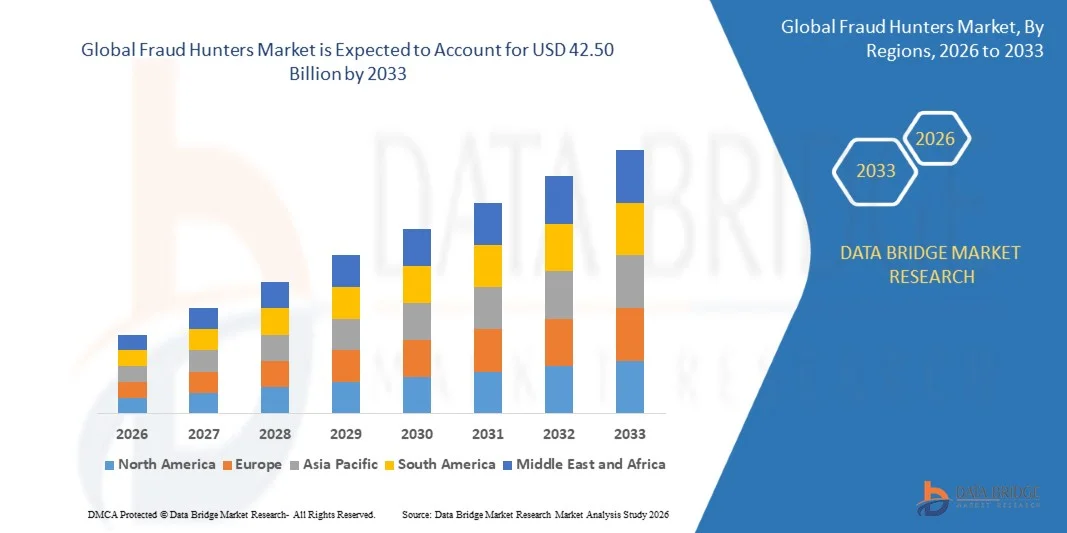
As per Data Bridge Market Research analysis the global fraud hunters market was valued at USD 12.70 billion in 2025 and is projected to reach USD 42.50 billion by 2033, growing at a CAGR of 16.30% from 2026 to 2033. The fraud hunters market is experiencing significant growth driven by the increasing sophistication of cyber fraud, the rapid adoption of digital payment platforms, and growing demand for AI-powered fraud detection and investigation solutions across banking, financial services, insurance, e-commerce, and government sectors.
The rising incidence of identity theft, payment fraud, account takeover attacks, money laundering, synthetic identity fraud, and digital transaction fraud, combined with increasingly stringent regulatory requirements related to anti-money laundering (AML), know your customer (KYC), and financial crime compliance, is compelling organizations to invest in advanced fraud hunting solutions. AI- and machine learning-enabled fraud hunting platforms are increasingly replacing traditional rule-based fraud detection systems by providing real-time anomaly detection, behavioral analytics, network analysis, and predictive risk scoring. Furthermore, the growing adoption of cloud-based fraud intelligence platforms, big data analytics, and automated investigation tools is enabling enterprises to identify emerging fraud patterns faster, reduce financial losses, strengthen regulatory compliance, and improve operational efficiency, thereby driving sustained growth in the fraud hunters market.
Market Size & Forecast
- Market Value (2025): USD 12.70 Billion
- Expected Market Value (2033): USD 42.50 Billion
- Forecast CAGR (2026–2033): 16.30%
- Leading Region in 2025: North America
- Fastest Growing Region: Asia-Pacific
Key Market Trends & Insights
- North America dominated the global fraud hunters market with an estimated revenue share of 39.42% in 2025, driven by the widespread adoption of AI-powered fraud detection platforms, increasing digital payment transactions, stringent regulatory compliance requirements, and the strong presence of leading fraud prevention solution providers across the U.S. and Canada.
- The banks and financial institutions segment dominated the market with an estimated 76% share in 2025 due to the continuously increasing volume of digital financial transactions, mobile banking services, online payment platforms, and cross-border financial activities.
- Asia-Pacific is expected to be the fastest-growing region at an estimated CAGR of 17.3% from 2026 to 2033, fueled by rapid digitalization, expanding fintech ecosystems, increasing online banking and e-commerce transactions, growing cyber fraud incidents, and rising investments in AI-based fraud detection technologies across China, India, Japan, and Southeast Asia.
- The government segment is anticipated to register the fastest CAGR of 6% from 2026 to 2033, driven by increasing efforts to combat public sector fraud, tax fraud, procurement fraud, social benefit fraud, cybercrime, and identity-related financial crimes.
- The consumer fraud segment is expected to witness the fastest CAGR of 1% from 2026 to 2033, driven by the rapid expansion of e-commerce, digital wallets, online marketplaces, and social commerce platforms worldwide
Report Scope and Fraud Hunters Market Segmentation
|
Attributes |
Fraud Hunters Key Market Insights |
|
Segments Covered |
|
|
Countries Covered |
North America
Europe
Asia-Pacific
Middle East and Africa
South America
|
|
Key Market Players |
|
|
Market Opportunities |
|
|
Value Added Data Infosets |
In addition to the insights on market scenarios such as market value, growth rate, segmentation, geographical coverage, and major players, the market reports curated by the Data Bridge Market Research also include in-depth expert analysis, geographically represented company-wise production and capacity, network layouts of distributors and partners, detailed and updated price trend analysis and deficit analysis of supply chain and demand. |
What is the Key Trend in the Fraud Hunters Market?
Trend: Increasing Adoption of AI-Powered Fraud Detection and Real-Time Transaction Monitoring
Organizations across banking, financial services, insurance, e-commerce, and digital payment ecosystems are increasingly adopting AI-powered fraud hunting platforms to identify suspicious activities in real time. Modern fraud hunting solutions integrate machine learning, behavioral analytics, device intelligence, and graph analytics to detect complex fraud patterns, reduce false positives, and improve investigation efficiency. The rapid growth of digital payments, online banking, and e-commerce has further accelerated investments in intelligent fraud detection platforms capable of adapting to evolving cyber threats. For instance, in September 2024, Mastercard announced its agreement to acquire Recorded Future, a leading threat intelligence company, to strengthen AI-driven fraud prevention, cybersecurity, and risk intelligence capabilities across its global payments ecosystem. The increasing sophistication of digital fraud and cyber threats is accelerating the adoption of AI-powered fraud hunting platforms, making intelligent, real-time fraud detection an essential component of modern financial security strategies.
Fraud Hunters Market Dynamics
Key Market Driver: Rising Digital Payment Transactions and Growing Financial Cybercrime
The rapid expansion of digital banking, instant payments, e-commerce, and mobile wallets has significantly increased the demand for advanced fraud hunting solutions capable of detecting financial fraud in real time. Organizations are increasingly deploying AI, machine learning, and behavioral analytics to monitor millions of transactions, identify suspicious activities, and reduce financial losses while maintaining regulatory compliance. Growing cybercrime and increasingly sophisticated fraud techniques continue to drive investment in next-generation fraud detection technologies. For instance, in February 2024, Visa Inc. launched the Visa Account Attack Intelligence (VAAI) Score, an AI-powered solution designed to help issuers identify enumeration attacks and payment fraud before financial losses occur. The continuous growth of digital financial transactions and increasingly sophisticated fraud attacks are expected to remain the primary drivers of investment in AI-enabled fraud hunting platforms worldwide.
Key Restraint/Challenge: Increasing Sophistication of Fraud Techniques and High Implementation Complexity
Fraud hunting platforms require continuous model training, integration with multiple enterprise systems, regulatory compliance, and access to large volumes of high-quality transactional data. The growing use of AI-generated fraud, synthetic identities, account takeover attacks, and deepfake technologies has significantly increased the complexity of fraud detection. Organizations must continuously update fraud detection models while balancing detection accuracy, operational costs, customer experience, and data privacy requirements. For instance, NICE Actimize regularly highlights the need for continuous AI model updates and behavioral analytics to combat increasingly sophisticated financial crime and fraud schemes across banking institutions. The rapidly evolving nature of financial fraud, combined with increasing implementation complexity and regulatory requirements, remains one of the biggest challenges for fraud hunting solution providers.
Key Market Opportunity: Expansion of Generative AI and Cloud-Based Fraud Detection Platforms
The growing adoption of generative AI, cloud computing, and real-time analytics is creating substantial opportunities for fraud hunting vendors. Cloud-native fraud detection platforms enable organizations to process large transaction volumes, improve fraud detection accuracy, accelerate investigations, and scale operations without significant infrastructure investments. As financial institutions continue modernizing their digital infrastructure, demand for AI-enabled fraud hunting solutions is expected to increase significantly. For instance, in May 2024, Visa announced the Visa Account Attack Intelligence (VAAI) Score, a generative AI-powered fraud detection solution that uses advanced AI models to identify and score card enumeration attacks in real time. The solution enables issuers to detect high-risk card-not-present transactions, improve authorization decisions through real-time risk scoring, reduce fraud losses, and strengthen payment security across digital payment ecosystems. The rapid adoption of generative AI, cloud-native analytics, and intelligent automation is creating significant long-term growth opportunities for fraud hunting solution providers by enabling faster, more accurate, and scalable fraud detection across digital ecosystems.
Fraud Hunters Market Scope
The fraud hunters market is segmented on the basis of type of fraud and application.
- By Type of Fraud
On the basis of type of fraud, the global fraud hunters market is segmented into financial statement fraud, healthcare fraud, insurance and banking fraud, consumer fraud, intellectual property fraud, and others. The insurance and banking fraud segment dominated the market with an estimated 39.42% share in 2025 due to the rising incidence of digital payment fraud, account takeover attacks, identity theft, money laundering, card fraud, and online banking fraud across financial institutions worldwide. The increasing adoption of digital banking, real-time payment systems, and mobile financial services has significantly increased the need for advanced fraud hunting platforms capable of detecting suspicious activities in real time. Financial institutions are investing heavily in AI-powered fraud analytics, behavioral biometrics, predictive analytics, and machine learning algorithms to reduce fraud losses and improve customer trust. Additionally, stringent regulatory requirements related to anti-money laundering (AML), Know Your Customer (KYC), and financial crime compliance are compelling banks to modernize fraud investigation capabilities. The growing integration of cloud-based fraud detection platforms, real-time transaction monitoring, network analytics, and automated case management solutions further strengthens market demand. Rising cybersecurity investments and continuous innovation in fraud intelligence solutions continue to reinforce the dominance of this segment across the global fraud hunters market.
The consumer fraud segment is expected to witness the fastest CAGR of 14.1% from 2026 to 2033, driven by the rapid expansion of e-commerce, digital wallets, online marketplaces, and social commerce platforms worldwide. Increasing incidents of phishing attacks, synthetic identity fraud, refund fraud, account takeover, promotional abuse, and fake merchant activities are creating strong demand for advanced consumer fraud detection solutions. Organizations are increasingly deploying AI-driven behavioral analytics, device fingerprinting, identity verification technologies, and real-time fraud intelligence platforms to minimize financial losses and improve customer experiences. Growing consumer awareness regarding cybersecurity and digital privacy is encouraging enterprises to strengthen fraud prevention strategies. Furthermore, increasing adoption of cloud-based fraud hunting platforms by retailers, fintech companies, payment processors, and digital service providers is accelerating market growth. Continuous innovation in predictive analytics and machine learning-based fraud detection technologies is expected to further support rapid expansion of this segment throughout the forecast period.
- By Application
On the basis of application, the global fraud hunters market is segmented into defense, government, banks and financial institutions, and others. The banks and financial institutions segment dominated the market with an estimated 48.76% share in 2025 due to the continuously increasing volume of digital financial transactions, mobile banking services, online payment platforms, and cross-border financial activities. Financial institutions remain primary targets for cybercriminals involved in payment fraud, identity theft, account takeover, credit card fraud, and money laundering activities. Consequently, banks are investing significantly in AI-enabled fraud hunting platforms, real-time transaction monitoring systems, predictive analytics, behavioral biometrics, and network intelligence solutions to detect sophisticated fraud patterns. Increasing regulatory mandates related to AML, KYC, PCI-DSS, and financial crime reporting further support widespread adoption. Integration of fraud hunting solutions with enterprise risk management, cybersecurity platforms, and digital identity verification systems is enhancing operational efficiency while reducing false positives. Continuous investments by global banks in advanced fraud intelligence technologies continue to strengthen the leadership of this segment in the fraud hunters market.
The government segment is anticipated to register the fastest CAGR of 13.6% from 2026 to 2033, driven by increasing efforts to combat public sector fraud, tax fraud, procurement fraud, social benefit fraud, cybercrime, and identity-related financial crimes. Governments across developed and emerging economies are strengthening digital governance initiatives while deploying AI-enabled fraud investigation platforms capable of identifying complex fraudulent networks across multiple public databases. Increasing investments in digital identity programs, national cybersecurity frameworks, forensic analytics, and big data platforms are significantly improving fraud detection capabilities. Regulatory agencies are increasingly utilizing machine learning, graph analytics, and predictive intelligence to strengthen financial transparency and reduce public revenue losses. Rising public-sector digital transformation initiatives and growing collaboration with cybersecurity vendors are expected to accelerate the deployment of advanced fraud hunting technologies. Continuous modernization of government fraud investigation infrastructure will further support strong growth of this application segment during the forecast period.
Fraud Hunters Market Regional Analysis
North America dominated the fraud hunters market and accounted for the largest revenue share of 39.42% in 2025, driven by the widespread adoption of AI-powered fraud detection platforms, increasing digital payment transactions, stringent regulatory compliance requirements, and the strong presence of leading fraud prevention solution providers across the United States and Canada. The region also benefits from advanced cybersecurity infrastructure, high adoption of cloud-based fraud analytics, and growing investments in artificial intelligence and machine learning technologies for financial crime prevention. Increasing cyber threats, identity theft, and payment fraud continue to strengthen North America's leadership position in the global fraud hunters market.
U.S. Fraud Hunters Market Insight
The U.S. fraud hunters market is witnessing strong growth due to increasing digital payment volumes, expanding online banking services, and rising investments in AI-powered fraud detection technologies. The country's mature financial services ecosystem, coupled with stringent regulatory compliance requirements and growing cybersecurity investments, is driving demand for advanced fraud hunting solutions across banking, insurance, e-commerce, and government sectors. In addition, the increasing frequency of identity theft, account takeover attacks, and payment fraud is accelerating the adoption of real-time fraud analytics and behavioral monitoring platforms across the United States.
Europe Fraud Hunters Market Insight
The Europe fraud hunters market remains a major contributor to global revenue, driven by stringent data protection regulations, increasing adoption of digital banking services, and rising investments in financial crime prevention technologies. Financial institutions and enterprises across the region are increasingly deploying AI-enabled fraud detection platforms to combat payment fraud, money laundering, and identity theft. Growing regulatory focus on anti-money laundering (AML) compliance and secure digital transactions continues to support the expansion of the fraud hunters market throughout Europe.
U.K. Fraud Hunters Market Insight
The U.K. fraud hunters market is experiencing steady growth, supported by the rapid expansion of digital financial services, increasing online payment transactions, and growing investments in cybersecurity technologies. Banks, fintech companies, and e-commerce platforms are increasingly implementing AI-driven fraud detection and real-time transaction monitoring solutions to minimize financial losses and improve regulatory compliance. Furthermore, the country's strong fintech ecosystem continues to drive innovation in fraud prevention technologies.
Germany Fraud Hunters Market Insight
The Germany fraud hunters market is expanding steadily due to the country's advanced banking infrastructure, growing digital economy, and increasing adoption of enterprise cybersecurity solutions. Financial institutions, insurance providers, retailers, and government organizations are investing in AI-powered fraud detection platforms to identify suspicious transactions, reduce financial crime, and strengthen regulatory compliance. Continuous investments in digital transformation and intelligent analytics are further driving growth in the fraud hunters market across Germany.
Asia-Pacific Fraud Hunters Market Insight
The Asia-Pacific fraud hunters market is expected to witness the fastest growth, registering an estimated CAGR of 17.3% from 2026 to 2033, driven by rapid digitalization, expanding fintech ecosystems, increasing online banking and e-commerce transactions, growing cyber fraud incidents, and rising investments in AI-based fraud detection technologies across China, India, Japan, and Southeast Asia. The increasing adoption of digital wallets, real-time payment platforms, and cloud-based financial services is creating substantial demand for intelligent fraud detection and financial crime prevention solutions throughout the region.
Japan Fraud Hunters Market Insight
The Japan fraud hunters market is witnessing consistent growth due to increasing adoption of digital banking, cashless payment systems, and advanced cybersecurity technologies. Financial institutions are investing in AI-powered fraud detection, behavioral analytics, and real-time transaction monitoring to combat increasingly sophisticated cyber threats. Moreover, government initiatives promoting secure digital financial infrastructure and growing fintech innovation continue to support market expansion.
China Fraud Hunters Market Insight
The China fraud hunters market is growing rapidly, driven by the rapid expansion of digital payment platforms, booming e-commerce activity, and increasing government efforts to strengthen cybersecurity and financial crime prevention. Rising investments in artificial intelligence, big data analytics, and cloud computing are significantly improving fraud detection capabilities across banking, fintech, and digital commerce sectors. The country's large digital economy and accelerating adoption of intelligent fraud prevention technologies position China as one of the fastest-growing markets for the fraud hunters market globally.
Fraud Hunters Market Share
The fraud hunters industry is primarily led by well-established companies, including:
- SAS Institute Inc. (U.S.)
- FICO (U.S.)
- NiCE Ltd. (Israel)
- Feedzai (Portugal)
- LexisNexis Risk Solutions (U.S.)
- Experian Information Solutions, Inc. (Ireland)
- TransUnion LLC. (U.S.)
- Equifax Inc. (U.S.)
- BAE Systems (U.K.)
- Oracle (U.S.)
- SAP SE (Germany)
- Microsoft (U.S.)
- Mastercard (U.S.)
- SEON Technologies Ltd. (Hungary)
- Sift Science, Inc. (U.S.)
Latest Developments in Fraud Hunters Market
- In September 2025, Moog Inc. has unveiled its latest motion systems all electric E60 Series and the electro pneumatic P60 Series, setting a new benchmark for simulation across aviation, land, and maritime training with support for up to 14,000 kg loads and high fidelity motion for Level D flight simulators and other professional uses. The upgraded platforms deliver enhanced reliability, compact design and sustained operational uptime, reflecting modernized electronics and sustainable operation. These new systems strengthen Moog’s market leadership in simulation motion technology by boosting performance, energy efficiency, and usability
- In January 2025, Exail Technologies has acquired Leukos, a French photonics specialist known for pulsed micro lasers, supercontinuum laser sources, ultrafast lasers, and simulation-enabled optical systems, strengthening its technological and industrial capabilities in advanced laser and simulation technologies. The deal integrates Leukos’s expertise with Exail’s photonics, optical, and simulation platforms, broadening product offerings for applications in biophotonics, microelectronics, and high-fidelity training simulations. This strategic acquisition accelerates Exail’s innovation in high-tech technologies, creating synergies that expand its reach in scientific, industrial, and simulation applications while reinforcing its position as a leading advanced-technology provider
- In November 2025, IPG Automotive launched CarMaker 15.0, the latest version of its driving simulation software used for virtual vehicle development. The new release improves simulation accuracy by integrating virtual electronic control units (vECUs), allowing engineers to test software and vehicle systems at earlier development stages. It also includes enhanced sensor models and improved endurance testing capabilities for ADAS and autonomous vehicles. This development strengthens IPG Automotive’s position in the driving simulator market, as CarMaker enables automotive manufacturers to perform complex vehicle tests in a virtual driving environment instead of physical road testing.
- In November 2024, IPG Automotive released CarMaker 14.0, introducing new simulation capabilities including advanced sensor models and more realistic virtual environments. The update allows developers to simulate complex traffic scenarios involving pedestrians, vehicles, and different weather conditions. These features help automotive companies test ADAS and autonomous driving systems more efficiently in driving simulators, reducing development time and cost. The upgrade also expanded simulation capabilities for heavy-duty vehicles using the TruckMaker platform.
- In June 2023, IPG Automotive participated in the UNICARagil research project, collaborating with universities and industry partners to develop automated vehicle architectures. The company contributed its CarMaker driving simulation platform to support simulation and validation of automated driving systems in Software-in-the-Loop (SIL) and Hardware-in-the-Loop (HIL) environments. This collaboration demonstrates the application of Fraud Hunters in research and development of autonomous mobility solutions

- Interactive Data Analysis Dashboard
- Company Analysis Dashboard for high growth potential opportunities
- Research Analyst Access for customization & queries
- Competitor Analysis with Interactive dashboard
- Latest News, Updates & Trend analysis
- Harness the Power of Benchmark Analysis for Comprehensive Competitor Tracking
Data collection and base year analysis are done using data collection modules with large sample sizes. The stage includes obtaining market information or related data through various sources and strategies. It includes examining and planning all the data acquired from the past in advance. It likewise envelops the examination of information inconsistencies seen across different information sources. The market data is analysed and estimated using market statistical and coherent models. Also, market share analysis and key trend analysis are the major success factors in the market report. To know more, please request an analyst call or drop down your inquiry.
The key research methodology used by DBMR research team is data triangulation which involves data mining, analysis of the impact of data variables on the market and primary (industry expert) validation. Data models include Vendor Positioning Grid, Market Time Line Analysis, Market Overview and Guide, Company Positioning Grid, Patent Analysis, Pricing Analysis, Company Market Share Analysis, Standards of Measurement, Global versus Regional and Vendor Share Analysis. To know more about the research methodology, drop in an inquiry to speak to our industry experts.
Data Bridge Market Research is a leader in advanced formative research. We take pride in servicing our existing and new customers with data and analysis that match and suits their goal. The report can be customized to include price trend analysis of target brands understanding the market for additional countries (ask for the list of countries), clinical trial results data, literature review, refurbished market and product base analysis. Market analysis of target competitors can be analyzed from technology-based analysis to market portfolio strategies. We can add as many competitors that you require data about in the format and data style you are looking for. Our team of analysts can also provide you data in crude raw excel files pivot tables (Fact book) or can assist you in creating presentations from the data sets available in the report.













