




Asia Pacific Industrial X Ray Market
Market Size in USD Million
CAGR :
% 
 USD
900.00 Million
USD
1,619.52 Million
2025
2033
USD
900.00 Million
USD
1,619.52 Million
2025
2033
 Forecast Period Forecast Period |
2026 –2033 |
 Market Size (Base Year) Market Size (Base Year) |
USD 900.00 Million |
 Market Size (Forecast Year) Market Size (Forecast Year) |
USD 1,619.52 Million |
 CAGR CAGR |
% |
| Major Markets Players |
|
Asia-Pacific Industrial X-Ray Market Size
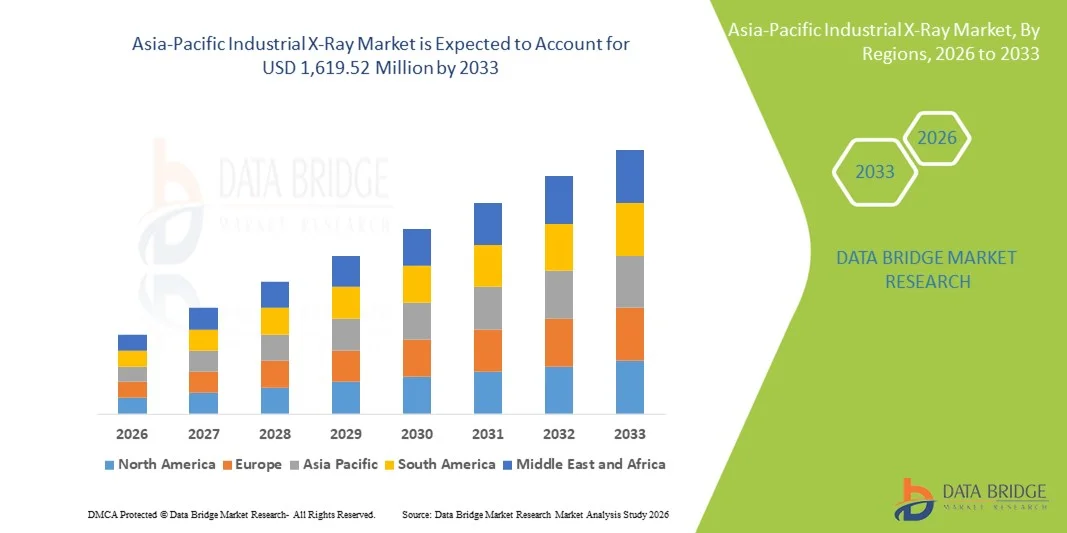
- The Asia-Pacific industrial X-ray market size was valued at USD 900.00 million in 2025 and is expected to reach USD 1,619.52 million by 2033, at a CAGR of 7.62% during the forecast period
- The market growth is largely fueled by increasing adoption of advanced industrial inspection technologies and automation across manufacturing sectors such as automotive, electronics, aerospace, and battery production, driving the demand for precise non-destructive testing solutions
- Furthermore, rising regulatory standards for product safety and quality, along with the need for faster, high-resolution inspection methods, are establishing industrial X-ray systems as the preferred choice for quality assurance and research applications. These converging factors are accelerating the uptake of industrial X-ray solutions, thereby significantly boosting the industry's growth
Asia-Pacific Industrial X-Ray Market Analysis
- Industrial X-ray systems, offering non-destructive testing (NDT) and high-precision inspection for components and assemblies, are increasingly vital in modern manufacturing and research environments across automotive, aerospace, electronics, and battery industries due to their accuracy, speed, and ability to detect hidden defects
- The escalating demand for industrial X-ray systems is primarily fueled by growing automation in manufacturing, stricter quality control regulations, and a rising need for high-resolution inspection solutions to ensure product safety and reliability
- Japan dominated the Asia-Pacific industrial X-ray market with the largest revenue share of 35.1% in 2025, characterized by its advanced manufacturing infrastructure, early adoption of NDT technologies, and strong presence of leading industrial X-ray system providers, with substantial growth in automotive and electronics inspection applications
- China is expected to be the fastest-growing country in the Asia-Pacific industrial X-ray market during the forecast period due to rapid industrialization, increasing production in automotive, electronics, and battery manufacturing sectors, and rising adoption of automated and high-precision inspection technologies
- Micro-focus segment dominated the market in 2025 with a market share of 40.9%, driven by their high precision, versatility, and suitability for inspecting complex components in compact and high-value manufacturing setups across Japan, China, and South Korea
Report Scope and Asia-Pacific Industrial X-Ray Market Segmentation
|
Attributes |
Asia-Pacific Industrial X-Ray Key Market Insights |
|
Segments Covered |
|
|
Countries Covered |
Asia-Pacific
|
|
Key Market Players |
|
|
Market Opportunities |
|
|
Value Added Data Infosets |
In addition to the insights on market scenarios such as market value, growth rate, segmentation, geographical coverage, and major players, the market reports curated by the Data Bridge Market Research also include in-depth expert analysis, patient epidemiology, pipeline analysis, pricing analysis, and regulatory framework |
Asia-Pacific Industrial X-Ray Market Trends
Advancements Through Automation and AI-Enhanced Inspection
- A significant and accelerating trend in the Asia-Pacific industrial X-ray market is the integration of AI and automation technologies in inspection workflows, enhancing precision, reducing human error, and improving throughput in manufacturing and R&D settings
- For instance, Nikon Metrology’s XT V X-ray systems employ AI-assisted defect recognition to automatically identify structural anomalies in automotive and aerospace components, enabling faster and more accurate quality assessments
- AI integration enables predictive analysis and adaptive inspection strategies, optimizing scan parameters based on prior component data and reducing unnecessary scans. For instance, YXLON’s micro-focus X-ray systems utilize AI to detect micro-cracks in electronics and battery cells, minimizing inspection time and improving yield
- Automated and AI-enabled industrial X-ray systems allow for seamless integration with factory production lines and centralized quality control software, providing manufacturers with a unified interface to monitor, analyze, and report inspection results in real time
- The trend towards intelligent, automated, and connected inspection solutions is reshaping user expectations for quality assurance. Consequently, companies such as Hamamatsu Photonics are developing AI-enhanced X-ray systems capable of real-time defect detection and automated reporting
- The demand for high-speed, high-resolution, and AI-enabled industrial X-ray inspection solutions is growing rapidly across automotive, electronics, and aerospace sectors, as manufacturers increasingly prioritize precision, efficiency, and defect-free production
- Adoption of portable and compact X-ray systems is increasing for on-site inspections and rapid quality checks, providing flexibility for industries such as aerospace maintenance, construction, and field electronics testing
Asia-Pacific Industrial X-Ray Market Dynamics
Driver
Rising Demand Due to Stringent Quality Standards and Industrial Automation
- The increasing adoption of automated manufacturing lines and the enforcement of stricter quality control standards are significant drivers for the heightened demand for industrial X-ray systems
- For instance, in March 2025, Nikon Metrology announced the launch of an AI-assisted X-ray inspection system for automotive safety components, designed to integrate with automated production lines and enhance defect detection accuracy
- As manufacturers seek to minimize recalls, ensure compliance with international safety standards, and reduce production waste, industrial X-ray systems offer high-resolution inspection and accurate defect identification, providing a compelling advantage over traditional quality control methods
- Furthermore, rapid industrialization in countries such as China, Japan, and South Korea, combined with the rise of advanced electronics, battery, and aerospace manufacturing, is making industrial X-ray systems an essential component of modern quality assurance processes
- The increasing need for faster inspection, cost reduction in non-destructive testing, and real-time monitoring capabilities are key factors driving adoption across automotive, electronics, and aerospace sectors
- Expansion of electric vehicle and lithium-ion battery manufacturing in Asia-Pacific is further boosting demand for high-precision X-ray inspection systems to ensure safety, performance, and regulatory compliance
- Government initiatives and incentives promoting smart manufacturing and Industry 4.0 adoption across countries such as China, Japan, and South Korea are accelerating investments in advanced X-ray inspection technology
Restraint/Challenge
High Equipment Cost and Skilled Workforce Requirement
- The relatively high capital investment required for industrial X-ray systems and associated AI-enabled software poses a significant challenge to broader market adoption among small and medium-sized manufacturers
- For instance, high acquisition costs of micro-focus or nanofocus X-ray systems can limit adoption in emerging manufacturing hubs, where budget constraints are more pronounced
- Addressing the challenge of system complexity and the need for trained operators is crucial for market expansion. Companies such as Hamamatsu Photonics provide specialized training programs and user-friendly interfaces to facilitate adoption and operational efficiency
- Additionally, maintaining calibration, software updates, and system upkeep adds to the operational cost, creating a barrier for smaller production facilities
- While costs may decrease over time with wider adoption and technological advancements, the premium investment required for high-resolution, AI-integrated X-ray systems can still hinder adoption, particularly in price-sensitive industrial sectors
- Limited standardization of inspection protocols across industries can slow adoption, as manufacturers may require custom configurations and training for each production application
- Dependence on continuous software updates and cybersecurity safeguards is critical; system vulnerabilities or technical downtime can disrupt inspection workflows, posing operational risks for manufacturer
Asia-Pacific Industrial X-Ray Market Scope
The market is segmented on the basis of product type, technology, and end user
- By Product Type
On the basis of product type, the Asia-Pacific industrial X-ray market is segmented into instruments and consumables. The Instruments segment dominated the market with the largest revenue share of 70% in 2025, driven by the essential role of X-ray machines in non-destructive testing (NDT) across automotive, aerospace, electronics, and battery manufacturing. Manufacturers prioritize investing in instruments due to their long lifespan, high precision, and ability to perform complex inspections. Instruments such as micro-focus and nanofocus X-ray systems provide critical defect detection capabilities that are not achievable with consumables alone. The market demand is also reinforced by ongoing industrial automation, high-quality standards, and government regulations for safety and compliance. Companies offering instruments often provide integrated solutions, combining hardware with AI-enabled software, which further strengthens adoption. As a result, instruments remain the backbone of the industrial X-ray ecosystem in Asia-Pacific.
The Consumables segment is anticipated to witness the fastest growth rate of 12.5% CAGR from 2026 to 2033, fueled by the increasing usage of X-ray tubes, detectors, filters, and other consumable parts across expanding manufacturing and research applications. Consumables need regular replacement, which ensures recurring revenue streams for suppliers. The segment benefits from rising adoption of micro- and nanofocus X-ray systems that require high-quality consumables for precision inspections. Small and medium enterprises in electronics and battery sectors increasingly rely on consumables to maintain instrument performance without large upfront investment. Additionally, technological advancements in detector materials and X-ray sources are expanding consumable applications. The flexibility and cost-effectiveness of consumables make them attractive for both emerging and established manufacturers in the region.
- By Technology
On the basis of technology, the Asia-Pacific industrial X-ray market is segmented into micro focus, mini focus, and nanofocus. The Micro Focus segment dominated the market with the largest share of 40.9% in 2025, driven by its precision in detecting fine defects in automotive components, electronics, and aerospace parts. Micro-focus systems allow high-resolution imaging for small and complex components, which is crucial in quality assurance and failure analysis. The adoption of micro-focus technology is accelerated by the integration of AI-enabled defect recognition software. Industries such as semiconductors, Li-ion batteries, and precision engineering prefer micro-focus systems due to their versatility and reliability. The market for micro-focus X-rays is reinforced by strong industrial bases in Japan, China, and South Korea, where advanced manufacturing and research investments are concentrated. Manufacturers continue to innovate by enhancing X-ray tube power and detector sensitivity to support higher throughput without compromising image quality.
The Nanofocus segment is expected to witness the fastest CAGR of 14% from 2026 to 2033, fueled by the growing demand for ultra-high-resolution inspection in electronics, semiconductors, and advanced battery cells. Nanofocus technology is capable of detecting minute structural flaws that are critical in high-performance and safety-sensitive applications. The expansion of EV manufacturing, semiconductor fabrication, and miniaturized electronic devices in Asia-Pacific drives nanofocus adoption. The segment benefits from rising automation and AI-assisted defect analysis, which optimizes inspection speed and reduces human error. Companies offering compact and flexible nanofocus systems are capturing demand from R&D labs and commercial manufacturers alike. The increasing requirement for reliable and repeatable inspections at the micro- and nano-scale ensures sustained growth for nanofocus X-ray technology.
- By End User
On the basis of end user, the Asia-Pacific industrial X-ray market is segmented into automotive, aerospace, semiconductors, electronics, li-battery, academia & research, and others. The Automotive segment dominated the market with a revenue share of 28% in 2025, driven by the rising demand for quality assurance, safety compliance, and defect detection in engines, castings, and assembled components. X-ray systems help manufacturers identify structural faults, weld defects, and material inconsistencies without destroying components. Rapid EV adoption and stricter safety regulations in countries such as Japan and China further reinforce automotive X-ray demand. Companies are increasingly integrating AI to detect anomalies in complex assemblies, boosting inspection efficiency. The segment also benefits from recurring instrument maintenance and consumable replacement cycles. Advanced inspection solutions such as micro-focus X-rays ensure high reliability, making them indispensable in automotive manufacturing lines.
The Electronics segment is expected to witness the fastest CAGR of 15% from 2026 to 2033, fueled by growing production of consumer electronics, semiconductors, and printed circuit boards (PCBs) across Asia-Pacific. X-ray systems enable defect detection in solder joints, microchips, and Li-ion battery packs, which is critical in ensuring product quality and reducing failure rates. Countries such as China, South Korea, and Japan lead in electronics manufacturing, driving high adoption of automated and AI-assisted X-ray inspection systems. Miniaturization of electronic components increases the reliance on nanofocus and micro-focus X-rays for accurate inspection. The segment is also supported by rising R&D investments and regulatory compliance requirements. The rapid pace of innovation in electronics ensures continued expansion of the industrial X-ray market in this subsegment.
Asia-Pacific Industrial X-Ray Market Regional Analysis
- Japan dominated the Asia-Pacific industrial X-ray market with the largest revenue share of 35.1% in 2025, characterized by its advanced manufacturing infrastructure, early adoption of NDT technologies, and strong presence of leading industrial X-ray system providers, with substantial growth in automotive and electronics inspection applications
- Manufacturers in Japan highly value the precision, reliability, and high-resolution defect detection offered by micro-focus and nanofocus X-ray systems, which are critical for automotive, electronics, and aerospace applications
- This widespread adoption is further supported by strict quality control regulations, high automation levels in production lines, and the integration of AI-enabled inspection software, establishing industrial X-ray systems as a preferred solution for both commercial manufacturing and R&D facilities
The Japan Industrial X-Ray Market Insight
The Japan industrial X-ray market is dominated by advanced manufacturing and high-tech sectors, contributing the largest market revenue share in 2025. The country emphasizes precision, quality, and defect-free production in automotive, electronics, and aerospace industries. Adoption is fueled by micro-focus and nanofocus X-ray systems with AI-assisted inspection capabilities. Additionally, integration with automated production lines and centralized monitoring platforms enhances efficiency. Japan’s focus on research and development further drives demand for advanced instruments in both commercial manufacturing and academic laboratories.
China Industrial X-Ray Market Insight
The China industrial X-ray market is expected to be the fastest-growing country in the Asia-Pacific region, driven by rapid industrialization, booming electronics, automotive, and Li-ion battery manufacturing, and increasing investments in smart factories. Manufacturers are increasingly deploying high-speed, AI-enabled X-ray inspection systems to ensure product quality, minimize defects, and comply with international safety standards. Government initiatives supporting Industry 4.0, automation, and digitalization further accelerate adoption across commercial and research applications. Additionally, China’s role as a manufacturing hub for X-ray components is making systems more accessible and cost-effective.
India Industrial X-Ray Market Insight
The India industrial X-ray market accounted for a significant revenue share in Asia-Pacific in 2025, supported by rapid urbanization, growing electronics and automotive production, and rising adoption of advanced manufacturing technologies. India’s expanding industrial base, coupled with government initiatives promoting smart factories and industrial quality standards, is boosting demand for industrial X-ray systems. Small and medium manufacturers are increasingly investing in AI-assisted micro-focus and nanofocus X-ray systems to enhance quality assurance, reduce production defects, and comply with safety regulations. The availability of cost-effective instruments and consumables further propels market growth across both commercial manufacturing and research labs.
South Korea Industrial X-Ray Market Insight
The South Korea industrial X-ray market is witnessing steady growth due to its strong semiconductor, electronics, and automotive sectors. Adoption is driven by high-precision inspection needs, integration of AI and automated production lines, and emphasis on safety and quality compliance. Manufacturers rely on micro- and nanofocus X-ray systems for defect detection in high-value and safety-critical components. R&D investment in advanced imaging technologies, along with government support for smart manufacturing, further strengthens market expansion. South Korea’s industrial X-ray ecosystem is increasingly integrating real-time monitoring, predictive analytics, and centralized quality control platforms to optimize inspection efficiency.
Asia-Pacific Industrial X-Ray Market Share
The Asia-Pacific Industrial X-Ray industry is primarily led by well-established companies, including:
- Viscom SE (Germany)
- YXLON International GmbH (Germany)
- Waygate Technologies GmbH (Germany)
- Nikon Metrology NV (Netherlands)
- 3DX‑RAY Ltd (U.K.)
- VisiConsult X‑ray Systems & Solutions GmbH (Germany)
- X‑RIS (Belgium)
- Euroteck Systems UK Ltd (U.K.)
- Nordson Corporation (U.S.)
- Mettler‑Toledo International Inc. (U.S.)
- Ishida Co., Ltd. (Japan)
- Minebea Intec GmbH (Germany)
- Sesotec GmbH (Germany)
- Anritsu Industrial Solutions (Japan)
- Mesnac (China)
- Thermo Fisher Scientific Inc. (U.S.)
- Shimadzu Corporation (Japan)
- North Star Imaging (U.S.)
- Bosello High Technology (Italy)
- Carl Zeiss AG (Germany)
What are the Recent Developments in Asia-Pacific Industrial X-Ray Market?
- In May 2025, UNICOMP Technology showcased two flagship advanced industrial X‑ray inspection systems at SEMICON Southeast Asia 2025 in Singapore, including the CX3000 R2R inline solution and the AX8300S Plus 2.5D X‑ray inspection system for SMT and PCBA applications. These systems were introduced to address high‑throughput defect inspection and complex PCB assembly analysis, highlighting growing demand for high‑precision X‑ray technology in semiconductors and electronics manufacturing across Asia‑Pacific
- In February 2024, Rad Source NDT expanded its inspection product lineup with the launch of the NDT 1000 X‑ray Inspection System, offering real‑time imaging with high‑resolution digital panels and optional automatic defect recognition for industrial applications. The system’s introduction underscores the increasing need for portable, high‑performance X‑ray inspection tools that enable rapid quality checks and NDT across manufacturing settings in Asia‑Pacific industries
- In July 2023, Shimadzu Corporation announced the release of the VCT (Vertical CT) imaging option for its Xslicer SMX‑6010 microfocus X‑ray inspection system, expanding its 3D inspection capabilities for detailed internal structure analysis. The new VCT option enhances quality control and failure analysis for electronics components, enabling cross‑sectional imaging crucial for semiconductor and PCB inspection markets across Asia‑Pacific industries
- In April 2023, Nikon Corporation launched its large‑volume high‑performance industrial X‑ray and CT system “VOXLS 40 C 450,” enabling advanced non‑destructive inspection of small to large components using X‑ray and computed tomography technology. The system supports high‑accuracy internal shape measurement and defect analysis across automotive, aerospace, EV lithium‑ion batteries, and additive manufacturing parts, reflecting growing demand for versatile, high‑resolution X‑ray inspection equipment in Asia‑Pacific manufacturing
- In September 2021, Shimadzu Corporation released the Xslicer SMX‑1010 and SMX‑1020 microfocus X‑ray inspection systems in Japan and other markets. These models offered improved image quality and faster workflows with enhanced flat panel detectors, supporting non‑destructive testing (NDT) for electronics assemblies a key application area in Asia‑Pacific’s booming electronics manufacturing sector
SKU-
Get online access to the report on the World's First Market Intelligence Cloud

- Interactive Data Analysis Dashboard
- Company Analysis Dashboard for high growth potential opportunities
- Research Analyst Access for customization & queries
- Competitor Analysis with Interactive dashboard
- Latest News, Updates & Trend analysis
- Harness the Power of Benchmark Analysis for Comprehensive Competitor Tracking
Research Methodology
Data collection and base year analysis are done using data collection modules with large sample sizes. The stage includes obtaining market information or related data through various sources and strategies. It includes examining and planning all the data acquired from the past in advance. It likewise envelops the examination of information inconsistencies seen across different information sources. The market data is analysed and estimated using market statistical and coherent models. Also, market share analysis and key trend analysis are the major success factors in the market report. To know more, please request an analyst call or drop down your inquiry.
The key research methodology used by DBMR research team is data triangulation which involves data mining, analysis of the impact of data variables on the market and primary (industry expert) validation. Data models include Vendor Positioning Grid, Market Time Line Analysis, Market Overview and Guide, Company Positioning Grid, Patent Analysis, Pricing Analysis, Company Market Share Analysis, Standards of Measurement, Global versus Regional and Vendor Share Analysis. To know more about the research methodology, drop in an inquiry to speak to our industry experts.
Customization Available
Data Bridge Market Research is a leader in advanced formative research. We take pride in servicing our existing and new customers with data and analysis that match and suits their goal. The report can be customized to include price trend analysis of target brands understanding the market for additional countries (ask for the list of countries), clinical trial results data, literature review, refurbished market and product base analysis. Market analysis of target competitors can be analyzed from technology-based analysis to market portfolio strategies. We can add as many competitors that you require data about in the format and data style you are looking for. Our team of analysts can also provide you data in crude raw excel files pivot tables (Fact book) or can assist you in creating presentations from the data sets available in the report.












