




Europe Aromatic Compounds Market
Market Size in USD Billion
CAGR :
% 
 USD
27.66 Billion
USD
36.70 Billion
2025
2033
USD
27.66 Billion
USD
36.70 Billion
2025
2033
 Forecast Period Forecast Period |
2026 –2033 |
 Market Size (Base Year) Market Size (Base Year) |
USD 27.66 Billion |
 Market Size (Forecast Year) Market Size (Forecast Year) |
USD 36.70 Billion |
 CAGR CAGR |
% |
| Major Markets Players |
|
What is the Europe Aromatic Compounds Market Size and Growth Rate?
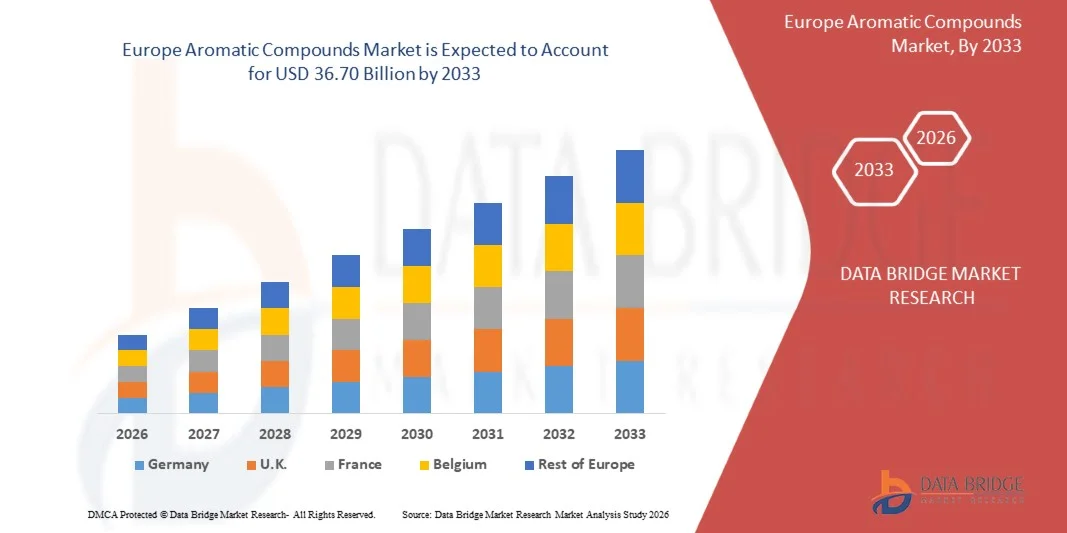
- The Europe aromatic compounds market size was valued at USD 27.66 billion in 2025 and is expected to reach USD 36.70 billion by 2033, at a CAGR of 3.6% during the forecast period
- Rise in demand for aromatic compounds by the paints and coatings industry in developed and developing economies is the root cause fuelling up the market growth rate
- Rising application areas for aromatic compounds such as in the pharmaceuticals and medical devices and growth and expansion of various end user industries especially in the developing economies will also directly and positively impact the growth rate of the market
What are the Major Takeaways of Aromatic Compounds Market?
- Rising preference for diverse culinary lifestyles, rising expenditure for research and development proficiencies by the major companies, surging urbanization of backward areas and economies, growing focus on the technological advancements and modernization in the production techniques will further carve the way for the growth of the market
- However, insufficiency in raw material demand and supply owing to the lockdown and volatility in their prices will pose a major challenge to the growth of the market. High costs associated with research and development proficiencies, stringent government regulations for replacement of harmful chemicals with bio-based chemicals, emergence of low priced substitutes and strict Europe trade restrictions will dampen the market growth rate
- Germany dominated the aromatic compounds market with a 38.9% revenue share in 2025, driven by a strong chemical manufacturing base, advanced refining capabilities, and high demand from automotive, packaging, and construction industries
- France is projected to register the fastest CAGR of 7.1% from 2026 to 2033, driven by increasing investments in sustainable chemical production and expanding refining and petrochemical infrastructure
- The Xylene segment dominated the market with a 38.6% share in 2025, driven by its extensive use in the production of purified terephthalic acid (PTA) and dimethyl terephthalate (DMT), which are key raw materials for polyester fibers and PET resins
Report Scope and Aromatic Compounds Market Segmentation
|
Attributes |
Aromatic Compounds Key Market Insights |
|
Segments Covered |
|
|
Countries Covered |
Europe
|
|
Key Market Players |
|
|
Market Opportunities |
|
|
Value Added Data Infosets |
In addition to the insights on market scenarios such as market value, growth rate, segmentation, geographical coverage, and major players, the market reports curated by the Data Bridge Market Research also include in-depth expert analysis, pricing analysis, brand share analysis, consumer survey, demography analysis, supply chain analysis, value chain analysis, raw material/consumables overview, vendor selection criteria, PESTLE Analysis, Porter Analysis, and regulatory framework. |
What is the Key Trend in the Aromatic Compounds Market?
“Increasing Shift Toward Sustainable and Bio-Based Aromatic Compounds”
- The aromatic compounds market is witnessing a strong shift toward bio-based and renewable feedstocks as industries aim to reduce dependency on petroleum-derived chemicals
- Manufacturers are increasingly focusing on green chemistry processes, including catalytic reforming and biomass conversion, to produce environmentally friendly aromatics
- Growing regulatory pressure regarding emissions, toxicity, and environmental impact is encouraging adoption of low-VOC and eco-friendly aromatic compounds
- For instance, companies such as BASF SE, Dow, SABIC, and Exxon Mobil Corporation are investing in sustainable production technologies and circular economy initiatives
- Increasing demand from end-use industries such as packaging, automotive, and construction is accelerating the shift toward high-performance and environmentally compliant aromatic derivatives
- As sustainability becomes a core industry focus, aromatic compounds will play a vital role in enabling eco-friendly materials, advanced polymers, and specialty chemicals
What are the Key Drivers of Aromatic Compounds Market?
- Rising demand from plastics, synthetic fibers, dyes, detergents, and pharmaceuticals is driving large-scale consumption of aromatic compounds Europely
- For instance, in 2025, companies such as Reliance Industries Limited, INEOS, and China National Petroleum Corporation expanded their petrochemical production capacities to meet increasing downstream demand
- Growing urbanization and industrialization across regions such as Asia-Pacific are boosting demand for paints, coatings, adhesives, and construction materials
- Advancements in refining technologies such as catalytic reforming, steam cracking, and aromatics extraction are improving yield and efficiency
- Increasing consumption of polyethylene terephthalate (PET), polystyrene, and nylon is driving demand for key aromatics such as benzene, toluene, and xylene
- Supported by expanding petrochemical infrastructure and strong investments in refining capacity, the Aromatic Compounds market is expected to witness steady long-term growth
Which Factor is Challenging the Growth of the Aromatic Compounds Market?
- Volatility in crude oil prices significantly impacts the cost structure of petroleum-based aromatic compounds
- For instance, during 2024–2025, fluctuations in Europe oil supply chains and geopolitical tensions affected feedstock availability and pricing for major producers such as bp p.l.c. and Shell plc
- Stringent environmental regulations regarding benzene emissions, toxicity, and hazardous waste management increase compliance costs
- Health concerns associated with exposure to certain aromatic compounds, especially benzene, limit usage in sensitive applications
- Availability of alternative bio-based chemicals and green solvents creates competitive pressure for traditional aromatics
- To overcome these challenges, companies are focusing on sustainable production, emission control technologies, and diversification into bio-based aromatics, ensuring long-term market stability
How is the Aromatic Compounds Market Segmented?
The market is segmented on the basis of type, application, and end use.
• By Type
On the basis of type, the aromatic compounds market is segmented into Benzene, Xylene, Toluene, and Others. The Xylene segment dominated the market with a 38.6% share in 2025, driven by its extensive use in the production of purified terephthalic acid (PTA) and dimethyl terephthalate (DMT), which are key raw materials for polyester fibers and PET resins. Rising demand for packaging materials, textiles, and plastic bottles has significantly increased xylene consumption across Europe markets. In addition, its role in coatings, solvents, and chemical intermediates supports widespread industrial adoption.
The Benzene segment is expected to grow at the fastest CAGR from 2026 to 2033, supported by increasing demand for styrene, phenol, and cyclohexane used in plastics, resins, and synthetic fibers. Growth in construction, automotive, and consumer goods industries is further accelerating benzene consumption Europely.
• By Application
On the basis of application, the market is segmented into Solvent and Additive. The Solvent segment dominated the market with a 57.2% share in 2025, as aromatic compounds such as toluene and xylene are widely used as industrial solvents in paints, coatings, adhesives, and chemical processing. Their high solvency power, volatility, and compatibility with various formulations make them essential across manufacturing and construction industries. Increasing demand for high-performance coatings and industrial cleaning agents continues to support segment growth.
The Additive segment is projected to grow at the fastest CAGR from 2026 to 2033, driven by rising usage of aromatic compounds as fuel additives to enhance octane rating and improve combustion efficiency. Expanding automotive production, fuel quality regulations, and demand for high-performance fuels are key factors accelerating growth in this segment.
• By End Use
On the basis of end use, the aromatic compounds market is segmented into Packaging, Detergent and Dyes, Automobile, Electronic Devices, Medical Devices, Pharmaceuticals, Gasoline, Tyre, Household Goods, Paints and Coatings, PVC Pipes and Cables, and Others. The Packaging segment dominated the market with a 29.8% share in 2025, driven by increasing demand for PET bottles, plastic containers, and flexible packaging materials. Aromatic compounds such as xylene derivatives play a critical role in producing lightweight, durable, and recyclable packaging solutions, especially in food and beverage industries.
The Automobile segment is expected to grow at the fastest CAGR from 2026 to 2033, supported by rising demand for synthetic rubber, plastics, coatings, and fuel additives used in vehicle manufacturing. Increasing production of electric vehicles, lightweight materials, and advanced automotive components is further driving consumption of aromatic compounds across the Europe automotive sector.
Which Region Holds the Largest Share of the Aromatic Compounds Market?
- Germany dominated the aromatic compounds market with a 38.9% revenue share in 2025, driven by a strong chemical manufacturing base, advanced refining capabilities, and high demand from automotive, packaging, and construction industries
- Increasing production of engineering plastics, synthetic fibers, and specialty chemicals is driving consumption of aromatic compounds such as benzene, toluene, and xylene. Rising demand for sustainable materials, coatings, and fuel additives further supports market expansion across industrial applications
- Presence of leading chemical companies, continuous investments in green chemistry, circular economy initiatives, and petrochemical modernization, along with strong export capabilities, enhances Germany’s dominance in the Europe Aromatic Compounds market
France Aromatic Compounds Market Insight
France is projected to register the fastest CAGR of 7.1% from 2026 to 2033, driven by increasing investments in sustainable chemical production and expanding refining and petrochemical infrastructure. Rising demand for aromatic derivatives in packaging, coatings, and automotive applications is supporting market growth. Government initiatives focused on carbon reduction, bio-based chemicals, and industrial innovation are further accelerating adoption. Strong presence of integrated chemical complexes and growing emphasis on eco-friendly production technologies continue to strengthen the country’s position in the regional market.
Italy Aromatic Compounds Market Insight
Italy is emerging as a significant contributor in the Europe Aromatic Compounds market, supported by expanding industrial activities and rising demand from automotive, construction, and packaging sectors. Increasing investments in petrochemical refining and downstream chemical production are boosting consumption of aromatic compounds. Growth in coatings, adhesives, and specialty materials further enhances market demand. Improving industrial infrastructure, strong manufacturing base, and rising export opportunities continue to drive steady market expansion across Italy.
Which are the Top Companies in Aromatic Compounds Market?
The aromatic compounds industry is primarily led by well-established companies, including:
- Shell Group of Companies (U.K.)
- Exxon Mobil Corporation (U.S.)
- Total (France)
- McDermott (U.S.)
- JX Nippon Oil & Gas Exploration Corporation (Japan)
- bp p.l.c. (U.K.)
- Canada Colors and Chemicals Limited (India)
- China National Petroleum Corporation (China)
- Honeywell International Inc. (U.S.)
- Reliance Industries Limited (India)
- INEOS (U.K.)
- Chevron Phillips Chemical Company (U.S.)
- Toray Industries, Inc. (Japan)
- Dow (U.S.)
- GS Caltex Corporation (South Korea)
- LyondellBasell Industries Holdings B.V. (Netherlands)
- DuPont (U.S.)
- Koch Industries, Inc. (U.S.)
- Formosa Plastics Corporation (Taiwan)
- ENEOS Corporation (Japan)
- SABIC (Saudi Arabia)
What are the Recent Developments in Europe Aromatic Compounds Market?
- In May 5, 2025, LANXESS announced the showcase of its broad portfolio of aroma chemicals at SIMPPAR 2025, scheduled for June 4–5 at Espace Champerret in Paris, highlighting its innovation and strong presence in the Europe fragrance chemicals market, strengthening its position in specialty aroma compounds
- In January 2025, a study on nucleophilic aromatic substitution (SNAr) was published in Nature, where researchers from University of Manchester introduced a novel enzyme-driven approach that improves efficiency and sustainability in chemical synthesis, marking a significant advancement toward greener production of aromatic compounds and pharmaceuticals
- In December 2024, chemists from Heinrich Heine University Düsseldorf published research in Angewandte Chemie International Edition on fluorinated squareimines used for selective molecular sieving of aromatic over aliphatic compounds, enabling enhanced separation efficiency and opening new opportunities in advanced chemical processing
- In April 2024, INEOS completed the acquisition of petrochemical assets from TotalEnergies at Lavera, France, including a 50% stake in Naphtachimie, Gexaro, and Appryl along with an aromatics production capacity of 270,000 tons annually, strengthening its footprint and production capabilities in the Europe aromatic compounds market
SKU-
Get online access to the report on the World's First Market Intelligence Cloud

- Interactive Data Analysis Dashboard
- Company Analysis Dashboard for high growth potential opportunities
- Research Analyst Access for customization & queries
- Competitor Analysis with Interactive dashboard
- Latest News, Updates & Trend analysis
- Harness the Power of Benchmark Analysis for Comprehensive Competitor Tracking
Europe Aromatic Compounds Market, Supply Chain Analysis and Ecosystem Framework
To support market growth and help clients navigate the impact of geopolitical shifts, DBMR has integrated in-depth supply chain analysis into its Europe Aromatic Compounds Market research reports. This addition empowers clients to respond effectively to global changes affecting their industries. The supply chain analysis section includes detailed insights such as Europe Aromatic Compounds Market consumption and production by country, price trend analysis, the impact of tariffs and geopolitical developments, and import and export trends by country and HSN code. It also highlights major suppliers with data on production capacity and company profiles, as well as key importers and exporters. In addition to research, DBMR offers specialized supply chain consulting services backed by over a decade of experience, providing solutions like supplier discovery, supplier risk assessment, price trend analysis, impact evaluation of inflation and trade route changes, and comprehensive market trend analysis.
Research Methodology
Data collection and base year analysis are done using data collection modules with large sample sizes. The stage includes obtaining market information or related data through various sources and strategies. It includes examining and planning all the data acquired from the past in advance. It likewise envelops the examination of information inconsistencies seen across different information sources. The market data is analysed and estimated using market statistical and coherent models. Also, market share analysis and key trend analysis are the major success factors in the market report. To know more, please request an analyst call or drop down your inquiry.
The key research methodology used by DBMR research team is data triangulation which involves data mining, analysis of the impact of data variables on the market and primary (industry expert) validation. Data models include Vendor Positioning Grid, Market Time Line Analysis, Market Overview and Guide, Company Positioning Grid, Patent Analysis, Pricing Analysis, Company Market Share Analysis, Standards of Measurement, Global versus Regional and Vendor Share Analysis. To know more about the research methodology, drop in an inquiry to speak to our industry experts.
Customization Available
Data Bridge Market Research is a leader in advanced formative research. We take pride in servicing our existing and new customers with data and analysis that match and suits their goal. The report can be customized to include price trend analysis of target brands understanding the market for additional countries (ask for the list of countries), clinical trial results data, literature review, refurbished market and product base analysis. Market analysis of target competitors can be analyzed from technology-based analysis to market portfolio strategies. We can add as many competitors that you require data about in the format and data style you are looking for. Our team of analysts can also provide you data in crude raw excel files pivot tables (Fact book) or can assist you in creating presentations from the data sets available in the report.












