


Global Automotive Idle Air Control Valve Market
Market Size in USD Billion
CAGR :
% 
 USD
16.95 Billion
USD
45.00 Billion
2025
2033
USD
16.95 Billion
USD
45.00 Billion
2025
2033
 Forecast Period Forecast Period |
2026 –2033 |
 Market Size (Base Year) Market Size (Base Year) |
USD 16.95 Billion |
 Market Size (Forecast Year) Market Size (Forecast Year) |
USD 45.00 Billion |
 CAGR CAGR |
% |
| Major Markets Players |
|
What is the Global Automotive Idle Air Control Valve Market Size and Growth Rate?
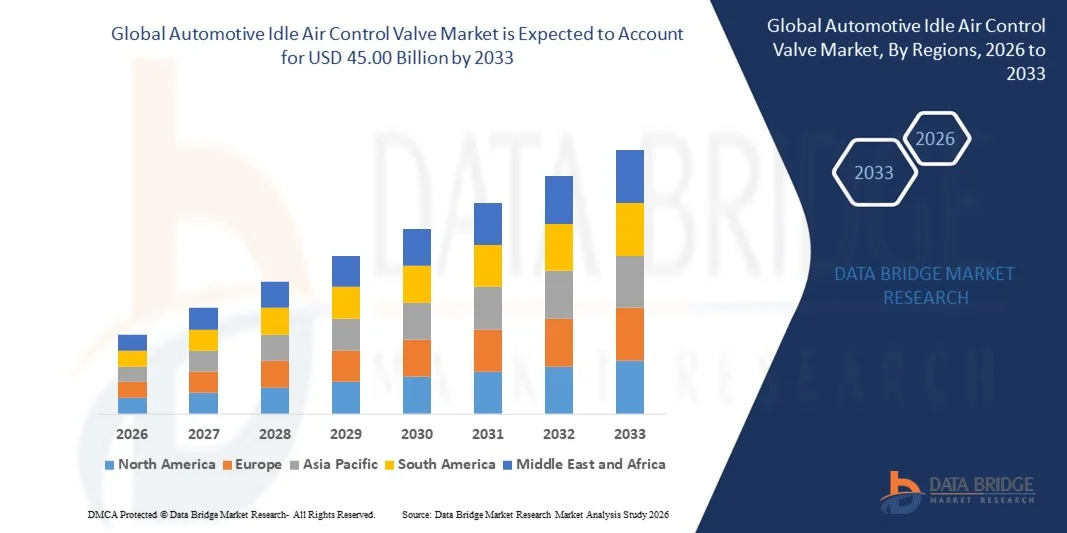
- The global automotive idle air control valve market size was valued at USD 16.95 billion in 2025 and is expected to reach USD 45.00 billion by 2033, at a CAGR of 13.00% during the forecast period
- The expansion of production in the automobile sector across the globe acts as one of the major factors driving the growth of idle air control valve market
- The rise in the number of research and development initiatives leading to the development of new products and high focus of companies on reducing the overall weight of automobiles by integrating electronic components in place of manual components accelerate the market growth
What are the Major Takeaways of Automotive Idle Air Control Valve Market?
- The high usage in the end-use applications of the technology and automotive idle air control valve is playing an integral component in all vehicles further influence the market. In addition, expansion of automotive sector, change in lifestyle, surge in disposable income, and increase in the sales and production of automobile vehicles positively affect the idle air control valve market
- Europe dominated the automotive idle air control valve market with a 38.7% revenue share in 2025, driven by strong automotive manufacturing capacity, stringent emission regulations (Euro 6 standards), and continuous advancements in internal combustion engine optimization across Germany, France, Italy, and the U.K
- Asia-Pacific is projected to register the fastest CAGR of 9.84% from 2026 to 2033, driven by rapid vehicle production growth, expanding automotive component manufacturing, and rising demand for fuel-efficient vehicles across China, Japan, India, and South Korea
- The Stepping Motor Type segment dominated the market with a 44.6% share in 2025, as it offers precise airflow control, superior idle stability, and enhanced compatibility with modern electronic control units (ECUs)
Report Scope and Automotive Idle Air Control Valve Market Segmentation
|
Attributes |
Automotive Idle Air Control Valve Key Market Insights |
|
Segments Covered |
|
|
Countries Covered |
North America
Europe
Asia-Pacific
Middle East and Africa
South America
|
|
Key Market Players |
|
|
Market Opportunities |
|
|
Value Added Data Infosets |
In addition to the insights on market scenarios such as market value, growth rate, segmentation, geographical coverage, and major players, the market reports curated by the Data Bridge Market Research also include in-depth expert analysis, pricing analysis, brand share analysis, consumer survey, demography analysis, supply chain analysis, value chain analysis, raw material/consumables overview, vendor selection criteria, PESTLE Analysis, Porter Analysis, and regulatory framework. |
What is the Key Trend in the Automotive Idle Air Control Valve Market?
Integration of Smart, Compact, and Electronically Controlled Idle Air Control Valves
- The automotive idle air control valve market is witnessing a strong shift toward electronically controlled and compact IAC valves designed to deliver precise idle speed management, improved fuel efficiency, and reduced engine emissions
- Manufacturers are introducing stepper motor-based and rotary solenoid IAC valves with enhanced response time, durability, and compatibility with modern engine control units (ECUs)
- Growing demand for fuel-efficient passenger cars, light commercial vehicles, and hybrid vehicles is accelerating the adoption of advanced idle air management systems across global automotive markets
- For instance, companies such as Robert Bosch GmbH, DENSO CORPORATION, AISIN SEIKI Co., Ltd., and BorgWarner Inc. are focusing on precision-engineered idle control components integrated with advanced engine management systems
- Increasing focus on emission compliance (Euro 6, BS6, EPA standards) and smoother engine performance is driving innovation in airflow control and throttle body integration technologies
- As internal combustion engines continue to dominate several emerging markets, Automotive Idle Air Control Valves will remain critical for stable idle speed, reduced stalling, and optimized fuel combustion performance
What are the Key Drivers of Automotive Idle Air Control Valve Market?
- Rising demand for fuel-efficient and low-emission vehicles is encouraging automakers to adopt precise idle air regulation technologies to optimize combustion efficiency
- For instance, in 2025, leading suppliers such as Continental AG and Hitachi Automotive Systems, Ltd. enhanced their engine management portfolios to support improved airflow calibration and electronic idle control integration
- Growing vehicle production across the U.S., Europe, China, and India is increasing demand for reliable engine control components in passenger and light commercial vehicles
- Advancements in electronic throttle control systems, ECU software algorithms, and sensor integration have strengthened idle stability and cold-start performance
- Expanding aftermarket demand for replacement IAC valves due to wear, clogging, or carbon buildup is supporting steady revenue growth for OEMs and distributors
- Supported by consistent investments in automotive powertrain optimization and emission-reduction technologies, the Automotive Idle Air Control Valve market is projected to witness steady long-term expansion
Which Factor is Challenging the Growth of the Automotive Idle Air Control Valve Market?
- Increasing shift toward electric vehicles (EVs), which do not require idle air control systems, is gradually reducing long-term demand for IAC valves in fully electric platforms
- For instance, during 2024–2025, accelerated EV adoption in Europe and China led several automakers to scale down ICE-focused component investments
- Stringent emission regulations and the transition toward electronic throttle control systems without traditional IAC valves in modern vehicles are limiting standalone valve demand
- Price volatility in raw materials such as aluminum, copper windings, and electronic components increases manufacturing costs for suppliers
- Intense competition among global and regional manufacturers creates pricing pressure and reduces profit margins, particularly in the aftermarket segment
- To overcome these challenges, companies are focusing on high-durability designs, integration with advanced throttle systems, and expansion into hybrid vehicle platforms to sustain growth in the evolving automotive landscape
How is the Automotive Idle Air Control Valve Market Segmented
The market is segmented on the basis of type, end use, and distribution channel.
- By Type
On the basis of type, the Automotive Idle Air Control Valve market is segmented into Pulse Solenoid Valve Type, Rotary Solenoid Valve Type, and Stepping Motor Type. The Stepping Motor Type segment dominated the market with a 44.6% share in 2025, as it offers precise airflow control, superior idle stability, and enhanced compatibility with modern electronic control units (ECUs). These valves enable accurate step-by-step air regulation, improving fuel efficiency, cold-start performance, and emission control. Their durability and adaptability to advanced throttle body systems further strengthen adoption across passenger and commercial vehicles.
The Rotary Solenoid Valve Type segment is expected to grow at the fastest CAGR from 2026 to 2033, driven by demand for compact designs, faster response times, and improved airflow modulation in next-generation internal combustion engines. Increasing integration of electronically controlled throttle systems is further accelerating innovation in rotary solenoid configurations.
- By End Use
On the basis of end use, the market is segmented into Light Commercial Vehicles, Heavy Commercial Vehicles, Passenger Cars, Two and Three Wheelers, and Sports Cars. The Passenger Cars segment dominated the market with a 51.3% share in 2025, supported by high global vehicle production volumes and growing demand for fuel-efficient, low-emission engines. Idle air control valves play a vital role in maintaining smooth idling, preventing engine stalling, and optimizing combustion in urban driving conditions. Rising middle-class vehicle ownership in Asia-Pacific and consistent replacement demand in the aftermarket further strengthen segment dominance.
The Light Commercial Vehicles segment is projected to grow at the fastest CAGR from 2026 to 2033, driven by expanding logistics networks, e-commerce growth, and increasing demand for efficient fleet vehicles requiring stable engine idle performance.
- By Distribution Channel
On the basis of distribution channel, the Automotive Idle Air Control Valve market is segmented into Original Equipment Manufacturers (OEM) and Aftermarket. The OEM segment dominated the market with a 62.8% share in 2025, as vehicle manufacturers increasingly integrate high-precision idle control systems during initial engine assembly to meet stringent emission and fuel efficiency standards. Strong partnerships between automotive OEMs and component suppliers ensure consistent product quality, technological integration, and large-scale procurement volumes.
The Aftermarket segment is expected to grow at the fastest CAGR from 2026 to 2033, driven by rising vehicle parc, increased wear and tear of idle control valves due to carbon buildup, and growing consumer preference for cost-effective replacement components. Expansion of online automotive parts platforms and service networks is further supporting aftermarket growth globally.
Which Region Holds the Largest Share of the Automotive Idle Air Control Valve Market?
- Europe dominated the automotive idle air control valve market with a 38.7% revenue share in 2025, driven by strong automotive manufacturing capacity, stringent emission regulations (Euro 6 standards), and continuous advancements in internal combustion engine optimization across Germany, France, Italy, and the U.K. The region’s focus on fuel efficiency, cold-start emission reduction, and precise airflow management continues to fuel demand for high-performance idle air control valves across passenger and commercial vehicle segments
- Leading automotive component manufacturers in Europe are introducing electronically controlled and high-durability IAC valves integrated with advanced ECU systems, strengthening the region’s technological leadership. Continuous investments in hybrid powertrain development and emission control technologies further support long-term market growth
- Strong OEM presence, well-established supplier networks, and consistent innovation in engine management systems reinforce Europe’s dominant market position
Germany Automotive Idle Air Control Valve Market Insight
Germany is the largest contributor within Europe, supported by its strong automotive production base and presence of leading OEMs and Tier-1 suppliers such as Robert Bosch GmbH and Continental AG. Increasing demand for high-efficiency engines, strict carbon emission targets, and advanced fuel injection systems drive adoption of precision idle air control valves. Continuous R&D in powertrain optimization and hybrid vehicle development further accelerates market expansion across the country.
France Automotive Idle Air Control Valve Market Insight
France contributes significantly due to steady passenger vehicle production and rising focus on emission compliance and fuel economy improvements. Automotive manufacturers are integrating advanced engine management technologies to enhance idle stability and reduce fuel consumption. Government-led environmental initiatives and modernization of automotive manufacturing facilities further strengthen demand for reliable idle air control components.
U.K. Automotive Idle Air Control Valve Market Insight
The U.K. market is supported by specialized automotive engineering, motorsport innovation, and growing hybrid vehicle adoption. Increasing emphasis on engine downsizing and efficiency improvement drives demand for compact and electronically controlled IAC valves. Strong aftermarket networks and replacement demand also contribute to steady growth.
Asia-Pacific Automotive Idle Air Control Valve Market
Asia-Pacific is projected to register the fastest CAGR of 9.84% from 2026 to 2033, driven by rapid vehicle production growth, expanding automotive component manufacturing, and rising demand for fuel-efficient vehicles across China, Japan, India, and South Korea. Increasing urbanization, rising disposable incomes, and stricter emission regulations are accelerating integration of advanced idle control systems in mass-market vehicles. Growth in hybrid vehicles and expanding automotive export activities further support regional expansion.
China Automotive Idle Air Control Valve Market Insight
China is the largest contributor within Asia-Pacific due to its massive automotive production capacity and strong domestic component manufacturing ecosystem. Rising adoption of emission-compliant engines and continuous upgrades in engine control technologies are driving demand for high-precision idle air control valves. Competitive manufacturing costs and export-oriented production further enhance market growth.
Japan Automotive Idle Air Control Valve Market Insight
Japan shows stable growth supported by advanced automotive engineering and strong presence of global suppliers such as DENSO CORPORATION and AISIN SEIKI Co., Ltd.. Focus on fuel efficiency, hybrid vehicle innovation, and compact engine design continues to drive adoption of electronically controlled IAC valves.
India Automotive Idle Air Control Valve Market Insight
India is emerging as a high-growth market, driven by expanding passenger vehicle demand, stricter BS6 emission norms, and rising automotive exports. Increasing localization of auto component manufacturing and strong aftermarket demand for replacement idle air control valves further accelerate market penetration.
South Korea Automotive Idle Air Control Valve Market Insight
South Korea contributes significantly due to strong automotive OEM presence and growing focus on efficient powertrain technologies. Rising hybrid vehicle production, export-driven automotive manufacturing, and technological innovation in engine management systems support sustained demand for high-performance idle air control valves.
Which are the Top Companies in Automotive Idle Air Control Valve Market?
The automotive idle air control valve industry is primarily led by well-established companies, including:
- AISIN SEIKI Co., Ltd. (Japan)
- Mikuni Corporation (Japan)
- NINGBO MIDLAND AUTO PARTS CO., LTD (China)
- Guangzhou Marvine Auto Parts Co., Ltd. (China)
- Jiangsu Great Industrials (Group) Corp. Ltd. (China)
- Tridon Australia (Australia)
- Ruian Fanwei Auto Parts Co., Ltd. (China)
- Wenzhou Guocheng Electrical Parts Co., Ltd. (China)
- Ruian Kingway Auto Parts Manufacturing Co., Limited (China)
- PUCHENG SENSORS (SHANGHAI) CO., LTD. (China)
- Robert Bosch GmbH (Germany)
- BorgWarner Inc. (U.S.)
- Continental AG (Germany)
- EDELBROCK, LLC. (U.S.)
- GB Remanufacturing, Inc. (U.S.)
- DENSO CORPORATION (Japan)
- Hitachi Automotive Systems, Ltd. (Japan)
- Kinsler Fuel Injection (U.S.)
- Tenneco Inc. (U.S.)
- Ruian City Yangyu Motor Vehicle Parts Co., Ltd. (China)
SKU-
Get online access to the report on the World's First Market Intelligence Cloud

- Interactive Data Analysis Dashboard
- Company Analysis Dashboard for high growth potential opportunities
- Research Analyst Access for customization & queries
- Competitor Analysis with Interactive dashboard
- Latest News, Updates & Trend analysis
- Harness the Power of Benchmark Analysis for Comprehensive Competitor Tracking
Research Methodology
Data collection and base year analysis are done using data collection modules with large sample sizes. The stage includes obtaining market information or related data through various sources and strategies. It includes examining and planning all the data acquired from the past in advance. It likewise envelops the examination of information inconsistencies seen across different information sources. The market data is analysed and estimated using market statistical and coherent models. Also, market share analysis and key trend analysis are the major success factors in the market report. To know more, please request an analyst call or drop down your inquiry.
The key research methodology used by DBMR research team is data triangulation which involves data mining, analysis of the impact of data variables on the market and primary (industry expert) validation. Data models include Vendor Positioning Grid, Market Time Line Analysis, Market Overview and Guide, Company Positioning Grid, Patent Analysis, Pricing Analysis, Company Market Share Analysis, Standards of Measurement, Global versus Regional and Vendor Share Analysis. To know more about the research methodology, drop in an inquiry to speak to our industry experts.
Customization Available
Data Bridge Market Research is a leader in advanced formative research. We take pride in servicing our existing and new customers with data and analysis that match and suits their goal. The report can be customized to include price trend analysis of target brands understanding the market for additional countries (ask for the list of countries), clinical trial results data, literature review, refurbished market and product base analysis. Market analysis of target competitors can be analyzed from technology-based analysis to market portfolio strategies. We can add as many competitors that you require data about in the format and data style you are looking for. Our team of analysts can also provide you data in crude raw excel files pivot tables (Fact book) or can assist you in creating presentations from the data sets available in the report.












