


Global Automotive Quality Service Market
Market Size in USD Billion
CAGR :
% 
 USD
29.74 Billion
USD
52.60 Billion
2025
2033
USD
29.74 Billion
USD
52.60 Billion
2025
2033
 Forecast Period Forecast Period |
2026 –2033 |
 Market Size (Base Year) Market Size (Base Year) |
USD 29.74 Billion |
 Market Size (Forecast Year) Market Size (Forecast Year) |
USD 52.60 Billion |
 CAGR CAGR |
% |
| Major Markets Players |
|
Automotive Quality Service Market Size
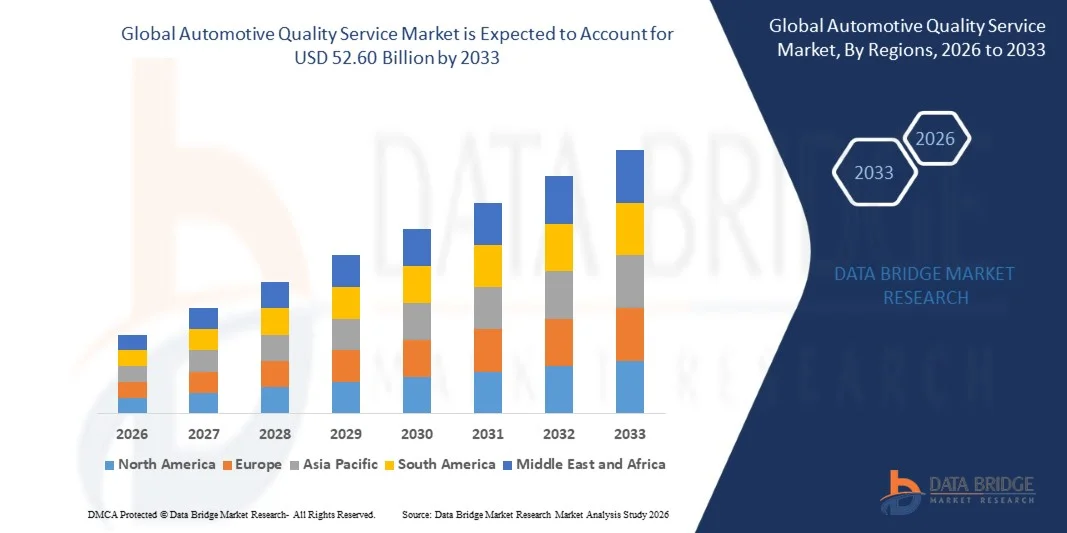
- The global automotive quality service market size was valued at USD 29.74 billion in 2025 and is expected to reach USD 52.60 billion by 2033, at a CAGR of 7.39% during the forecast period
- The market growth is largely fuelled by the increasing emphasis on vehicle safety, regulatory compliance, and quality assurance processes across automotive manufacturing and aftermarket operations
- The rising adoption of electric vehicles, connected vehicle technologies, and advanced driver assistance systems is accelerating demand for automotive quality inspection, testing, and certification services
Automotive Quality Service Market Analysis
- The market is witnessing strong growth due to the increasing integration of automation, artificial intelligence, and digital inspection technologies in automotive quality management systems across manufacturing facilities
- Rising consumer expectations for vehicle performance, durability, and safety, combined with stringent emission and compliance regulations, are encouraging automakers and suppliers to strengthen quality assurance and validation processes
- North America dominated the automotive quality service market with the largest revenue share in 2025, driven by the strong presence of automotive OEMs, increasing adoption of electric and connected vehicles, and growing investments in advanced manufacturing technologies
- Asia-Pacific region is expected to witness the highest growth rate in the global automotive quality service market, driven by expanding automotive manufacturing activities, increasing adoption of smart factory technologies, and rising demand for electric vehicles and advanced automotive testing solutions across countries such as China, Japan, and India
- The passenger cars segment held the largest market revenue share in 2025 driven by the rising production of passenger vehicles, increasing consumer demand for advanced safety systems, and growing integration of connected and electric vehicle technologies. Automotive manufacturers are increasingly adopting quality inspection, testing, and certification services to ensure compliance with stringent safety and emission regulations while maintaining vehicle reliability and customer satisfaction
Report Scope and Automotive Quality Service Market Segmentation
|
Attributes |
Automotive Quality Service Key Market Insights |
|
Segments Covered |
· By Vehicle Type: Passenger Cars and Commercial Vehicles · By Testing Type: Testing Services, Certifying & Validating, and Quality Sorting Service · By Application: Electrical System and Components, Telematics, Vehicle Inspection Services, Homologation Services, Interior and Exterior Materials, and Others · By End-use: OEMs, Tier 1 and Tier 2 Suppliers, and Aftermarket Services Providers |
|
Countries Covered |
North America · U.S. · Canada · Mexico Europe · Germany · France · U.K. · Netherlands · Switzerland · Belgium · Russia · Italy · Spain · Turkey · Rest of Europe Asia-Pacific · China · Japan · India · South Korea · Singapore · Malaysia · Australia · Thailand · Indonesia · Philippines · Rest of Asia-Pacific Middle East and Africa · Saudi Arabia · U.A.E. · South Africa · Egypt · Israel · Rest of Middle East and Africa South America · Brazil · Argentina · Rest of South America |
|
Key Market Players |
• TÜV SÜD (Germany) |
|
Market Opportunities |
• Expansion Of Electric Vehicle Quality Testing Services |
|
Value Added Data Infosets |
In addition to the market insights such as market value, growth rate, market segments, geographical coverage, market players, and market scenario, the market report curated by the Data Bridge Market Research team includes in-depth expert analysis, import/export analysis, pricing analysis, production consumption analysis, and pestle analysis. |
Automotive Quality Service Market Trends
“Growing Adoption of Digital Inspection and Predictive Quality Management”
- The increasing integration of digital technologies and predictive analytics is significantly transforming the automotive quality service market, as manufacturers and suppliers focus on improving vehicle reliability, production efficiency, and compliance with global safety standards. Automotive quality services are gaining importance due to their ability to detect defects, optimize manufacturing workflows, and reduce recalls, supporting higher operational efficiency across automotive production facilities
- Rising demand for connected vehicles, electric vehicles, and autonomous driving technologies has accelerated the need for advanced quality assurance solutions in automotive manufacturing. Automakers are increasingly adopting AI-powered inspection systems, real-time monitoring tools, and predictive maintenance solutions to improve product consistency and ensure compliance with evolving regulatory requirements. This trend is also encouraging collaborations between automotive OEMs and quality service providers to enhance production accuracy and reduce downtime
- Digital transformation and Industry 4.0 adoption are influencing purchasing and operational decisions, with manufacturers emphasizing automated testing, cloud-based analytics, and smart factory integration. These factors are helping automotive companies strengthen quality control processes, reduce manufacturing errors, and improve customer satisfaction, while also driving investments in robotics, machine vision systems, and data-driven inspection technologies
- For instance, in 2024, Toyota in Japan and BMW in Germany expanded the deployment of AI-enabled quality inspection systems and predictive maintenance solutions across their automotive manufacturing facilities. These initiatives were introduced to improve production precision, minimize defects, and support efficient electric vehicle manufacturing operations. The integration of automated quality management systems also enhanced operational productivity and strengthened brand reliability in competitive automotive markets
- While demand for advanced automotive quality services is increasing, sustained market growth depends on continuous investment in automation technologies, workforce training, and scalable digital infrastructure. Manufacturers are also focusing on improving interoperability, cybersecurity, and data management capabilities to support long-term adoption of intelligent quality assurance systems across global production networks
Automotive Quality Service Market Dynamics
Driver
“Increasing Focus on Vehicle Safety, Compliance, and Manufacturing Efficiency”
- Rising emphasis on vehicle safety standards, emission regulations, and production efficiency is a major driver for the automotive quality service market. Automotive manufacturers are increasingly adopting advanced inspection, testing, and quality assurance services to improve vehicle performance, reduce recalls, and comply with stringent regulatory frameworks. This trend is also driving investments in automated inspection technologies and digital quality management platforms to strengthen manufacturing precision
- Expanding production of electric vehicles, connected vehicles, and autonomous driving systems is positively influencing market growth. Automotive quality services help manufacturers ensure component reliability, software accuracy, and operational safety while maintaining production consistency and reducing warranty costs. The growing complexity of vehicle electronics and software integration further reinforces the need for advanced testing and validation services across the automotive value chain
- Automotive OEMs and component suppliers are actively promoting digital quality management solutions through strategic partnerships, technology integration, and smart manufacturing initiatives. These efforts are supported by the increasing demand for efficient production systems and enhanced customer satisfaction, while also encouraging investments in AI-powered diagnostics, robotics, and cloud-based monitoring technologies to improve operational performance
- For instance, in 2023, Ford Motor Company in the U.S. and Volkswagen in Germany increased investments in automated vehicle inspection systems and predictive quality analytics across electric vehicle production lines. These developments followed rising demand for reliable EV manufacturing and stricter safety compliance standards, improving defect detection and enhancing production efficiency. Both companies also emphasized digital quality management and smart factory integration to strengthen operational productivity and customer trust
- Although growing safety and efficiency requirements support market expansion, wider adoption depends on cost optimization, skilled workforce availability, and integration of advanced digital technologies. Investment in AI-based analytics, smart manufacturing infrastructure, and scalable quality assurance systems will be essential for supporting long-term growth and maintaining competitive advantage in the automotive industry
Restraint/Challenge
“High Implementation Costs and Complexity of Advanced Quality Systems”
- The relatively high cost associated with advanced automotive quality service solutions remains a key challenge, limiting adoption among small and mid-sized manufacturers. Investments in automated inspection systems, robotics, AI-based analytics, and smart factory infrastructure significantly increase operational expenses. In addition, continuous maintenance and software upgrades for digital quality management systems can further impact cost efficiency and market penetration
- Technical complexity and integration challenges also restrain market growth, particularly for manufacturers operating with legacy production systems. Integrating advanced quality assurance technologies with existing manufacturing processes often requires extensive customization, workforce training, and operational restructuring. This can slow technology adoption and reduce efficiency gains for companies with limited technical expertise or budget constraints
- Supply chain disruptions and data security concerns are further impacting the automotive quality service market, as manufacturers increasingly rely on cloud-based monitoring systems and connected production environments. Cybersecurity risks, interoperability issues, and fluctuating availability of semiconductor components and automation equipment can affect production continuity and operational stability. Companies must also invest in secure data management systems and compliance frameworks to protect manufacturing operations
- For instance, in 2024, automotive component manufacturers in India and Brazil supplying electric vehicle and commercial vehicle producers reported slower adoption of AI-powered inspection technologies due to high implementation costs and integration complexities. Cybersecurity concerns and limited availability of skilled professionals were additional barriers affecting digital transformation initiatives. These challenges also prompted some manufacturers to delay automation investments and continue relying on conventional inspection processes, affecting productivity improvements and operational scalability
- Overcoming these challenges will require cost-efficient automation solutions, workforce development initiatives, and stronger cybersecurity frameworks across automotive manufacturing ecosystems. Collaboration between technology providers, automotive OEMs, and regulatory authorities can help accelerate digital quality transformation and unlock long-term growth opportunities in the global automotive quality service market. Furthermore, investments in scalable AI-based inspection platforms, cloud integration, and smart manufacturing infrastructure will be critical for improving efficiency, reducing operational risks, and supporting widespread adoption of advanced automotive quality services
Automotive Quality Service Market Scope
The automotive quality service market is segmented on the basis of vehicle type, testing type, application, and end-use.
- By Vehicle Type
On the basis of vehicle type, the automotive quality service market is segmented into passenger cars and commercial vehicles. The passenger cars segment held the largest market revenue share in 2025 driven by the rising production of passenger vehicles, increasing consumer demand for advanced safety systems, and growing integration of connected and electric vehicle technologies. Automotive manufacturers are increasingly adopting quality inspection, testing, and certification services to ensure compliance with stringent safety and emission regulations while maintaining vehicle reliability and customer satisfaction.
The commercial vehicles segment is expected to witness the fastest growth rate from 2026 to 2033, driven by increasing demand for fleet management efficiency, rising logistics activities, and the growing adoption of electric and autonomous commercial vehicles. Quality service providers are focusing on predictive diagnostics, component validation, and real-time inspection technologies to improve operational performance and minimize downtime in commercial transportation systems.
- By Testing Type
On the basis of testing type, the automotive quality service market is segmented into testing services, certifying & validating, and quality sorting service. The testing services segment accounted for the largest market revenue share in 2025 due to the growing complexity of automotive electronics, software systems, and advanced driver assistance technologies. Automotive testing services are widely utilized to ensure product durability, safety compliance, and functional efficiency across vehicle manufacturing and component production processes.
The certifying & validating segment is expected to witness the fastest growth rate from 2026 to 2033, driven by increasing global regulatory requirements and the rapid expansion of electric and autonomous vehicle production. Manufacturers are increasingly relying on certification and validation services to meet international safety, cybersecurity, and environmental standards, while also improving brand credibility and market acceptance.
- By Application
On the basis of application, the automotive quality service market is segmented into electrical system and components, telematics, vehicle inspection services, homologation services, interior and exterior materials, and others. The electrical system and components segment held the largest market revenue share in 2025 driven by the increasing adoption of electric vehicles, connected technologies, and advanced electronic systems in modern automobiles. Automotive companies are investing heavily in quality inspection and testing solutions to ensure the reliability and efficiency of batteries, sensors, infotainment systems, and electronic control units.
The telematics segment is expected to witness the fastest growth rate from 2026 to 2033, driven by rising demand for connected vehicle solutions, real-time vehicle monitoring, and advanced fleet management systems. Increasing integration of IoT, AI-powered analytics, and cloud-based communication technologies is encouraging automotive manufacturers to strengthen quality validation and cybersecurity testing for telematics systems.
- By End-use
On the basis of end-use, the automotive quality service market is segmented into OEMs, tier 1 and tier 2 suppliers, and aftermarket services providers. The OEMs segment accounted for the largest market revenue share in 2025 driven by the increasing focus on manufacturing precision, regulatory compliance, and customer satisfaction across automotive production facilities. OEMs are actively adopting automated quality inspection systems, predictive analytics, and digital testing platforms to improve production efficiency and reduce warranty claims.
The aftermarket services providers segment is expected to witness the fastest growth rate from 2026 to 2033, driven by the growing global vehicle parc, rising demand for maintenance and repair services, and increasing adoption of digital diagnostic tools. Aftermarket service providers are increasingly investing in advanced quality inspection technologies and predictive maintenance solutions to improve service reliability, enhance customer experience, and support long-term vehicle performance.
Automotive Quality Service Market Regional Analysis
- North America dominated the automotive quality service market with the largest revenue share in 2025, driven by the strong presence of automotive OEMs, increasing adoption of electric and connected vehicles, and growing investments in advanced manufacturing technologies
- Manufacturers in the region highly prioritize vehicle safety, regulatory compliance, and production efficiency, leading to rising demand for automated testing, inspection, and certification services across automotive production facilities
- This widespread adoption is further supported by advanced industrial infrastructure, increasing integration of AI-powered quality management systems, and rising demand for predictive maintenance and digital inspection technologies, establishing automotive quality services as a critical component of modern vehicle manufacturing and aftermarket operations
U.S. Automotive Quality Service Market Insight
The U.S. automotive quality service market captured the largest revenue share in 2025 within North America, fueled by the rapid adoption of electric vehicles, autonomous driving technologies, and smart manufacturing systems. Automotive manufacturers are increasingly focusing on improving vehicle reliability, operational efficiency, and regulatory compliance through advanced testing and quality assurance solutions. The growing deployment of AI-driven inspection systems, robotics, and predictive analytics further accelerates market expansion. Moreover, increasing investments in connected vehicle technologies and digital production infrastructure are significantly contributing to the growth of the automotive quality service market in the U.S.
Europe Automotive Quality Service Market Insight
The Europe automotive quality service market is expected to witness the fastest growth rate from 2026 to 2033, primarily driven by stringent automotive safety regulations, sustainability initiatives, and increasing production of electric vehicles. The growing demand for advanced driver assistance systems and connected mobility solutions is encouraging manufacturers to strengthen quality inspection and certification processes. European automotive companies are also focusing on reducing production defects and improving operational efficiency through automation and digital quality management systems. The increasing adoption of Industry 4.0 technologies across automotive manufacturing facilities further supports regional market growth.
U.K. Automotive Quality Service Market Insight
The U.K. automotive quality service market is expected to witness the fastest growth rate from 2026 to 2033, driven by increasing investments in electric vehicle manufacturing and rising adoption of advanced automotive testing technologies. Automotive manufacturers and suppliers are increasingly focusing on improving compliance with safety and emission regulations while enhancing vehicle performance and durability. The country’s growing emphasis on smart manufacturing, digital inspection systems, and connected mobility solutions is expected to continue supporting market growth. In addition, the expansion of automotive R&D activities and innovation centers is accelerating demand for quality assurance services across the U.K. automotive industry.
Germany Automotive Quality Service Market Insight
The Germany automotive quality service market is expected to witness the fastest growth rate from 2026 to 2033, fueled by the country’s strong automotive manufacturing base, technological innovation, and focus on engineering excellence. Germany’s leading automotive OEMs are increasingly investing in automated testing, AI-powered inspection systems, and digital manufacturing solutions to improve production efficiency and maintain high-quality standards. The rapid expansion of electric vehicle production and connected vehicle technologies is also driving demand for advanced validation and certification services. Furthermore, the integration of smart factory solutions and predictive maintenance systems is strengthening the adoption of automotive quality services across Germany.
Asia-Pacific Automotive Quality Service Market Insight
The Asia-Pacific automotive quality service market is expected to witness the fastest growth rate from 2026 to 2033, driven by increasing automotive production, rapid industrialization, and growing adoption of electric and connected vehicles in countries such as China, Japan, and India. The region’s expanding automotive manufacturing ecosystem, supported by favorable government initiatives and rising foreign investments, is accelerating demand for testing, inspection, and certification services. Furthermore, increasing deployment of automation technologies and digital manufacturing systems is improving production efficiency and strengthening the growth of automotive quality services across the Asia-Pacific region.
Japan Automotive Quality Service Market Insight
The Japan automotive quality service market is expected to witness the fastest growth rate from 2026 to 2033 due to the country’s advanced automotive manufacturing capabilities, strong focus on innovation, and increasing demand for electric and autonomous vehicles. Japanese automotive manufacturers are prioritizing precision engineering, vehicle reliability, and advanced quality assurance systems to maintain global competitiveness. The growing integration of robotics, AI-driven diagnostics, and smart factory technologies is supporting market growth. Moreover, Japan’s emphasis on connected mobility and sustainable transportation solutions is driving further investments in automotive testing and certification services.
China Automotive Quality Service Market Insight
The China automotive quality service market accounted for the largest market revenue share in Asia Pacific in 2025, attributed to the country’s large-scale automotive production capabilities, rapid expansion of electric vehicle manufacturing, and increasing adoption of smart mobility technologies. China remains one of the largest automotive markets globally, with manufacturers increasingly investing in digital inspection systems, automated testing solutions, and quality management technologies to improve operational efficiency and meet international standards. The government’s strong focus on electric mobility, industrial automation, and advanced manufacturing infrastructure is further propelling the automotive quality service market in China.
Automotive Quality Service Market Share
The Automotive Quality Service industry is primarily led by well-established companies, including:
• TÜV SÜD (Germany)
• Bureau Veritas (France)
• SGS Group (Switzerland)
• DEKRA (Germany)
• Intertek Group (U.K.)
• Applus+ IDIADA (Spain)
• UL Solutions (U.S.)
• DNV (Norway)
• Element Materials Technology (U.K.)
• Qualitek Labs (U.S.)
• Eurofins Scientific (Luxembourg)
• TÜV Rheinland (Germany)
• Mistras Group, Inc. (U.S.)
• Ricardo plc (U.K.)
• HORIBA, Ltd. (Japan)
Latest Developments in Global Automotive Quality Service Market
- In November 2025, Bureau Veritas, a global testing and certification company, announced the acquisition of Lab System in Brazil to expand its consumer products testing capabilities and strengthen its regional laboratory network. Through this acquisition, the company aims to provide broader local testing solutions for consumer goods while improving compliance verification with international and domestic safety standards. The development enhances Bureau Veritas’ ability to support manufacturers and brands with advanced quality assurance and third-party certification services. This strategic expansion is expected to improve service accessibility, strengthen market presence in Latin America, and increase demand for advanced automotive and consumer product quality testing solutions globally
- In September 2025, DEKRA, a leading automotive testing and certification provider, acquired Wireless Approval Consultants (WAC), a U.S.-based company specializing in radio frequency certification services for automotive technologies. The acquisition was undertaken to strengthen DEKRA’s automotive wireless testing portfolio and expand its presence across major automotive markets such as North America, Europe, Japan, China, and Brazil. The development enables the company to deliver faster and more comprehensive RF approval and compliance solutions for OEMs and automotive suppliers. This expansion is expected to accelerate innovation in connected vehicle technologies, improve global certification efficiency, and support the growing demand for advanced automotive quality and validation services
SKU-
Get online access to the report on the World's First Market Intelligence Cloud

- Interactive Data Analysis Dashboard
- Company Analysis Dashboard for high growth potential opportunities
- Research Analyst Access for customization & queries
- Competitor Analysis with Interactive dashboard
- Latest News, Updates & Trend analysis
- Harness the Power of Benchmark Analysis for Comprehensive Competitor Tracking
Research Methodology
Data collection and base year analysis are done using data collection modules with large sample sizes. The stage includes obtaining market information or related data through various sources and strategies. It includes examining and planning all the data acquired from the past in advance. It likewise envelops the examination of information inconsistencies seen across different information sources. The market data is analysed and estimated using market statistical and coherent models. Also, market share analysis and key trend analysis are the major success factors in the market report. To know more, please request an analyst call or drop down your inquiry.
The key research methodology used by DBMR research team is data triangulation which involves data mining, analysis of the impact of data variables on the market and primary (industry expert) validation. Data models include Vendor Positioning Grid, Market Time Line Analysis, Market Overview and Guide, Company Positioning Grid, Patent Analysis, Pricing Analysis, Company Market Share Analysis, Standards of Measurement, Global versus Regional and Vendor Share Analysis. To know more about the research methodology, drop in an inquiry to speak to our industry experts.
Customization Available
Data Bridge Market Research is a leader in advanced formative research. We take pride in servicing our existing and new customers with data and analysis that match and suits their goal. The report can be customized to include price trend analysis of target brands understanding the market for additional countries (ask for the list of countries), clinical trial results data, literature review, refurbished market and product base analysis. Market analysis of target competitors can be analyzed from technology-based analysis to market portfolio strategies. We can add as many competitors that you require data about in the format and data style you are looking for. Our team of analysts can also provide you data in crude raw excel files pivot tables (Fact book) or can assist you in creating presentations from the data sets available in the report.












