




Global Botnet Detection Market
Market Size in USD Million
CAGR :
% 
 USD
520.00 Million
USD
6,987.50 Million
2025
2033
USD
520.00 Million
USD
6,987.50 Million
2025
2033
 Forecast Period Forecast Period |
2026 –2033 |
 Market Size (Base Year) Market Size (Base Year) |
USD 520.00 Million |
 Market Size (Forecast Year) Market Size (Forecast Year) |
USD 6,987.50 Million |
 CAGR CAGR |
% |
| Major Markets Players |
|
Botnet Detection Market Size
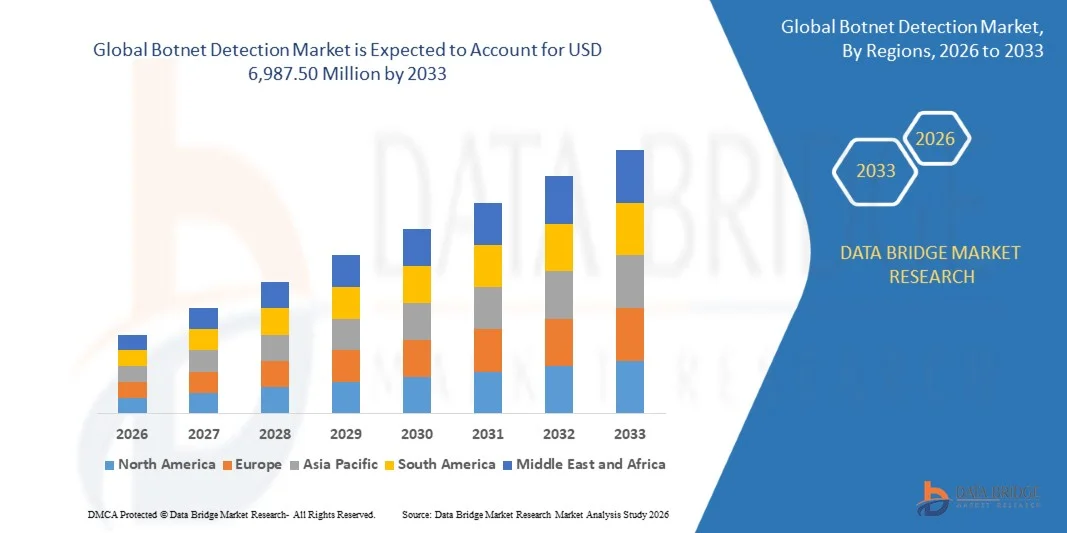
- The global botnet detection market size was valued at USD 520.00 million in 2025 and is expected to reach USD 6,987.50 million by 2033, at a CAGR of 38.30% during the forecast period
- The market growth is largely fuelled by the rising frequency of cyberattacks, increasing deployment of IoT devices, and the growing need for advanced network security solutions to detect and prevent botnet-driven threats
- Increasing adoption of cloud computing, digital transformation initiatives, and enterprise security frameworks is further accelerating the demand for botnet detection technologies across industries
Botnet Detection Market Analysis
- The market is experiencing rapid growth due to the rising sophistication of botnet attacks targeting enterprise networks, financial institutions, and critical infrastructure, prompting organizations to invest in advanced threat detection and prevention solutions
- Increasing integration of artificial intelligence, machine learning, and behavioral analytics in cybersecurity platforms is improving the ability to identify and mitigate botnet activities in real time, strengthening the overall cybersecurity ecosystem
- North America dominated the botnet detection market with the largest revenue share in 2025, driven by the rising frequency of cyberattacks and increasing investments in advanced cybersecurity infrastructure
- Asia-Pacific region is expected to witness the highest growth rate in the global botnet detection market, driven by increasing internet penetration, expansion of e-commerce, and growing adoption of cloud-based cybersecurity solutions across industries
- The Professional segment held the largest market revenue share in 2025 driven by the increasing need for cybersecurity consulting, deployment support, and threat analysis services. Organizations rely on professional services to assess vulnerabilities, implement botnet detection platforms, and strengthen overall network security frameworks. These services also support regulatory compliance and help enterprises respond effectively to complex cyber incidents
Report Scope and Botnet Detection Market Segmentation
|
Attributes |
Botnet Detection Key Market Insights |
|
Segments Covered |
|
|
Countries Covered |
North America
Europe
Asia-Pacific
Middle East and Africa
South America
|
|
Key Market Players |
• Imperva (U.S.) |
|
Market Opportunities |
• Increasing Adoption Of AI-Based Cybersecurity Solutions |
|
Value Added Data Infosets |
In addition to the market insights such as market value, growth rate, market segments, geographical coverage, market players, and market scenario, the market report curated by the Data Bridge Market Research team includes in-depth expert analysis, import/export analysis, pricing analysis, production consumption analysis, and pestle analysis. |
Botnet Detection Market Trends
“Rising Frequency of Advanced Cyber Threats and Botnet Attacks”
• The increasing number of cyberattacks and sophisticated botnet activities is significantly shaping the botnet detection market, as organizations increasingly seek advanced cybersecurity solutions capable of identifying and mitigating malicious network traffic. Botnet detection technologies are gaining traction due to their ability to monitor large volumes of network data, detect abnormal patterns, and prevent coordinated cyber threats. This trend is strengthening their adoption across sectors such as banking, healthcare, government, and telecommunications, encouraging cybersecurity vendors to develop more advanced threat detection platforms
• Increasing awareness around cybersecurity risks and data protection has accelerated the demand for botnet detection solutions across enterprises and digital service providers. Organizations are actively deploying advanced security systems to safeguard networks, connected devices, and critical infrastructure from distributed denial-of-service (DDoS) attacks, malware propagation, and unauthorized access. This rising focus on proactive threat detection is encouraging enterprises to integrate botnet monitoring technologies into their cybersecurity frameworks
• The growing expansion of IoT devices, cloud computing platforms, and digital transformation initiatives is influencing security strategies across industries. Botnet detection solutions are becoming essential for identifying compromised devices and preventing large-scale cyberattacks targeting connected networks. Companies are increasingly adopting machine learning-based detection systems to analyze network behavior, detect anomalies, and strengthen cybersecurity resilience across digital ecosystems
• For instance, in 2024, several global cybersecurity providers expanded their advanced threat intelligence platforms by integrating botnet detection capabilities to improve real-time monitoring and incident response. These solutions were introduced to enhance network visibility, prevent automated cyberattacks, and protect enterprise infrastructure from evolving botnet threats. Such innovations are expected to support organizations in strengthening their cybersecurity posture and maintaining operational continuity
• While demand for botnet detection solutions is increasing, sustained market growth depends on continuous innovation in cybersecurity technologies, improved threat intelligence capabilities, and enhanced integration with enterprise security frameworks. Vendors are also focusing on developing scalable and automated detection systems capable of responding to emerging cyber threats in complex digital environments
Botnet Detection Market Dynamics
Driver
“Growing Adoption of Advanced Cybersecurity Solutions”
• Rising cyber threats targeting enterprise networks and connected devices are a major driver for the botnet detection market. Organizations are increasingly investing in advanced cybersecurity platforms to detect malicious activities, prevent network infiltration, and ensure the protection of sensitive data and digital assets. This growing demand for proactive threat detection solutions is encouraging the adoption of advanced botnet monitoring systems across industries
• Expanding digital infrastructure and widespread adoption of connected devices across sectors such as banking, healthcare, government, and telecommunications are influencing market growth. Botnet detection solutions help organizations identify compromised systems, prevent distributed denial-of-service attacks, and improve overall network security. The increasing reliance on digital platforms and online services further reinforces the need for robust cybersecurity frameworks
• Cybersecurity providers are actively investing in research and development, strategic collaborations, and technology innovations to enhance their threat detection capabilities. These initiatives are supported by increasing demand for intelligent security systems capable of analyzing large-scale network data and identifying hidden cyber threats. The integration of artificial intelligence, machine learning, and behavioral analytics is further strengthening botnet detection technologies
• For instance, in 2023, several cybersecurity companies enhanced their network security platforms by incorporating advanced botnet detection algorithms designed to identify malicious botnet activities across enterprise and cloud environments. These advancements improved real-time threat monitoring and incident response capabilities, enabling organizations to prevent cyberattacks and protect critical digital infrastructure
• Although rising cybersecurity concerns support market growth, widespread adoption depends on improving system affordability, strengthening cybersecurity awareness, and ensuring seamless integration with existing enterprise security infrastructures. Continuous investment in advanced threat intelligence and cybersecurity innovation will remain essential for strengthening the botnet detection ecosystem
Restraint/Challenge
“Complexity of Cyber Threat Detection and High Implementation Costs”
• The complexity associated with detecting evolving botnet attacks remains a key challenge for the botnet detection market. Cybercriminals continuously develop sophisticated techniques to disguise malicious activities, making it difficult for traditional security systems to detect botnet communications effectively. As a result, organizations must invest in advanced detection technologies capable of identifying hidden network threats
• Limited cybersecurity expertise and workforce shortages in certain regions also hinder market adoption. Effective implementation of botnet detection systems requires skilled professionals capable of analyzing network behavior, managing threat intelligence systems, and responding to cyber incidents. The lack of trained cybersecurity specialists may slow deployment in some organizations
• Integration challenges with existing security infrastructure and enterprise networks further impact market growth. Organizations often need to upgrade security frameworks, implement advanced monitoring systems, and provide employee training to ensure effective deployment of botnet detection technologies. These operational changes can increase implementation timelines and costs
• For instance, in 2024, several organizations across developing markets reported challenges in adopting advanced botnet detection systems due to high deployment costs and limited availability of skilled cybersecurity professionals. Concerns related to system integration, infrastructure upgrades, and operational complexity also contributed to slower adoption in certain sectors
• Overcoming these challenges will require the development of cost-efficient cybersecurity solutions, expansion of cybersecurity training programs, and improved collaboration between technology providers and enterprises. Strengthening global cybersecurity awareness and investing in advanced threat detection technologies will be essential for unlocking the long-term growth potential of the global botnet detection market
Botnet Detection Market Scope
The market is segmented on the basis of services, application area, deployment type, organization size, and vertical.
• By Services
On the basis of services, the botnet detection market is segmented into Professional and Managed. The Professional segment held the largest market revenue share in 2025 driven by the increasing need for cybersecurity consulting, deployment support, and threat analysis services. Organizations rely on professional services to assess vulnerabilities, implement botnet detection platforms, and strengthen overall network security frameworks. These services also support regulatory compliance and help enterprises respond effectively to complex cyber incidents.
The Managed segment is expected to witness the fastest growth rate from 2026 to 2033, driven by the growing demand for outsourced cybersecurity monitoring and threat management solutions. Managed service providers offer continuous network surveillance, automated botnet detection, and rapid incident response capabilities. These services help organizations reduce operational burden while ensuring constant protection against evolving cyber threats and malicious botnet activities.
• By Application Area
On the basis of application area, the botnet detection market is segmented into Website Security, Mobile Application Security and Application Programming Interface (API) Security. The Website Security segment held the largest market revenue share in 2025 driven by the increasing number of bot-driven cyberattacks targeting e-commerce platforms, enterprise portals, and online services. Botnet detection systems help identify malicious traffic, prevent automated fraud attempts, and protect website performance and customer data.
The Application Programming Interface (API) Security segment is expected to witness the fastest growth rate from 2026 to 2033, driven by the growing reliance on APIs for connecting digital platforms, mobile applications, and cloud services. Securing APIs against botnet attacks and unauthorized requests has become critical as businesses increasingly adopt digital ecosystems and data-sharing platforms.
• By Deployment Type
On the basis of deployment type, the botnet detection market is segmented into Cloud and On Premises. The Cloud segment held the largest market revenue share in 2025 driven by the rising adoption of cloud-based cybersecurity platforms and the increasing migration of enterprise applications to cloud environments. Cloud deployment allows organizations to access scalable detection solutions, real-time threat intelligence updates, and centralized monitoring across distributed networks.
The On Premises segment is expected to witness steady growth from 2026 to 2033, driven by enterprises requiring enhanced control over sensitive data and internal security infrastructure. Organizations in regulated industries such as banking, healthcare, and government often prefer on-premises deployment to maintain strict security policies and compliance with data protection regulations.
• By Organization Size
On the basis of organization size, the botnet detection market is segmented into Small and Medium-sized Enterprises (SMEs) and Large Enterprises. The Large Enterprises segment held the largest market revenue share in 2025 driven by higher cybersecurity spending and the need to protect complex digital ecosystems. Large organizations manage extensive networks and data systems, making them prime targets for botnet attacks and prompting stronger investment in advanced detection technologies.
The Small and Medium-sized Enterprises (SMEs) segment is expected to witness the fastest growth rate from 2026 to 2033, driven by rising awareness of cybersecurity threats and increasing availability of affordable cloud-based botnet detection solutions. SMEs are increasingly adopting automated security tools to safeguard digital assets and maintain business continuity.
• By Vertical
On the basis of vertical, the botnet detection market is segmented into Healthcare, Manufacturing, Hospitality, Telecom and IT, Energy and Utilities, Government, Media and Entertainment, Education and Others. The Telecom and IT segment held the largest market revenue share in 2025 driven by the high volume of internet traffic and the critical role of communication networks in digital operations. Telecom and IT companies deploy advanced botnet detection solutions to protect network infrastructure and maintain service reliability.
The Government segment is expected to witness the fastest growth rate from 2026 to 2033, driven by increasing concerns related to cyber espionage, national security threats, and protection of critical infrastructure. Governments are strengthening cybersecurity frameworks and deploying advanced botnet detection systems to safeguard public sector networks and sensitive information systems.
Botnet Detection Market Regional Analysis
• North America dominated the botnet detection market with the largest revenue share in 2025, driven by the rising frequency of cyberattacks and increasing investments in advanced cybersecurity infrastructure
• Organizations across the region prioritize strong network security and threat monitoring systems to protect digital assets, financial transactions, and sensitive data from botnet-driven attacks
• The presence of leading cybersecurity companies, high adoption of cloud technologies, and strict regulatory frameworks further support market growth, encouraging enterprises to implement advanced botnet detection and mitigation solutions across industries
U.S. Botnet Detection Market Insight
The U.S. botnet detection market captured the largest revenue share in 2025 within North America, fueled by the rapid adoption of digital technologies and the growing complexity of cyber threats. Organizations are increasingly deploying advanced threat intelligence, artificial intelligence, and machine learning tools to identify and neutralize botnet activities. Rising cybersecurity spending by enterprises and government institutions, along with strong investments in security innovation, continues to accelerate the adoption of botnet detection solutions across multiple sectors.
Europe Botnet Detection Market Insight
The Europe botnet detection market is expected to witness the fastest growth rate from 2026 to 2033, primarily driven by strict data protection regulations and increasing cybersecurity awareness among organizations. Governments and enterprises are strengthening digital security frameworks to protect critical infrastructure and online services from botnet-driven cyber threats. The rising adoption of cloud computing and digital transformation initiatives is also encouraging companies to invest in advanced botnet detection technologies across the region.
U.K. Botnet Detection Market Insight
The U.K. botnet detection market is expected to witness the fastest growth rate from 2026 to 2033, driven by increasing cybercrime incidents and the growing need for robust digital security systems. Organizations across financial services, healthcare, and government sectors are prioritizing advanced threat detection tools to secure networks and prevent unauthorized access. The country’s strong cybersecurity ecosystem and increasing investment in digital infrastructure further contribute to the expansion of botnet detection solutions.
Germany Botnet Detection Market Insight
The Germany botnet detection market is expected to witness the fastest growth rate from 2026 to 2033, fueled by increasing adoption of industrial automation and connected devices across manufacturing and enterprise environments. As cyber threats targeting industrial systems grow, companies are focusing on implementing advanced network monitoring and botnet detection solutions. Germany’s strong technological capabilities and emphasis on secure digital infrastructure further support the growth of the market.
Asia-Pacific Botnet Detection Market Insight
The Asia-Pacific botnet detection market is expected to witness the fastest growth rate from 2026 to 2033, driven by rapid digital transformation, increasing internet penetration, and expanding cloud adoption across emerging economies. Governments and enterprises are strengthening cybersecurity frameworks to protect growing digital ecosystems from large-scale cyberattacks. The rising number of connected devices and expanding e-commerce platforms across the region are further accelerating the demand for advanced botnet detection solutions.
Japan Botnet Detection Market Insight
The Japan botnet detection market is expected to witness the fastest growth rate from 2026 to 2033 due to the country’s advanced technological environment and strong focus on cybersecurity. Organizations are increasingly investing in sophisticated threat detection platforms to secure critical infrastructure and enterprise networks. The growing adoption of Internet of Things (IoT) devices and smart technologies also increases the need for reliable botnet detection systems to prevent large-scale network disruptions.
China Botnet Detection Market Insight
The China botnet detection market accounted for the largest market revenue share in Asia Pacific in 2025, attributed to the country’s rapidly expanding digital economy and increasing internet usage. The widespread adoption of cloud computing, e-commerce platforms, and connected technologies has heightened the need for strong cybersecurity solutions. Government initiatives to strengthen national cybersecurity capabilities and protect critical infrastructure are further driving the adoption of botnet detection technologies across the country.
Botnet Detection Market Share
The Botnet Detection industry is primarily led by well-established companies, including:
• Imperva (U.S.)
• PerimeterX, Inc. (U.S.)
• Intechnica (U.K.)
• Oracle (U.S.)
• Radware (Israel)
• Kasada (Australia)
• Reblaze Technologies Ltd. (Israel)
• Infisecure (U.S.)
• Digital Hands (U.S.)
• Integral Ad Science, Inc. (U.S.)
• F5, Inc. (U.S.)
• UnFraud (U.S.)
• Pixalate (U.S.)
• AppsFlyer Ltd. (Israel)
• Variti Limited (U.K.)
• mFilterIt (India)
• CriticalBlue, Ltd. (U.K.)
• DataDome (France)
• Stealth Security (U.S.)
• Microsoft (U.S.)
Latest Developments in Global Botnet Detection Market
- In March 2024, Radware, a leading provider of application delivery and cybersecurity solutions, launched the next-generation Radware Bot Manager with AI-based protections. The solution is designed to detect and mitigate sophisticated AI-driven, human-like bots while ensuring legitimate user traffic is unaffected, enhancing enterprise security and optimizing website performance. This development strengthens market adoption of advanced botnet detection technologies
- In February 2024, Akamai Technologies introduced Content Protector, a cybersecurity tool aimed at preventing scraping attacks without disrupting legitimate traffic. By monitoring user interactions and differentiating between malicious bots and genuine users, it protects website content from theft, reduces operational risks, and supports business continuity. This product underscores the growing demand for proactive and intelligent botnet mitigation solutions
- In June 2023, The Government of India launched free botnet detection and removal tools through its Cyber Swachhta Kendra initiative. Part of the Digital India program, these tools help identify botnet infections, remove malware, and secure affected systems for citizens and organizations. The initiative promotes widespread awareness, strengthens national cybersecurity infrastructure, and accelerates botnet detection adoption across the country
SKU-
Get online access to the report on the World's First Market Intelligence Cloud

- Interactive Data Analysis Dashboard
- Company Analysis Dashboard for high growth potential opportunities
- Research Analyst Access for customization & queries
- Competitor Analysis with Interactive dashboard
- Latest News, Updates & Trend analysis
- Harness the Power of Benchmark Analysis for Comprehensive Competitor Tracking
Research Methodology
Data collection and base year analysis are done using data collection modules with large sample sizes. The stage includes obtaining market information or related data through various sources and strategies. It includes examining and planning all the data acquired from the past in advance. It likewise envelops the examination of information inconsistencies seen across different information sources. The market data is analysed and estimated using market statistical and coherent models. Also, market share analysis and key trend analysis are the major success factors in the market report. To know more, please request an analyst call or drop down your inquiry.
The key research methodology used by DBMR research team is data triangulation which involves data mining, analysis of the impact of data variables on the market and primary (industry expert) validation. Data models include Vendor Positioning Grid, Market Time Line Analysis, Market Overview and Guide, Company Positioning Grid, Patent Analysis, Pricing Analysis, Company Market Share Analysis, Standards of Measurement, Global versus Regional and Vendor Share Analysis. To know more about the research methodology, drop in an inquiry to speak to our industry experts.
Customization Available
Data Bridge Market Research is a leader in advanced formative research. We take pride in servicing our existing and new customers with data and analysis that match and suits their goal. The report can be customized to include price trend analysis of target brands understanding the market for additional countries (ask for the list of countries), clinical trial results data, literature review, refurbished market and product base analysis. Market analysis of target competitors can be analyzed from technology-based analysis to market portfolio strategies. We can add as many competitors that you require data about in the format and data style you are looking for. Our team of analysts can also provide you data in crude raw excel files pivot tables (Fact book) or can assist you in creating presentations from the data sets available in the report.












