




Global Commercial Refrigeration Equipment Market
Market Size in USD Billion
CAGR :
% 
 USD
47.34 Billion
USD
76.02 Billion
2025
2033
USD
47.34 Billion
USD
76.02 Billion
2025
2033
 Forecast Period Forecast Period |
2026 –2033 |
 Market Size (Base Year) Market Size (Base Year) |
USD 47.34 Billion |
 Market Size (Forecast Year) Market Size (Forecast Year) |
USD 76.02 Billion |
 CAGR CAGR |
% |
| Major Markets Players |
|
Commercial Refrigeration Equipment Market Size
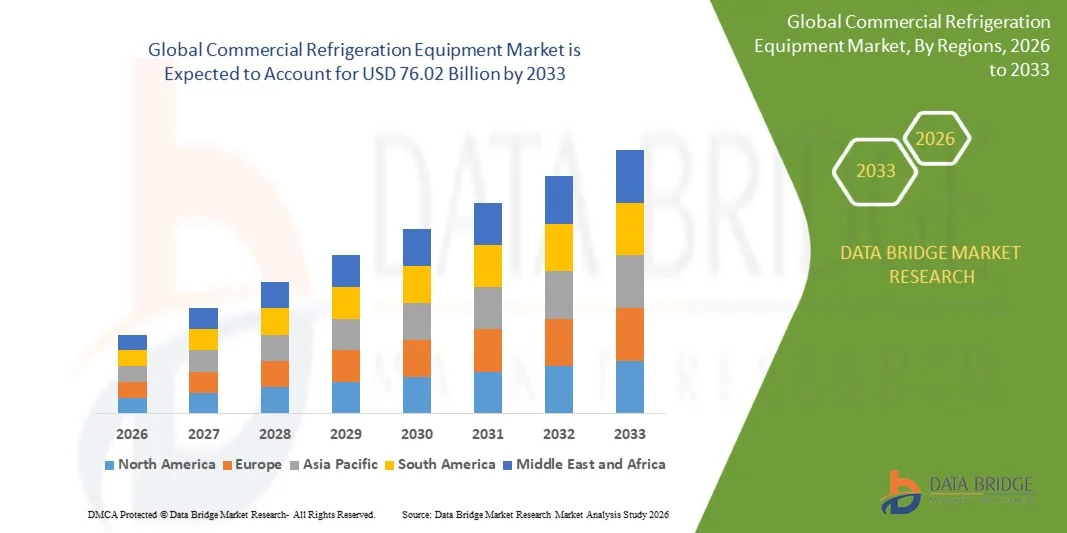
- The global commercial refrigeration equipment market size was valued at USD 47.34 billion in 2025 and is expected to reach USD 76.02 billion by 2033, at a CAGR of 6.10% during the forecast period
- The market growth is largely driven by the rising expansion of organized retail formats, supermarkets, hypermarkets, and foodservice chains, which require reliable temperature-controlled storage and display systems to preserve product quality and safety. Increasing global demand for frozen, processed, and ready-to-eat food products is further accelerating the need for advanced refrigeration infrastructure across commercial environments
- Furthermore, stringent food safety regulations, growing focus on energy efficiency, and the shift toward low-global-warming refrigerants are pushing businesses to adopt modern, eco-friendly refrigeration systems. These converging factors are accelerating the deployment of smart, sustainable refrigeration solutions, thereby significantly boosting industry growth
Commercial Refrigeration Equipment Market Analysis
- Commercial refrigeration equipment includes systems such as refrigerated display cases, walk-in coolers, freezers, condensers, compressors, and refrigeration racks used for storing and preserving perishable goods in retail, foodservice, logistics, and industrial applications. These systems ensure consistent temperature control, regulatory compliance, and reduced food wastage across supply chains
- The increasing demand for commercial refrigeration equipment is primarily fueled by rapid urbanization, expansion of cold chain logistics, rising consumption of perishable food products, and the growing adoption of energy-efficient and digitally monitored refrigeration technologies across global commercial sectors
- North America dominated the commercial refrigeration equipment market with a share of 33% in 2025, due to strong demand from food service chains, supermarkets, and cold storage infrastructure, along with high adoption of advanced refrigeration systems for efficient temperature control and energy savings
- Asia-Pacific is expected to be the fastest growing region in the commercial refrigeration equipment market during the forecast period due to rapid urbanization, rising disposable incomes, and expansion of modern retail formats in countries such as China, India, and Japan
- Refrigerator & freezer segment dominated the market with a market share of 40% in 2025, due to its essential role across food storage, preservation, and processing environments. These systems are widely adopted in supermarkets, restaurants, and food processing facilities due to their ability to maintain consistent temperature control for perishable goods. Strong demand is supported by expanding cold chain infrastructure and increasing consumption of frozen and packaged foods
Report Scope and Commercial Refrigeration Equipment Market Segmentation
|
Attributes |
Commercial Refrigeration Equipment Key Market Insights |
|
Segments Covered |
|
|
Countries Covered |
North America
Europe
Asia-Pacific
Middle East and Africa
South America
|
|
Key Market Players |
|
|
Market Opportunities |
|
|
Value Added Data Infosets |
In addition to the insights on market scenarios such as market value, growth rate, segmentation, geographical coverage, and major players, the market reports curated by the Data Bridge Market Research also include in-depth expert analysis, pricing analysis, brand share analysis, consumer survey, demography analysis, supply chain analysis, value chain analysis, raw material/consumables overview, vendor selection criteria, PESTLE Analysis, Porter Analysis, and regulatory framework. |
Commercial Refrigeration Equipment Market Trends
“Rising Adoption of Natural Refrigerants and Low-GWP Cooling Systems”
- A significant trend in the commercial refrigeration equipment market is the increasing shift toward natural refrigerants such as CO₂, ammonia, and hydrocarbons, driven by global regulatory pressure to reduce greenhouse gas emissions and phase down high-GWP refrigerants. This transition is reshaping system design priorities, with manufacturers focusing on energy efficiency, sustainability, and compliance with evolving environmental standards across retail and foodservice applications
- For instance, Carrier Global Corporation has expanded its CO₂ refrigeration portfolio for supermarket systems in Europe and North America, supporting retailers in meeting stringent F-Gas regulations. Such solutions enable improved environmental performance while maintaining stable cooling efficiency in large-scale retail environments
- The adoption of low-GWP refrigeration systems is accelerating in response to corporate sustainability commitments and national climate targets across developed and emerging economies. This is encouraging food retailers and logistics operators to upgrade legacy systems with eco-friendly alternatives that reduce carbon footprint
- Supermarket chains such as Tesco and Walmart are increasingly integrating CO₂-based refrigeration systems across new and refurbished stores to align with sustainability goals. This reflects a broader industry movement toward environmentally responsible cooling infrastructure
- Manufacturers are also investing in hybrid and transcritical CO₂ systems that improve performance under varying temperature conditions while reducing energy consumption. This technological evolution is strengthening the role of sustainable refrigerants as a core industry standard in commercial cooling applications
Commercial Refrigeration Equipment Market Dynamics
Driver
“Expansion of Cold Chain Infrastructure in Emerging Economies”
- The expansion of cold chain infrastructure in emerging economies is a key driver of the commercial refrigeration equipment market, supported by rising demand for processed food, pharmaceuticals, and temperature-sensitive goods. Governments and private investors are increasingly focusing on developing reliable storage and transportation networks to reduce post-harvest losses and improve food security
- For instance, the National Centre for Cold-chain Development (NCCD) in India has been actively supporting the expansion of integrated cold storage and refrigerated transport networks. This initiative is improving rural-to-urban food supply efficiency and boosting demand for advanced refrigeration systems
- The rapid growth of organized retail and food delivery platforms is further accelerating the need for modern refrigeration infrastructure in warehouses, distribution centers, and retail outlets. This is increasing the deployment of scalable and energy-efficient refrigeration systems across supply chains
- Companies such as Lineage Logistics are expanding cold storage facilities globally to support rising demand for temperature-controlled warehousing. These investments are strengthening global cold chain connectivity and improving perishable goods distribution efficiency
- The continuous expansion of cold chain ecosystems is expected to remain a strong growth catalyst, improving supply chain resilience and reducing spoilage across perishable product segments
Restraint/Challenge
“High Installation and Maintenance Costs of Advanced Refrigeration Systems”
- The commercial refrigeration equipment market faces significant challenges due to the high installation and maintenance costs associated with advanced refrigeration systems, particularly those using natural refrigerants and smart monitoring technologies. These systems require specialized components, skilled technicians, and complex infrastructure, increasing overall capital expenditure for end users
- For instance, the adoption of transcritical CO₂ systems by retailers such as ALDI in Europe has involved substantial upfront investment in system redesign and installation. While operational efficiency improves over time, initial costs remain a barrier for small and medium-sized enterprises
- The need for regular maintenance, leak detection systems, and compliance with safety standards further increases operational expenses for businesses. This creates financial pressure, particularly for retailers operating in highly competitive and cost-sensitive markets
- Advanced refrigeration systems also require integration with digital monitoring and control technologies, adding to both installation complexity and long-term service costs. These requirements often limit adoption among smaller retail chains and independent operators
- These cost-related challenges collectively slow down the widespread adoption of next-generation refrigeration systems despite their long-term energy and sustainability benefits
Commercial Refrigeration Equipment Market Scope
The market is segmented on the basis of type, refrigerant type, application, and end user.
• By Type
On the basis of type, the commercial refrigeration equipment market is segmented into blast chillers, refrigerator & freezer, transportation refrigeration, refrigerated display case, beverage refrigeration, ice cream merchandiser, and refrigerated vending machine. The refrigerator & freezer segment dominated the largest market revenue share of 40% in 2025, driven by its essential role across food storage, preservation, and processing environments. These systems are widely adopted in supermarkets, restaurants, and food processing facilities due to their ability to maintain consistent temperature control for perishable goods. Strong demand is supported by expanding cold chain infrastructure and increasing consumption of frozen and packaged foods. Technological improvements in energy efficiency and temperature precision further strengthen adoption across commercial facilities.
The refrigerated display case segment is anticipated to witness the fastest growth rate from 2026 to 2033, driven by rising demand in retail food outlets and quick service restaurants. These systems enhance product visibility and merchandising efficiency, directly influencing consumer purchase behavior in high-traffic environments. Growth is further supported by increasing expansion of supermarkets, convenience stores, and modern retail formats. Integration of LED lighting, smart temperature controls, and eco-friendly refrigerants is improving operational efficiency. Rising focus on attractive food presentation and extended shelf life is accelerating adoption in competitive retail spaces.
• By Refrigerant Type
On the basis of refrigerant type, the market is segmented into fluorocarbons, hydrocarbons, and inorganics. The fluorocarbons segment dominated the largest market revenue share in 2025, supported by its long-standing use in commercial refrigeration systems due to stable cooling performance and broad compatibility with existing equipment. These refrigerants are widely used in large-scale refrigeration units across supermarkets and food processing plants. Established infrastructure and ease of maintenance continue to support their widespread deployment. Demand remains strong in regions where transition to alternative refrigerants is gradual due to cost and retrofit limitations.
The hydrocarbons segment is expected to witness the fastest growth rate from 2026 to 2033, driven by increasing environmental regulations and the shift toward low global warming potential refrigerants. Hydrocarbon refrigerants offer high energy efficiency and lower environmental impact compared to conventional alternatives. Their adoption is expanding in small to medium commercial refrigeration systems due to improved safety standards and technological advancements. Rising sustainability commitments from food retail and hospitality sectors further support this transition. Growing preference for eco-friendly refrigeration solutions is accelerating market uptake globally.
• By Application
On the basis of application, the commercial refrigeration equipment market is segmented into food service, food and beverage distribution, food and beverage retail, and other. The food and beverage retail segment dominated the largest market revenue share in 2025, driven by extensive use of refrigeration systems in supermarkets, hypermarkets, and convenience stores. These environments require continuous cooling for dairy products, frozen foods, and beverages to maintain product quality and compliance standards. Rapid expansion of organized retail and urbanization supports sustained demand. Increasing consumer preference for packaged and chilled food products further strengthens this segment.
The food service segment is anticipated to witness the fastest growth rate from 2026 to 2033, driven by rising expansion of restaurants, cafes, and quick-service outlets. These establishments require efficient refrigeration systems for ingredient storage, food preparation, and beverage cooling. Growth is supported by increasing out-of-home food consumption and the expansion of global food chains. Demand for compact, energy-efficient refrigeration units is rising in commercial kitchens with limited space. Strong focus on food safety and freshness preservation is accelerating adoption across the sector.
• By End User
On the basis of end user, the market is segmented into food processing industry, food service industry, full service restaurant & hotels, quick service restaurants, and catering services. The food processing industry segment dominated the largest market revenue share in 2025, driven by its high dependence on large-scale refrigeration systems for raw material storage, processing, and preservation. These systems ensure product safety, quality retention, and compliance with food safety regulations. Expansion of processed and packaged food production facilities continues to support demand. Strong cold chain integration within processing units further reinforces segment dominance.
The quick service restaurants segment is expected to witness the fastest growth rate from 2026 to 2033, driven by rapid global expansion of fast-food chains and increasing demand for ready-to-eat meals. These establishments require efficient and compact refrigeration solutions to support high-volume, fast-paced operations. Growth is supported by rising urban lifestyles and increasing consumer preference for convenience food. Technological advancements in energy-efficient and smart refrigeration systems are improving operational efficiency. Expanding franchise networks are further accelerating adoption across emerging and developed markets.
Commercial Refrigeration Equipment Market Regional Analysis
- North America dominated the commercial refrigeration equipment market with the largest revenue share of 33% in 2025, driven by strong demand from food service chains, supermarkets, and cold storage infrastructure, along with high adoption of advanced refrigeration systems for efficient temperature control and energy savings
- The region benefits from a well-established retail and food supply chain ecosystem, where consistent demand for perishable food storage and transportation refrigeration supports market expansion. Strict regulatory standards focused on energy efficiency and environmentally friendly refrigerants further accelerate the replacement of conventional systems with advanced solutions
- This widespread adoption is further supported by high investment capacity, rapid technological upgrades in refrigeration systems, and strong presence of major food retail and hospitality industries, making commercial refrigeration equipment essential across both commercial and industrial applications
U.S. Commercial Refrigeration Equipment Market Insight
The U.S. commercial refrigeration equipment market captured the largest revenue share within North America in 2025, supported by the rapid expansion of grocery chains, convenience stores, and quick-service restaurants. Strong demand for frozen and processed food storage is accelerating the adoption of advanced refrigeration systems. Businesses are increasingly shifting toward smart refrigeration units with remote monitoring and predictive maintenance capabilities. Growth is further strengthened by the modernization of cold storage infrastructure and rising focus on reducing energy consumption across commercial facilities.
Europe Commercial Refrigeration Equipment Market Insight
The Europe commercial refrigeration equipment market is expected to expand at a steady CAGR throughout the forecast period, driven by strict environmental regulations and rising demand for low-emission cooling systems. The region’s strong food retail sector and well-established hospitality industry are key contributors to sustained equipment adoption. Businesses are focusing on natural refrigerants and energy-efficient systems to align with sustainability targets. Growth is also supported by refurbishment of aging refrigeration infrastructure across supermarkets and food distribution networks.
U.K. Commercial Refrigeration Equipment Market Insight
The U.K. commercial refrigeration equipment market is projected to grow at a steady rate during the forecast period, driven by expansion in convenience retail stores and food delivery services. Rising demand for temperature-controlled storage in urban food supply chains is supporting market penetration. Businesses are increasingly adopting compact and modular refrigeration systems to optimize space utilization in retail outlets. Growth is also influenced by sustainability initiatives and the transition toward low-global-warming refrigerant technologies.
Germany Commercial Refrigeration Equipment Market Insight
The Germany commercial refrigeration equipment market is expected to expand at a considerable CAGR during the forecast period, supported by strong industrial food processing and retail infrastructure. The country’s emphasis on energy efficiency and environmental compliance is accelerating the adoption of advanced refrigeration technologies. Supermarkets and logistics operators are investing in high-performance systems to reduce energy costs and maintain strict temperature control. Demand is also driven by modernization of cold storage facilities across manufacturing and distribution sectors.
Asia-Pacific Commercial Refrigeration Equipment Market Insight
The Asia-Pacific commercial refrigeration equipment market is projected to grow at the fastest CAGR during the forecast period of 2026 to 2033, driven by rapid urbanization, rising disposable incomes, and expansion of modern retail formats in countries such as China, India, and Japan. Growth in food processing and cold chain logistics is significantly increasing equipment demand. Governments across the region are investing in food security infrastructure and temperature-controlled supply networks. Rising adoption of organized retail and expanding hospitality sector further strengthen market growth.
Japan Commercial Refrigeration Equipment Market Insight
The Japan commercial refrigeration equipment market is gaining steady traction due to advanced retail infrastructure and strong demand for high-precision temperature control systems. The country’s focus on food quality, safety, and freshness is encouraging adoption of technologically advanced refrigeration solutions. Convenience stores and supermarkets play a major role in driving equipment deployment. Growth is further supported by integration of energy-saving systems and automation in commercial cooling applications.
China Commercial Refrigeration Equipment Market Insight
The China commercial refrigeration equipment market accounted for the largest revenue share in Asia-Pacific in 2025, supported by rapid expansion of retail chains, food delivery platforms, and large-scale cold chain logistics. Strong manufacturing capabilities and availability of cost-effective equipment are boosting adoption across commercial sectors. Government initiatives supporting cold chain infrastructure development are further accelerating market growth. Rising demand for frozen food storage and urban supermarket expansion continue to drive strong equipment deployment across the country.
Commercial Refrigeration Equipment Market Share
The commercial refrigeration equipment industry is primarily led by well-established companies, including:
- Emerson Electric Co. (U.S.)
- Carrier (U.S.)
- National Refrigeration Company (U.S.)
- Bharat Refrigerations Private Limited (India)
- Danfoss (Denmark)
- GEA Group Aktiengesellschaft (Germany)
- Daikin Industries, Ltd. (Japan)
- Western Refrigeration Private Limited (India)
- Johnson Controls (Ireland)
- BITZER SE (Germany)
- Mayekawa Mfg. Co., Ltd. (Japan)
- Baltimore Aircoil Company, Inc. (U.S.)
- Commercial Refrigeration Inc. (U.S.)
- Dover Corporation (A Dover Company) (U.S.)
- Carnot Refrigeration (India)
- Rockwell Industries Limited (India)
- Beijer Ref AB (Sweden)
- Green & Cool (Sweden)
- Henry Group Industries (U.S.)
- Evapco, Inc. (U.S.)
Latest Developments in Global Commercial Refrigeration Equipment Market
- In May 2025, AHT Cooling Systems GmbH introduced SPI CIRCUMPOLAR, a patented modular pump station designed for semi-plug-in water-loop refrigeration systems. This development enhances system flexibility, scalability, and integration across commercial refrigeration installations, enabling retailers and foodservice operators to optimize cooling infrastructure with lower energy consumption. The innovation strengthens the shift toward sustainable refrigeration technologies, supporting rising demand for eco-friendly and high-performance cooling solutions in global retail and foodservice applications
- In May 2025, Hussmann Corporation entered an exclusive distribution partnership with Refra to expand its portfolio of transcritical CO₂ racks and R290 heat pump systems across Australia and New Zealand. This collaboration reinforces Hussmann’s strategic focus on natural refrigerant-based solutions, improving its ability to meet tightening environmental regulations and sustainability targets. The partnership enhances market penetration in the Asia-Pacific region while accelerating adoption of low-GWP refrigeration technologies in commercial applications
- In April 2025, Daikin launched the Pro-C CRAH range, a new line of computer room air handlers delivering 30–210 kW cooling capacity with modular design and optimized control systems. This launch strengthens Daikin’s position in precision cooling for data center environments, improving energy efficiency and operational reliability. The development supports growing demand for high-performance refrigeration and cooling solutions in digital infrastructure and mission-critical facilities
- In March 2025, Carrier Global Corporation introduced an upgraded line of CO₂-based refrigerated display cases designed for supermarkets and hypermarkets, enhancing energy efficiency and reducing greenhouse gas emissions. This advancement improves temperature consistency and operational cost savings for retailers while supporting compliance with global sustainability regulations. It reinforces Carrier’s leadership in environmentally responsible commercial refrigeration solutions across large-scale retail environments
- In February 2025, Danfoss unveiled its next-generation intelligent refrigeration controllers with integrated IoT-enabled monitoring and predictive maintenance capabilities for commercial cold chain systems. This innovation improves system reliability, reduces downtime, and enables real-time performance optimization across refrigeration networks. It strengthens the adoption of smart refrigeration infrastructure, supporting digital transformation in food storage, logistics, and retail sectors
SKU-
Get online access to the report on the World's First Market Intelligence Cloud

- Interactive Data Analysis Dashboard
- Company Analysis Dashboard for high growth potential opportunities
- Research Analyst Access for customization & queries
- Competitor Analysis with Interactive dashboard
- Latest News, Updates & Trend analysis
- Harness the Power of Benchmark Analysis for Comprehensive Competitor Tracking
Global Commercial Refrigeration Equipment Market, Supply Chain Analysis and Ecosystem Framework
To support market growth and help clients navigate the impact of geopolitical shifts, DBMR has integrated in-depth supply chain analysis into its Global Commercial Refrigeration Equipment Market research reports. This addition empowers clients to respond effectively to global changes affecting their industries. The supply chain analysis section includes detailed insights such as Global Commercial Refrigeration Equipment Market consumption and production by country, price trend analysis, the impact of tariffs and geopolitical developments, and import and export trends by country and HSN code. It also highlights major suppliers with data on production capacity and company profiles, as well as key importers and exporters. In addition to research, DBMR offers specialized supply chain consulting services backed by over a decade of experience, providing solutions like supplier discovery, supplier risk assessment, price trend analysis, impact evaluation of inflation and trade route changes, and comprehensive market trend analysis.
Research Methodology
Data collection and base year analysis are done using data collection modules with large sample sizes. The stage includes obtaining market information or related data through various sources and strategies. It includes examining and planning all the data acquired from the past in advance. It likewise envelops the examination of information inconsistencies seen across different information sources. The market data is analysed and estimated using market statistical and coherent models. Also, market share analysis and key trend analysis are the major success factors in the market report. To know more, please request an analyst call or drop down your inquiry.
The key research methodology used by DBMR research team is data triangulation which involves data mining, analysis of the impact of data variables on the market and primary (industry expert) validation. Data models include Vendor Positioning Grid, Market Time Line Analysis, Market Overview and Guide, Company Positioning Grid, Patent Analysis, Pricing Analysis, Company Market Share Analysis, Standards of Measurement, Global versus Regional and Vendor Share Analysis. To know more about the research methodology, drop in an inquiry to speak to our industry experts.
Customization Available
Data Bridge Market Research is a leader in advanced formative research. We take pride in servicing our existing and new customers with data and analysis that match and suits their goal. The report can be customized to include price trend analysis of target brands understanding the market for additional countries (ask for the list of countries), clinical trial results data, literature review, refurbished market and product base analysis. Market analysis of target competitors can be analyzed from technology-based analysis to market portfolio strategies. We can add as many competitors that you require data about in the format and data style you are looking for. Our team of analysts can also provide you data in crude raw excel files pivot tables (Fact book) or can assist you in creating presentations from the data sets available in the report.












