




Global Nanoparticles Market
Market Size in USD Million
CAGR :
% 
 USD
505.62 Million
USD
805.88 Million
2025
2033
USD
505.62 Million
USD
805.88 Million
2025
2033
 Forecast Period Forecast Period |
2026 –2033 |
 Market Size (Base Year) Market Size (Base Year) |
USD 505.62 Million |
 Market Size (Forecast Year) Market Size (Forecast Year) |
USD 805.88 Million |
 CAGR CAGR |
% |
| Major Markets Players |
|
What is the Global Nanoparticles Market Size and Growth Rate?
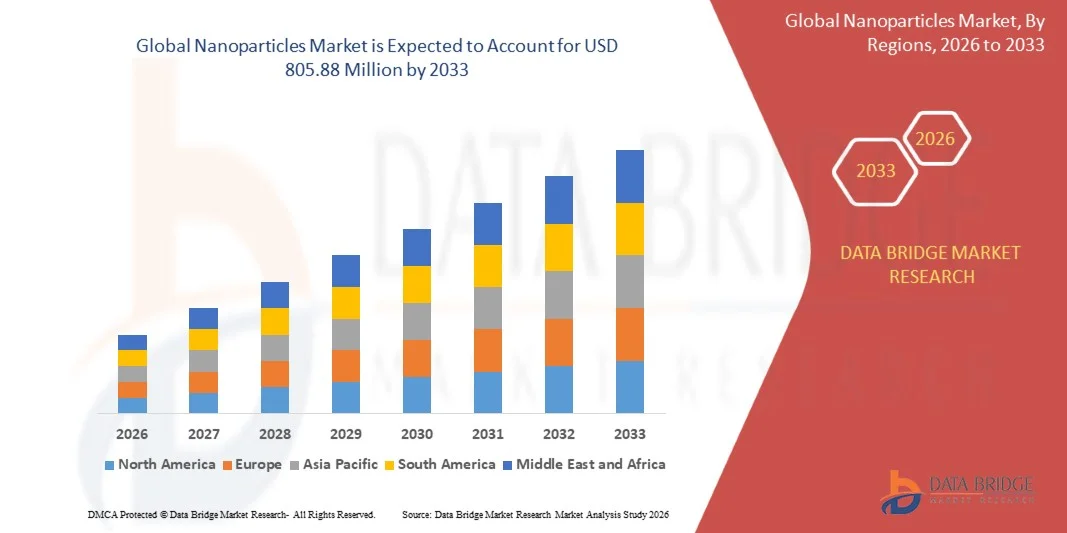
- The global nanoparticles market size was valued at USD 505.62 million in 2025 and is expected to reach USD 805.88 million by 2033, at a CAGR of 6.00% during the forecast period
- The increasing focus on nanotechnology research will influence the growth rate of the nanoparticles market
- The rising government investment in pharmaceutical research and development activities and expanding medical diagnostic industry are the key elements driving market expansion. The surge in the demand from various end-use industries will cushion the growth of nanoparticles market
What are the Major Takeaways of Nanoparticles Market?
- The nanoparticles market is also being driven by factors such as increasing advantages in medicinal imaging applications and the surging growth in advance healthcare technology
- Furthermore, increasing collaboration among private organization and government focusing on continuous advancement in nanoparticles technologies will enhance the growth rate of nanoparticles market. Also, increasing modernization and the rise in the prevalence of chronic disorders such as diabetes, cardiovascular diseases and cancer will act as major factors influencing the growth of nanoparticles market
- North America dominated the nanoparticles market with a 41.6% revenue share in 2025, driven by strong growth in the pharmaceutical, biotechnology, research, diagnostics, and advanced materials sectors across the U.S. and Canada
- Asia-Pacific is projected to register the fastest CAGR of 8.11% from 2026 to 2033, driven by rapid expansion in pharmaceutical manufacturing, biotechnology research, healthcare infrastructure, and nanotechnology innovation across China, Japan, India, South Korea, and Southeast Asia
- The Inorganic Nanoparticles segment dominated the market with a 31.6% share in 2025, as it remains widely adopted across pharmaceuticals, diagnostics, electronics, and advanced coatings applications
Report Scope and Nanoparticles Market Segmentation
|
Attributes |
Nanoparticles Key Market Insights |
|
Segments Covered |
|
|
Countries Covered |
North America
Europe
Asia-Pacific
Middle East and Africa
South America
|
|
Key Market Players |
|
|
Market Opportunities |
|
|
Value Added Data Infosets |
In addition to the insights on market scenarios such as market value, growth rate, segmentation, geographical coverage, and major players, the market reports curated by the Data Bridge Market Research also include in-depth expert analysis, pricing analysis, brand share analysis, consumer survey, demography analysis, supply chain analysis, value chain analysis, raw material/consumables overview, vendor selection criteria, PESTLE Analysis, Porter Analysis, and regulatory framework. |
What is the Key Trend in the Nanoparticles Market?
“Increasing Shift Toward Precision Applications, Functional Nanomaterials, and Sustainable Synthesis”
- The nanoparticles market is witnessing strong adoption of engineered nanoparticles with controlled size, surface chemistry, and functionality across healthcare, electronics, energy storage, coatings, and water treatment applications
- Manufacturers are increasingly introducing metal, metal oxide, polymeric, and lipid-based nanoparticles that offer enhanced conductivity, catalytic activity, drug delivery efficiency, and optical performance
- Growing demand for cost-efficient, high-purity, and application-specific nanomaterials is driving usage across biomedical labs, semiconductor manufacturing, advanced coatings, and industrial processing environments
- For instance, companies such as Bruker, Agilent Technologies, Shimadzu, JEOL, and HORIBA are supporting the market with advanced nanoparticle characterization, measurement, and analytical solutions
- Increasing need for targeted drug delivery, advanced sensors, energy-efficient batteries, and high-performance coatings is accelerating the shift toward specialized nanoparticle solutions
- As industries continue to prioritize miniaturization, precision engineering, and sustainable material innovation, nanoparticles will remain vital for next-generation industrial and healthcare applications
What are the Key Drivers of Nanoparticles Market?
- Rising demand for advanced functional materials to support healthcare diagnostics, targeted therapeutics, electronics miniaturization, and renewable energy systems is a major growth driver
- For instance, in 2025–2026, leading companies and research institutions expanded focus on gold nanoparticles, iron oxide nanoparticles, and lipid-based nanocarriers for imaging, sensing, and drug delivery applications
- Growing adoption across pharmaceuticals, semiconductors, cosmetics, automotive coatings, and energy storage systems is significantly boosting market demand across the U.S., Europe, and Asia-Pacific
- Advancements in nanoparticle synthesis methods, surface modification technologies, and scalable manufacturing processes have strengthened product consistency, purity, and commercial viability
- Rising use of nanoparticles in AI chips, biosensors, battery electrodes, and water purification systems is creating strong demand for high-performance materials
- Supported by steady investments in nanotechnology R&D, precision medicine, and advanced manufacturing infrastructure, the nanoparticles market is expected to witness strong long-term growth
Which Factor is Challenging the Growth of the Nanoparticles Market?
- High costs associated with high-purity nanoparticle production, advanced synthesis equipment, and surface functionalization technologies restrict adoption among smaller manufacturers and research institutions
- For instance, during 2024–2026, fluctuations in raw material costs, stringent purity requirements, and specialized processing techniques increased production expenses for several global vendors
- Complexity in ensuring particle size uniformity, long-term stability, and biocompatibility increases the need for skilled expertise and specialized validation processes
- Limited awareness in emerging markets regarding application-specific benefits, handling protocols, and regulatory standards slows adoption
- Competition from conventional materials, bulk chemicals, and alternative advanced composites creates pricing pressure and reduces product differentiation
- To address these issues, companies are focusing on cost-optimized synthesis, green chemistry approaches, and higher integration with end-use applications to increase global adoption of nanoparticles
How is the Nanoparticles Market Segmented?
The market is segmented on the basis of technology, type of analysis, end use, and application.
• By Technology
On the basis of technology, the nanoparticles market is segmented into Liposomes, Nanotubes, Polymeric Nanoparticles, Polymer Conjugated Drugs, Dendrimers, Inorganic Nanoparticles, and Others. The Inorganic Nanoparticles segment dominated the market with a 31.6% share in 2025, as it remains widely adopted across pharmaceuticals, diagnostics, electronics, and advanced coatings applications. Gold, silver, silica, and iron oxide nanoparticles are extensively used due to their high stability, controlled functionality, strong optical and magnetic properties, and broad biomedical compatibility. Their widespread use in imaging, diagnostics, catalysis, and industrial materials continues to support large-scale commercial adoption.
The Polymeric Nanoparticles segment is expected to grow at the fastest CAGR from 2026 to 2033, driven by rising demand for targeted drug delivery, controlled release systems, and advanced therapeutic formulations. Increasing focus on precision medicine and nanomedicine is expected to accelerate segment growth globally.
• By Type of Analysis
On the basis of type of analysis, the market is segmented into Particle Size Analysis, Particle Concentration Analysis, Zeta Potential Analysis, Molecular Structure Analysis, Particle Shape Analysis, and Others. The Particle Size Analysis segment dominated the market with a 34.8% share in 2025, supported by its critical role in determining nanoparticle performance, stability, surface interaction, and application suitability across healthcare, materials science, and industrial processing. Particle size analysis is extensively used in drug formulation, colloidal systems, coatings, semiconductors, and advanced materials research. Its importance in quality control and product standardization makes it a key market segment.
The Zeta Potential Analysis segment is projected to grow at the fastest CAGR from 2026 to 2033, driven by increasing demand for stability testing, suspension analysis, and surface charge characterization in pharmaceutical and biotechnology applications.
• By End Use
On the basis of end use, the nanoparticles market is segmented into Pharmaceuticals Industry, Biochemical Industry, Research Institutions, and Others. The Pharmaceuticals Industry segment dominated the market with a 39.2% share in 2025, driven by extensive use of nanoparticles in drug delivery systems, imaging agents, vaccines, diagnostics, and targeted therapeutics. Rising demand for advanced drug formulations, cancer therapies, and precision medicine continues to strengthen this segment’s leadership.
The Research Institutions segment is expected to grow at the fastest CAGR from 2026 to 2033, propelled by increasing investments in nanotechnology research, academic innovation, and government-supported biomedical programs.
• By Application
On the basis of application, the market is segmented into Biotechnology, Drug Development, and Drug Delivery. The Drug Delivery segment dominated the market with a 42.5% share in 2025, driven by increasing adoption of nanoparticles for targeted therapies, controlled release mechanisms, and enhanced bioavailability solutions. Their use in oncology, vaccines, and chronic disease treatment continues to accelerate adoption.
The Drug Development segment is expected to grow at the fastest CAGR from 2026 to 2033, supported by rising focus on next-generation therapeutics, biologics, and personalized medicine platforms.
Which Region Holds the Largest Share of the Nanoparticles Market?
- North America dominated the nanoparticles market with a 41.6% revenue share in 2025, driven by strong growth in the pharmaceutical, biotechnology, research, diagnostics, and advanced materials sectors across the U.S. and Canada. High adoption of nanoparticles in drug delivery systems, molecular imaging, diagnostics, precision medicine, and material characterization continues to fuel demand across research laboratories, pharmaceutical manufacturing facilities, biotechnology companies, and academic institutions
- Leading companies in North America are continuously introducing advanced nanoparticle synthesis technologies, high-precision characterization systems, and next-generation analytical platforms, strengthening the region’s technological advantage. Continuous investment in nanomedicine, targeted therapeutics, life sciences R&D, and advanced healthcare infrastructure drives long-term market expansion
- Strong concentration of research institutions, high healthcare spending, robust innovation ecosystems, and sustained investments in biotechnology further reinforce regional market leadership
U.S. Nanoparticles Market Insight
The U.S. is the largest contributor in North America, supported by strong pharmaceutical R&D, rapid adoption of nanomedicine, biologics, and precision diagnostics, and extensive utilization of nanoparticles across oncology, drug delivery, and molecular imaging applications. Increasing development of liposomal drugs, polymeric nanoparticles, and targeted therapeutics intensifies market demand. Presence of major players such as Johnson & Johnson, Amgen, Gilead Sciences, and Agilent Technologies further drives market growth.
Canada Nanoparticles Market Insight
Canada contributes significantly to regional growth, driven by expanding biotech research clusters, pharmaceutical innovation, and growing investments in life sciences R&D. Universities and research labs increasingly utilize nanoparticles for drug formulation, biomarker analysis, and nanotechnology-based healthcare solutions.
Asia-Pacific Nanoparticles Market
Asia-Pacific is projected to register the fastest CAGR of 8.11% from 2026 to 2033, driven by rapid expansion in pharmaceutical manufacturing, biotechnology research, healthcare infrastructure, and nanotechnology innovation across China, Japan, India, South Korea, and Southeast Asia. High-volume production of generic drugs, biosimilars, nanoparticle-based formulations, and diagnostic solutions increases demand for advanced nanoparticle technologies. Growth in precision medicine, biotechnology startups, life sciences research, and healthcare digitization continues to accelerate market expansion across the region
China Nanoparticles Market Insight
China is the largest contributor to Asia-Pacific due to massive investments in pharmaceutical manufacturing, biomedical research, and nanotechnology innovation. Rising development of targeted therapies, biosensors, and advanced diagnostics significantly drives demand for nanoparticles.
Japan Nanoparticles Market Insight
Japan shows steady growth supported by advanced healthcare systems, pharmaceutical innovation, and precision diagnostics technologies. Strong focus on high-quality biomedical tools and drug development reinforces long-term market expansion.
India Nanoparticles Market Insight
India is emerging as a major growth hub, driven by expanding pharmaceutical production, biotech startups, and government-backed healthcare innovation initiatives. Growing demand for drug delivery systems and diagnostics fuels market penetration.
South Korea Nanoparticles Market Insight
South Korea contributes significantly due to strong demand for biopharmaceuticals, diagnostics, and advanced healthcare technologies. Continuous innovation and strong research infrastructure support sustained market growth.
Which are the Top Companies in Nanoparticles Market?
The nanoparticles industry is primarily led by well-established companies, including:
- Bristol-Myers Squibb Company (U.S.)
- Johnson & Johnson Private Limited (U.S.)
- Leadiant Biosciences, Inc. (U.S.)
- Malvern Panalytical Ltd (U.K.)
- Novartis AG (Switzerland)
- Gilead Sciences, Inc. (U.S.)
- Johnson & Johnson Services, Inc. (U.S.)
- Amgen, Inc. (U.S.)
- Bruker (U.S.)
- JEOL Ltd. (Japan)
- Shimadzu Corporation (Japan)
- Agilent Technologies, Inc. (U.S.)
- Bruker Corporation (U.S.)
- Hitachi, Ltd. (Japan)
- Jeol Ltd (Japan)
- Microtrac Retsch GmbH (Germany)
- TSI (U.S.)
- Wyatt Technology Corporation (U.S.)
- HORIBA, Ltd. (Japan)
- Beckman Coulter, Inc. (U.S.)
What are the Recent Developments in Global Nanoparticles Market?
- In February 2026, Lazuriton Nano Biotechnology achieved a major breakthrough in nanomaterial production by scaling up the mass manufacturing of fertilizers below 100 nanometers to 750 kilograms every eight hours, marking a significant advancement in scalable nano-enabled agricultural technologies and strengthening its global leadership in innovative crop solutions, thereby supporting enhanced nutrient efficiency, reduced environmental impact, and long-term growth in the nanoparticles market
- In January 2026, Tekna, a global supplier of advanced materials and plasma systems, expanded its titanium powder supply to a Tier-1 supplier in the U.S. aerospace and defence sector through a new CAD 2.0 million order for high-performance Ti-6Al-4V powder used in additive manufacturing, building on its previous 2025 order and reflecting strong demand growth, thereby reinforcing its market position in high-performance nanoparticle materials for critical aerospace applications
- In November 2025, CHASM Advanced Materials, Inc. and Ingevity Corporation expanded their strategic partnership through a licensing agreement enabling localized manufacturing of patented carbon nanotube conductive additives for EV battery applications across North America and select European countries, thereby strengthening regional supply chains and accelerating innovation in battery-grade nanoparticle materials
- In November 2024, Nawah inaugurated a new carbon-nanotube production facility in Rousset, France, significantly increasing its annual 3D nanocarbon output capacity from 20,000 m² to 400,000 m², thereby enhancing global availability of advanced nanomaterials and supporting broader industrial market expansion
- In October 2024, OCSiAl inaugurated its first European TUBALL nanotube production facility in Serbia with an initial capacity of 60 tons per year and plans for a second production line within 12 months, thereby strengthening the regional supply chain and driving long-term growth in the nanoparticles market through improved material availability
SKU-
Get online access to the report on the World's First Market Intelligence Cloud

- Interactive Data Analysis Dashboard
- Company Analysis Dashboard for high growth potential opportunities
- Research Analyst Access for customization & queries
- Competitor Analysis with Interactive dashboard
- Latest News, Updates & Trend analysis
- Harness the Power of Benchmark Analysis for Comprehensive Competitor Tracking
Global Nanoparticles Market, Supply Chain Analysis and Ecosystem Framework
To support market growth and help clients navigate the impact of geopolitical shifts, DBMR has integrated in-depth supply chain analysis into its Global Nanoparticles Market research reports. This addition empowers clients to respond effectively to global changes affecting their industries. The supply chain analysis section includes detailed insights such as Global Nanoparticles Market consumption and production by country, price trend analysis, the impact of tariffs and geopolitical developments, and import and export trends by country and HSN code. It also highlights major suppliers with data on production capacity and company profiles, as well as key importers and exporters. In addition to research, DBMR offers specialized supply chain consulting services backed by over a decade of experience, providing solutions like supplier discovery, supplier risk assessment, price trend analysis, impact evaluation of inflation and trade route changes, and comprehensive market trend analysis.
Research Methodology
Data collection and base year analysis are done using data collection modules with large sample sizes. The stage includes obtaining market information or related data through various sources and strategies. It includes examining and planning all the data acquired from the past in advance. It likewise envelops the examination of information inconsistencies seen across different information sources. The market data is analysed and estimated using market statistical and coherent models. Also, market share analysis and key trend analysis are the major success factors in the market report. To know more, please request an analyst call or drop down your inquiry.
The key research methodology used by DBMR research team is data triangulation which involves data mining, analysis of the impact of data variables on the market and primary (industry expert) validation. Data models include Vendor Positioning Grid, Market Time Line Analysis, Market Overview and Guide, Company Positioning Grid, Patent Analysis, Pricing Analysis, Company Market Share Analysis, Standards of Measurement, Global versus Regional and Vendor Share Analysis. To know more about the research methodology, drop in an inquiry to speak to our industry experts.
Customization Available
Data Bridge Market Research is a leader in advanced formative research. We take pride in servicing our existing and new customers with data and analysis that match and suits their goal. The report can be customized to include price trend analysis of target brands understanding the market for additional countries (ask for the list of countries), clinical trial results data, literature review, refurbished market and product base analysis. Market analysis of target competitors can be analyzed from technology-based analysis to market portfolio strategies. We can add as many competitors that you require data about in the format and data style you are looking for. Our team of analysts can also provide you data in crude raw excel files pivot tables (Fact book) or can assist you in creating presentations from the data sets available in the report.












