




Global Phycocyanin Market
Market Size in USD Million
CAGR :
% 
 USD
200.98 Million
USD
378.39 Million
2025
2033
USD
200.98 Million
USD
378.39 Million
2025
2033
 Forecast Period Forecast Period |
2026 –2033 |
 Market Size (Base Year) Market Size (Base Year) |
USD 200.98 Million |
 Market Size (Forecast Year) Market Size (Forecast Year) |
USD 378.39 Million |
 CAGR CAGR |
% |
| Major Markets Players |
|
Phycocyanin Market Size
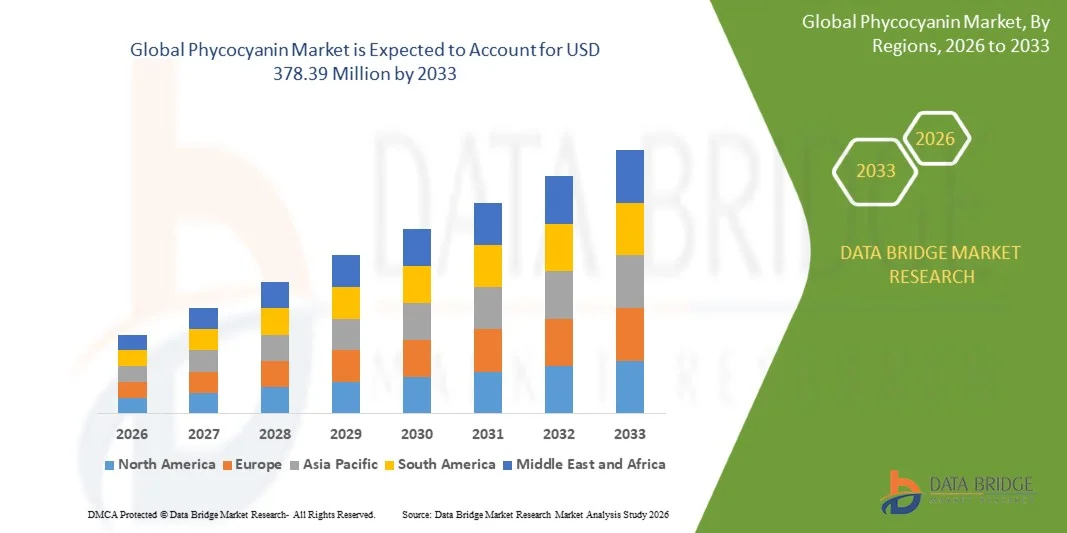
- The global phycocyanin market size was valued at USD 200.98 million in 2025 and is expected to reach USD 378.39 million by 2033, at a CAGR of 8.23% during the forecast period
- The market growth is largely fueled by the rising demand for natural blue colorants derived from algae-based sources, especially phycocyanin, as consumers and manufacturers increasingly shift away from synthetic food dyes toward clean-label and plant-based alternatives
- Furthermore, advancements in spirulina cultivation technologies, improved extraction processes, and growing applications across food and beverage, nutraceutical, cosmetics, and pharmaceutical industries are strengthening production efficiency and expanding commercial utilization, thereby significantly boosting phycocyanin market growth
Phycocyanin Market Analysis
- Phycocyanin, a natural blue pigment extracted primarily from spirulina, is increasingly becoming a key functional ingredient in modern food, nutraceutical, and cosmetic formulations due to its antioxidant, anti-inflammatory, and coloring properties
- The rising global emphasis on health-conscious consumption, sustainability-driven ingredient sourcing, and regulatory restrictions on artificial food colorants is accelerating the adoption of phycocyanin as a preferred natural alternative across multiple end-use industries
- North America dominated the phycocyanin market with a share of 35.35% in 2025, due to strong demand for natural colorants in food and beverage formulations and rising consumer shift toward clean-label products
- Asia-Pacific is expected to be the fastest growing region in the phycocyanin market during the forecast period due to rapid urbanization, rising disposable incomes, and increasing awareness of natural food ingredients
- Phycocyanin E18 segment dominated the market with a market share of 57.4% in 2025, due to its widespread use in food-grade applications and cost-effective production profile. It is commonly preferred in food and beverage formulations where moderate purity levels are sufficient for color enhancement. The segment benefits from strong demand in bakery, confectionery, and dairy-based products. Its balanced performance between cost and functionality makes it a preferred choice for mass-market applications
Report Scope and Phycocyanin Market Segmentation
|
Attributes |
Phycocyanin Key Market Insights |
|
Segments Covered |
|
|
Countries Covered |
North America · U.S. · Canada · Mexico Europe · Germany · France · U.K. · Netherlands · Switzerland · Belgium · Russia · Italy · Spain · Turkey · Rest of Europe Asia-Pacific · China · Japan · India · South Korea · Singapore · Malaysia · Australia · Thailand · Indonesia · Philippines · Rest of Asia-Pacific Middle East and Africa · Saudi Arabia · U.A.E. · South Africa · Egypt · Israel · Rest of Middle East and Africa South America · Brazil · Argentina · Rest of South America |
|
Key Market Players |
· Cyanotech Corporation (U.S.) · DIC CORPORATION (Japan) · Dongtai City Spirulina Bio-engineering Co., Ltd. (China) · GNT Group B.V. (Netherlands) · Fraken Biochem Co., Ltd (China) · Parry Nutraceuticals (India) · NATUREX (France) · DDW The Color House (U.S.) · Zhejiang Binmei Biotechnology Co., Ltd (China) · NutraCulture (India) · Japan Algae Co., Ltd (Japan) · AlgoSource (France) · Wellisen Nutraceuticals Pvt. Ltd. (India) · Bluetec Naturals Co., Ltd (Thailand) · Pond Tech (Canada) · Tianjin Norland Biotech Co., Ltd (China) · Merck KGaA (Germany) |
|
Market Opportunities |
· Expansion in Nutraceutical and Dietary Supplement Applications · Increasing Use in Cosmetics and Pharmaceutical Formulations |
|
Value Added Data Infosets |
In addition to the insights on market scenarios such as market value, growth rate, segmentation, geographical coverage, and major players, the market reports curated by the Data Bridge Market Research also include in-depth expert analysis, pricing analysis, brand share analysis, consumer survey, demography analysis, supply chain analysis, value chain analysis, raw material/consumables overview, vendor selection criteria, PESTLE Analysis, Porter Analysis, and regulatory framework. |
Phycocyanin Market Trends
“Rising Demand for Natural Blue Colorants in Food and Beverage Applications”
- A significant trend in the phycocyanin market is the increasing adoption of natural blue colorants in food and beverage formulations, driven by the shift away from synthetic dyes toward algae derived pigments. This transition is strengthening the role of phycocyanin extracted from spirulina as a key ingredient in clean label and plant based product development across global food processing industries.
- For instance, DIC Corporation produces spirulina derived phycocyanin used as a natural coloring agent in confectionery and beverage applications across multiple international markets. Such usage supports food manufacturers in meeting regulatory requirements while aligning with consumer demand for naturally sourced additives in packaged food products
- The beverage industry is increasingly incorporating phycocyanin in functional drinks, smoothies, and wellness beverages due to its vibrant color stability and perceived nutritional benefits. This trend is expanding its application beyond traditional food coloring into health oriented product segments that emphasize natural ingredient sourcing
- The bakery and dairy sectors are also integrating phycocyanin based pigments to replace artificial blue and green colorants in desserts, ice creams, and specialty bakery items. This is helping manufacturers create visually appealing products while maintaining compliance with clean label standards
- Cosmetic manufacturers are adopting phycocyanin for its natural pigment properties in skincare and personal care formulations where plant based colorants are preferred. This is supporting product differentiation in premium cosmetic lines focused on sustainability and natural ingredient positioning
- The market is witnessing growing research into improving pigment stability under varying pH and temperature conditions to enhance usability across broader applications. This ongoing innovation is reinforcing phycocyanin’s role as a scalable natural color solution across food, beverage, and cosmetic industries
Phycocyanin Market Dynamics
Driver
“Growing Consumer Preference for Plant Based and Clean Label Ingredients”
- The rising consumer shift toward plant based diets and clean label products is driving demand for naturally derived ingredients such as phycocyanin, which is perceived as a safer alternative to synthetic colorants. This preference is strongly influencing food, beverage, and nutraceutical manufacturers to reformulate products using algae based pigments that align with transparency and health focused consumption trends
- For instance, Cyanotech Corporation supplies spirulina based phycocyanin used in dietary supplements and functional foods targeting health conscious consumers in North America and Asia Pacific. This supports manufacturers in meeting growing demand for plant derived ingredients that comply with clean label certification standards
- The increasing awareness of artificial additive related health concerns is encouraging brands to adopt natural colorants that are free from chemical processing and synthetic additives. This shift is enhancing consumer trust and strengthening product positioning in premium health oriented categories
- The expansion of vegan and vegetarian lifestyles is further supporting the adoption of algae derived ingredients such as phycocyanin across multiple end use industries. This is driving formulation changes in packaged foods and beverages to meet dietary preference requirements
- The sustained emphasis on sustainability and environmentally responsible sourcing is reinforcing demand for plant based pigments derived from renewable biological sources. This driver continues to position phycocyanin as a preferred ingredient in next generation clean label product development
Restraint/Challenge
“High Production Cost and Limited Large Scale Cultivation Efficiency”
- The phycocyanin market faces significant challenges due to high production costs associated with spirulina cultivation, extraction, and purification processes that require controlled environmental conditions. These factors limit scalability and increase the final cost of pigment production compared to synthetic alternatives
- For instance, Earthrise Nutritionals, a major spirulina producer in the U.S., operates large scale cultivation systems that still require substantial resource input for maintaining optimal growth conditions. Such operational intensity contributes to higher production expenses and restricts cost competitiveness in mass market applications
- The extraction of high purity phycocyanin involves advanced filtration and separation technologies that increase processing complexity and energy consumption. This raises manufacturing costs and limits accessibility for small and medium scale producers
- Maintaining consistent pigment quality across batches is challenging due to variations in microalgae growth conditions influenced by temperature, light, and nutrient availability. These inconsistencies further add to production inefficiencies and quality control requirements
- The combination of resource intensive cultivation and complex downstream processing continues to create cost barriers for widespread commercialization. This challenge remains a key factor influencing the adoption rate of phycocyanin in price sensitive applications
Phycocyanin Market Scope
The market is segmented on the basis of nature, form, grade, and application.
- By Nature
On the basis of nature, the phycocyanin market is segmented into organic and conventional. The organic segment dominated the market with the largest revenue share in 2025, supported by rising demand for clean-label, plant-based, and naturally derived colorants across food and nutraceutical industries. Consumers increasingly prefer organic phycocyanin due to its perception of higher purity, safety, and alignment with sustainable sourcing practices. Food manufacturers are also shifting toward organic inputs to meet stringent regulatory standards and premium product positioning. The growing popularity of vegan and natural ingredients further strengthens its dominance in the global market. The segment continues to expand as brands focus on transparency and environmentally responsible production practices.
The conventional segment is anticipated to witness steady growth over the forecast period, driven by cost advantages and wider industrial availability. It remains preferred in price-sensitive applications where large-scale production efficiency is prioritized over premium positioning. However, its growth is relatively moderated due to increasing consumer shift toward organic alternatives in premium product categories.
- By Form
On the basis of form, the phycocyanin market is segmented into powder and liquid. The powder segment dominated the market with the largest revenue share in 2025, attributed to its superior stability, longer shelf life, and ease of incorporation into dry formulations. Powdered phycocyanin is widely used in food and beverage applications such as confectionery, bakery, and dietary supplements due to its high color intensity and storage convenience. Manufacturers prefer powder form as it reduces transportation costs and enhances formulation flexibility. Its compatibility with encapsulation and blending processes further supports large-scale industrial usage. The segment remains dominant due to strong demand from processed food and nutraceutical industries.
The liquid segment is expected to register the fastest growth rate from 2026 to 2033, driven by increasing use in ready-to-drink beverages and functional drinks. Liquid phycocyanin offers easier dispersion and faster processing, making it suitable for modern beverage manufacturing lines. Rising consumer demand for natural colored beverages and wellness drinks is accelerating its adoption across global markets.
- By Grade
On the basis of grade, the phycocyanin market is segmented into Phycocyanin E18, Phycocyanin E25, and Phycocyanin E3.0. The Phycocyanin E18 segment dominated the market with the largest revenue share of 57.4% in 2025, supported by its widespread use in food-grade applications and cost-effective production profile. It is commonly preferred in food and beverage formulations where moderate purity levels are sufficient for color enhancement. The segment benefits from strong demand in bakery, confectionery, and dairy-based products. Its balanced performance between cost and functionality makes it a preferred choice for mass-market applications. The segment continues to hold strong positioning due to its broad industrial acceptance and scalable production.
The Phycocyanin E25 segment is anticipated to witness the fastest growth rate from 2026 to 2033, driven by rising demand for high-purity grades in nutraceutical, pharmaceutical, and biotechnology applications. Higher purity levels enhance bioactivity and stability, making it suitable for advanced health-focused formulations. Increasing research into therapeutic and antioxidant properties further supports its adoption in premium applications.
- By Applications
On the basis of applications, the phycocyanin market is segmented into food and beverages, nutraceutical, animal feed, medicines/pharmaceuticals, biotechnology, cosmetics and personal care, aquaculture, and others. The food and beverages segment dominated the market with the largest revenue share in 2025, driven by strong demand for natural blue colorants as replacements for synthetic additives. Phycocyanin is widely used in confectionery, dairy products, beverages, and bakery items due to its vibrant color and plant-based origin. Growing consumer preference for clean-label and natural ingredients further strengthens its dominance. Food manufacturers are increasingly reformulating products to align with health-conscious trends and regulatory restrictions on artificial dyes. The segment remains the primary revenue contributor due to high-volume consumption.
The nutraceutical segment is expected to witness the fastest growth rate from 2026 to 2033, fueled by rising awareness of health benefits associated with phycocyanin, including antioxidant and anti-inflammatory properties. Increasing demand for dietary supplements and functional foods is driving its incorporation into wellness products. Expanding preventive healthcare trends and rising consumer focus on immunity support further accelerate segment growth across global markets.
Phycocyanin Market Regional Analysis
- North America dominated the phycocyanin market with the largest revenue share of 35.35% in 2025, driven by strong demand for natural colorants in food and beverage formulations and rising consumer shift toward clean-label products
- Consumers in the region increasingly prefer plant-based and algae-derived ingredients due to growing health awareness and regulatory restrictions on synthetic dyes
- The presence of advanced nutraceutical and functional food industries further strengthens adoption across multiple applications including dietary supplements and beverages
U.S. Phycocyanin Market Insight
The U.S. phycocyanin market captured the largest revenue share in North America in 2025, supported by rapid expansion of the functional food and dietary supplement industries. Growing consumer preference for natural blue coloring agents in beverages, confectionery, and wellness products is driving strong demand. Increasing adoption of vegan and plant-based diets is further accelerating usage across food manufacturing sectors. The presence of key nutraceutical brands and strong regulatory support for natural additives continues to strengthen market penetration.
Europe Phycocyanin Market Insight
The Europe phycocyanin market is projected to grow at a steady CAGR during the forecast period, driven by strict regulations on synthetic food colorants and rising demand for organic and sustainable ingredients. Consumers in the region increasingly prefer natural additives in food, cosmetics, and personal care products. The expanding plant-based food sector and strong clean-label movement are further supporting market growth. High awareness of environmental sustainability also encourages adoption of algae-derived pigments across multiple industries.
U.K. Phycocyanin Market Insight
The U.K. phycocyanin market is expected to witness stable growth, driven by rising demand for natural food coloring in bakery, beverages, and nutraceutical applications. Increasing health consciousness among consumers is pushing manufacturers to replace synthetic dyes with natural alternatives. Strong growth in vegan and vegetarian product launches further supports adoption. The well-developed retail and e-commerce infrastructure also enhances product availability and market penetration.
Germany Phycocyanin Market Insight
The Germany phycocyanin market is expanding steadily, supported by strong emphasis on organic food production and sustainable ingredient sourcing. High demand from functional food and pharmaceutical industries is driving usage of high-purity phycocyanin grades. Germany’s focus on innovation in biotechnology and natural product development strengthens industrial adoption. Strict food safety regulations continue to encourage transition toward plant-based colorants across multiple sectors.
Asia-Pacific Phycocyanin Market Insight
The Asia-Pacific phycocyanin market is poised to grow at the fastest CAGR during 2026 to 2033, driven by rapid urbanization, rising disposable incomes, and increasing awareness of natural food ingredients. Expanding food and beverage manufacturing industries and growing nutraceutical demand are key growth contributors. Government support for biotechnology and algae cultivation further accelerates production capacity in the region. Rising preference for plant-based and functional foods continues to strengthen market expansion across developing economies.
Japan Phycocyanin Market Insight
The Japan phycocyanin market is gaining momentum due to strong demand for high-quality functional foods and advanced nutraceutical products. Consumers in the country prioritize health, safety, and premium ingredient quality, driving adoption of natural pigments. Integration of phycocyanin in beverages and dietary supplements is increasing steadily. Technological advancement in food processing supports stable usage across industrial applications.
China Phycocyanin Market Insight
The China phycocyanin market accounted for the largest revenue share in Asia-Pacific in 2025, supported by rapid expansion of the food processing industry and strong domestic production capabilities. Growing middle-class population and increasing health awareness are driving demand for natural food colorants. Large-scale algae cultivation and cost-efficient manufacturing support strong supply availability. Expansion of functional beverages and nutraceutical products continues to fuel market growth across the country.
Phycocyanin Market Share
The phycocyanin industry is primarily led by well-established companies, including:
- Cyanotech Corporation (U.S.)
- DIC CORPORATION (Japan)
- Dongtai City Spirulina Bio-engineering Co., Ltd. (China)
- GNT Group B.V. (Netherlands)
- Fraken Biochem Co., Ltd (China)
- Parry Nutraceuticals (India)
- NATUREX (France)
- DDW The Color House (U.S.)
- Zhejiang Binmei Biotechnology Co., Ltd (China)
- NutraCulture (India)
- Japan Algae Co., Ltd (Japan)
- AlgoSource (France)
- Wellisen Nutraceuticals Pvt. Ltd. (India)
- Bluetec Naturals Co., Ltd (Thailand)
- Pond Tech (Canada)
- Tianjin Norland Biotech Co., Ltd (China)
- Merck KGaA (Germany)
Latest Developments in Global Phycocyanin Market
- In May 2025, Fermentalg received approval from the U.S. Food and Drug Administration for its novel natural blue color additive derived from Galdieria sulphuraria, marking a major regulatory milestone for the company. Marketed as Everzure Galdieria in collaboration with Givaudan, this phycocyanin-rich extract was approved for use across multiple food applications, including beverages, confectionery, and ice cream. The development significantly strengthens Fermentalg’s position in the North American market by enabling commercialization of a more stable natural blue pigment. Its enhanced resistance to heat and acidic conditions provides a strong competitive advantage over traditional spirulina-based colorants, supporting broader adoption of bio-based alternatives to synthetic dyes
- In March 2025, Sensient Technologies introduced Marine Blue Capri, a spirulina-derived natural blue colorant designed specifically for beverage applications. The product was developed to address long-standing challenges related to phycocyanin instability in acidic and high-water-content environments. It enables manufacturers to achieve consistent blue, green, and purple shades in sports drinks and carbonated beverages without color degradation. This launch represents a key advancement in the phycocyanin market by improving functional performance and expanding the usability of natural blue colorants in mainstream beverage formulations
- In October 2023, SpirulinaNord secured USD 600 thousand in funding to scale its innovative indoor spirulina cultivation technology using photobioreactors. The system is designed to eliminate contamination risks from water, air, and insects, thereby improving product purity and nutritional quality. This investment supports the development of high-quality spirulina-based ingredients for food applications. The initiative strengthens the upstream supply chain of the phycocyanin market by improving production efficiency and ensuring more controlled and sustainable cultivation methods
- In July 2022, DIC Corp. and Innoqua Inc. entered a research collaboration focused on studying the environmental impact of natural blue phycocyanin on marine ecosystems. The study utilizes spirulina cultivated by DIC to examine its effects through coral growth experiments aimed at marine ecosystem restoration. This initiative highlights the expanding role of phycocyanin beyond food applications into environmental and ecological research. The collaboration also supports innovation in sustainable algae-based technologies, reinforcing scientific interest in multifunctional uses of phycocyanin
- In November 2022, GNT Group received approval from the U.S. Food & Drug Administration for the use of its spirulina extract in beverage applications. This regulatory clearance enables the company to deliver a clean-label natural blue coloring solution for the U.S. food and beverage industry. The approval significantly expands commercialization opportunities for plant-based colorants in mainstream beverage formulations. It also strengthens the phycocyanin market by increasing regulatory acceptance and accelerating the shift away from synthetic dyes in consumer products
SKU-
Get online access to the report on the World's First Market Intelligence Cloud

- Interactive Data Analysis Dashboard
- Company Analysis Dashboard for high growth potential opportunities
- Research Analyst Access for customization & queries
- Competitor Analysis with Interactive dashboard
- Latest News, Updates & Trend analysis
- Harness the Power of Benchmark Analysis for Comprehensive Competitor Tracking
Global Phycocyanin Market, Supply Chain Analysis and Ecosystem Framework
To support market growth and help clients navigate the impact of geopolitical shifts, DBMR has integrated in-depth supply chain analysis into its Global Phycocyanin Market research reports. This addition empowers clients to respond effectively to global changes affecting their industries. The supply chain analysis section includes detailed insights such as Global Phycocyanin Market consumption and production by country, price trend analysis, the impact of tariffs and geopolitical developments, and import and export trends by country and HSN code. It also highlights major suppliers with data on production capacity and company profiles, as well as key importers and exporters. In addition to research, DBMR offers specialized supply chain consulting services backed by over a decade of experience, providing solutions like supplier discovery, supplier risk assessment, price trend analysis, impact evaluation of inflation and trade route changes, and comprehensive market trend analysis.
Research Methodology
Data collection and base year analysis are done using data collection modules with large sample sizes. The stage includes obtaining market information or related data through various sources and strategies. It includes examining and planning all the data acquired from the past in advance. It likewise envelops the examination of information inconsistencies seen across different information sources. The market data is analysed and estimated using market statistical and coherent models. Also, market share analysis and key trend analysis are the major success factors in the market report. To know more, please request an analyst call or drop down your inquiry.
The key research methodology used by DBMR research team is data triangulation which involves data mining, analysis of the impact of data variables on the market and primary (industry expert) validation. Data models include Vendor Positioning Grid, Market Time Line Analysis, Market Overview and Guide, Company Positioning Grid, Patent Analysis, Pricing Analysis, Company Market Share Analysis, Standards of Measurement, Global versus Regional and Vendor Share Analysis. To know more about the research methodology, drop in an inquiry to speak to our industry experts.
Customization Available
Data Bridge Market Research is a leader in advanced formative research. We take pride in servicing our existing and new customers with data and analysis that match and suits their goal. The report can be customized to include price trend analysis of target brands understanding the market for additional countries (ask for the list of countries), clinical trial results data, literature review, refurbished market and product base analysis. Market analysis of target competitors can be analyzed from technology-based analysis to market portfolio strategies. We can add as many competitors that you require data about in the format and data style you are looking for. Our team of analysts can also provide you data in crude raw excel files pivot tables (Fact book) or can assist you in creating presentations from the data sets available in the report.












