
Middle East And Africa Internet Of Medical Things Iomt Market
Market Size in USD Billion
CAGR :
% 
 USD
27.33 Billion
USD
135.89 Billion
2025
2033
USD
27.33 Billion
USD
135.89 Billion
2025
2033
 Forecast Period Forecast Period |
2026 –2033 |
 Market Size (Base Year) Market Size (Base Year) |
USD 27.33 Billion |
 Market Size (Forecast Year) Market Size (Forecast Year) |
USD 135.89 Billion |
 CAGR CAGR |
% |
| Major Markets Players |
|
Middle East and Africa Internet of Medical Things (IoMT) Market Size
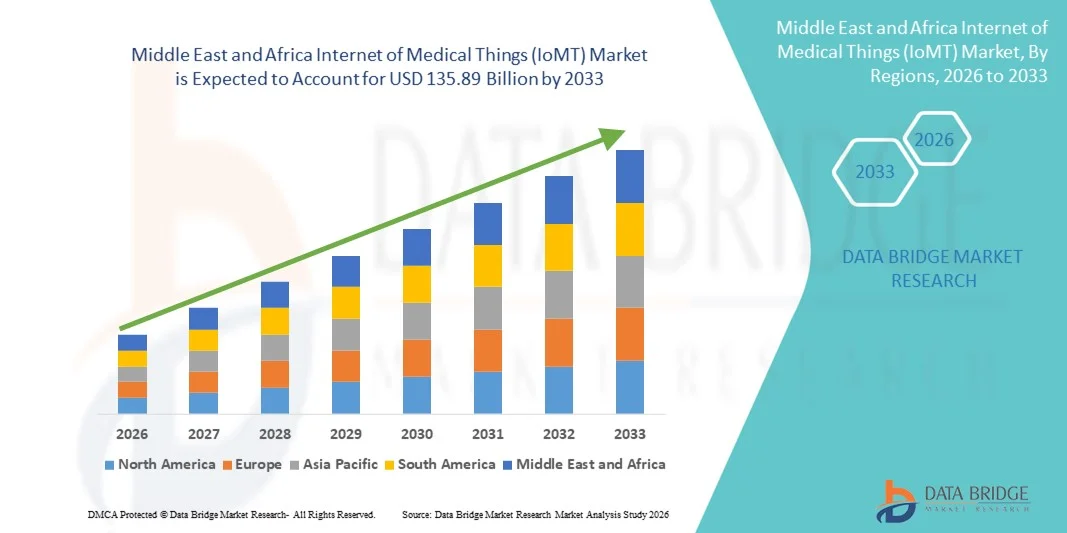
- The Middle East and Africa Internet of Medical Things (IoMT) market size was valued at USD 27.33 billion in 2025 and is expected to reach USD 135.89 billion by 2033, at a CAGR of 22.2% during the forecast period
- The market growth is primarily driven by increasing adoption of connected medical devices, telemedicine, and remote patient monitoring solutions, coupled with the region’s gradual digital transformation in healthcare infrastructure
- Moreover, rising demand for real-time patient data, enhanced operational efficiency, and improved healthcare outcomes is positioning IoMT solutions as critical components in modern healthcare systems across both urban and remote areas. These converging trends are accelerating IoMT deployment, thereby significantly boosting the industry’s growth
Middle East and Africa Internet of Medical Things (IoMT) Market Analysis
- Internet of Medical Things (IoMT) market, comprising connected medical devices, remote patient monitoring systems, and telehealth platforms, is becoming increasingly critical in modern healthcare delivery across hospitals, clinics, and homecare settings in MEA countries due to its ability to provide real-time patient data, enhance operational efficiency, and enable proactive patient management
- The rising adoption of the Internet of Medical Things (IoMT) is primarily fueled by increasing demand for digital healthcare solutions, growing awareness of chronic disease management, and government initiatives supporting telemedicine and smart healthcare infrastructure
- Saudi Arabia dominated the Middle East and Africa Internet of Medical Things (IoMT) market with the largest revenue share of 28.5% in 2025, driven by significant investments in smart hospitals, advanced healthcare infrastructure, and integration of device management and cloud-based platforms
- UAE is expected to be the fastest-growing country during the forecast period due to rapid adoption of home-use medical devices, wearable monitoring technologies, and expansion of remote patient monitoring services supported by strong wireless connectivity and favorable healthcare policies
- Hardware segment dominated the Middle East and Africa Internet of Medical Things (IoMT) market with a market share of 41.2% in 2025, driven by strong demand for wearable devices, sensors, and connected diagnostic tools across these countries, forming the backbone of IoMT ecosystems and facilitating seamless integration with software platforms and cloud services
Report Scope and Middle East and Africa Internet of Medical Things (IoMT) Market Segmentation
|
Attributes |
Middle East and Africa Internet of Medical Things (IoMT) Key Market Insights |
|
Segments Covered |
|
|
Countries Covered |
Middle East and Africa
|
|
Key Market Players |
|
|
Market Opportunities |
|
|
Value Added Data Infosets |
In addition to the insights on market scenarios such as market value, growth rate, segmentation, geographical coverage, and major players, the market reports curated by the Data Bridge Market Research also include in-depth expert analysis, patient epidemiology, pipeline analysis, pricing analysis, and regulatory framework |
Middle East and Africa Internet of Medical Things (IoMT) Market Trends
Enhanced Connectivity and AI-Driven Healthcare Solutions
- A significant and accelerating trend in the Middle East and Africa Internet of Medical Things (IoMT) market is the growing integration of AI, cloud platforms, and wireless connectivity, enhancing real-time monitoring, predictive analytics, and patient management across hospitals and homecare
- For instance, wearable glucose monitors and smart blood pressure devices can transmit patient data directly to cloud platforms, allowing healthcare providers to track conditions remotely and intervene proactively
- AI integration in IoMT enables predictive health alerts, personalized treatment recommendations, and automated device management. For instance, AI-enabled remote monitoring systems can detect anomalies in patient vitals and alert doctors or caregivers instantly
- Seamless connectivity across IoMT platforms facilitates centralized management of multiple devices and applications. For instance, hospitals can manage on-body devices, home-use medical devices, and cloud-based analytics dashboards from a single interface
- This trend toward more intelligent, connected, and patient-centric healthcare solutions is reshaping service delivery expectations. For instance, companies such as GE Healthcare and Philips are developing AI-enabled monitoring platforms with cloud integration and remote management capabilities
- The demand for IoMT solutions offering real-time monitoring, AI-driven insights, and seamless device connectivity is growing rapidly across hospitals, clinics, and homecare, as stakeholders prioritize efficiency, patient safety, and proactive healthcare delivery
- Integration with national health data systems is gaining momentum, allowing aggregated analytics for better public health planning. For instance, cloud-based IoMT platforms in Saudi Arabia are connecting multiple hospitals for population-level health monitoring
Middle East and Africa Internet of Medical Things (IoMT) Market Dynamics
Driver
Rising Demand Due to Digital Healthcare Adoption and Chronic Disease Management
- The increasing adoption of digital healthcare solutions, coupled with the rising prevalence of chronic diseases, is a significant driver for the Middle East and Africa Internet of Medical Things (IoMT) market growth
- For instance, in March 2025, the UAE Ministry of Health announced expansion of remote patient monitoring programs for diabetes and cardiovascular care, integrating IoMT devices into national telehealth initiatives
- As hospitals and clinics aim to improve patient outcomes and operational efficiency, IoMT devices enable continuous monitoring, data-driven decision-making, and remote consultations, offering a compelling upgrade over conventional healthcare processes
- Furthermore, the growing popularity of homecare and wearable medical devices is making IoMT an essential component of connected healthcare systems, enabling real-time data sharing and automated alerts
- Remote monitoring, cloud-based analytics, and smartphone-based patient management apps are key factors propelling adoption in hospitals, clinics, and homecare. For instance, wireless on-body devices and home-use medical equipment allow caregivers to track patients efficiently
- Increasing government and private sector investments in smart healthcare infrastructure are fueling IoMT deployment. For instance, Saudi Arabia’s Vision 2030 healthcare initiatives promote nationwide adoption of connected medical devices
- Rising patient awareness about remote monitoring and telemedicine benefits is boosting demand. For instance, more patients in UAE and Egypt are adopting home-use devices to manage chronic conditions and reduce hospital visits
Restraint/Challenge
Cybersecurity Risks and Regulatory Compliance Hurdles
- Concerns regarding data security and compliance with regional healthcare regulations pose a major challenge to the Middle East and Africa Internet of Medical Things (IoMT) market, slowing broader adoption
- For instance, reports of vulnerabilities in connected medical devices have caused some hospitals and homecare providers to hesitate in deploying IoMT solutions
- Addressing cybersecurity risks through encryption, secure authentication, and software updates is essential. For instance, companies such as Philips and Honeywell emphasize HIPAA-compliant data protection and encrypted cloud storage to reassure healthcare providers
- The high cost of advanced IoMT solutions relative to traditional medical devices can also limit adoption in budget-constrained hospitals or smaller clinics. For instance, premium remote monitoring kits and AI-enabled devices are priced higher than standard monitoring equipment
- Overcoming these challenges through stronger cybersecurity measures, regulatory compliance adherence, and cost-effective device options will be critical for sustained growth of the Middle East and Africa Internet of Medical Things (IoMT) market
- Fragmented regulatory standards across MEA countries can complicate market expansion. For instance, differing telehealth and data privacy laws in UAE, Egypt, and South Africa require device manufacturers to customize solutions for each country
- Limited technical expertise and training among healthcare staff can hinder optimal IoMT utilization. For instance, some clinics in Morocco and sub-Saharan Africa struggle to integrate connected devices due to lack of skilled IT and biomedical personnel
Middle East and Africa Internet of Medical Things (IoMT) Market Scope
The market is segmented on the basis of component, platform, mode of service delivery, connectivity devices, application, and end-user.
- By Component
On the basis of component, the Middle East and Africa Internet of Medical Things (IoMT) market is segmented into hardware, software, and services. The hardware segment dominated the market with the largest market revenue share of 41.2% in 2025, driven by the high demand for wearable devices, sensors, and connected diagnostic tools. Hospitals and clinics prioritize hardware investments for patient monitoring, telehealth, and chronic disease management. The market growth is also supported by the increasing deployment of home-use devices, such as smart glucose monitors and blood pressure sensors. Hardware devices are critical as they form the backbone of IoMT ecosystems, allowing seamless integration with cloud platforms and AI analytics. Robust hardware solutions are also essential for regulatory compliance and reliable patient data collection. Strong partnerships between device manufacturers and healthcare providers in countries such as Saudi Arabia and UAE further boost this segment.
The software segment is anticipated to witness the fastest growth rate of 22.4% from 2026 to 2033, fueled by increasing adoption of AI-driven analytics, remote patient monitoring platforms, and cloud-based applications. Software enables hospitals and clinics to manage vast amounts of patient data efficiently and supports predictive healthcare insights. Advanced applications allow integration with multiple devices, providing centralized dashboards for healthcare providers. The rising focus on personalized treatment plans and population health management is further driving demand for software solutions. Software solutions also facilitate interoperability between devices from different manufacturers, enhancing the value of the IoMT ecosystem. The growing reliance on telemedicine and homecare monitoring is accelerating the software adoption curve.
- By Platform
On the basis of platform, the market is segmented into device management, application management, and cloud management. The device management segment dominated the market in 2025, with healthcare institutions prioritizing centralized control over connected devices. Hospitals and clinics use device management platforms to monitor device performance, ensure compliance with maintenance schedules, and receive real-time alerts for device malfunctions. Device management platforms improve operational efficiency by reducing downtime and enabling predictive maintenance. In homecare applications, caregivers can remotely track patient devices to ensure accurate usage. Countries such as UAE and Saudi Arabia are investing heavily in device management infrastructure to optimize hospital workflows. Integration with AI and analytics platforms further strengthens the dominance of this segment.
The cloud management segment is expected to witness the fastest growth from 2026 to 2033, driven by the growing trend of storing, analyzing, and sharing patient data via secure cloud infrastructure. Cloud platforms enable seamless interoperability across multiple hospitals and clinics, facilitating telemedicine, remote monitoring, and real-time reporting. Healthcare providers can access patient data anytime, anywhere, improving decision-making and reducing hospital visits. Cloud solutions also offer scalability, allowing small clinics to adopt IoMT without heavy upfront hardware investments. The increasing adoption of AI-based predictive healthcare applications relies on robust cloud infrastructure. Strong government initiatives in GCC countries for cloud-based healthcare services further accelerate this growth.
- By Mode of Service Delivery
On the basis of service delivery, the market is segmented into on-premise and cloud. The on-premise segment dominated the market in 2025, with hospitals and research institutes preferring local deployment for greater data security and compliance with regional health regulations. On-premise solutions enable organizations to maintain full control over sensitive patient information. They are particularly popular among large hospitals that require high-speed data processing for imaging, diagnostics, and monitoring devices. On-premise deployment ensures minimal latency, which is critical for real-time monitoring and emergency interventions. Countries such as Saudi Arabia and Egypt, with strict health data regulations, have fueled demand for on-premise systems. Strong IT infrastructure in urban hospitals also supports the deployment of these solutions.
The cloud segment is expected to witness the fastest growth rate from 2026 to 2033, driven by increased adoption of remote patient monitoring, telemedicine services, and home-use devices. Cloud solutions provide scalability and flexibility, allowing hospitals and homecare providers to expand services without additional hardware investments. They also support AI-driven analytics, predictive monitoring, and population health insights. For instance, UAE and South Africa are investing in cloud-based health platforms to facilitate multi-site device integration. The cloud segment benefits from rising internet penetration and government incentives for digital health solutions. Homecare monitoring, in particular, leverages cloud systems for continuous patient tracking and data storage.
- By Connectivity Devices
On the basis of connectivity devices, the market is segmented into wired and wireless. The wireless segment dominated the market with the largest revenue share in 2025, as hospitals and homecare providers increasingly prefer Wi-Fi and Bluetooth-enabled devices for real-time patient monitoring. Wireless devices allow flexible placement, easy installation, and remote monitoring without extensive cabling. The rising adoption of wearables and home-use devices fuels demand for wireless connectivity. Wireless IoMT devices are also compatible with mobile applications and cloud platforms, enhancing usability and patient engagement. Countries such as UAE and Saudi Arabia are early adopters of wireless-enabled hospital infrastructure. Wireless devices reduce maintenance costs and improve patient mobility. Integration with AI and predictive analytics further strengthens this segment’s market position.
The wired segment is expected to witness the fastest growth rate from 2026 to 2033, driven by hospitals that require highly secure, stable, and uninterrupted data transmission for critical monitoring systems. Wired connections are particularly used in intensive care units (ICUs), operating rooms, and research facilities where latency and reliability are crucial. Hospitals in Egypt and South Africa are increasingly upgrading their wired device networks for high-volume data transmission. Wired connectivity ensures compliance with stringent healthcare regulations and reduces cybersecurity risks. For instance, wired patient monitoring devices maintain consistent data flow for real-time clinical decision-making. The rising focus on hybrid systems combining wired reliability and wireless flexibility is also boosting wired segment adoption.
- By Application
On the basis of application, the market is segmented into on-body devices, healthcare providers, home-use medical devices, community, and others. The healthcare providers segment dominated the market in 2025, driven by hospitals and clinics adopting IoMT for remote patient monitoring, chronic disease management, and telemedicine. Hospitals rely on connected devices, cloud platforms, and device management systems to streamline operations and improve patient outcomes. Providers also benefit from integrated analytics and AI-powered decision support tools. Countries such as Saudi Arabia and UAE are leading in hospital-based IoMT deployment due to government investments. Healthcare providers also use IoMT platforms for research and training purposes. Strong focus on operational efficiency, reduced hospital stays, and proactive patient management supports dominance of this segment.
The home-use medical devices segment is expected to witness the fastest growth from 2026 to 2033, fueled by increasing patient awareness and adoption of wearable monitors, smart inhalers, and connected glucose meters. Home-use devices enable chronic disease patients to self-manage conditions while transmitting data to healthcare providers. Countries such as UAE, Egypt, and South Africa are promoting homecare monitoring programs to reduce hospital visits. IoMT home devices are increasingly integrated with cloud platforms and smartphone apps for real-time feedback. Telemedicine services are further accelerating adoption, especially in remote areas. Consumer preference for convenience and preventive healthcare drives rapid growth in this segment.
- By End-User
On the basis of end-user, the market is segmented into hospitals, clinics, research institutes & academics, homecare, and others. The hospitals segment dominated the market in 2025 with the largest revenue share, as large medical centers invest heavily in IoMT infrastructure for patient monitoring, diagnostics, and telehealth services. Hospitals leverage device management platforms, cloud systems, and software solutions to improve operational efficiency and patient outcomes. Countries such as Saudi Arabia and UAE are leading in hospital-based deployments, with strong government support and high healthcare budgets. Hospitals benefit from integration with AI-driven analytics for predictive care and early diagnosis. Critical care units and surgical centers use IoMT devices extensively for real-time monitoring. The need for compliance with health regulations and seamless integration of multi-device networks further supports hospital dominance.
The homecare segment is expected to witness the fastest growth rate from 2026 to 2033, driven by rising chronic disease prevalence, adoption of wearable devices, and demand for remote patient monitoring. Homecare solutions allow patients to manage conditions such as diabetes, hypertension, and respiratory disorders while minimizing hospital visits. Countries such as UAE, Egypt, and South Africa are promoting homecare initiatives to expand access to healthcare in remote areas. IoMT devices for homecare integrate with mobile apps and cloud platforms, enabling caregivers and healthcare providers to track patient health remotely. Rising patient awareness of self-care benefits accelerates adoption. The convenience, cost-effectiveness, and personalized care potential of homecare devices make this segment a high-growth area.
Middle East and Africa Internet of Medical Things (IoMT) Market Regional Analysis
- Saudi Arabia dominated the Middle East and Africa Internet of Medical Things (IoMT) market with the largest revenue share of 28.5% in 2025, driven by significant investments in smart hospitals, advanced healthcare infrastructure, and integration of device management and cloud-based platforms
- Healthcare providers in the country highly prioritize real-time monitoring, AI-enabled analytics, and seamless integration of IoMT devices with cloud platforms and hospital management systems, enabling improved patient outcomes and operational efficiency
- This widespread adoption is further supported by government initiatives such as Vision 2030, strong healthcare budgets, and increasing digital health awareness, establishing IoMT solutions as a critical component of both hospital and homecare healthcare delivery
The Saudi Arabia Internet of Medical Things (IoMT) Market Insight
The Saudi Arabia Internet of Medical Things (IoMT) market captured the largest revenue share of 28.5% in 2025, fueled by substantial investments in smart hospitals, AI-enabled monitoring systems, and nationwide telehealth initiatives. Healthcare providers are increasingly prioritizing connected devices, cloud management, and remote patient monitoring to enhance operational efficiency and patient outcomes. Government programs such as Vision 2030 and rising awareness of digital health solutions are significantly contributing to market expansion. Moreover, hospitals and clinics are adopting device management platforms to streamline workflows and integrate IoMT devices with hospital information systems. The country’s focus on chronic disease management and homecare solutions further accelerates market growth.
UAE Internet of Medical Things (IoMT) Market Insight
The UAE Internet of Medical Things (IoMT) market is expected to grow at the fastest CAGR during the forecast period, driven by rapid adoption of home-use devices, wearable health monitors, and remote patient monitoring solutions. Consumers and healthcare providers are increasingly leveraging cloud-based analytics and AI platforms for real-time patient data tracking. Strong government support, high disposable incomes, and well-established healthcare infrastructure are encouraging hospitals and homecare providers to implement IoMT solutions. Furthermore, the UAE is witnessing growing integration of IoMT with mobile applications, enabling caregivers and physicians to manage patient health remotely. The country is also actively promoting smart healthcare initiatives in urban and semi-urban areas, expanding market penetration.
Egypt Internet of Medical Things (IoMT) Market Insight
The Egypt Middle East and Africa Internet of Medical Things (IoMT) market is experiencing significant growth due to increasing modernization of hospitals, adoption of on-body devices, and rising telemedicine programs. Healthcare providers are leveraging IoMT for chronic disease management, emergency monitoring, and operational optimization. The government is supporting digital healthcare transformation through infrastructure upgrades and public-private partnerships. Patients are also adopting home-use devices, allowing healthcare providers to monitor health remotely and improve preventive care. Furthermore, the integration of cloud-based platforms and AI-driven analytics is strengthening IoMT adoption in both urban and semi-urban hospitals.
South Africa Internet of Medical Things (IoMT) Market Insight
The South Africa Middle East and Africa Internet of Medical Things (IoMT) market is expanding steadily due to rising investments in connected healthcare infrastructure, homecare devices, and hospital monitoring systems. Hospitals and clinics are integrating device management and cloud solutions to enhance patient monitoring and operational efficiency. Government initiatives promoting telemedicine and digital health adoption are contributing to market growth. The increasing prevalence of chronic diseases and rising awareness of remote healthcare solutions among patients further fuels demand. Integration of AI analytics and real-time alerts allows healthcare providers to make data-driven decisions, improving patient outcomes.
Middle East and Africa Internet of Medical Things (IoMT) Market Share
The Middle East and Africa Internet of Medical Things (IoMT) industry is primarily led by well-established companies, including:
- Medtronic (Ireland)
- GE HealthCare (U.S.)
- Koninklijke Philips N.V. (Netherlands)
- Cisco Systems, Inc. (U.S.)
- IBM Corporation (U.S.)
- Honeywell International Inc. (U.S.)
- Lenovo Group Ltd. (Hong Kong)
- Boston Scientific Corporation (U.S.)
- Siemens Healthineers AG (Germany)
- BIOTRONIK SE & Co. KG (Germany)
- Unison Healthcare Group (Taiwan)
- Cadi Scientific (Singapore)
- imedtac Co., Ltd (Taiwan)
- Meril Life Sciences (India)
- Omron Healthcare Co., Ltd (Japan)
- Terumo Corporation (Japan)
- NIHON KOHDEN CORPORATION (Japan)
- Lepu Medical Technology Co., Ltd (China)
- Accuster Technologies Pvt Ltd (India)
- iHealth Labs, Inc. (U.S.)
What are the Recent Developments in Middle East and Africa Internet of Medical Things (IoMT) Market?
- In October 2025, Saudi Arabia launched the world’s first digital diabetes command and control center, designed to monitor diabetic patients’ health indicators in real time. This digital platform enhances early detection, supports proactive management of diabetes, and marks a significant step toward preventive, data-driven healthcare across the Kingdom. Such initiatives signal expanding adoption of connected medical monitoring and real‑time health analytics in the region
- In September 2025, WHX Tech was announced as a major digital health innovation event in Dubai, set to convene global health tech leaders, startups, and investors. The summit aims to showcase AI diagnostics, telemedicine tools, remote monitoring systems, and next‑generation digital health solutions driving collaboration and adoption of IoMT‑related technologies across the Middle East
- In May 2025, Saudi Arabia hosted the MENA Telehealth and Virtual Care Expo in Riyadh, bringing together health officials and industry leaders to explore digitally enabled healthcare solutions including telemedicine, cloud platforms, and integrated care models. This event highlights the growing regional focus on scalable IoMT‑like healthcare delivery and digital health ecosystems
- In April 2025, Saudi Arabia accelerated AI‑powered telemedicine and virtual care services, reshaping healthcare delivery by linking remote populations with specialists and enabling virtual diagnostics, consultations, and e‑ICU services. Platforms such as Seha Virtual Hospital demonstrate how AI, telemedicine, and IoMT‑style connectivity are transforming chronic care and access in underserved areas
- In March 2025, Saudi Arabia’s Seha Virtual Hospital was officially recognized by Guinness World Records as the world’s largest virtual hospital network, treating patients remotely via video consultations and connected devices. With connections to 224 hospitals and delivery of 44 specialized services, this milestone underscores the role of connected medical technologies in expanding access and reducing healthcare inequities
SKU-
Get online access to the report on the World's First Market Intelligence Cloud
- Interactive Data Analysis Dashboard
- Company Analysis Dashboard for high growth potential opportunities
- Research Analyst Access for customization & queries
- Competitor Analysis with Interactive dashboard
- Latest News, Updates & Trend analysis
- Harness the Power of Benchmark Analysis for Comprehensive Competitor Tracking
Research Methodology
Data collection and base year analysis are done using data collection modules with large sample sizes. The stage includes obtaining market information or related data through various sources and strategies. It includes examining and planning all the data acquired from the past in advance. It likewise envelops the examination of information inconsistencies seen across different information sources. The market data is analysed and estimated using market statistical and coherent models. Also, market share analysis and key trend analysis are the major success factors in the market report. To know more, please request an analyst call or drop down your inquiry.
The key research methodology used by DBMR research team is data triangulation which involves data mining, analysis of the impact of data variables on the market and primary (industry expert) validation. Data models include Vendor Positioning Grid, Market Time Line Analysis, Market Overview and Guide, Company Positioning Grid, Patent Analysis, Pricing Analysis, Company Market Share Analysis, Standards of Measurement, Global versus Regional and Vendor Share Analysis. To know more about the research methodology, drop in an inquiry to speak to our industry experts.
Customization Available
Data Bridge Market Research is a leader in advanced formative research. We take pride in servicing our existing and new customers with data and analysis that match and suits their goal. The report can be customized to include price trend analysis of target brands understanding the market for additional countries (ask for the list of countries), clinical trial results data, literature review, refurbished market and product base analysis. Market analysis of target competitors can be analyzed from technology-based analysis to market portfolio strategies. We can add as many competitors that you require data about in the format and data style you are looking for. Our team of analysts can also provide you data in crude raw excel files pivot tables (Fact book) or can assist you in creating presentations from the data sets available in the report.