


Global Accessing Sensors Market Segmentation, By Technology (CMOS, MEMS, NEMS, and Others), Connectivity (Wired and Wireless), End User (Electronics, IT and Telecom, Industrial, Automotive, Aerospace and Defense, Healthcare, and Others) - Industry Trends and Forecast to 2033
Accessing Sensors Market Size
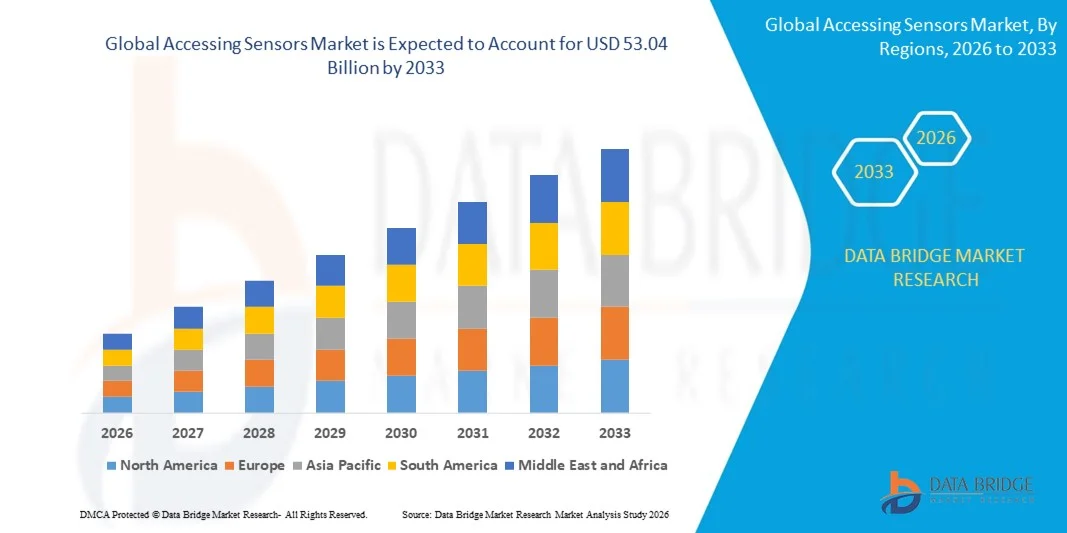
- The global accessing sensors market size was valued at USD 29.96 billion in 2025 and is expected to reach USD 53.04 billion by 2033, at a CAGR of 7.40% during the forecast period
- The market growth is largely driven by the increasing adoption of automation, IoT-enabled systems, and advanced sensing technologies across industrial, automotive, consumer electronics, and smart infrastructure applications, resulting in higher demand for precise and reliable accessing sensors
- Furthermore, the growing need for real-time monitoring, enhanced safety, and seamless interaction between physical and digital systems is positioning accessing sensors as essential components in modern electronic and automated environments. These combined factors are accelerating sensor integration across end-use industries, thereby supporting sustained market expansion
Accessing Sensors Market Analysis
- Accessing sensors, which enable detection, identification, positioning, and interaction within electronic and automated systems, are becoming critical in applications ranging from smart devices and industrial automation to automotive systems and healthcare equipment due to their accuracy, responsiveness, and integration flexibility
- The rising demand for accessing sensors is primarily fueled by rapid digitalization, increasing deployment of smart and connected devices, and growing emphasis on efficiency, safety, and data-driven operations across residential, commercial, and industrial sectors
- Asia-Pacific dominated the accessing sensors market with a share of 45.10% in 2025, due to large-scale electronics manufacturing, rising adoption of IoT-enabled devices, and strong demand from automotive and industrial automation sectors
- North America is expected to be the fastest growing region in the accessing sensors market during the forecast period due to strong demand for advanced sensing solutions in automotive, healthcare, and industrial automation
- MEMS segment dominated the market with a market share of 47.3% in 2025, due to its wide adoption across consumer electronics, automotive systems, and industrial automation due to its compact size, cost efficiency, and high reliability. MEMS-based accessing sensors benefit from mature manufacturing processes and strong integration capabilities with electronic systems, which continue to support large-scale deployment across multiple applications
Report Scope and Accessing Sensors Market Segmentation
|
Attributes |
Accessing Sensors Key Market Insights |
|
Segments Covered |
|
|
Countries Covered |
North America
Europe
Asia-Pacific
Middle East and Africa
South America
|
|
Key Market Players |
|
|
Market Opportunities |
|
|
Value Added Data Infosets |
In addition to the insights on market scenarios such as market value, growth rate, segmentation, geographical coverage, and major players, the market reports curated by the Data Bridge Market Research also include in-depth expert analysis, geographically represented company-wise production and capacity, network layouts of distributors and partners, detailed and updated price trend analysis and deficit analysis of supply chain and demand. |
Accessing Sensors Market Trends
Growing Integration of Accessing Sensors with IoT and Smart Connected Systems
- A prominent trend in the accessing sensors market is the increasing integration of these sensors with IoT platforms and smart connected systems, driven by the need for continuous data collection, real-time responsiveness, and intelligent decision-making across industries. Accessing sensors are becoming core components in connected environments where accurate detection, positioning, and interaction are required to enable automation and digital transformation
- For instance, Infineon Technologies AG supplies advanced sensor solutions that are widely integrated into IoT-enabled industrial and automotive platforms to support real-time monitoring and secure system access. These sensors enhance operational visibility and enable seamless communication between physical assets and digital control systems
- The integration of accessing sensors in smart manufacturing environments is accelerating as factories adopt connected equipment and predictive maintenance frameworks. Sensors embedded within machines support condition monitoring, access validation, and system optimization, strengthening the transition toward Industry 4.0 architectures
- In smart cities and infrastructure projects, accessing sensors are being deployed to support intelligent transportation systems, building automation, and public safety monitoring. Their ability to provide accurate and continuous data supports improved resource management and responsive urban systems
- Consumer electronics manufacturers are increasingly embedding accessing sensors into smart devices to enhance user interaction, security, and functionality. This trend is reinforcing demand for compact, low-power sensors capable of operating reliably within connected ecosystems
- Overall, the growing convergence of accessing sensors with IoT and smart systems is reinforcing their role as foundational technologies for interconnected digital environments, supporting long-term market expansion across diverse application areas
Accessing Sensors Market Dynamics
Driver
Rising Demand for Automation and Real-Time Monitoring Solutions
- The increasing reliance on automation across industrial, automotive, and commercial sectors is a key driver for the accessing sensors market, as these sensors enable accurate detection, access control, and real-time system feedback. Automated environments require continuous sensing to maintain efficiency, safety, and operational reliability
- For instance, Siemens integrates accessing and proximity sensors into its industrial automation and smart factory solutions to support machine monitoring, process control, and secure operational access. These sensor deployments improve productivity and reduce unplanned downtime
- The automotive industry is driving demand through the integration of accessing sensors in advanced driver assistance systems, vehicle access control, and in-cabin monitoring applications. Sensors enable real-time detection and response, supporting safer and more intelligent vehicle operations
- In healthcare and logistics, automation supported by accessing sensors improves workflow efficiency, asset tracking, and system reliability. Real-time monitoring capabilities help organizations optimize operations while maintaining high accuracy and safety standards
- The growing emphasis on operational efficiency, safety compliance, and intelligent systems is reinforcing automation as a long-term driver for the accessing sensors market
Restraint/Challenge
High Integration Complexity and Development Costs
- The accessing sensors market faces challenges related to the complexity of integrating sensors into diverse systems that require high accuracy, reliability, and interoperability. Customization needs, varying system architectures, and compatibility requirements increase development complexity for manufacturers and end users
- For instance, STMicroelectronics invests heavily in R&D to ensure its MEMS and accessing sensors meet stringent performance and integration requirements across automotive, industrial, and consumer electronics applications. These efforts raise development costs and lengthen product validation cycles
- Ensuring seamless communication between accessing sensors, processors, and connectivity modules often requires advanced firmware development and extensive testing. This increases time-to-market and adds financial pressure on sensor developers
- High precision requirements in applications such as automotive safety and industrial automation demand strict quality control and certification processes. These processes further elevate production and integration costs
- Smaller manufacturers and system integrators may face difficulties scaling sensor deployments due to cost constraints and technical complexity. Collectively, these challenges continue to act as a restraint on faster market adoption despite growing demand
Accessing Sensors Market Scope
The market is segmented on the basis of technology, connectivity, and end user.
- By Technology
On the basis of technology, the Accessing Sensors market is segmented into CMOS, MEMS, NEMS, and Others. The MEMS segment dominated the market with the largest share of 47.3% in 2025, driven by its wide adoption across consumer electronics, automotive systems, and industrial automation due to its compact size, cost efficiency, and high reliability. MEMS-based accessing sensors benefit from mature manufacturing processes and strong integration capabilities with electronic systems, which continue to support large-scale deployment across multiple applications.
The NEMS segment is expected to witness the fastest growth from 2026 to 2033, supported by rising demand for ultra-miniaturized sensors with enhanced sensitivity and lower power consumption. Advancements in nanofabrication technologies and growing research investments are accelerating the commercialization of NEMS-based accessing sensors, particularly in high-precision and next-generation electronic applications.
- By Connectivity
On the basis of connectivity, the Accessing Sensors market is segmented into wired and wireless. The wired segment held the largest market revenue share in 2025, attributed to its stable data transmission, lower latency, and higher reliability in industrial and mission-critical environments. Wired accessing sensors are widely preferred in manufacturing plants, aerospace systems, and infrastructure monitoring where consistent performance and secure communication are essential.
The wireless segment is projected to grow at the fastest rate during the forecast period, driven by increasing adoption of IoT-enabled devices and the need for flexible, scalable sensor networks. Wireless accessing sensors reduce installation complexity and support remote monitoring, making them highly suitable for smart facilities, automotive systems, and portable electronic applications.
- By End User
On the basis of end user, the Accessing Sensors market is categorized into electronics, IT and telecom, industrial, automotive, aerospace and defense, healthcare, and others. The electronics segment dominated the market in 2025, supported by the extensive use of accessing sensors in smartphones, wearables, smart home devices, and consumer electronics. High production volumes and continuous innovation in electronic products are sustaining strong demand from this segment.
The automotive segment is anticipated to register the fastest growth from 2026 to 2033, driven by increasing integration of accessing sensors in advanced driver assistance systems, vehicle access control, and electric vehicles. Growing focus on vehicle safety, automation, and connected mobility solutions is significantly accelerating sensor adoption across the automotive industry.
Accessing Sensors Market Regional Analysis
- Asia-Pacific dominated the accessing sensors market with the largest revenue share of 45.10% in 2025, driven by large-scale electronics manufacturing, rising adoption of IoT-enabled devices, and strong demand from automotive and industrial automation sectors
- The region’s cost-efficient manufacturing ecosystem, increasing investments in semiconductor fabrication, and expanding production of consumer electronics are accelerating market growth
- Availability of skilled technical workforce, supportive government initiatives, and rapid industrialization across emerging economies are contributing to higher adoption of accessing sensors across multiple end-use industries
China Accessing Sensors Market Insight
China held the largest share in the Asia-Pacific accessing sensors market in 2025, supported by its dominance in electronics manufacturing and semiconductor assembly. Strong government backing for sensor innovation, large domestic demand for smart devices, and extensive supply chain integration are key growth drivers. The country’s focus on automation and smart manufacturing further strengthens market expansion.
India Accessing Sensors Market Insight
India is witnessing the fastest growth in the Asia-Pacific region, fueled by rapid expansion of electronics manufacturing, rising adoption of industrial automation, and increasing investments in automotive electronics. Government initiatives promoting domestic semiconductor and sensor production are enhancing market opportunities. Growing demand from healthcare and IT infrastructure development is further supporting growth.
Europe Accessing Sensors Market Insight
The Europe accessing sensors market is expanding steadily, driven by strong demand from automotive, aerospace, and industrial sectors. The region’s emphasis on precision engineering, regulatory compliance, and advanced manufacturing technologies supports consistent adoption. Increasing integration of sensors in smart factories and connected systems is further driving market growth.
Germany Accessing Sensors Market Insight
Germany’s market is driven by its leadership in industrial automation, automotive engineering, and advanced manufacturing technologies. Strong R&D capabilities and close collaboration between sensor manufacturers and OEMs are fostering innovation. High demand for accessing sensors in Industry 4.0 applications continues to support market growth.
U.K. Accessing Sensors Market Insight
The U.K. market benefits from growing adoption of smart infrastructure, expanding electronics design capabilities, and rising demand from healthcare and aerospace sectors. Increased focus on digital transformation and sensor-based monitoring systems is supporting market development. Academic–industry collaboration is further strengthening innovation in sensor technologies.
North America Accessing Sensors Market Insight
North America is projected to grow at the fastest CAGR from 2026 to 2033, driven by strong demand for advanced sensing solutions in automotive, healthcare, and industrial automation. High investments in R&D, early adoption of IoT technologies, and rapid integration of smart systems are key growth factors. The region’s focus on high-performance and precision sensors is accelerating market expansion.
U.S. Accessing Sensors Market Insight
The U.S. accounted for the largest share in the North America accessing sensors market in 2025, supported by its advanced semiconductor industry and strong presence of technology innovators. High demand from aerospace, defense, healthcare, and industrial sectors is driving adoption. Continuous investments in sensor miniaturization and smart system integration further reinforce the country’s leading position.
Accessing Sensors Market Share
The accessing sensors industry is primarily led by well-established companies, including:
- ABB Ltd. (Switzerland)
- Analog Devices, Inc. (U.S.)
- Eaton Corporation plc (Ireland)
- Honeywell International Inc. (U.S.)
- Infineon Technologies AG (Germany)
- NXP Semiconductors N.V. (Netherlands)
- Renesas Electronics Corporation (Japan)
- Siemens AG (Germany)
- STMicroelectronics N.V. (Switzerland)
- Texas Instruments Incorporated (U.S.)
- Robert Bosch GmbH (Germany)
- SENSINOVATE Connectivity (France)
- TDK Corporation (Japan)
- Qualcomm Technologies, Inc. (U.S.)
- First Sensor AG (Germany)
- Microchip Technology Inc. (U.S.)
- Johnson & Johnson Services, Inc. (U.S.)
- Sony Corporation (Japan)
- DENSO CORPORATION (Japan)
- BorgWarner Inc. (U.S.)
- SAMSUNG (South Korea)
Latest Developments in Global Accessing Sensors Market
- In January 2026, Aeva Technologies introduced its Omni 4D LiDAR sensor engineered for wide-field, short-range perception across robotics, smart infrastructure, and automated mobility platforms. This launch expands the scope of accessing and perception sensors beyond traditional automotive use, enabling more precise object detection and motion tracking in dense environments. The development supports broader deployment of high-accuracy sensing solutions in next-generation automation and intelligent access systems
- In December 2025, Aeva Technologies unveiled its next-generation Atlas Ultra 4D LiDAR sensor alongside a windshield-integrated automotive demonstration. This advancement signals a shift toward deeper sensor integration within vehicle architectures, reducing system complexity while improving real-time perception accuracy. Such integration is accelerating adoption of accessing sensors in automotive safety, autonomous driving features, and vehicle access control systems
- In July 2025, STMicroelectronics announced the acquisition of NXP Semiconductors’ MEMS sensors business, significantly strengthening its MEMS technology portfolio. The acquisition enhances production scale, broadens application coverage, and improves supply reliability for accessing sensors. This move positions STMicroelectronics to better serve growing demand from automotive, industrial automation, and consumer electronics markets
- In July 2025, LG Innotek entered a strategic partnership and investment agreement with Aeva Technologies to support large-scale manufacturing of advanced 4D LiDAR sensors. The collaboration improves manufacturing scalability and cost efficiency, accelerating commercialization of high-precision accessing sensors. This development strengthens supply chains for automotive, robotics, and industrial automation applications requiring advanced sensing performance
- In January 2025, Infineon Technologies established its Sensor Units and Radio Frequency business division to unify sensor and RF technology development. This organizational restructuring accelerates innovation, shortens product development cycles, and improves integration of accessing sensors with connectivity solutions. The move enhances Infineon’s competitiveness in IoT, mobility, and industrial sensing markets by aligning advanced sensing with communication capabilities
SKU-
Erhalten Sie Online-Zugriff auf den Bericht zur weltweit ersten Market Intelligence Cloud

- Interaktives Datenanalyse-Dashboard
- Unternehmensanalyse-Dashboard für Chancen mit hohem Wachstumspotenzial
- Zugriff für Research-Analysten für Anpassungen und Abfragen
- Konkurrenzanalyse mit interaktivem Dashboard
- Aktuelle Nachrichten, Updates und Trendanalyse
- Nutzen Sie die Leistungsfähigkeit der Benchmark-Analyse für eine umfassende Konkurrenzverfolgung
Forschungsmethodik
Die Datenerfassung und Basisjahresanalyse werden mithilfe von Datenerfassungsmodulen mit großen Stichprobengrößen durchgeführt. Die Phase umfasst das Erhalten von Marktinformationen oder verwandten Daten aus verschiedenen Quellen und Strategien. Sie umfasst die Prüfung und Planung aller aus der Vergangenheit im Voraus erfassten Daten. Sie umfasst auch die Prüfung von Informationsinkonsistenzen, die in verschiedenen Informationsquellen auftreten. Die Marktdaten werden mithilfe von marktstatistischen und kohärenten Modellen analysiert und geschätzt. Darüber hinaus sind Marktanteilsanalyse und Schlüsseltrendanalyse die wichtigsten Erfolgsfaktoren im Marktbericht. Um mehr zu erfahren, fordern Sie bitte einen Analystenanruf an oder geben Sie Ihre Anfrage ein.
Die wichtigste Forschungsmethodik, die vom DBMR-Forschungsteam verwendet wird, ist die Datentriangulation, die Data Mining, die Analyse der Auswirkungen von Datenvariablen auf den Markt und die primäre (Branchenexperten-)Validierung umfasst. Zu den Datenmodellen gehören ein Lieferantenpositionierungsraster, eine Marktzeitlinienanalyse, ein Marktüberblick und -leitfaden, ein Firmenpositionierungsraster, eine Patentanalyse, eine Preisanalyse, eine Firmenmarktanteilsanalyse, Messstandards, eine globale versus eine regionale und Lieferantenanteilsanalyse. Um mehr über die Forschungsmethodik zu erfahren, senden Sie eine Anfrage an unsere Branchenexperten.
Anpassung möglich
Data Bridge Market Research ist ein führendes Unternehmen in der fortgeschrittenen formativen Forschung. Wir sind stolz darauf, unseren bestehenden und neuen Kunden Daten und Analysen zu bieten, die zu ihren Zielen passen. Der Bericht kann angepasst werden, um Preistrendanalysen von Zielmarken, Marktverständnis für zusätzliche Länder (fordern Sie die Länderliste an), Daten zu klinischen Studienergebnissen, Literaturübersicht, Analysen des Marktes für aufgearbeitete Produkte und Produktbasis einzuschließen. Marktanalysen von Zielkonkurrenten können von technologiebasierten Analysen bis hin zu Marktportfoliostrategien analysiert werden. Wir können so viele Wettbewerber hinzufügen, wie Sie Daten in dem von Ihnen gewünschten Format und Datenstil benötigen. Unser Analystenteam kann Ihnen auch Daten in groben Excel-Rohdateien und Pivot-Tabellen (Fact Book) bereitstellen oder Sie bei der Erstellung von Präsentationen aus den im Bericht verfügbaren Datensätzen unterstützen.











