



Global Agriculture Drone Market Segmentation, By Type (Fixed-Wing Drones, Multi-Rotor Drones, and Hybrid Drones), Product (Software and Hardware), Battery Life ( 100 Minutes), Components (Flight Controllers, Propulsion Systems, Camera System, Batteries, and Global Positioning System), Mode of Operation (Fully-Autonomous, Semi-Autonomous, and Remotely Operated), Range (Extended Visual Line of Sight, Beyond Line of Sight, and Visual Line of Sight), Technology (GNSS, Obstacle Detection and Collision Avoidance Technology, Drone Analytics, and Others), Application (Spraying, Field Mapping, Scouting, Soil and Field Analysis, Crop Monitoring, Health Assessment, Irrigation, Crop Spraying, Aerial Planting, Precision Agriculture, Livestock Monitoring, Agricultural Photography, Precision Fish Farming, and Others) - Industry Trends and Forecast to 2033
Was ist die Landwirtschaft Drone Markt Größe und Wachstum Rate
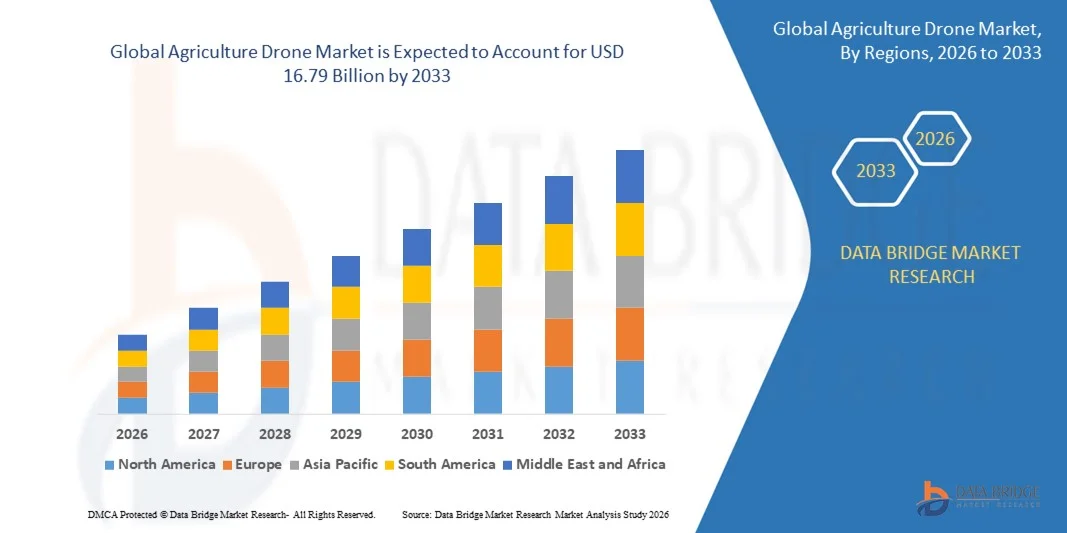
- Wie pro Data Bridge Market Research Analysis wurde die globale Landwirtschaft Drohnenmarktgröße geschätzt3,88 Milliarden USD in 2025und wird voraussichtlich erreichen16,79 Mrd. USD bis 2033, beiCAGR von 20.10%während des Prognosezeitraums
- Das Marktwachstum wird größtenteils durch die zunehmende Annahme von Präzisions-Landwirtschaftspraktiken und die rasche Integration fortschrittlicher Technologien wie KI, GNSS und Datenanalysen in landwirtschaftliche Betriebe gefördert, was zu einer verstärkten Digitalisierung über landwirtschaftliche Aktivitäten führt
- Darüber hinaus stellt die steigende Nachfrage nach höheren Ernteerträgen, einer effizienten Pestizide-Anwendung und einer Senkung der Arbeitskosten die Landwirtschaft Drohnen als wesentliche Werkzeuge für das moderne Betriebsmanagement dar. Diese konvergierenden Faktoren beschleunigen den Einsatz von Drohnen-basierten Lösungen, wodurch das Gesamtwachstum des landwirtschaftlichen Drohnenmarktes deutlich gesteigert wird.
Marktgröße und Prognose
- Globaler Marktwert (2025):USD 3.88 Milliarden
- Voraussichtlicher Marktwert (2033):USD 16.79 Milliarden
- Wettervorhersage CAGR (2026–2033): 20.10%
Was sind die großen Takeaways der Landwirtschaft Drone Markt
- Landwirtschaftsdrohnen, ausgestattet mit fortschrittlichen bildgebenden Sensoren, Spritzsystemen und Echtzeit-Datenübertragungsfunktionen, werden durch ihre Fähigkeit, die Betriebseffizienz zu verbessern, die Gesundheit der Pflanzen zu überwachen und die Ressourcenauslastung zu optimieren, zu kritischen Bestandteilen von intelligenten landwirtschaftlichen Ökosystemen in kleinen, mittleren und großen landwirtschaftlichen Betrieben.
- Die eskalierende Nachfrage nach landwirtschaftlichen Drohnen wird in erster Linie durch die zunehmende globale Lebensmittelnachfrage, die schrumpfende Ackerlandwirtschaft, steigende Arbeitsknappheit in ländlichen Gebieten und den zunehmenden Wandel in Richtung datengetriebener und automatisierter Landwirtschaftspraktiken zur Verbesserung der Produktivität und Nachhaltigkeit getrieben
- Nordamerika dominierte den Agrardrohnenmarkt mit einem Anteil34% im Jahr 2025, durch die rasche Einführung von Präzisions-Agrartechnologien und starke Präsenz fortschrittlicher landwirtschaftlicher Infrastruktur
- Asia-Pacific wird voraussichtlich die am schnellsten wachsende Region in der Landwirtschaft Drohnenmarkt während der Prognosezeit durch schnelle Urbanisierung, Erweiterung der landwirtschaftlichen Aktivitäten und zunehmende Regierungsinitiativen zur Unterstützung der digitalen Landwirtschaft in Ländern wie China, Japan und Indien sein.
- Das Segment Multi-Rotor Drohnen dominierte den Markt mit einem Marktanteil von 62,9% im Jahr 2025, aufgrund ihrer überlegenen Manövrierfähigkeit, vertikalen Start- und Landefähigkeit und Eignung für kleine bis mittlere Betriebe. Landwirte bevorzugen Multi-Rotor Drohnen für Präzisionsspritzen, Ernteüberwachung und Feldscouting aufgrund ihrer Fähigkeit, stetig über bestimmte Bereiche zu schweben
Bericht Umfang und Landwirtschaft Drone Marktsegmentierung
|
Attribute |
Landwirtschaft Drohne Schlüsselmarkt Einblicke |
|
Verdeckte Segmente |
|
|
Überarbeitete Länder |
Nordamerika
Europa
Asien-Pazifik
Naher Osten und Afrika
Südamerika
|
|
Key Market Players |
|
|
Marktmöglichkeiten |
|
|
Daten Infos zum Wert hinzugefügt |
Neben den Markteinblicken wie Marktwert, Wachstumsrate, Marktsegmente, geographischer Erfassung, Marktteilnehmer und Marktszenario umfasst der vom Data Bridge Market Research Team kuratierte Marktbericht eine tiefgreifende Expertenanalyse, Import/Export-Analyse, Preisanalyse, Produktionsverbrauchsanalyse und pestle-Analyse. |
Was ist der Haupttrend im Agrar-Drohne-Markt
Rising Adoption von AI-fähigen Präzisions-Landwirtschaft Drohnen
- Ein wesentlicher Trend im Agrardrohnenmarkt ist der zunehmende Einsatz von AI-fähigen Drohnen, die mit multispektralen Sensoren und fortschrittlichen Analysen ausgestattet sind, um die Erntegutüberwachung und die Entscheidungsfindung zu verbessern. Diese Integration verstärkt die Rolle von Drohnen als wesentliche Werkzeuge in präzisen Landwirtschaftssystemen, die darauf abzielen, den Ertrag zu maximieren und die Ressourcenauslastung zu optimieren.
- Zum Beispiel hat DJI fortgeschrittene landwirtschaftliche Drohnen wie die Agras-Serie mit intelligenter Flugplanung und Echtzeit-Datenanalyse integriert, um die Sprühgenauigkeit und die Betriebseffizienz zu verbessern. Diese Systeme ermöglichen es den Landwirten, große Sprühaufgaben zu automatisieren und gleichzeitig die chemische Verschwendung zu minimieren und die Deckungskonsistenz zu verbessern
- Die Annahme von AI-gestützten Bildgebungslösungen wächst, da die Landwirte zunehmend auf Vegetationsindizes und prognostizierende Analytik angewiesen sind, um Erntestress, Schädlingsbefall und Nährstoffmangel frühzeitig zu erkennen. Dies ist die Positionierung der Landwirtschaft Drohnen als proaktives Betriebsmanagement-Tool anstatt nur Überwachungsausrüstung
- Große Agrarunternehmen enthalten Drohnendaten in integrierte Betriebsmanagement-Plattformen, in denen Lufteinschlüsse die Bewässerungsplanung, Bodenanalyse und Ertragsprognose unterstützen. Diese wachsende Abhängigkeit von datengetriebener Kultivierung verstärkt die Umwandlung konventioneller Landwirtschaft in technologiegestützte Präzisionslandwirtschaft
- Regierungen in wichtigen Agrarwirtschaften fördern digitale Landwirtschaftsinitiativen, die die Drohnenannahme fördern, um Arbeitsknappheit zu bekämpfen und die Produktivität zu verbessern. Diese politische Unterstützung trägt zu einer stärkeren Marktdurchdringung und einem strukturierten Einsatz in gewerblichen Betrieben bei
- Der Markt zeigt eine beschleunigte Innovation in der autonomen Navigation, der Vermeidung von Hindernissen und der Cloud-basierten Analyse, die die Betriebssicherheit und Skalierbarkeit verbessern. Diese zunehmende Integration von KI und Automatisierung verstärkt den breiteren Übergang zu intelligenten, effizienten und nachhaltigen landwirtschaftlichen Ökosystemen
Landwirtschaft Drone Market Dynamics
Fahrer
Steigerung der Nachfrage nach verbesserten Ernteerträgen und betrieblichen Effizienz
- Die zunehmende globale Nachfrage nach einer höheren landwirtschaftlichen Produktivität treibt die Einführung von Drohnen, die in der Lage sind, präzises Sprühen, Erntegutüberwachung und Echtzeit-Feldkartierung zu ermöglichen. Diese Technologien ermöglichen es Landwirten, die Anwendung von Düngemitteln und Pestiziden zu optimieren und manuelle Arbeits- und Betriebsuneffizienzen zu reduzieren.
- So hat Yamaha Motor Co., Ltd. seine RMAX unbemannten Helikoptersysteme für landwirtschaftliches Spritzen in ganz Japan und anderen Ländern eingesetzt, um die Effizienz des großen Erntegutmanagements zu steigern. Diese UAV-Plattformen unterstützen eine einheitliche Anwendung und reduzieren zeitintensive manuelle Prozesse auf umfangreichem Land
- Die Landwirte nutzen zunehmend Drohnen, um die Gesundheit der Pflanzen durch hochauflösende Luftbilder zu überwachen, um Stressfaktoren frühzeitig zu identifizieren und potenzielle Ertragsverluste zu reduzieren. Diese proaktive Fähigkeit trägt direkt zu verbesserten Ernteergebnissen und einer besseren Ressourcenzuweisung bei
- Der steigende Druck, eine wachsende globale Bevölkerung zu ernähren, während die Verwaltung begrenzter landwirtschaftlicher Flächen die Investitionen in die Präzisions-Agrartechnologien fördern. Drohnen bieten skalierbare Lösungen, die helfen, die Produktivität zu maximieren, ohne die Landnutzung erheblich zu erweitern
- Die kontinuierliche Betonung auf Produktivitätssteigerung und Betriebsoptimierung verstärkt diesen Fahrer auf den entwickelten und aufstrebenden Agrarmärkten. Die Notwendigkeit einer effizienten, datengestützten und automatisierten Landwirtschaftspraxis beschleunigt weiterhin die Expansion des Agrarmarktes
Zurückhaltung/Challenge
Hohe anfängliche Investitions- und Regulierungsanforderungen
- Der Agrardrohnenmarkt stellt Herausforderungen im Zusammenhang mit den hohen Kosten im Zusammenhang mit fortgeschrittenen Drohnensystemen, Sensoren und Datenanalyseplattformen. Kleine und mittlere Landwirte treffen oft auf finanzielle Zwänge, die eine große Annahme trotz betrieblicher Vorteile begrenzen
- So erzwingt die Federal Aviation Administration in den USA strenge Betriebs- und Zertifizierungsanforderungen für die Nutzung landwirtschaftlicher Drohnen, was die Compliance-Komplexität für gewerbliche Betriebsinhaber erhöht. Diese Regelungsverfahren können die Einsatzzeitpläne verlängern und Verwaltungslasten für Drohnen-Umsetzungsstrategien hinzufügen
- Die Anforderung an lizenzierte Piloten, die betriebliche Ausbildung und die Einhaltung von Luftraumbeschränkungen erhöht die Betriebskosten und die Zugänglichkeit in bestimmten Regionen weiter. Die Einhaltung der sich entwickelnden Luftfahrtvorschriften bleibt eine kritische Barriere für neue Marktteilnehmer
- Fortgeschrittene, mit KI-Analysen und multispektralen Sensoren ausgerüstete Landwirtschaftsdrohnen beinhalten höhere Beschaffungs- und Wartungskosten, was die Erschwinglichkeit in preissensitiven Märkten beeinträchtigt. Dieser Kostenfaktor begrenzt die weit verbreitete Durchdringung der Kleinbauern in Entwicklungsländern
- Inkonsistente regulatorische Rahmenbedingungen in Ländern schaffen Unsicherheit für Hersteller und Dienstleister, die eine globale Expansion suchen. Diese regulatorischen und finanziellen Herausforderungen bündeln eine schnellere Marktakzeptanz trotz starker technologischer Fortschritte und Produktivitätsvorteile.
Wie wird der Landwirtschafts-Drone-Markt segmentiert
Der Markt wird auf Basis von Typ, Produkt, Akkulaufzeit, Komponenten, Betriebsart, Reichweite, Technologie und Anwendung segmentiert.
- Typ
Der landwirtschaftliche Drohnenmarkt wird auf der Basis des Typs zu festwachsenden Drohnen, Mehrläuferdromen und Hybriddromen segmentiert. Das Segment Multi-Rotor Drohnen dominierte den Markt mit dem größten Umsatzanteil von 62,9% im Jahr 2025, angetrieben durch ihre überlegene Manövrierfähigkeit, vertikale Start- und Landefähigkeit und Eignung für kleine bis mittlere Betriebe. Landwirte bevorzugen häufig Multi-Rotor Drohnen für Präzisionsspritzen, Erntegutüberwachung und Feldscouting aufgrund ihrer Fähigkeit, stetig über bestimmte Bereiche zu schweben. Ihre geringere operative Komplexität und vergleichsweise erschwingliche Preisgestaltung stärken die Adoption von einzelnen Landwirten und Landwirten. Das Segment profitiert weiterhin von laufenden Verbesserungen in der Nutzlastkapazität und der Sensorintegration, die die betriebliche Effizienz steigern.
Das Hybrid-Dronen-Segment wird erwartet, dass die schnellste Wachstumsrate von 2026 bis 2033, die durch den wachsenden Bedarf an längerer Flugdauer kombiniert mit vertikaler Startfähigkeit. Hybrid-Modelle integrieren die Vorteile der festen Ausdauer und Multi-Rotor Flexibilität, so dass sie für Großbetriebe geeignet, die eine umfangreiche Feldabdeckung erfordern. Zunehmende Investitionen in fortschrittliche Agrartechnologien und die Nachfrage nach hocheffizienten Luftplanerlösungen beschleunigen die Annahme. Ihre Fähigkeit, eine große Zunahme mit reduziertem Energieverbrauch zu decken, macht sie zunehmend attraktiv für kommerzielle Landwirtschaftsbetriebe.
- Nach Produkt
Auf Basis des Produkts wird der Agrardrohnenmarkt in Software und Hardware segmentiert. Das Hardware-Segment dominierte den Markt mit dem größten Umsatzanteil im Jahr 2025, angetrieben durch starke Nachfrage nach Drohnenplattformen, Sensoren, Kameras, Antriebssystemen und Batterien. Die zunehmende Einführung hochauflösender Abbildungssysteme und fortschrittlicher Sprühmechanismen trägt maßgeblich zum Hardware-Verkauf bei. Landwirte und Dienstleister investieren stark in langlebige Drohnenstrukturen und Präzisionskomponenten, um die Feldproduktivität zu steigern. Kontinuierliche technologische Weiterentwicklungen in Leichtbaustoffen und verbesserten Batteriesystemen unterstützen die Hardware Dominanz weiter.
Das Software-Segment wird voraussichtlich die schnellste Wachstumsrate von 2026 bis 2033 bezeugen, die durch die zunehmende Abhängigkeit von Datenanalysen, AI-basierten Kulturmonitoring und Cloud-basierten Farm Management-Plattformen angetrieben wird. Fortgeschrittene Softwarelösungen ermöglichen die Echtzeit-Feldkartierung, die Erntegesundheitsbewertung und die Ertragsvorhersage, die die Entscheidungsgenauigkeit verbessert. Die Integration von Drohnenanalysen mit landwirtschaftlichen Managementsystemen verbessert die operative Transparenz und Ressourcenoptimierung. Das zunehmende Bewusstsein für Präzisions-Agrarpraktiken erhöht die Nachfrage nach abonnierten und datengesteuerten Softwareplattformen.
- Durch Batterieleben
Auf der Grundlage der Batterielebensdauer wird der landwirtschaftliche Drohnenmarkt in < 30 Minuten, 30–60 Minuten, 60–100 Minuten und > 100 Minuten segmentiert. Das Segment 30–60 Minuten dominierte den Markt mit dem größten Umsatzanteil im Jahr 2025, der durch seine ausgewogene Kombination aus operativer Ausdauer und Kosteneffizienz getrieben wurde. Die meisten kommerziellen Landwirtschaft Drohnen sind in diesem Flugdauerbereich entwickelt, um Spritz- und Kartierungsaufgaben effizient zu unterstützen. Das Segment erfüllt die Anforderungen der mittelständischen Betriebe unter Beibehaltung des überschaubaren Batteriegewichts und der Ladezeit. Die Hersteller optimieren weiterhin Lithium-basierte Batteriesysteme, um die Zuverlässigkeit in diesem Bereich zu verbessern.
Das > 100-Minuten-Segment soll die schnellste Wachstumsrate von 2026 bis 2033 bezeugen, die durch steigende Nachfrage nach großräumiger Feldüberwachung und erweiterten Mapping-Operationen verursacht wird. Lang anhaltende Drohnen reduzieren den Bedarf an häufigen Batteriewechseln und verbessern die Produktivität in expansiven landwirtschaftlichen Flächen. Technologischer Fortschritt in hochdichten Batteriechemikalien und Hybrid-Power-Lösungen unterstützt die Expansion dieses Segments. Kommerzielle Agrarunternehmen investieren zunehmend in Langstreckendrosseln, um die betriebliche Effizienz zu maximieren.
- Von den Komponenten
Auf Basis von Komponenten wird der Agrardrohnenmarkt in Flugsteuerungen, Antriebssysteme, Kamerasystem, Batterien und globales Positionierungssystem segmentiert. Das Segment Kamerasystem dominierte den Markt mit dem größten Umsatzanteil im Jahr 2025, der durch die zunehmende Nachfrage nach multispektraler und thermischer Bildgebung zur Beurteilung von Pflanzenschutz- und Bodenbedingungen getrieben wurde. Hochauflösende Abbildungssysteme ermöglichen es Landwirten, Schädlingsbefall, Nährstoffmangel und Bewässerungsprobleme frühzeitig zu erkennen. Kontinuierliche Innovation in der Sensorgenauigkeit und der Abbildungsfähigkeit erhöht die Akzeptanz deutlich. Die steigende Bedeutung von datengetriebenen Landwirtschaftspraktiken stärkt die Dominanz von Kamerasystemen weiter.
Das Segment Flugsteuerungen wird voraussichtlich die schnellste Wachstumsrate von 2026 bis 2033 beobachten, die durch Fortschritte in der autonomen Navigations- und Präzisionsflugstabilisierungstechnologien gefördert wird. Moderne Flugsteuerungen integrieren AI-Algorithmen und Echtzeit-Datenverarbeitung, um Routenplanung und Hindernisvermeidung zu verbessern. Die zunehmende Betonung der Automatisierung in der Landwirtschaft erhöht die Nachfrage nach intelligenten Steuerungssystemen. Die verbesserte Kompatibilität mit GNSS- und Analyseplattformen beschleunigt die Segmenterweiterung weiter.
- Nach Betriebsart
Auf der Grundlage der Betriebsweise wird der landwirtschaftliche Drohnenmarkt in voll-autonome, semi-autonome und fernbediente Segmente segmentiert. Das voll-autonome Segment dominierte den Markt mit dem größten Umsatzanteil im Jahr 2025, der durch die zunehmende Einführung automatisierter Flugplanung und minimaler menschlicher Interventionssysteme getrieben wurde. Landwirte bevorzugen voll-autonome Drohnen für konsistente Sprühmuster und effiziente Feldmapping reduzieren Arbeitsabhängigkeit. Die Integration mit AI-getriebener Analytik verbessert die operative Präzision und Produktivität. Die Erweiterung der digitalen Transformation in der Landwirtschaft unterstützt die Segmentführung.
Das halbautonome Segment wird von 2026 bis 2033 mit der schnellsten Wachstumsrate bezeugt, die durch die Notwendigkeit einer flexiblen Steuerung in Verbindung mit der Automatisierung bedingt ist. Semi-autonome Drohnen ermöglichen es den Betreibern, bei Bedarf zu intervenieren und dabei von automatisierten Navigationssystemen zu profitieren. Diese Betriebsbilanz macht sie geeignet für Betriebe, die in Richtung fortgeschrittener Automatisierung übergehen. Die zunehmenden Ausbildungsprogramme und benutzerfreundliche Schnittstellen beschleunigen die Adoption in der Entwicklung landwirtschaftlicher Volkswirtschaften.
- Von Range
Auf Basis der Reichweite wird der landwirtschaftliche Drohnenmarkt in eine erweiterte Sichtlinie, jenseits der Sichtlinie, und visuelle Sichtlinie segmentiert. Die visuelle Sichtlinie dominierte den Markt mit dem größten Umsatzanteil im Jahr 2025, der durch regulatorische Compliance-Anforderungen in mehreren Ländern und einfache Betriebsgenehmigungen getrieben wurde. Die meisten kleinen und mittleren Landwirte betreiben Drohnen im sichtbaren Bereich, um Sicherheit und Kontrolle zu gewährleisten. Geringere technische Komplexität und reduzierte regulatorische Barrieren stärken die Annahme. Das Segment bleibt für lokalisierte Erntegutüberwachungs- und Sprühaktivitäten weit verbreitet.
Das jenseitse Sichtfeld wird erwartet, dass die schnellste Wachstumsrate von 2026 bis 2033, die durch regulatorische Fortschritte und zunehmende Nachfrage nach großräumiger Deckung betrieben wird. BVLOS-Betriebe ermöglichen eine effiziente Überwachung von expansiven landwirtschaftlichen Feldern, die die Betriebszeit reduzieren. Technologische Verbesserungen in Kommunikationssystemen und Kollisionsvermeidung erhöhen Sicherheit und Zuverlässigkeit. Die wachsende kommerzielle Landwirtschaft treibt Investitionen in langjährige Drohnenkapazitäten an.
- Von der Technik
Auf der Grundlage der Technologie wird der Agrardrohnenmarkt in GNSS, Hinderniserkennung und Kollisionsvermeidung Technologie, Drohnenanalyse und andere segmentiert. Das Segment GNSS dominierte den Markt mit dem größten Umsatzanteil im Jahr 2025, der von seiner entscheidenden Rolle bei der Sicherstellung einer genauen Positionierung und Navigation während des Sprüh- und Kartierungsvorgangs angetrieben wurde. Präzisionslandwirtschaft hängt stark von satellitengestützten Leitsystemen ab, um die Eingabeanwendung zu optimieren. Zuverlässige GNSS-Integration verbessert die Flugstabilität und Feldabdeckungsgenauigkeit. Die zunehmende Bereitstellung hochpräziser GPS-Module stärkt die Segmentherrschaft.
Das Segment der Drohnenanalytik wird von 2026 bis 2033 mit der schnellsten Wachstumsrate bezeugt, die durch steigende Nachfrage nach handlungsfähigen landwirtschaftlichen Erkenntnissen aus Luftdaten bedingt ist. Fortgeschrittene Analytik-Plattformen wandeln die Roh-Drohne-Bildung in die pflanzlichen Gesundheitsindizes und Ertragsprognosen um, die das strategische Betriebsmanagement unterstützen. Die Integration mit KI- und maschinellen Lerntechnologien verbessert die Vorhersagefähigkeit. Die Ausweitung der Einführung datenzentrierter Landwirtschaftsmodelle beschleunigt das Wachstum in diesem Segment.
- Anwendung
Auf der Grundlage der Anwendung wird der Agrardrohnenmarkt in Spray, Feld Mapping, Scouting, Boden- und Feldanalyse, Ernteüberwachung, Gesundheitsbewertung, Bewässerung, Pflanzenspritzen, Luftanpflanzung, Präzisionslandwirtschaft, Tierbeobachtung, Agrarfotografie, Präzisionsfischzucht und andere segmentiert. Das Segment Getreidespritzen dominierte den Markt mit dem größten Umsatzanteil im Jahr 2025, der durch den wachsenden Bedarf an effizienter Pestizide und Düngemittelapplikation mit minimaler Verschwendung getrieben wurde. Drohnen ermöglichen eine einheitliche chemische Verteilung, die Arbeitskosten und Umweltauswirkungen reduziert. Der zunehmende Fokus auf Präzisions-Input-Management erhöht die Akzeptanz in diesem Segment deutlich. Kontinuierliche Verbesserungen der Nutzlastsysteme verbessern die betriebliche Wirksamkeit weiter.
Das Segment Präzisionslandwirtschaft wird voraussichtlich die schnellste Wachstumsrate von 2026 bis 2033 beobachten, die durch zunehmende globale Betonung auf nachhaltige Landwirtschaft und Ressourcenoptimierung gefördert wird. Präzisions-Landwirtschaft integriert Drohnen-basierte Analytik, GNSS-Mapping und automatisierte Entscheidungsfindung, um Ertrag zu maximieren und Eingangskosten zu minimieren. Die zunehmende staatliche Unterstützung für intelligente Landwirtschaftstechnologien stärkt die Marktausweitung. Die zunehmende Sensibilisierung der Landwirte im Hinblick auf das datengetriebene Kulturmanagement beschleunigt die Adoption in den entwickelten und Schwellenländern weiter.
Welche Region hält den größten Teil des Landwirtschaftsdrohnenmarktes
- Nordamerika dominierte den Agrardrohnenmarkt mit dem größten Umsatzanteil von 34% im Jahr 2025, angetrieben durch die rasche Einführung von Präzisions-Agrartechnologien und starke Präsenz fortschrittlicher landwirtschaftlicher Infrastruktur
- Landwirte in der Region hochwertig Drohnen-basierte Erntegutüberwachung, Feldkartierung und Sprühlösungen zur Verbesserung der Ertragseffizienz und zur Senkung der Betriebskosten
- Diese weit verbreitete Adoption wird durch günstige regulatorische Rahmenbedingungen, hohes Bewusstsein für intelligente Landwirtschaftspraktiken und starke Investitionen in die Agrar-Tech-Innovation unterstützt, die Landwirtschaft Drohnen als kritischer Bestandteil des modernen landwirtschaftlichen Managements zu etablieren
US-Landwirtschaft Drone Market Insight
Der US-Agrardrohnenmarkt eroberte den größten Umsatzanteil im Jahr 2025 in Nordamerika, der durch die frühzeitige Annahme von Präzisionsbauwerkzeugen und die Erhöhung der landwirtschaftlichen Konsolidierung in großen landwirtschaftlichen Flächen gefördert wurde. Landwirte priorisieren zunehmend das datengesteuerte Erntegutmanagement und automatisierte Sprühsysteme, um die Produktivität zu steigern und den Einsatz zu optimieren. Starke staatliche Unterstützung für intelligente Landwirtschaftsinitiativen, kombiniert mit der Präsenz führender Drohnenhersteller wie DJI und AeroVironment, die auf dem Markt tätig sind, beschleunigt die Expansion der Branche weiter.
Europa Landwirtschaft Drone Markt Insight
Der EU-Agrardrohnenmarkt wird in der gesamten Vorausschätzungsperiode auf einem beträchtlichen CAGR ausbauen, vor allem durch die zunehmende Betonung auf nachhaltige Landwirtschaft und strenge Umweltvorschriften im Hinblick auf den Einsatz von Pestiziden. Die steigende Nachfrage nach Präzisions-Agrarwerkzeugen zur Steigerung der Ernteerträge und zur Minimierung der Umweltauswirkungen fördert die Einführung von Drohnen. Die Region erlebt ein stetiges Wachstum in den Ländern, die in die Transformation der digitalen Landwirtschaft und fortschrittliche Technologien zur Überwachung der landwirtschaftlichen Betriebe investieren.
U.K. Landwirtschaft Drone Markt Insight
Der US-amerikanische Landwirtschaftsdrohnenmarkt wird voraussichtlich während der Prognosezeit mit einem bemerkenswerten CAGR wachsen, der durch die zunehmende Digitalisierung der landwirtschaftlichen Betriebe und die Nachfrage nach effizienten Pflanzenschutzsystemen getrieben wird. Farmer übernehmen Drohnen-basierte Analysen, um die Bodenbewertung und die Überwachung der Pflanzengesundheit zu verbessern. Eine unterstützende Agrarpolitik und ein steigendes Interesse an autonomen landwirtschaftlichen Anlagen dürften weiterhin das Marktwachstum im Land fördern.
Deutschland Landwirtschaft Drone Market Insight
Der deutsche Landwirtschaftsdrohnenmarkt soll sich während der Prognosezeit mit einem beträchtlichen CAGR ausweiten, der durch einen starken Fokus auf technologische Innovation und nachhaltige Agrarpraktiken gefördert wird. Die fortschrittlichen Fertigungsfähigkeiten Deutschlands und die Betonung auf Präzisionstechnik fördern die Integration von Drohnen in das Pflanzenschutz- und Tiermanagement. Die zunehmende Investition in intelligente Landwirtschaftslösungen und digitale Infrastruktur stärkt die Marktentwicklung weiter.
Asien-Pazifik-Landwirtschaft Drone Market Insight
Der asiatisch-pazifische Landbau-Drohne-Markt wird während der Prognosezeit von 2026 bis 2033 am schnellsten CAGR wachsen, angetrieben durch schnelle Urbanisierung, Erweiterung der landwirtschaftlichen Aktivitäten und zunehmende staatliche Initiativen zur Unterstützung der digitalen Landwirtschaft in Ländern wie China, Japan und Indien. Die Steigerung der Lebensmittelnachfrage und der Arbeitsknappheit fördern die Landwirte, automatisierte Luftlösungen für ein effizientes Betriebsmanagement zu übernehmen. Darüber hinaus verbessert die wachsende Rolle der Region als Fertigungsstandort für Drohnenkomponenten die Erreichbarkeit und Zugänglichkeit in Schwellenländern.
Japan Landwirtschaft Drone Markt Insight
Die japanische Landwirtschaftsdrohnenmarkt gewinnt an Dynamik aufgrund von Arbeitsmangel in ländlichen Gebieten und starker Übernahme fortschrittlicher Robotik- und Automatisierungstechnologien. Die japanischen Bauern setzen zunehmend Drohnen für das Erntespritzen und die Präzisionsüberwachung ein, um die Produktivität zu steigern und den manuellen Aufwand zu reduzieren. Die Integration von Drohnensystemen mit intelligenten Landwirtschaftsplattformen und IoT-basierten Farmmanagement-Tools trägt zum Marktwachstum bei.
China Landwirtschaft Drone Markt Insight
Der China-Agrardrohnenmarkt entfiel 2025 auf den größten Marktanteil im asiatisch-pazifischen Raum, der auf eine rasche Modernisierung landwirtschaftlicher Praktiken und eine starke inländische Produktionskapazität zurückzuführen war. Das Land hat einen weit verbreiteten Einsatz von Pflanzenschutzdrohnen in Großbetrieben beobachtet, um die Effizienz zu verbessern und die chemische Verschwendung zu reduzieren. Die Präsenz großer Drohnenhersteller wie DJI und unterstützende Regierungspolitiken zur Förderung der landwirtschaftlichen Mechanisierung sind wichtige Faktoren, die die Markterweiterung in China fördern.
Welche sind die Top-Unternehmen in der Landwirtschaft Drone Markt
Die Landwirtschaftsdrohnenindustrie wird in erster Linie von etablierten Unternehmen geleitet, darunter:
- AeroVironment Inc. (USA)
- AGCO Corporation (USA)
- AgEagle Aerial Systems Inc. (USA)
- Delair (Frankreich)
- DroneDeploy (USA)
- Trimble Inc. (USA)
- Parrot Drone SAS (Frankreich)
- Yamaha Motor Co., Ltd. (Japan)
- OPTiM Corp. (Japan)
- Sentera (USA)
- Insitu Pacific Pty Ltd (Australien)
- ALTI UAS (PTY) LTD (Südafrika)
- sinFly (Schweiz)
- AgEagle Sensor Systems Inc. (USA)
- Pix4D SA (Schweiz)
- DJI (China)
Was sind die neuesten Entwicklungen in der Landwirtschaft Drone Markt
- Im Dezember 2025 führte Jyoti Global Plast die AeroCrop UAS Landwirtschaftsdrohne ein, um Präzision, Betriebssicherheit und Sprüheffizienz für Landwirte in ganz Indien zu verbessern. Dieser Start markiert die strategische Expansion des Unternehmens durch Kunststoff- und FRP-Formgebung in das Segment der unbemannten Luftsysteme, wodurch die häuslichen Fertigungsmöglichkeiten gestärkt werden. Die Entwicklung soll die Einführung von Präzisions-Agrartechnologien in Indien beschleunigen, indem sie Arbeitsknappheit anspricht, die chemische Verschwendung verringert und die Produktivität der Ernte verbessert, wodurch die landwirtschaftlichen Drohnenmarktwachstum insgesamt gefördert werden
- Im Dezember 2025 hat Connecticut, USA, das Gesetz 25-152 erlassen, mit dem der erweiterte Einsatz landwirtschaftlicher Drohnen für Saatgut-, Sprüh- und Erntegutvermessungstätigkeiten ermöglicht wird. Der aktualisierte regulatorische Rahmen optimiert die Compliance-Anforderungen in Übereinstimmung mit den Standards der Federal Aviation Administration und ermöglicht es Farmen, UAV-Technologien effizienter zu integrieren. Diese gesetzgeberische Unterstützung soll die kommerzielle Drohnenentwicklung im gesamten Staat verbessern und Investitionen und Innovationen im regionalen Agrarmarkt fördern
- Im August 2025 hat die Terra Drone Corporation eine Vertriebspartnerschaft mit PT aufgenommen. Yanmar Diesel Indonesia, eine Tochtergesellschaft von Yanmar Co., Ltd., um seine landwirtschaftlichen Drohnen G20 und E16 an Reis- und Feldfrüchtebauern in Indonesien zu verteilen. Diese Zusammenarbeit stärkt Terra Drones Fußabdruck in Südostasien, indem Yanmars etabliertes landwirtschaftliches Vertriebsnetz genutzt wird. Die Partnerschaft soll die Zugänglichkeit der Drohnen zwischen den lokalen Landwirten erweitern, die regionale Adoption vorantreiben und die Marktdurchdringung in den Schwellenländern stärken
- Im April 2024 kündigte DJI die weltweite Einführung der Agrardrohnen Agras T50 und T25 an, die sowohl großräumige als auch kleinfeldwirtschaftliche Betriebe anvisierten. Die T50 bietet eine hocheffiziente Leistung für eine umfangreiche landwirtschaftliche Abdeckung, während die T25 die Portabilität und Betriebsflexibilität betont. Integration mit der SmartFarm-Applikation verbessert das Luftsprühmanagement und datengesteuerte Entscheidungsfindung, die Wettbewerbsposition von DJI und die fortschrittlichen technologischen Standards im globalen Agrardrohnenmarkt
- Im Juli 2023 startete Pix4D SA PIX4Dfields 2.4 mit einem verbesserten Workflow, der darauf abzielt, Anwendungen in der Präzisionslandwirtschaft zu optimieren. Die Einführung von Targeted Operations ermöglicht es Anwendern, kundenspezifische Rezeptkarten effizienter zu erstellen, Ressourcenoptimierung und Ressourcenmanagementgenauigkeit zu verbessern. Diese Innovation verbessert den softwaregetriebenen Wert innerhalb von Drohnenökosystemen, unterstützt die breitere Einführung von datenzentrierten landwirtschaftlichen Lösungen und verstärktes Wachstum im Bereich der Landwirtschaft Drohnenanalytik
SKU-
Erhalten Sie Online-Zugriff auf den Bericht zur weltweit ersten Market Intelligence Cloud

- Interaktives Datenanalyse-Dashboard
- Unternehmensanalyse-Dashboard für Chancen mit hohem Wachstumspotenzial
- Zugriff für Research-Analysten für Anpassungen und Abfragen
- Konkurrenzanalyse mit interaktivem Dashboard
- Aktuelle Nachrichten, Updates und Trendanalyse
- Nutzen Sie die Leistungsfähigkeit der Benchmark-Analyse für eine umfassende Konkurrenzverfolgung
Forschungsmethodik
Die Datenerfassung und Basisjahresanalyse werden mithilfe von Datenerfassungsmodulen mit großen Stichprobengrößen durchgeführt. Die Phase umfasst das Erhalten von Marktinformationen oder verwandten Daten aus verschiedenen Quellen und Strategien. Sie umfasst die Prüfung und Planung aller aus der Vergangenheit im Voraus erfassten Daten. Sie umfasst auch die Prüfung von Informationsinkonsistenzen, die in verschiedenen Informationsquellen auftreten. Die Marktdaten werden mithilfe von marktstatistischen und kohärenten Modellen analysiert und geschätzt. Darüber hinaus sind Marktanteilsanalyse und Schlüsseltrendanalyse die wichtigsten Erfolgsfaktoren im Marktbericht. Um mehr zu erfahren, fordern Sie bitte einen Analystenanruf an oder geben Sie Ihre Anfrage ein.
Die wichtigste Forschungsmethodik, die vom DBMR-Forschungsteam verwendet wird, ist die Datentriangulation, die Data Mining, die Analyse der Auswirkungen von Datenvariablen auf den Markt und die primäre (Branchenexperten-)Validierung umfasst. Zu den Datenmodellen gehören ein Lieferantenpositionierungsraster, eine Marktzeitlinienanalyse, ein Marktüberblick und -leitfaden, ein Firmenpositionierungsraster, eine Patentanalyse, eine Preisanalyse, eine Firmenmarktanteilsanalyse, Messstandards, eine globale versus eine regionale und Lieferantenanteilsanalyse. Um mehr über die Forschungsmethodik zu erfahren, senden Sie eine Anfrage an unsere Branchenexperten.
Anpassung möglich
Data Bridge Market Research ist ein führendes Unternehmen in der fortgeschrittenen formativen Forschung. Wir sind stolz darauf, unseren bestehenden und neuen Kunden Daten und Analysen zu bieten, die zu ihren Zielen passen. Der Bericht kann angepasst werden, um Preistrendanalysen von Zielmarken, Marktverständnis für zusätzliche Länder (fordern Sie die Länderliste an), Daten zu klinischen Studienergebnissen, Literaturübersicht, Analysen des Marktes für aufgearbeitete Produkte und Produktbasis einzuschließen. Marktanalysen von Zielkonkurrenten können von technologiebasierten Analysen bis hin zu Marktportfoliostrategien analysiert werden. Wir können so viele Wettbewerber hinzufügen, wie Sie Daten in dem von Ihnen gewünschten Format und Datenstil benötigen. Unser Analystenteam kann Ihnen auch Daten in groben Excel-Rohdateien und Pivot-Tabellen (Fact Book) bereitstellen oder Sie bei der Erstellung von Präsentationen aus den im Bericht verfügbaren Datensätzen unterstützen.











