


Global Air Transport MRO Market Segmentation, By Aircraft Type (Narrow Body Aircraft, Wide Body Aircraft, Regional Jet, and Turbo Prop), Application (Air frame, Engine, Component, and Line) - Industry Trends and Forecast to 2033
Was ist die Luftverkehr MRO Marktgröße und Übersicht
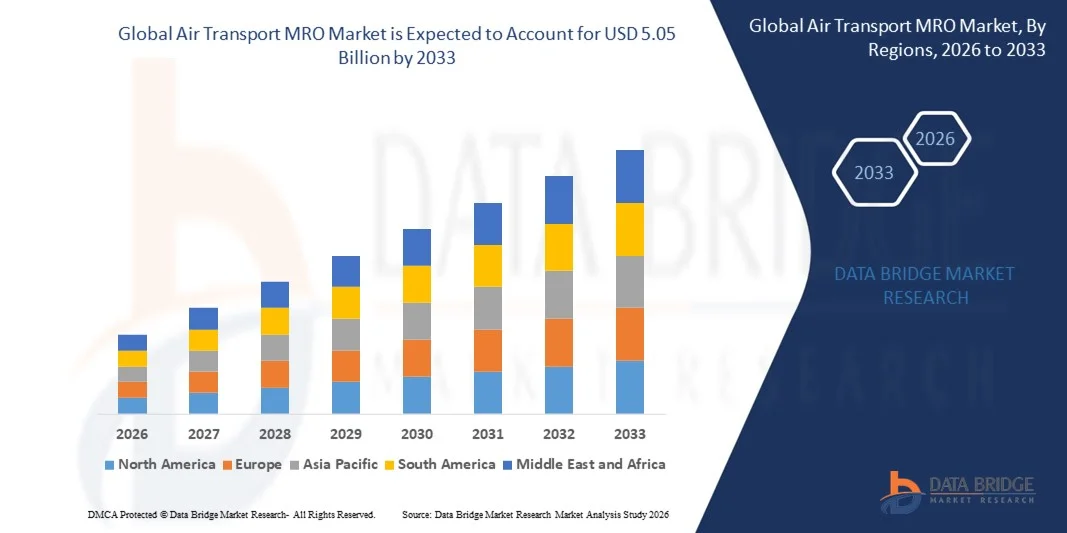
- Wie pro Data Bridge Market Research Analysis Global Air Transport MRO Die Marktgröße wurde bei2,99 Milliarden USD im Jahr 2025und wird voraussichtlich erreichen5,05 Milliarden USD bis 2033, beiCAGR von 6,75%während des Prognosezeitraums
- Das Marktwachstum wird größtenteils durch den kontinuierlichen Ausbau der globalen kommerziellen Flugzeugflotten und den steigenden Fluggastverkehr gefördert, was zu einer erhöhten Nachfrage nach Routinewartung, Motorüberholungen und Komponentenreparaturdiensten über Fluglinienbetreiber führt.
- Darüber hinaus erhöht die zunehmende Induktion von Flugzeugen der nächsten Generation mit fortschrittlichen Motoren und Avioniksystemen die Komplexität der Wartungsanforderungen. Diese konvergierenden Faktoren beschleunigen Investitionen in fortschrittliche diagnostische Technologien undvorausschauende WartungLösungen, wodurch die Expansion des Luftverkehrs MRO-Marktes deutlich gesteigert wird
Marktgröße und Prognose
- Globaler Marktwert (2025):2,99 Mrd. USD
- Voraussichtlicher Marktwert (2033):5,05 Milliarden USD
- Wettervorhersage CAGR (2025–2033):6.75%
Luftverkehr MRO Marktanalyse
- Luftverkehrs-MRO-Dienste, die Luft-, Motor-, Bauteil- und Linienwartung umfassen, sind von entscheidender Bedeutung, um die Sicherheit von Luftfahrzeugen, die Einhaltung der Vorschriften und die operative Zuverlässigkeit von Luftfahrtunternehmen in globalen Luftfahrtnetzen zu gewährleisten.
- Die steigende Nachfrage nach MRO-Diensten wird in erster Linie von alternden Flugzeugflotten, zunehmenden Flugfrequenzen und strengen Lufttüchtigkeitsvorschriften der Luftfahrtbehörden, zwingenden Fluggesellschaften, regelmäßige Inspektionen, schwere Instandhaltungsüberprüfungen und Rettungsmaschinendienst durchzuführen, angetrieben.
- Nordamerika dominierte den Luftverkehr MRO Markt mit einem Anteil von über 40%in 2025, aufgrund der Anwesenheit von großen Fluggesellschaften, umfangreichen kommerziellen Flugzeugflotten und etablierte Wartungsinfrastruktur in der gesamten Region
- Asia-Pacific wird voraussichtlich die am schnellsten wachsende Region im Luftverkehr MRO-Markt während der Prognoseperiode aufgrund eines schnellen Flugverkehrswachstums, der Ausweitung Low-Cost-Carrier-Netzwerke und der zunehmenden Größe der Flugzeugflotte in Schwellenländern sein
- Das Segment Narrow Body Flugzeuge dominierte den Markt mit einem Marktanteil von 47,3% im Jahr 2025, aufgrund des hohen weltweiten Einsatzes von Single-aisle-Flotten für Kurz- und Mittelstrecken. Fluggesellschaften nutzen Flugzeuge wie Airbus A320 und Boeing 737 aufgrund ihrer Kraftstoffeffizienz und Betriebsflexibilität ausgiebig, was zu häufigen Wartungs- und Bauteilersatzprüfungen führt. Die schnellen Turnaround-Zyklen und hohen Flugfrequenzen von schmalen Körperflotten erhöhen die Nachfrage nach Routineinspektionen, Linienwartung und Motorüberholungen weiter
Bericht Umfang und Luftverkehr MRO Marktsegmentierung
|
Attribute |
Luftverkehr MRO Schlüsselmarkt Einblicke |
|
Verdeckte Segmente |
|
|
Überarbeitete Länder |
Nordamerika
Europa
Asien-Pazifik
Naher Osten und Afrika
Südamerika
|
|
Key Market Players |
|
|
Marktmöglichkeiten |
|
|
Daten Infos zum Wert hinzugefügt |
|
Was ist der Haupttrend im Luftverkehr MRO Markt
Erhöhung der Adoption von prädiktiven und digitalen Wartungstechnologien
- Ein wesentlicher Trend im Luftverkehr MRO-Markt ist die zunehmende Übernahme von prädiktiven und digitalen Wartungstechnologien zur Verbesserung der Flugsicherheit und zur Minimierung ungeplanter Ausfallzeiten. Fluggesellschaften und MRO-Anbieter nutzen Datenanalysen, Echtzeit-Überwachungssysteme und digitale Plattformen, um Wartungsplanung und Betriebseffizienz zu verbessern
- So hat Lufthansa Technik über seine AVIATAR-Plattform prädiktive Analyselösungen implementiert, um eine bedingte Wartung und Echtzeit-Flottenüberwachung zu ermöglichen. Diese digitalen Tools helfen Fluggesellschaften, Bauteilausfälle zu antizipieren, Wartungsintervalle zu optimieren und die Verfügbarkeit von Flugzeugen zu reduzieren und die Verfügbarkeit von Flugzeugen zu verbessern
- Die IntegrationSysteme der Gesundheitsüberwachungwird immer breiter, da die Betreiber versuchen, von traditionellen planmäßigen Kontrollen auf datengesteuerte Wartungsstrategien zu überführen. Diese Verschiebung unterstützt eine verbesserte Asset-Nutzung und senkt die Instandhaltungskosten für den Lebenszyklus in kommerziellen Flotten
- MRO-Anbieter übernehmen zunehmendDigitale Zwillingeund fortgeschrittene Diagnosen, um die Flugleistung zu simulieren und potenzielle technische Probleme zu identifizieren, bevor sie eskalieren. Dieser Ansatz verbessert die Planungsgenauigkeit und verstärkt die Zusammenarbeit zwischen Fluggesellschaften, OEMs und unabhängigen Dienstleistern
- Der Einsatz mobiler Wartungsanwendungen und papierloser Dokumentationssysteme verbessert die Workflow-Transparenz und regulatorische Compliance im Hangar-Betrieb. Digitale Datenerfassung ermöglicht schnellere Inspektionen, optimierte Audits und eine bessere Rückverfolgbarkeit der Wartungsgeschichte
- Die weitere Modernisierung der Instandhaltungsinfrastruktur durch digitale Technologien verstärkt operative Widerstandsfähigkeit und Kosteneffizienz in globalen Luftfahrtnetzen. Dieser Übergang zu prädiktiven und vernetzten Wartungsökosystemen ist die Umgestaltung der Service-Liefermodelle und die Stärkung der langfristigen Wettbewerbsfähigkeit im Luftverkehr MRO-Markt
Luftverkehr MRO Marktdynamik
Fahrer
Rising Global Aircraft Fleet Expansion und Fluggastverkehr
- Die stetige Expansion der globalen Nutzfahrzeugflotte in Verbindung mit steigendem Fluggastverkehr ist ein wichtiger Treiber für den MRO-Markt. Steigende Flugzeuglieferungen und höhere Flugfrequenzen verstärken Wartungsanforderungen, um Lufttüchtigkeit und Betriebssicherheit zu gewährleisten
- Zum Beispiel, International Air Transport Association hat ein anhaltendes Wachstum im globalen Passagierverkehr berichtet, die Fluggesellschaften zu erweitern Flotten und maximieren Flugzeugauslastung. Dieses Wachstum erhöht direkt die Nachfrage nach Linienwartung, schweren Kontrollen, Motorüberholungen und Komponentenreparaturdienstleistungen in Regionen
- Aufstrebende Volkswirtschaften sind Zeugen von signifikanten Ergänzungen der Luftfahrtflotte, um die steigenden Anforderungen an die Reisen der mittleren Klasse und den Ausbau der Luftverbindungsnetze zu berücksichtigen. Dieses Flottenwachstum generiert langfristige Dienstleistungsverträge für MRO-Anbieter und verstärkt nachgelagerte Umsatzströme
- Die Einführung von Flugzeugen der nächsten Generation mit fortschrittlichen Motoren und Verbundstrukturen erfordert spezialisierte Wartungskapazitäten und verbesserte technische Infrastruktur. MRO-Anbieter investieren in neue Tools, Schulungen und Zertifizierungen, um diese modernen Plattformen zu unterstützen
- Der kombinierte Effekt der Flottenmodernisierung und des anhaltenden Passagierverkehrswachstums verfestigt die Instandhaltungsdienstleistungen weiterhin als wesentliche Säule des Luftfahrtbetriebs. Diese strukturelle Expansion der globalen Flotte untermauert eine stabile und wiederkehrende Nachfrage im Luftverkehr MRO-Markt
Zurückhaltung/Challenge
Mangel an Fachkräften und Wartungskosten
- Der MRO-Markt im Luftverkehr steht vor Herausforderungen durch einen Mangel an qualifizierten Luftfahrttechnikern und zertifizierten Ingenieuren, die für die Unterstützung komplexer Flugzeugsysteme erforderlich sind. Die Kluft zwischen Arbeitskräftenachfrage und verfügbarem qualifiziertem Personal wirkt sich auf die Servicewendezeiten und die betriebliche Effizienz aus.
- So hat Boeing in seinem Pilot- und Technikerausblick den wachsenden Bedarf an Hunderttausenden neuer Luftfahrttechniker in den kommenden Jahren hervorgehoben. Dieser Mangel an Arbeitskräften verstärkt den Wettbewerb für Fachkräfte und erhöht den Lohndruck in der Industrie
- Moderne Flugzeuge, die mit fortschrittlichen Avionik, Verbundwerkstoffen und digitalen Systemen ausgestattet sind, erfordern höhere technische Expertise und kontinuierliche Schulungsinvestitionen. MRO-Anbieter müssen erhebliche Ressourcen zur Personalaufwertung bereitstellen, um die Einhaltung von Regulierungs- und Sicherheitsstandards zu gewährleisten.
- Steigende Kosten für Ersatzteile, fortschrittliche diagnostische Geräte und regulatorische Compliance erhöhen den finanziellen Druck auf Dienstleister. Diese steigenden operativen Ausgaben können die Gewinnspannen verringern, insbesondere für unabhängige MRO-Organisationen
- Die Kombination von Arbeitskräftemangel und eskalierenden Wartungskosten stellt eine strukturelle Herausforderung für ein anhaltendes Marktwachstum dar. Die Bewältigung von Talententwicklung und Kostenoptimierung ist für eine langfristige Stabilität und Serviceeffizienz im Luftverkehr MRO-Markt von entscheidender Bedeutung.
Luftverkehr MRO Marktbereich
Der Markt wird auf der Grundlage von Flugzeugtyp und Anwendung segmentiert.
- Mit Flugzeugtyp
Auf der Grundlage des Flugzeugtyps wird der Luftverkehr MRO-Markt in schmale Körperflugzeuge, Großkörperflugzeuge, Regionalstrahl und Turbopropos segmentiert. Das Segment Schmalkörperflugzeuge dominierte den Markt mit dem größten Marktanteil von 47,3 % im Jahr 2025, angetrieben durch den hohen globalen Einsatz von Ein-Aisle-Flotten für Kurz- und Mittelstrecken. Fluggesellschaften nutzen Flugzeuge wie Airbus A320 und Boeing 737 aufgrund ihrer Kraftstoffeffizienz und Betriebsflexibilität ausgiebig, was zu häufigen Wartungs- und Bauteilersatzprüfungen führt. Die schnellen Turnaround-Zyklen und hohen Flugfrequenzen von schmalen Körperflotten erhöhen die Nachfrage nach Routineinspektionen, Linienwartung und Motorüberholungen weiter. Darüber hinaus stärkt der Ausbau der Low-Cost-Träger in Schwellenländern die Wartungsvolumina für dieses Segment, was seine führende Position im Air Transport MRO-Markt verstärkt.
Das regionale Jet-Segment wird erwartet, dass die schnellste Wachstumsrate von 2026 bis 2033, die durch die zunehmende Erweiterung der regionalen Vernetzung und Punkt-zu-Punkt-Reise-Netzwerke gefördert wird. Flugzeuge wie der Embraer E-Jet und der Mitsubishi SpaceJet gewinnen an Traktion zwischen regionalen Fluggesellschaften, die die Flexibilität der Route verbessern und die Belastungsfaktoren der Passagiere optimieren. Die zunehmenden Investitionen in Sekundärflughäfen und Regierungsinitiativen zur Stärkung der regionalen Luftverbindung tragen zu einer höheren Flotteninduktion regionaler Jets bei. Diese Flugzeuge benötigen spezialisierte Wartungsdienste, die auf ihre Betriebsmuster zugeschnitten sind und die beschleunigte Nachfrage nach MRO unterstützen. Der steigende Fokus auf die Flottenmodernisierung und den Austausch von alternden regionalen Flugzeugen unterstützt weiterhin die starken Wachstumsaussichten dieses Segments.
- Anwendung
Auf der Grundlage der Anwendung wird der Luftverkehr MRO-Markt in Luftrahmen, Motor, Bauteil und Linie segmentiert. Das Triebwerkssegment hatte 2025 den größten Marktanteil, der von der hohen Kosten-, technischen Komplexität und kritischen Leistungsrolle von Flugzeugtriebwerken angetrieben wurde. Moderne Motoren wie der CFM LEAP und der Pratt & Whitney PW1000G erfordern fortschrittliche Diagnostik, regelmäßige Leistungsüberwachung und regelmäßige Überholungen, um Kraftstoffeffizienz und Sicherheitsstandards zu erhalten. Die Wartung der Motoren beinhaltet intensive Arbeit, spezialisierte Werkzeuge und strenge regulatorische Compliance, was zu höheren Service-Einnahmen im Vergleich zu anderen Anwendungen führt. Steigende Flugstunden und steigender globaler Personenverkehr erhöhen den Motorverschleiß und die Überholfrequenz weiter und stärken die Dominanz dieses Segments im Air Transport MRO-Markt.
Das Bauteilsegment wird von 2026 bis 2033 am schnellsten CAGR erleben, angetrieben durch die zunehmende Integration fortschrittlicher Avionik, elektronischer Systeme und leichter Verbundteile in modernen Flugzeugen. Fluggesellschaften sind zunehmend Outsourcing-Komponenten-Reparatur- und Überholservices für spezialisierte MRO-Anbieter, um Betriebsausfall- und Lagerkosten zu reduzieren. Die zunehmende Adoption von vorausschauenden Wartungstechnologien ermöglicht eine frühzeitige Erkennung von Bauteilausfällen und erhöht damit die Ersatz- und Reparaturzyklen. Die Ausweitung globaler Ersatzteil-Verteilungsnetze und die Bündelung von Vereinbarungen zwischen Fluggesellschaften unterstützt auch die Nachfrage nach höheren Komponentendiensten. Die kontinuierliche technologische Entwicklung von Flugzeugsystemen wird erwartet, dass die Wartungsanforderungen für Komponenten beschleunigt werden und in diesem Segment ein rasches Wachstum vorantreiben.
Luftverkehr MRO Markt Regionale Analyse
- Nordamerika dominierte den Luftverkehr MRO-Markt mit dem größten Umsatzanteil von über 40% im Jahr 2025, angetrieben durch die Anwesenheit von großen Fluggesellschaften, umfangreichen kommerziellen Flugzeugflotten und etablierte Wartungsinfrastruktur in der gesamten Region
- Die Region profitiert von führenden MRO-Dienstleistern wie AAR Corp. und Delta TechOps, sowie einer starken Regulierungsaufsicht der Federal Aviation Administration sorgen für strenge Wartungsstandards
- Diese Dominanz wird weiter unterstützt durch Hochgeschwindigkeits-Passagierverkehr, kontinuierliche Flottenmodernisierungsprogramme und bedeutende Verteidigungs-Luftfahrtaktivitäten, verstärkt stetige Nachfrage nach Motorüberholungen, Komponentenreparatur und Linienwartungsdienste in der gesamten Region
US Luftverkehr MRO Markt Insight
Der US Air Transport MRO-Markt eroberte den größten Umsatzanteil im Jahr 2025 in Nordamerika, der durch die Anwesenheit von großen Fluggesellschaften wie American Airlines und United Airlines, die große und vielfältige Flotten betrieben. Das Land unterhält eine starke Basis unabhängiger und flugliniengebundener MRO-Anbieter, die von fortschrittlichen technologischen Fähigkeiten und qualifizierten Arbeitskräften unterstützt werden. Inländische und internationale Flugbewegungen, kombiniert mit steigenden Investitionen in Flugzeuge der nächsten Generation, erzeugen weiterhin konsequente Nachfrage nach schweren Wartungs- und Motorendiensten.
Europa Luftverkehr MRO Marktaufsicht
Der Europa Air Transport MRO-Markt wird in der gesamten Vorausschätzungsperiode mit einem beträchtlichen CAGR expandiert, vor allem durch die Präsenz etablierter Luftfahrthersteller und Luftfahrtunternehmen. Führende MRO-Organisationen wie Lufthansa Technik und Air France Industries KLM Engineering & Maintenance stärken das regionale Service-Ökosystem. Die zunehmende Betonung auf die Effizienz der Flotte, die Nachhaltigkeitsinitiativen und die Einhaltung der von der Agentur für Flugsicherheit der Europäischen Union festgelegten Standards sind ermutigende Fluggesellschaften, in fortschrittliche vorausschauende Wartungslösungen zu investieren.
U.K. Luftverkehr MRO Markt Insight
Die U.K. Der MRO-Markt von Air Transport wird voraussichtlich während der Prognosezeit bei einem bemerkenswerten CAGR wachsen, unterstützt durch eine starke Luft- und Raumfahrt-Engineering-Basis und globale Flugverbindungen. Die Präsenz von Triebwerksherstellern wie Rolls-Royce Holdings spielt eine wichtige Rolle bei der Wartung und Überholung von Triebwerken. Die steigenden Flugzeugbewegungen über große Hubs und kontinuierliche Investitionen in die Flughafeninfrastruktur verstärken die Nachfrage nach Linien- und Komponentenwartungsdienstleistungen im Land.
Deutschland Luftverkehr MRO Marktaufsicht
Der deutsche Luftverkehr MRO-Markt wird voraussichtlich während des Prognosezeitraums mit einem beträchtlichen CAGR expandieren, der von seinem robusten Luftfahrtsektor und seiner strategischen Position in Europa betrieben wird. Die Präsenz von großen Branchenteilnehmern wie der MTU Aero Engines verbessert die Wartung von Motoren und technisches Know-how. Starke exportorientierte Fluglinienoperationen und die Zusammenarbeit zwischen Fluggesellschaften und MRO-Anbietern von Drittanbietern unterstützen eine nachhaltige Marktentwicklung in den Bereichen Luft- und Motoren.
Asien-Pazifik-Luftverkehr MRO Markt Einblick
Der asiatisch-pazifische Luftverkehr MRO-Markt ist bereit, während der Prognosezeit von 2026 bis 2033 mit dem schnellsten CAGR zu wachsen, der durch schnelles Flugverkehrswachstum, die Ausweitung der Low-Cost-Trägernetze und die Erhöhung der Flugzeugflottengröße in Schwellenländern angetrieben wird. Regierungen in der gesamten Region investieren in die Luftfahrtinfrastruktur und fördern die Entwicklung der inländischen MRO-Fähigkeiten, um die Abhängigkeit von überseeischen Dienstleistern zu reduzieren. Die steigenden Flugzeuglieferungen von Herstellern und die wachsende regionale Konnektivität erhöhen die Nachfrage nach umfassenden Wartungslösungen deutlich.
Japan Luftverkehr MRO Marktaufsicht
Der Japan Air Transport MRO Markt gewinnt aufgrund der fortschrittlichen Luftfahrttechnologiebasis und der starken Präsenz von Full-Service-Trägern an Dynamik. Fluggesellschaften wie All Nippon Airways investieren in die Flottenmodernisierung und effiziente Instandhaltungsplanung, um die Betriebssicherheit zu erhöhen. Ein zunehmender Fokus auf Sicherheitsstandards, Kraftstoffeffizienz und Lifecycle-Kostenoptimierung ist die stetige Nachfrage nach Motor- und Bauteilwartungsdienstleistungen.
China Luftverkehr MRO Markt Insight
Der China Air Transport MRO-Markt entfiel 2025 auf den größten Marktanteil im asiatisch-pazifischen Raum, der auf eine rasche Flottenerweiterung und eine starke Binnenluftfahrtnachfrage zurückzuführen ist. Das Wachstum von Fluggesellschaften wie China Southern Airlines und das Vorhandensein von staatlich unterstützten MRO-Anbietern wie Ameco Beijing stärken die lokalen Wartungskapazitäten. Die staatliche Unterstützung für die Entwicklung der Luftfahrtinfrastruktur und die zunehmende Induktion von Flugzeugen der neuen Generation sind wichtige Faktoren, die die langfristige Nachfrage der MRO in China fördern.
Welche sind die Top-Unternehmen im Luftverkehr MRO Markt
Die Luftfahrtindustrie MRO wird in erster Linie von etablierten Unternehmen geleitet, darunter:
- AAR Corp. (USA)
- Airbus S.A.S. (Frankreich)
- Delta TechOps (US)
- Hongkong Aircraft Engineering Company Limited (Hong Kong)
- KLM UK Engineering Limited (USA)
- Lufthansa Technik (Deutschland)
- MTU Aero Engines (Deutschland)
- Singapur Technologies Engineering Ltd (Singapur)
- TAP Wartung und Engineering (Portugal)
- United Technologies (USA)
- General Electric (US)
- L3Harris Technologies, Inc. (USA)
- SIA Engineering Company (Singapur)
- Rolls-Royce plc (U.K.)
- Air France Industries KLM Engineering & Maintenance (Frankreich)
Neueste Entwicklungen im Global Air Transport MRO Market
- Im Mai 2024 kündigte Lufthansa Technik die Erweiterung seiner Motor-Wartungskapazität in Asien an, um die steigende Nachfrage nach Schmalkörper- und Großkörperflugzeugmotoren der nächsten Generation anzusprechen. Die Erweiterung umfasst fortschrittliche Werkzeug-, Digital-Diagnose-Systeme und einen zusätzlichen qualifizierten Personaleinsatz, um neue Motorplattformen zu unterstützen. Diese Entwicklung verbessert die Effizienz der Turnarounds, reduziert Wartungs-Backlogs für Airline-Kunden und stärkt den Fußabdruck des Unternehmens in den wachstumsstarken asiatisch-pazifischen Märkten und beschleunigt damit Wettbewerbsintensität und Servicefähigkeit im Luftverkehr MRO-Markt
- Im April 2024 eröffnete ST Engineering einen neuen Luftrahmen-Wartungshangar in Singapur, der für die Handhabung von Großkörper- und Flugzeugmodellen der nächsten Generation konzipiert wurde. Die Anlage erhöht die hohe Wartungskapazität, unterstützt komplexe Strukturreparaturen und integriert digitale Wartungsplanungssysteme zur Verbesserung der Workflow-Effizienz. Diese strategische Expansion verstärkt die Position Singapurs als regionales MRO-Hub, verbessert den Service-Durchsatz für internationale Luftfahrtunternehmen und trägt zur Skalierung globaler Instandhaltungsfunktionen bei
- Im März 2024 hat die C&L Aviation Group zwei Citation Sovereign und zwei Citation XLS-Flugzeuge für die Abrissarbeiten an ihrem Standort Bangor MRO vergeben. Durch die systematische Demontage des Flugzeugs und die Zertifizierung von wiederverwendbaren Bauteilen befasst sich das Unternehmen mit anhaltenden Ersatzteilen und unterstützt schnellere Wartungszyklen für Geschäftsjetbetreiber. Dieser Ansatz verbessert die Verfügbarkeit von kostengünstigen, betriebsfähigen Materialien im Aftermarket, stabilisiert die Störungen der Lieferkette und stärkt die Widerstandsfähigkeit des Komponentenreparatursegments im Luftverkehr MRO-Markt
- Im März 2024 hat AAR Corp. den Erwerb des Product Support Business der Triumph Group abgeschlossen, um sein Reparatur- und Überholportfolio für kritische Flugzeugkomponenten zu erweitern. Die Akquisition erweitert die technischen Fähigkeiten von AAR über Hydraulik-, Avionik- und mechanische Systeme und vertieft gleichzeitig ihre Präsenz in der gewerblichen und Verteidigungsindustrie. Diese strategische Konsolidierung verbessert die Skalenwirtschaft, diversifiziert die Umsatzströme und verstärkt die wettbewerbsfähige Positionierung in der globalen MRO-Landschaft
- Im Februar 2024 investierte GE Aerospace 11 Millionen US-Dollar, um eine Smart Factory in der Flugzeugreparaturanlage Singapurs zu etablieren. Die Initiative integriert Automatisierungs-, Datenanalyse- und fortschrittliche Inspektionstechnologien, um die Prozesse der Motorüberholung zu optimieren und die Präzision zu verbessern. Durch die Verbesserung der Fähigkeiten und digitalen Fähigkeiten der Belegschaft reduziert die Investition Turnaround-Zeiten, verbessert die Service-Verlässlichkeit und stärkt den technologischen Fortschritt im gesamten Motor MRO-Segment und trägt zu langfristigem Marktwachstum bei
SKU-
Erhalten Sie Online-Zugriff auf den Bericht zur weltweit ersten Market Intelligence Cloud

- Interaktives Datenanalyse-Dashboard
- Unternehmensanalyse-Dashboard für Chancen mit hohem Wachstumspotenzial
- Zugriff für Research-Analysten für Anpassungen und Abfragen
- Konkurrenzanalyse mit interaktivem Dashboard
- Aktuelle Nachrichten, Updates und Trendanalyse
- Nutzen Sie die Leistungsfähigkeit der Benchmark-Analyse für eine umfassende Konkurrenzverfolgung
Forschungsmethodik
Die Datenerfassung und Basisjahresanalyse werden mithilfe von Datenerfassungsmodulen mit großen Stichprobengrößen durchgeführt. Die Phase umfasst das Erhalten von Marktinformationen oder verwandten Daten aus verschiedenen Quellen und Strategien. Sie umfasst die Prüfung und Planung aller aus der Vergangenheit im Voraus erfassten Daten. Sie umfasst auch die Prüfung von Informationsinkonsistenzen, die in verschiedenen Informationsquellen auftreten. Die Marktdaten werden mithilfe von marktstatistischen und kohärenten Modellen analysiert und geschätzt. Darüber hinaus sind Marktanteilsanalyse und Schlüsseltrendanalyse die wichtigsten Erfolgsfaktoren im Marktbericht. Um mehr zu erfahren, fordern Sie bitte einen Analystenanruf an oder geben Sie Ihre Anfrage ein.
Die wichtigste Forschungsmethodik, die vom DBMR-Forschungsteam verwendet wird, ist die Datentriangulation, die Data Mining, die Analyse der Auswirkungen von Datenvariablen auf den Markt und die primäre (Branchenexperten-)Validierung umfasst. Zu den Datenmodellen gehören ein Lieferantenpositionierungsraster, eine Marktzeitlinienanalyse, ein Marktüberblick und -leitfaden, ein Firmenpositionierungsraster, eine Patentanalyse, eine Preisanalyse, eine Firmenmarktanteilsanalyse, Messstandards, eine globale versus eine regionale und Lieferantenanteilsanalyse. Um mehr über die Forschungsmethodik zu erfahren, senden Sie eine Anfrage an unsere Branchenexperten.
Anpassung möglich
Data Bridge Market Research ist ein führendes Unternehmen in der fortgeschrittenen formativen Forschung. Wir sind stolz darauf, unseren bestehenden und neuen Kunden Daten und Analysen zu bieten, die zu ihren Zielen passen. Der Bericht kann angepasst werden, um Preistrendanalysen von Zielmarken, Marktverständnis für zusätzliche Länder (fordern Sie die Länderliste an), Daten zu klinischen Studienergebnissen, Literaturübersicht, Analysen des Marktes für aufgearbeitete Produkte und Produktbasis einzuschließen. Marktanalysen von Zielkonkurrenten können von technologiebasierten Analysen bis hin zu Marktportfoliostrategien analysiert werden. Wir können so viele Wettbewerber hinzufügen, wie Sie Daten in dem von Ihnen gewünschten Format und Datenstil benötigen. Unser Analystenteam kann Ihnen auch Daten in groben Excel-Rohdateien und Pivot-Tabellen (Fact Book) bereitstellen oder Sie bei der Erstellung von Präsentationen aus den im Bericht verfügbaren Datensätzen unterstützen.











