



Global Broadband Services Market Segmentation, By Broadband Connection (Fiber Optic, Wireless, Satellite, Cable and Digital Subscriber Line (DSL)), End User (Business, Household and Others)- Industry Trends and Forecast to 2033
Broadband Services Market Size
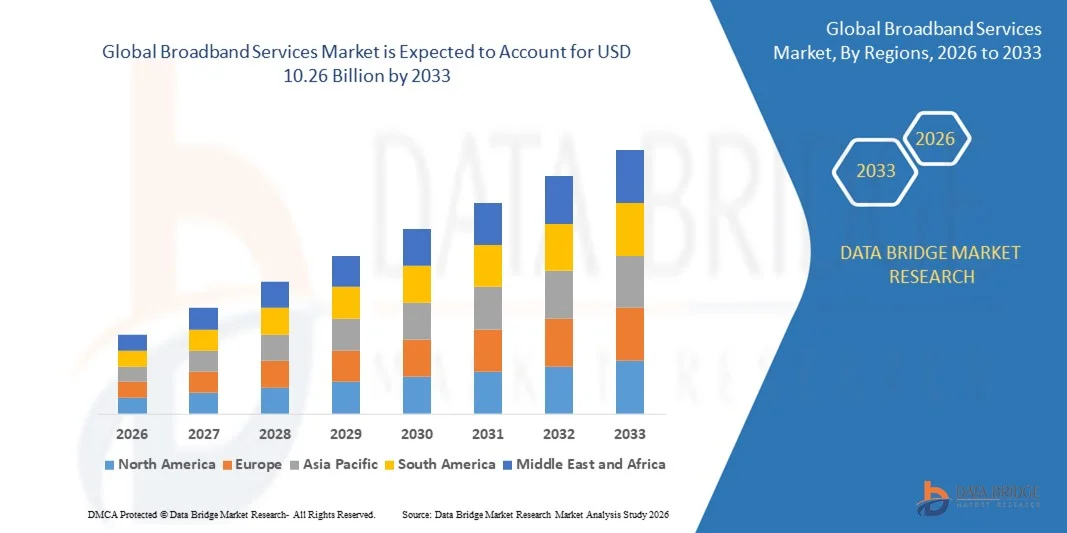
- The global broadband services market size was valued at USD 5.11 billion in 2025 and is expected to reach USD 10.26 billion by 2033, at a CAGR of 9.10% during the forecast period
- The market growth is largely fuelled by the increasing demand for high-speed internet connectivity driven by rising digitalization, remote working trends, and growing adoption of online streaming and cloud-based services
- Rapid expansion of fiber-optic infrastructure and 5G networks is significantly supporting broadband accessibility and improving internet service quality across urban and rural regions
Broadband Services Market Analysis
- Increasing investments in telecommunications infrastructure and government initiatives to expand broadband coverage are driving the overall market development
- Continuous technological advancements in broadband technologies such as fiber broadband, satellite internet, and fixed wireless access are enhancing connectivity speed, reliability, and network efficiency
- North America dominated the broadband services market with the largest revenue share of 38.75% in 2025, driven by increasing demand for high-speed internet, expanding digital infrastructure, and widespread adoption of connected devices across residential and commercial sectors
- Asia-Pacific region is expected to witness the highest growth rate in the global broadband services market, driven by rising demand for high-speed internet, digital transformation across industries, and expanding broadband infrastructure in emerging economies
- The Fiber Optic segment held the largest market revenue share in 2025 driven by its ability to provide ultra-high-speed internet connectivity, greater bandwidth capacity, and improved reliability compared to traditional broadband technologies. Fiber optic broadband services are widely adopted by households and businesses due to their ability to support high data consumption activities such as video streaming, cloud computing, and online gaming
Report Scope and Broadband Services Market Segmentation
|
Attributes |
Broadband Services Key Market Insights |
|
Segments Covered |
|
|
Countries Covered |
North America
Europe
Asia-Pacific
Middle East and Africa
South America
|
|
Key Market Players |
|
|
Market Opportunities |
|
|
Value Added Data Infosets |
In addition to the market insights such as market value, growth rate, market segments, geographical coverage, market players, and market scenario, the market report curated by the Data Bridge Market Research team includes in-depth expert analysis, import/export analysis, pricing analysis, production consumption analysis, and pestle analysis. |
Broadband Services Market Trends
Growing Demand for High-Speed Internet and Digital Connectivity
- The increasing reliance on high-speed internet connectivity is significantly shaping the broadband services market, as consumers and businesses depend heavily on seamless digital communication and data transfer. Broadband services are becoming essential for supporting activities such as video streaming, cloud computing, online gaming, and remote work, driving continuous expansion of broadband networks and infrastructure across developed and emerging economies
- Rapid digital transformation across industries such as healthcare, education, finance, and retail has accelerated the adoption of broadband services. Organizations require reliable internet connectivity to support digital platforms, real-time communication, and cloud-based applications. This shift is also encouraging telecom providers to enhance service quality, bandwidth capacity, and network coverage to meet the increasing demand for stable and high-speed connectivity
- Increasing penetration of smart devices and Internet of Things (IoT) technologies is further contributing to the growth of broadband services. Connected homes, smart cities, and industrial automation rely heavily on stable broadband networks to support data-intensive applications. Service providers are focusing on expanding fiber-optic networks, fixed wireless access solutions, and next-generation broadband technologies to support the growing number of connected devices
- For instance, in 2024, Comcast in the U.S. and BT Group in the U.K. expanded their fiber broadband coverage to reach additional households and businesses. These expansions were introduced to address the rising demand for high-speed internet services and support digital transformation initiatives. The upgraded networks enabled faster data speeds, improved reliability, and enhanced customer experience across residential and commercial sectors
- While demand for broadband services continues to rise, sustained market growth depends on continuous infrastructure investment, efficient spectrum utilization, and technological advancements. Service providers are also focusing on network modernization, improved service reliability, and cost-effective deployment strategies to ensure long-term scalability and accessibility across urban and rural regions
Broadband Services Market Dynamics
Driver
Increasing Adoption of Digital Services and Remote Connectivity
- The rapid growth of digital services such as video streaming, online education, telemedicine, and cloud computing is a major driver for the broadband services market. Consumers and businesses require reliable and high-speed internet connectivity to support data-intensive applications and digital platforms. This demand is encouraging telecom providers to expand broadband infrastructure and improve network performance
- Expanding adoption of remote working models and virtual collaboration tools has significantly increased the need for dependable broadband connectivity. Organizations across various sectors rely on stable internet services to support video conferencing, file sharing, and cloud-based operations. As remote and hybrid work models continue to gain traction, the demand for broadband services is expected to rise steadily
- Governments and regulatory authorities across the world are actively investing in broadband expansion initiatives to bridge the digital divide and improve connectivity in underserved regions. These initiatives include subsidies, infrastructure development programs, and policy support to encourage telecom companies to extend broadband coverage to rural and remote communities
- For instance, in 2023, AT&T in the U.S. and Telefónica in Spain announced major investments in fiber-optic broadband expansion to improve network coverage and internet speeds. These initiatives were aimed at supporting the growing demand for digital services, remote work infrastructure, and cloud-based platforms. The expansion projects also strengthened service reliability and enhanced connectivity for residential and enterprise users
- Although increasing digitalization supports broadband market growth, continued development depends on investments in network infrastructure, spectrum availability, and cost-effective deployment strategies. Strengthening partnerships between telecom operators, governments, and technology providers will be crucial for expanding broadband accessibility and improving service quality globally
Restraint/Challenge
High Infrastructure Costs and Connectivity Gaps in Rural Areas
- High infrastructure deployment costs remain a significant challenge for broadband service providers, particularly in rural and remote regions. Establishing fiber-optic networks, base stations, and related infrastructure requires substantial capital investment. These high costs can limit network expansion and delay broadband accessibility in less economically viable areas
- Connectivity gaps and limited digital infrastructure in developing regions also hinder broadband market growth. Many rural communities lack adequate telecommunications infrastructure, resulting in slower internet speeds and restricted access to broadband services. Addressing these connectivity gaps requires large-scale investments and coordinated efforts from both public and private sectors
- Operational challenges related to network maintenance, spectrum allocation, and regulatory compliance can further impact broadband deployment. Service providers must navigate complex regulatory frameworks, licensing procedures, and infrastructure requirements, which can increase operational costs and extend project timelines
- For instance, in 2024, internet service providers in countries such as Brazil and Indonesia reported slower broadband expansion in remote areas due to high deployment costs and limited infrastructure availability. Telecom operators highlighted challenges in building fiber networks in geographically difficult regions, which affected service reach and broadband adoption rates among rural populations
- Overcoming these challenges will require strategic investments in advanced broadband technologies such as satellite internet, fixed wireless access, and cost-efficient fiber deployment. Governments and telecom providers must collaborate to develop supportive policies, infrastructure funding programs, and innovative connectivity solutions to ensure inclusive and reliable broadband access worldwide
Broadband Services Market Scope
The market is segmented on the basis of broadband connection and end user.
- By Broadband Connection
On the basis of broadband connection, the broadband services market is segmented into Fiber Optic, Wireless, Satellite, Cable and Digital Subscriber Line (DSL). The Fiber Optic segment held the largest market revenue share in 2025 driven by its ability to provide ultra-high-speed internet connectivity, greater bandwidth capacity, and improved reliability compared to traditional broadband technologies. Fiber optic broadband services are widely adopted by households and businesses due to their ability to support high data consumption activities such as video streaming, cloud computing, and online gaming.
The Wireless segment is expected to witness the fastest growth rate from 2026 to 2033, driven by the rapid expansion of 5G networks and increasing demand for flexible internet connectivity solutions. Wireless broadband services offer easier deployment and wider coverage, particularly in remote and rural areas where fiber infrastructure may be limited. These services are increasingly used for residential internet access, mobile connectivity, and enterprise communication solutions.
- By End User
On the basis of end user, the broadband services market is segmented into Business, Household and Others. The Household segment held the largest market revenue share in 2025 driven by the rising demand for high-speed internet for streaming services, online education, gaming, and remote work activities. Increasing adoption of smart home devices and connected entertainment platforms is further strengthening broadband service demand among residential consumers.
The Business segment is expected to witness the fastest growth rate from 2026 to 2033, driven by increasing digital transformation initiatives and the growing reliance on cloud-based applications, data analytics, and enterprise communication platforms. Businesses require reliable broadband connectivity to support daily operations, secure data transfer, and real-time collaboration tools, encouraging organizations to invest in advanced broadband service solutions.
Broadband Services Market Regional Analysis
- North America dominated the broadband services market with the largest revenue share of 38.75% in 2025, driven by increasing demand for high-speed internet, expanding digital infrastructure, and widespread adoption of connected devices across residential and commercial sectors
- Consumers and businesses in the region highly value reliable, high-speed connectivity for streaming, remote work, e-commerce, and cloud-based services, further supporting broadband adoption
- This widespread uptake is bolstered by high disposable incomes, government initiatives promoting digitalization, and the rapid rollout of fiber optic and 5G networks, establishing broadband services as essential for both households and enterprises
U.S. Broadband Services Market Insight
The U.S. broadband services market captured the largest revenue share in North America in 2025, fueled by strong demand for ultra-fast internet and robust deployment of fiber optic and wireless networks. Increasing remote work, online learning, and cloud-based services are driving consumer and business reliance on broadband connectivity. The growing preference for bundled services, such as internet, TV, and phone, alongside advanced network infrastructure, is significantly propelling market growth. Moreover, initiatives supporting smart city development and next-generation 5G adoption are expanding broadband accessibility and reliability across the country.
Europe Broadband Services Market Insight
The Europe broadband services market is expected to witness the fastest growth rate from 2026 to 2033, primarily driven by the rollout of fiber networks and rising digital transformation across industries. Increasing urbanization, coupled with strong government policies promoting high-speed internet access, is fostering broadband adoption. European consumers and businesses are drawn to enhanced connectivity, reliability, and speed, supporting demand across residential, commercial, and industrial applications.
U.K. Broadband Services Market Insight
The U.K. broadband services market is expected to witness robust growth from 2026 to 2033, driven by the increasing demand for ultra-fast broadband and seamless connectivity for homes and businesses. Government programs promoting nationwide fiber deployment and smart city initiatives are encouraging adoption. Consumers are prioritizing high-speed internet for streaming, remote work, and online services, while enterprises are leveraging broadband for digital operations and cloud-based solutions.
Germany Broadband Services Market Insight
The Germany broadband services market is expected to witness strong growth from 2026 to 2033, fueled by investments in fiber optic infrastructure and 5G network expansion. Rising demand for reliable, high-speed connectivity across residential, commercial, and industrial segments supports market growth. Germany’s emphasis on digitalization, technological innovation, and smart infrastructure deployment is promoting widespread broadband adoption, particularly in urban areas.
Asia-Pacific Broadband Services Market Insight
The Asia-Pacific broadband services market is expected to witness the highest growth rate from 2026 to 2033, driven by rapid urbanization, rising disposable incomes, and government initiatives supporting digital infrastructure development in countries such as China, India, and Japan. The region’s increasing focus on smart cities, IoT applications, and digital economy expansion is driving broadband adoption. Furthermore, APAC’s growing manufacturing and technology hubs are enhancing network deployment, affordability, and accessibility of broadband services.
Japan Broadband Services Market Insight
The Japan broadband services market is expected to witness substantial growth from 2026 to 2033 due to the country’s advanced technological ecosystem, high internet penetration, and demand for reliable high-speed connectivity. Broadband adoption is propelled by smart city initiatives, enterprise digitalization, and consumer preference for fast, uninterrupted online services. In addition, Japan’s aging population and increasing remote work trends are driving the demand for accessible and user-friendly broadband solutions.
China Broadband Services Market Insight
The China broadband services market accounted for the largest revenue share in Asia-Pacific in 2025, attributed to the country’s rapid urbanization, expanding middle class, and extensive fiber optic and 5G network deployment. China is a major market for broadband services, with high demand across households, businesses, and government institutions. Strong government initiatives for smart city development, internet infrastructure expansion, and affordable broadband solutions are key factors driving market growth.
Broadband Services Market Share
The Broadband Services industry is primarily led by well-established companies, including:
- SES S.A. (Luxembourg)
- Inmarsat Global Limited (U.K.)
- Iridium Communications Inc. (U.S.)
- Viasat, Inc. (U.S.)
- EchoStar Corporation (U.S.)
- EarthLink LLC (U.S.)
- Intelsat (Luxembourg)
- EUTELSAT COMMUNICATIONS SA (France)
- ST Engineering iDirect, Inc. dba iDirect (U.S.)
- Singapore Telecommunication Limited (Singapore)
- KVH Mobile World (U.S.)
- SpeedCast (Australia)
- Gilat Telecom (Israel)
- Skycasters, LLC. (U.S.)
- Hispasat (Spain)
- China Telecom Global Limited (China)
- China Unicom (Hong Kong) Limited (China)
- Nippon Telegraph and Telephone East Corporation (Japan)
- AT&T Intellectual Property (U.S.)
- Deutsche Telekom AG (Germany)
- Verizon (U.S.)
- Cambium Networks, Ltd. (U.S.)
- Intracom Telecom (Greece)
Latest Developments in Global Broadband Services Market
- In May 2024, Comcast introduced NOW Internet and NOW Mobile services in the U.S., offering prepaid, flexible broadband and mobile options with no contracts or credit checks. The services leverage the Xfinity network, provide nationwide Wi-Fi hotspot access, and deliver reliable connectivity at competitive pricing, enhancing market accessibility for cost-conscious consumers
- In October 2024, AT&T launched an integrated gateway combining Business Fiber and 5G wireless connectivity for enterprises. This solution provides automatic failover to 5G during fiber outages, incorporates Wi-Fi 6E for faster and more reliable connections, and strengthens AT&T’s position in the business broadband and hybrid connectivity market
SKU-
Erhalten Sie Online-Zugriff auf den Bericht zur weltweit ersten Market Intelligence Cloud

- Interaktives Datenanalyse-Dashboard
- Unternehmensanalyse-Dashboard für Chancen mit hohem Wachstumspotenzial
- Zugriff für Research-Analysten für Anpassungen und Abfragen
- Konkurrenzanalyse mit interaktivem Dashboard
- Aktuelle Nachrichten, Updates und Trendanalyse
- Nutzen Sie die Leistungsfähigkeit der Benchmark-Analyse für eine umfassende Konkurrenzverfolgung
Forschungsmethodik
Die Datenerfassung und Basisjahresanalyse werden mithilfe von Datenerfassungsmodulen mit großen Stichprobengrößen durchgeführt. Die Phase umfasst das Erhalten von Marktinformationen oder verwandten Daten aus verschiedenen Quellen und Strategien. Sie umfasst die Prüfung und Planung aller aus der Vergangenheit im Voraus erfassten Daten. Sie umfasst auch die Prüfung von Informationsinkonsistenzen, die in verschiedenen Informationsquellen auftreten. Die Marktdaten werden mithilfe von marktstatistischen und kohärenten Modellen analysiert und geschätzt. Darüber hinaus sind Marktanteilsanalyse und Schlüsseltrendanalyse die wichtigsten Erfolgsfaktoren im Marktbericht. Um mehr zu erfahren, fordern Sie bitte einen Analystenanruf an oder geben Sie Ihre Anfrage ein.
Die wichtigste Forschungsmethodik, die vom DBMR-Forschungsteam verwendet wird, ist die Datentriangulation, die Data Mining, die Analyse der Auswirkungen von Datenvariablen auf den Markt und die primäre (Branchenexperten-)Validierung umfasst. Zu den Datenmodellen gehören ein Lieferantenpositionierungsraster, eine Marktzeitlinienanalyse, ein Marktüberblick und -leitfaden, ein Firmenpositionierungsraster, eine Patentanalyse, eine Preisanalyse, eine Firmenmarktanteilsanalyse, Messstandards, eine globale versus eine regionale und Lieferantenanteilsanalyse. Um mehr über die Forschungsmethodik zu erfahren, senden Sie eine Anfrage an unsere Branchenexperten.
Anpassung möglich
Data Bridge Market Research ist ein führendes Unternehmen in der fortgeschrittenen formativen Forschung. Wir sind stolz darauf, unseren bestehenden und neuen Kunden Daten und Analysen zu bieten, die zu ihren Zielen passen. Der Bericht kann angepasst werden, um Preistrendanalysen von Zielmarken, Marktverständnis für zusätzliche Länder (fordern Sie die Länderliste an), Daten zu klinischen Studienergebnissen, Literaturübersicht, Analysen des Marktes für aufgearbeitete Produkte und Produktbasis einzuschließen. Marktanalysen von Zielkonkurrenten können von technologiebasierten Analysen bis hin zu Marktportfoliostrategien analysiert werden. Wir können so viele Wettbewerber hinzufügen, wie Sie Daten in dem von Ihnen gewünschten Format und Datenstil benötigen. Unser Analystenteam kann Ihnen auch Daten in groben Excel-Rohdateien und Pivot-Tabellen (Fact Book) bereitstellen oder Sie bei der Erstellung von Präsentationen aus den im Bericht verfügbaren Datensätzen unterstützen.











