



Global Functional Food Market Segmentation, Nach Produkttyp (Bakery Products,Frühstück Getreide, Snack/Functional Bars, Dairy Products, Baby Food, and Other Product Types), Distribution Channel (Supermärkte/Hypermarkets, Specialist Retailers, Convenience Stores, Online Retail und andere Vertriebskanäle)- Branchentrends und Prognose bis 2033
Was ist das Functional Food Market Size and Growth Rate
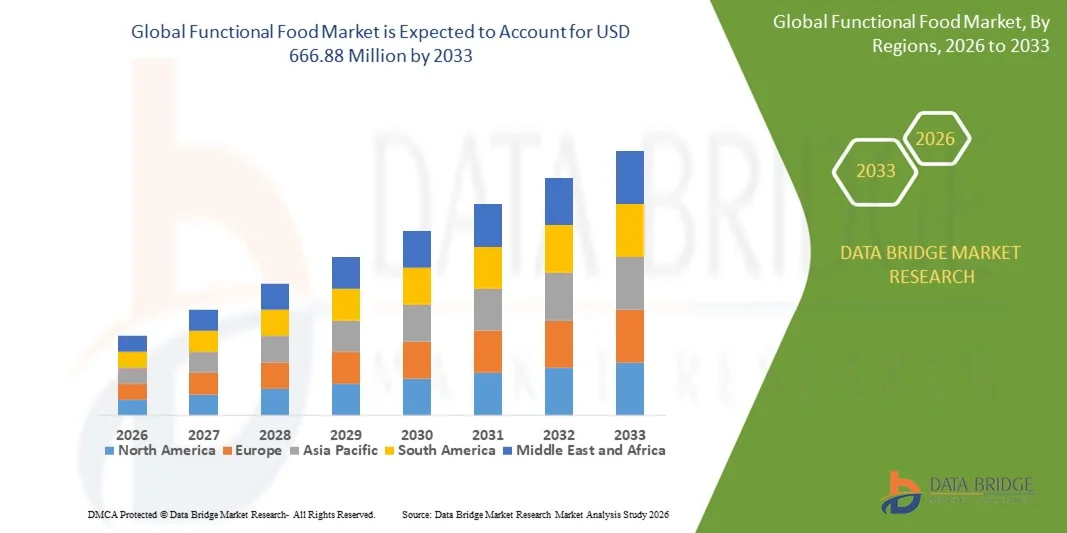
- Wie pro Data Bridge Market Research Analysis wurde die globale funktionale Lebensmittelmarktgröße bewertet379.53 Mio. USD in 2025und wird voraussichtlich erreichen666,88 Mio. USD bis 2033, beiCAGR von 7,30%während des Prognosezeitraums
- Das Marktwachstum wird größtenteils durch steigendes Gesundheitsbewusstsein, steigende Nachfrage nach angereicherten und nährstoffangereicherten Produkten und zunehmende Verbraucherpräferenz für präventive Gesundheitsversorgung durch Ernährung gefördert.
- Die zunehmende Prävalenz chronischer Krankheiten, verbunden mit der Annahme gesünderer Lebensstile, ist die Nachfrage nach funktionellen Lebensmitteln wie Probiotika, Vitamine, Mineralstoffe und pflanzlichen Inhaltsstoffen
Marktgröße und Prognose
- Globaler Marktwert (2025):379.53 Mio. USD
- Voraussichtlicher Marktwert (2033):666,88 Mio. USD
- Wettervorhersage CAGR (2026–2033):7.30%
Was sind die großen Takeaways des Functional Food Market
- Der Markt ist ein starkes Wachstum durch technologische Innovationen in der Lebensmittelverarbeitung, der Formulierung neuer bioaktiver Inhaltsstoffe und der Entwicklung personalisierter Ernährungslösungen.
- Die Sensibilisierung für die Immunitäts- und Bauchspeicheldrüsefördernde Lebensmittel sowie staatliche Initiativen zur Förderung gesunder Ernährung fördern die Annahme von funktionellen Nahrungsmitteln
- Nordamerika dominierte den funktionellen Lebensmittelmarkt mit dem größten Umsatzanteil von 35,20% im Jahr 2025, angetrieben durch wachsendes Gesundheitsbewusstsein, steigende Nachfrage nach befestigten und nährstoffangereicherten Produkten, und weit verbreitete Annahme von präventiven Gesundheitspraktiken
- Asien-Pazifik-Region wird die höchste Wachstumsrate in der globalenFunktionsfutterMarkt, angetrieben durch das Bewusstsein für präventive Gesundheitsversorgung, steigende Bevölkerung der Mittelklasse, schnelle Urbanisierung und Regierungsinitiativen zur Förderung gesünderer Ernährung und funktioneller Lebensmittelkonsum
- DieMilchprodukteDas Segment hielt den größten Marktanteil im Jahr 2025, angetrieben durch die weit verbreitete Annahme von Milch, Joghurt und probiotischen Getränken. Dairy-basierte funktionelle Lebensmittel sind sehr bevorzugt für ihre ernährungsphysiologischen Vorteile, einfache Verbrauch und Einarbeitung in tägliche Ernährung, so dass sie eine beliebte Wahl unter gesundheitsbewussten Verbrauchern
Report Scope und Functional Food Market Segmentation
|
Attribute |
Functional Food Key Market Insights |
|
Verdeckte Segmente |
|
|
Überarbeitete Länder |
Nordamerika
Europa
Asien-Pazifik
Naher Osten und Afrika
Südamerika
|
|
Key Market Players |
|
|
Marktmöglichkeiten |
|
|
Daten Infos zum Wert hinzugefügt |
Neben den Erkenntnissen über Marktszenarien wie Marktwert, Wachstumsrate, Segmentierung, geographische Erfassung und wichtige Akteure umfassen die Marktberichte, die von der Data Bridge Market Research kuratiert wurden, auch eingehende Expertenanalyse, Preisanalyse, Markenanteilsanalyse, Verbraucherumfrage, Demographieanalyse, Supply Chain Analyse, Wertschöpfungskettenanalyse, Rohstoff-/Verbrauchsübersicht, Herstellerauswahlkriterien, PESTLE Analyse, Porter Analysis und regulatorische Rahmenbedingungen. |
Was ist der Haupttrend im Functional Food Market
steigende Nachfrage nach gesunden und gesunden Lebensmitteln
- Der wachsende Fokus auf VorbeugungGesundheitund Wellness prägt den funktionellen Lebensmittelmarkt deutlich, da die Verbraucher zunehmend Produkte bevorzugen, die spezielle gesundheitliche Vorteile bieten, wie Immunitätsunterstützung, Verdauungsgesundheit und Herzgesundheit. Funktionelle Lebensmittel gewinnen aufgrund ihrer Fähigkeit, zusätzliche Nährstoffe, bioaktive Verbindungen und Probiotika zu liefern, während nahtlos in tägliche Ernährung. Dieser Trend stärkt ihre Einführung in Bäckerei-, Milch-, Getränke- und Snack-Segmente und ermutigt die Hersteller, mit neuen Formulierungen zu innovieren, die den Bedürfnissen der Verbraucher gerecht werden
- Das zunehmende Bewusstsein um lebensbedingte Krankheiten, Ernährung und Langlebigkeit hat die Nachfrage nach funktionellen Lebensmitteln in zu essenden Mahlzeiten, Getränken, Milchprodukten und Nahrungsergänzungsmitteln beschleunigt. Gesundheitsbewusste Verbraucher suchen aktiv Produkte, die mit Vitaminen, Mineralstoffen, Fasern und pflanzlichen Inhaltsstoffen angereichert sind und Marken dazu veranlassen, natürliche und saubere Formulierungen zu priorisieren. Dies hat auch zu Kooperationen zwischen Zutatlieferanten und Produktherstellern geführt, um funktionale Vorteile zu verbessern
- Wellness- und Sauberkeitstrends beeinflussen Kaufentscheidungen, wobei Hersteller transparente Etikettierung, wissenschaftliche Unterstützung und umweltfreundliche Beschaffung betonen. Diese Faktoren helfen Marken, Produkte in einem wettbewerbsfähigen Markt zu differenzieren und das Vertrauen der Verbraucher zu stärken, während auch die Annahme von Zertifizierungen wie nicht-GVO, organische und glutenfreie. Unternehmen nutzen zunehmend Marketing-Kampagnen, um diese Vorteile hervorzuheben, um die Markenpositionierung zu stärken und bewusste Verbraucher anzusprechen
- So erweiterte Danone im Jahr 2024 in Frankreich und Nestlé in der Schweiz ihre funktionellen Lebensmittel-Portfolio durch die Einbindung von befestigten Getränken,probiotische Joghurtund nährstoffreiche Snacks. Diese Starts wurden in Reaktion auf eine steigende Verbraucherpräferenz für gesundheitsorientierte Produkte eingeführt, mit Vertrieb über Einzelhandels-, Spezial- und Online-Kanäle. Die Produkte wurden auch als Beitrag zum Gesamt-Wellness vermarktet, die Markentreue zu verbessern und Wiedereinkäufe unter Zielgruppen zu wiederholen
- Während die Nachfrage nach funktionellen Lebensmitteln wächst, hängt die anhaltende Marktausweitung von kontinuierlicher FuE, kostengünstiger Produktion und der Aufrechterhaltung der Ernährungseffizienz ab. Die Hersteller konzentrieren sich auch auf die Verbesserung der Skalierbarkeit, der Zuverlässigkeit der Lieferkette und die Entwicklung innovativer Lösungen, die Kosten, Qualität und Gesundheitsvorteile für eine breitere Akzeptanz ausgleichen
Functional Food Market Dynamics
Fahrer
Wachsende Vorliebe für gesündere und gefestigte Produkte
- Die Erhöhung der Verbrauchernachfrage nach Lebensmitteln, die spezielle gesundheitliche Vorteile bieten, ist ein wichtiger Treiber für den funktionalen Lebensmittelmarkt. Die Hersteller sind immer stärkere Produkte mit Vitaminen, Mineralstoffen, Fasern und Probiotika, um gesundheitsbewusste Verbraucheranforderungen zu erfüllen und regulatorische Standards zu erfüllen. Dieser Trend drängt auch die Forschung zu neuartigen bioaktiven Inhaltsstoffen und pflanzenbasierten Quellen, unterstützt die Produktdiversifizierung
- Erweiterung von Anwendungen in Getränken, Bäckerei, Milch, Snacks und Nahrungsergänzungsmittel beeinflussen das Marktwachstum. Funktionelle Lebensmittel helfen, Immunität, Verdauung und allgemeine Wellness zu verbessern, während Geschmack und Bequemlichkeit zu erhalten, so dass Hersteller die Erwartungen der Verbraucher für hochwertige, nahrhafte Angebote erfüllen. Die zunehmende Übernahme präventiver Gesundheitsversorgung weltweit verstärkt diesen Trend weiter
- Lebensmittel- und Getränkehersteller fördern aktiv funktionelle Lebensmittel-basierte Formulierungen durch Produktinnovation, Marketingkampagnen und Gesundheitszertifizierungen. Diese Bemühungen werden durch die wachsende Verbraucherpräferenz für gesundheitsorientierte und nachhaltige Produkte unterstützt, und sie fördern auch Partnerschaften zwischen Zutatlieferanten und Marken, um die Produktleistung zu verbessern und den ökologischen Fußabdruck zu reduzieren
- So berichtete PepsiCo im Jahr 2023 in den USA und Yakult in Japan eine verstärkte Aufnahme von Probiotika und angereicherten Zutaten in Getränken und Milchprodukten. Diese Expansion folgte der höheren Nachfrage der Verbraucher nach immun-boosting, non-GMO und pflanzenbasierten Produkten, der Wiederholungskauf und der Produktdifferenzierung. Beide Unternehmen hoben auch die wissenschaftliche Validierung und Nachhaltigkeit in Marketingkampagnen hervor, um das Verbrauchervertrauen und die Markentreue zu stärken
- Obwohl steigende gesundheitsbewusste und saubere Trends das Wachstum unterstützen, hängt die breitere Annahme von Kostenoptimierung, Wirkstoffverfügbarkeit und skalierbaren Produktionsprozessen ab. Investitionen in die Effizienz der Supply-Chain-Kette, nachhaltige Beschaffung und fortschrittliche Formulierungstechnologie werden entscheidend sein, um die globale Nachfrage zu erfüllen und den Wettbewerbsvorteil zu erhalten
Zurückhaltung/Challenge
Höhere Kosten und begrenzte Aufmerksamkeit im Vergleich zu herkömmlichen Lebensmittelprodukten
- Die relativ höheren Kosten für funktionelle Lebensmittel im Vergleich zu konventionellen Produkten sind nach wie vor eine zentrale Herausforderung, die die Annahme von preisempfindlichen Verbrauchern einschränkt. Premium-Zutaten, komplexe Formulierungsverfahren und Befestigungstechniken tragen zu erhöhten Preisen bei. Darüber hinaus kann die schwankende Versorgung bestimmter bioaktiver Inhaltsstoffe die Kostenstabilität und die Marktdurchdringung weiter beeinträchtigen
- Das Bewusstsein der Verbraucher und der Hersteller bleibt uneinheitlich, vor allem bei der Entwicklung von Märkten, in denen noch präventive Gesundheitstrends auftreten. Ein begrenztes Verständnis der funktionellen Vorteile beschränkt die Annahme in bestimmten Produktkategorien. Dies führt auch zu einer langsameren Innovationsaufnahme in Schwellenländern, in denen Bildungsinitiativen zu funktionalen Lebensmitteln minimal sind
- Lieferkette und Distributionsherausforderungen wirken sich auch auf das Marktwachstum aus, da funktionale Lebensmittel die Beschaffung von spezialisierten Lieferanten und die Einhaltung strenger Qualitätsstandards erfordern. Logistische Komplexitäten, Temperaturkontrollanforderungen und kürzere Haltbarkeit für einige befestigte Produkte erhöhen die Betriebskosten. Unternehmen müssen in kalte Lagerung, ordnungsgemäße Handhabung und effiziente Transportnetze investieren, um die Produktintegrität zu erhalten
- So berichteten 2024 Händler in Indien und Südostasien, die feste Getränke und funktionelle Snacks beliefern, aufgrund der höheren Preise und des begrenzten Bewusstseins für funktionelle Vorteile im Vergleich zu herkömmlichen Lebensmitteln. Speicheranforderungen und Zertifizierungskonformität waren zusätzliche Barrieren. Diese Faktoren veranlassten auch einige Einzelhändler, den Lagerraum für Premium-Funktionsprodukte zu begrenzen, was die Sichtbarkeit und den Vertrieb betrifft
- Die Bewältigung dieser Herausforderungen erfordert eine kosteneffiziente Produktion, erweiterte Vertriebsnetze und fokussierte Bildungsinitiativen für Hersteller und Verbraucher. Die Zusammenarbeit mit Einzelhändlern, Lebensmittelunternehmern und Zertifizierungsstellen kann dazu beitragen, das langfristige Wachstumspotenzial des globalen funktionellen Lebensmittelmarkts zu entfalten. Darüber hinaus wird die Entwicklung kostenwettbewerbsfähiger Formulierungen und die Stärkung von Marketingstrategien rund um den Gesundheits- und Nachhaltigkeitsvorteil für die weit verbreitete Adoption unerlässlich sein.
Wie wird der Functional Food Market segmentiert
Der Markt wird auf der Grundlage von Produkttyp und Vertriebskanal segmentiert.
- Nach Produkttyp
Auf Basis des Produkttyps wird der funktionelle Lebensmittelmarkt in Backwaren, Frühstück Getreide, Snack/Functional Bars, Milchprodukte, Babynahrung und andere Produktarten segmentiert. Das Segment Dairy Products hielt den größten Marktanteil im Jahr 2025, angetrieben durch die weit verbreitete Annahme von Milch, Joghurt und probiotischen Getränken. Dairy-basierte funktionelle Lebensmittel sind sehr bevorzugt für ihre ernährungsphysiologischen Vorteile, einfache Verbrauch und Einarbeitung in tägliche Ernährung, so dass sie eine beliebte Wahl unter gesundheitsbewussten Verbraucher.
Das Segment Snack/Functional Bars wird voraussichtlich die schnellste Wachstumsrate von 2026 bis 2033 beobachten, die von der steigenden Nachfrage nach on-the-go Ernährung, Bequemlichkeit und proteinangereicherten oder faserverstärkten Optionen angetrieben wird. Functional Snack Bars sind besonders beliebt bei Millennials und Arbeitsprofis für ihre Portabilität und Fähigkeit, aktive Lebensstile zu unterstützen, oft als bequeme Alternative zu traditionellen Mahlzeiten.
- Durch den Verteilerkanal
Auf Basis des Vertriebskanals wird der Markt in Supermarkets/Hypermarkets, Specialist Retailers, Convenience Stores, Online Retail und andere Vertriebskanäle segmentiert. Das Segment Supermarkets/Hypermarkets hielt den größten Anteil im Jahr 2025 aufgrund der weit verbreiteten Verfügbarkeit von funktionellen Nahrungsmitteln, Werbeangeboten und hohem Konsumverlust. Große Einzelhandelsketten bieten einfachen Zugang zu einer Vielzahl von befestigten und funktionellen Lebensmitteln, die Verbesserung der Sichtbarkeit und des Fahrgeschäfts.
Das Online Retail-Segment wird erwartet, dass die schnellste Wachstumsrate von 2026 bis 2033, die durch die zunehmende E-Commerce-Pension, die Verbraucherpräferenz für die Türschwelle Lieferung, und die Verfügbarkeit von Nische, Premium und personalisierte funktionale Lebensmittel. Online-Plattformen ermöglichen es den Verbrauchern, auf eine Vielzahl von Marken zuzugreifen, Bewertungen zu lesen und Produkte bequem zu kaufen, das Marktwachstum weiter zu beschleunigen.
Welche Region hält den größten Teil des funktionalen Lebensmittelmarktes
- Nordamerika dominierte den funktionellen Lebensmittelmarkt mit dem größten Umsatzanteil von 35,20% im Jahr 2025, angetrieben durch wachsendes Gesundheitsbewusstsein, steigende Nachfrage nach befestigten und nährstoffangereicherten Produkten, und weit verbreitete Annahme von präventiven Gesundheitspraktiken
- Verbraucher in der Region hochwertig Bequemlichkeit, Ernährungsvorteile und wissenschaftlich unterstützte Ansprüche, mit funktionellen Lebensmitteln bieten gezielte Lösungen für Immunität, Verdauungsgesundheit und allgemeine Wellness
- Diese weit verbreitete Adoption wird weiterhin durch hohe Einwegeinkommen, fortgeschrittene Einzelhandels- und E-Commerce-Infrastruktur und steigendes Bewusstsein für lebensbedingte Krankheiten unterstützt und funktionelle Lebensmittel als bevorzugte Wahl für gesundheitsbewusste Verbraucher etabliert.
US Functional Food Market Insight
Der US-funktionelle Lebensmittelmarkt erfasste 2025 innerhalb Nordamerikas den größten Umsatzanteil, der durch steigendes Gesundheitsbewusstsein, wachsende Fitness- und Wellnesstrends und zunehmende Verbraucherpräferenz für befestigte und bioaktiv angereicherte Lebensmittel gefördert wurde. Verbraucher suchen zunehmend Produkte, die Immunität, Verdauungsgesundheit und Energie unterstützen und gleichzeitig Komfort und Geschmack kombinieren. Die wachsende Popularität von Online-Kräftigungsplattformen, Spezial-Gesundheits-Shops und Abonnement-Services fördert die funktionelle Lebensmittelindustrie weiter. Darüber hinaus treiben Partnerschaften zwischen Lebensmittelmarken und Ernährungsexperten Innovation und Marktwachstum.
Europa Funktionelle Lebensmittelmarktaufsicht
Der europäische funktionale Lebensmittelmarkt wird voraussichtlich die schnellste Wachstumsrate von 2026 bis 2033 beobachten, vor allem durch alternde Bevölkerung, zunehmende Prävalenz von lebensbedingten Störungen und Regierungsinitiativen, die gesunde Ernährung fördern. Die zunehmende Urbanisierung, verbunden mit einem hohen Verbraucherbewusstsein in Bezug auf Ernährung und Wellness, fördert die Annahme von befestigten Lebensmitteln. Die europäischen Verbraucher werden auch zu pflanzenbasierten, probiotischen und glutenfreien Produkten gezogen. Die Region erlebt deutliches Wachstum in Bäckerei-, Milch- und Getränkeanwendungen, wobei funktionelle Lebensmittel in tägliche Ernährungs- und Wellnessprogramme integriert werden.
US Functional Food Market Insight
Der US-funktionelle Lebensmittelmarkt wird erwartet, dass die schnellste Wachstumsrate von 2026 bis 2033, angetrieben durch steigende Gesundheitsbewusstsein, wachsende Nachfrage nach Immunität-Boosting und Verdauungs-Gesundheit-Produkte, und zunehmendes Interesse an personalisierten Ernährung. Verbraucher entscheiden sich für funktionelle Lebensmittel als bequeme Lösungen, um den gesamten Wellness zu erhalten. Das starke Einzelhandels- und E-Commerce-Ökosystem der USA, zusammen mit dem weit verbreiteten Zugang zu befestigten und pflanzenbasierten Produkten, soll das Marktwachstum weiter anregen.
Deutschland Functional Food Market Insight
Der funktionelle Lebensmittelmarkt Deutschlands wird voraussichtlich die schnellste Wachstumsrate von 2026 bis 2033 bezeugen, die durch das zunehmende Interesse der Verbraucher an der präventiven Gesundheitsversorgung, die steigende Nachfrage nach natürlichen und befestigten Produkten und die wissenschaftliche Validierung von funktionellen Vorteilen gefördert wird. Die gut ausgebaute Nahrungsmittelverarbeitungsinfrastruktur Deutschlands und der Fokus auf Nachhaltigkeit fördern die Einführung von funktionellen Lebensmitteln. Die Integration von funktionellen Inhaltsstoffen in Bäckerei-, Milch- und Getränkeprodukte wird immer häufiger, was die Verbraucherpräferenzen für gesunde, bequeme und qualitativ hochwertige Angebote angeht.
Asien-Pazifik Funktionelle Lebensmittelmarkt Einblick
Der asiatisch-pazifische funktionale Lebensmittelmarkt wird erwartet, dass die schnellste Wachstumsrate von 2026 bis 2033, angetrieben durch Urbanisierung, steigende Einwegeinkommen und zunehmendes Bewusstsein für Gesundheit und Wellness in Ländern wie China, Japan und Indien. Das wachsende Interesse der Region an befestigten und nährstoffangereicherten Produkten, zusammen mit staatlichen Initiativen zur Förderung gesündererer Ernährung, ist die Annahme. Darüber hinaus sorgt APACs starke Fertigungsbasis für funktionelle Inhaltsstoffe für die Erreichbarkeit und Zugänglichkeit von Produkten auf eine breitere Verbraucherbasis.
Japan Functional Food Markt Einblick
Der japanische funktionale Lebensmittelmarkt wird erwartet, dass die schnellste Wachstumsrate von 2026 bis 2033 aufgrund der alternden Bevölkerung, des hohen Gesundheitsbewusstseins und der Präferenz für präventive Ernährung zu beobachten ist. Japanische Verbraucher schätzen Produkte, die Immunität, Verdauung und allgemeine Wellness unterstützen. Die Integration von funktionellen Lebensmitteln in traditionelle Mahlzeiten, Annehmlichkeiten und Getränke fördert das Wachstum. Darüber hinaus fördert der Schwerpunkt des Landes auf wissenschaftliche Validierung und Innovation die Produktentwicklung und -akzeptanz im Einzelhandel und institutionellen Segmenten.
China Functional Food Markt Einblick
Der China funktionale Lebensmittelmarkt entfiel 2025 auf den größten Marktanteil im asiatisch-pazifischen Markt, der der wachsenden Mittelschicht des Landes, der steigenden Einwegeinkommen und der zunehmenden Annahme gesundheitsbewusster Lebensstile zugeschrieben wurde. Funktionelle Lebensmittel werden in Bäckerei-, Milch-, Snack- und Getränkesegmenten immer beliebter. Die Förderung gesündererer Ernährung, das wachsende Bewusstsein für die Krankheitsprävention und die starke Präsenz einheimischer und internationaler Hersteller sind wichtige Faktoren, die den Markt in China fördern. Die zunehmende Verfügbarkeit durch E-Commerce- und Retail-Kanäle unterstützt das Wachstum.
Welche sind die Top-Unternehmen im Functional Food Market
Die Functional Food-Industrie wird in erster Linie von etablierten Unternehmen geleitet, darunter:
- Archer Daniels Midland Co. (USA)
- Ashland Inc. (USA)
- Cargill (USA)
- CP Kelco (USA)
- EI DuPont De Nemours & Co. (USA)
- Fuerest Day Lawson Ltd. (U.K.)
- Ingredion Inc. (USA)
- Kerry Inc. (USA)
- Tate & Lyle PLC (USA)
- TIC Gums Inc. (USA)
- Associated British Foods (U.K.)
- Amway (USA)
- Nestlé (Schweiz)
- DMH Zutaten (US)
- Ajinomoto Co. Inc. (Japan)
Was sind die neuesten Entwicklungen im Functional Food Market
- Im September 2023 erweiterte Yoplait, ein führender Hersteller von Milchprodukten, sein Produktportfolio, indem er unter der Marke SKYR Energy High-Protein-Joghurt startete. Die neuen Joghurts verfügen über echte Fruchtstücke und sind mit Vitamin B6 und Vitamin D befestigt, erhältlich in Strawberry & Blackcurrant und Mango & Passion Fruit Aromen. Diese Entwicklung zielt darauf ab, die wachsende Nachfrage nach proteinreichen und nährstoffverstärkten Milchprodukten zu decken. Der Start stärkt die Präsenz von Yoplait im funktionellen Food-Segment, verbessert die Auswahl der Verbraucher für gesündere Snack-Optionen und wird voraussichtlich den Eiweiß-Joghurt-Markt positiv beeinflussen, indem gesundheitsbewusste Verbraucher angezogen werden
- Im Mai 2023 führte Javo Beverage, ein aufstrebendes Getränkeunternehmen, all-natürliche funktionelle Energie-Limonades und aromatisierte Tees an Lebensmittel-Service-Betreiber. Der Start richtet sich an die zunehmende Verbraucherpräferenz für funktionelle und natürliche Getränke. Durch den Ausbau in funktionelle Getränke will Javo Beverage den Marktanteil im wachsenden funktionellen Getränkesegment erfassen, die Markensicht verbessern und die Einführung gesündererer Getränkeoptionen vorantreiben
- Im April 2023 startete Hangobi, ein US-basierter Getränkehersteller, befestigte Getränke in drei Sorten: Wake, Essential und Calm. In Zusammenarbeit mit Händlern wie KeHE, UNFI Supervalu und C&S Wholesale sorgte Hangobi für eine breite Verfügbarkeit in New York. Diese Entwicklung konzentriert sich auf die Bereitstellung von funktionellen Getränkeoptionen, die Energie, Wellness und Entspannung unterstützen. Der Start wird voraussichtlich die Marktposition von Hangobi im erweiterten Getränkesegment stärken und eine breitere Verbraucherannahme von funktionellen Getränken fördern
SKU-
Erhalten Sie Online-Zugriff auf den Bericht zur weltweit ersten Market Intelligence Cloud

- Interaktives Datenanalyse-Dashboard
- Unternehmensanalyse-Dashboard für Chancen mit hohem Wachstumspotenzial
- Zugriff für Research-Analysten für Anpassungen und Abfragen
- Konkurrenzanalyse mit interaktivem Dashboard
- Aktuelle Nachrichten, Updates und Trendanalyse
- Nutzen Sie die Leistungsfähigkeit der Benchmark-Analyse für eine umfassende Konkurrenzverfolgung
Forschungsmethodik
Die Datenerfassung und Basisjahresanalyse werden mithilfe von Datenerfassungsmodulen mit großen Stichprobengrößen durchgeführt. Die Phase umfasst das Erhalten von Marktinformationen oder verwandten Daten aus verschiedenen Quellen und Strategien. Sie umfasst die Prüfung und Planung aller aus der Vergangenheit im Voraus erfassten Daten. Sie umfasst auch die Prüfung von Informationsinkonsistenzen, die in verschiedenen Informationsquellen auftreten. Die Marktdaten werden mithilfe von marktstatistischen und kohärenten Modellen analysiert und geschätzt. Darüber hinaus sind Marktanteilsanalyse und Schlüsseltrendanalyse die wichtigsten Erfolgsfaktoren im Marktbericht. Um mehr zu erfahren, fordern Sie bitte einen Analystenanruf an oder geben Sie Ihre Anfrage ein.
Die wichtigste Forschungsmethodik, die vom DBMR-Forschungsteam verwendet wird, ist die Datentriangulation, die Data Mining, die Analyse der Auswirkungen von Datenvariablen auf den Markt und die primäre (Branchenexperten-)Validierung umfasst. Zu den Datenmodellen gehören ein Lieferantenpositionierungsraster, eine Marktzeitlinienanalyse, ein Marktüberblick und -leitfaden, ein Firmenpositionierungsraster, eine Patentanalyse, eine Preisanalyse, eine Firmenmarktanteilsanalyse, Messstandards, eine globale versus eine regionale und Lieferantenanteilsanalyse. Um mehr über die Forschungsmethodik zu erfahren, senden Sie eine Anfrage an unsere Branchenexperten.
Anpassung möglich
Data Bridge Market Research ist ein führendes Unternehmen in der fortgeschrittenen formativen Forschung. Wir sind stolz darauf, unseren bestehenden und neuen Kunden Daten und Analysen zu bieten, die zu ihren Zielen passen. Der Bericht kann angepasst werden, um Preistrendanalysen von Zielmarken, Marktverständnis für zusätzliche Länder (fordern Sie die Länderliste an), Daten zu klinischen Studienergebnissen, Literaturübersicht, Analysen des Marktes für aufgearbeitete Produkte und Produktbasis einzuschließen. Marktanalysen von Zielkonkurrenten können von technologiebasierten Analysen bis hin zu Marktportfoliostrategien analysiert werden. Wir können so viele Wettbewerber hinzufügen, wie Sie Daten in dem von Ihnen gewünschten Format und Datenstil benötigen. Unser Analystenteam kann Ihnen auch Daten in groben Excel-Rohdateien und Pivot-Tabellen (Fact Book) bereitstellen oder Sie bei der Erstellung von Präsentationen aus den im Bericht verfügbaren Datensätzen unterstützen.











