



Global Industrial WLAN Market Segmentation, By Component (Hardware, Software und Services), Technology Standard (802.11a/b/g, 802.11n, 802.11ac (Wi-Fi 5), 802.11ax (Wi-Fi 6/6E) und 802.11be (Wi-Fi 7)), Bereitstellungsart (On-Premise, Cloud-based, and Hybrid), Anwendung (Machine-to-Machine
Was ist die industrielle WLAN-Marktgröße und -wachstumsrate
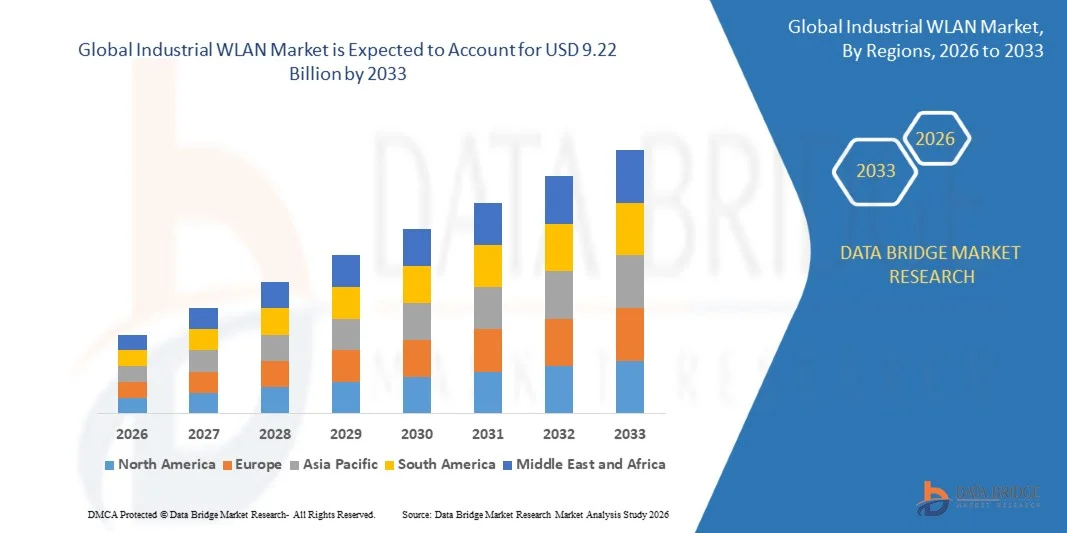
- Wie pro Data Bridge Market Research Analysis wurde die globale industrielle WLAN-Marktgröße bewertet4,72 Milliarden USD in 2025und wird voraussichtlich erreichen9,22 Milliarden USD bis 2033, beiCAGR von 8,71%während des Prognosezeitraums
- Das Marktwachstum wird größtenteils durch die beschleunigte Einführung von industrieller Automatisierung getrieben,Industrielles IoT, und Industrie 4.0-Initiativen, die die Notwendigkeit einer zuverlässigen, niedrigen Latenz und leistungsfähigen drahtlosen Vernetzung in Fertigungsanlagen, Lagern und Prozessindustrien erhöhen
- Darüber hinaus verstärkt die steigende Nachfrage nach Echtzeitdatenzugriffen, nahtloser Maschinenkonnektivität und flexibler Netzwerkinfrastruktur zur Unterstützung intelligenter Fabriken und digitaler Operationen die Einführung von Industrial WLAN-Lösungen und steigert so das Gesamtwachstum des Marktes deutlich
Marktgröße und Prognose
- Globaler Marktwert (2025):4,72 Milliarden USD
- Voraussichtlicher Marktwert (2033):9,22 Milliarden USD
- Wettervorhersage CAGR (2026–2033):8.71%
Was sind die großen Takeaways des Industrial WLAN Market
- Industrielle WLAN-Lösungen, die eine sichere und leistungsfähige drahtlose Kommunikation in rauen und missionskritischen Umgebungen ermöglichen, sind für die Unterstützung von Automatisierung, Asset Tracking, Worker Mobility und Machine-to-Maschine-Kommunikation über Industrieanlagen unerlässlich.
- Die zunehmende Abhängigkeit von drahtlosen Netzwerken wird in erster Linie durch die zunehmende Bereitstellung von intelligenten Fertigungssystemen, die Verbesserung der betrieblichen Effizienz und Sicherheit sowie die Notwendigkeit skalierbarer, sicherer Konnektivität zur Unterstützung fortgeschrittener industrieller Anwendungen gefördert.
- Asien-Pazifik dominiert den industriellen WLAN-Markt mit einem Anteil von 32,4%im Jahr 2025, aufgrund der schnellen industriellen Automatisierung, der Erweiterung von Fertigungsanlagen und der weitgehenden Übernahme von Industrie 4.0-Praktiken in Schwellenländern
- Nordamerika wird voraussichtlich die am schnellsten wachsende Region im Industrie-WLAN-Markt während der Prognosezeit sein, da die fortschrittliche Automatisierung, die starke Präsenz industrieller IoT-Bereitstellungen und die zunehmende Abhängigkeit von der drahtlosen Vernetzung für unternehmenskritische Operationen rasch angenommen werden.
- Das Segment Hardware dominierte den Markt mit einem Marktanteil von 67% im Jahr 2025, aufgrund der hohen Nachfrage nach industriellen Access Points, robusten Routern, Controllern und Antennen in der gesamten Produktions- und Prozessindustrie. Industrieumgebungen erfordern langlebige, leistungsstarke Netzwerkgeräte, die unter extremen Temperaturen, Vibrationen und elektromagnetischen Störungen arbeiten können. Kontinuierliche Erweiterung von Smart Factorys und Brownfield Automationsprojekten unterstützte die starke Hardware-Adoption
Report Scope und Industrial WLAN Market Segmentation
|
Attribute |
Industrial WLAN Schlüsselmarkt Einblicke |
|
Verdeckte Segmente |
|
|
Überarbeitete Länder |
Nordamerika
Europa
Asien-Pazifik
Naher Osten und Afrika
Südamerika
|
|
Key Market Players |
|
|
Marktmöglichkeiten |
|
|
Daten Infos zum Wert hinzugefügt |
Neben den Markteinblicken wie Marktwert, Wachstumsrate, Marktsegmente, geographischer Erfassung, Marktteilnehmer und Marktszenario umfasst der vom Data Bridge Market Research Team kuratierte Marktbericht eine tiefgreifende Expertenanalyse, Import/Export-Analyse, Preisanalyse, Produktionsverbrauchsanalyse und pestle-Analyse. |
Was ist der Haupttrend im industriellen WLAN-Markt
Steigende Annahme von WLAN 6 und WLAN 7 in Industrieumgebungen
- Ein großer Trend, der den Industrie-WLAN-Markt prägt, ist die beschleunigte Einführung von Wi-Fi 6 und Wi-Fi 7 Technologien zur Unterstützung von hochdichten, latenzempfindlichen Industriebetrieben. Diese Standards der nächsten Generation ermöglichen einen verbesserten Durchsatz, eine deterministische Leistungsfähigkeit und eine bessere Gerätehandhabung, die für intelligente Fabriken, automatisierte Lager und unternehmenskritische Industrienetze entscheidend sind
- So integriert Siemens aktiv Wi-Fi 6 Fähigkeiten in sein industrielles Netzwerkportfolio, um vernetzte Fertigungssysteme und Echtzeit-Industriekommunikation zu unterstützen. Diese Bereitstellungen verbessern die Zuverlässigkeit und gewährleisten eine gleichbleibende Leistung für Automatisierung, Robotik und datenintensive Industrieanwendungen
- Der Übergang zu Wi-Fi 6 und Wi-Fi 7 ermöglicht es Industrien, eine wachsende Anzahl von angeschlossenen Geräten, einschließlich Sensoren, AGVs und Industrierobotern, ohne die Netzstabilität zu beeinträchtigen. Dies ist besonders wichtig in Umgebungen, in denen kabelgebundene Konnektivität die Betriebsflexibilität begrenzt
- Industrielle Betreiber werden zunehmend fortschrittliche WLAN-Standards priorisieren, um Latenz zu reduzieren und die Synchronisation über Maschinen und Steuerungssysteme zu verbessern. Diese Verbesserungen unterstützen die Präzisionsfertigung und Echtzeit-Prozessoptimierung direkt
- High-Density Industrieeinstellungen profitieren von Features wie OFDMA und Multi-User-Konnektivität, die die Frequenzeffizienz verbessern und Störungen minimieren. Dies verstärkt die WLAN-Performance in komplexen industriellen Layouts
- Insgesamt verstärkt der zunehmende Einsatz von Wi-Fi 6 und Wi-Fi 7 den Wandel hin zu voll drahtlosen, skalierbaren und zukunftsweisenden Industrienetzwerkarchitekturen in der globalen Fertigungs- und Prozessindustrie
Industrielle WLAN-Marktdynamik
Fahrer
Steigerung der Implementierung von Industrie 4.0 und Industrial IoT-Initiativen
- Die zunehmende Umsetzung von Industrie 4.0- und Industrial IoT-Initiativen ist ein wichtiger Treiber des Industrie-WLAN-Marktes, da sich Branchen zunehmend auf drahtlose Netzwerke für Echtzeit-Datenaustausch und intelligente Automatisierung verlassen. Industrial WLAN ermöglicht eine nahtlose Verbindung zwischen Maschinen, Sensoren und Steuerungssystemen, die datengesteuerte Entscheidungsfindung und vorausschauende Vorgänge unterstützen
- So hat Bosch industrielle WLAN-Lösungen in seinen intelligenten Fabriken eingesetzt, um vernetzte Produktionslinien, Maschinenüberwachung und digitale Zwillinge zu unterstützen. Diese drahtlosen Netzwerke spielen eine zentrale Rolle bei der End-to-End-Sichtbarkeit und Betriebseffizienz
- Die Nachfrage nach flexiblen Fertigungssystemen treibt die Industrien dazu, WLAN-Lösungen zu übernehmen, die eine schnelle Neukonfiguration von Produktionslayouts ohne umfangreiche Verkabelung ermöglichen. Diese Flexibilität ist wesentlich für die Massenanpassung und agile Fertigungsmodelle
- Die Hersteller investieren zunehmend in die drahtlose Infrastruktur, um die Integration fortschrittlicher Analytik, AI-getriebener Systeme und Cloud-basierter Industrieplattformen zu unterstützen. Diese Abhängigkeit von vernetzten Ökosystemen verstärkt die Bedeutung robuster industrieller WLAN-Lösungen
- Die zunehmende Betonung auf Betriebseffizienz, reduzierte Ausfallzeiten und Echtzeit-Intelligenz treibt die anhaltende Nachfrage nach industriellem WLAN als Basiskomponente von Industrie 4.0-Umgebungen weiter voran
Zurückhaltung/Challenge
Netzwerksicherheit und Interferenzprobleme in Harsh Industrial Settings
- Der industrielle WLAN-Markt steht vor Herausforderungen im Zusammenhang mit Netzwerksicherheitsrisiken und kabellosen Störungen in komplexen und rauen Industrieumgebungen. Industrieanlagen enthalten oft schwere Maschinen, Metallstrukturen und elektromagnetische Störungen, die die drahtlose Signalqualität und Zuverlässigkeit stören können
- So müssen beispielsweise Industrieunternehmen, die WLAN-Netzwerke in Öl- und Gaseinrichtungen bereitstellen, strenge Sicherheitsanforderungen zum Schutz kritischer Infrastrukturen vor Cyberbedrohungen erfüllen. Unternehmen wie Fortinet konzentrieren sich auf die Integration industrieller Sicherheitsfunktionen, um diese Risiken zu mindern und die Komplexität der Sicherung drahtloser Netzwerke hervorzuheben
- Drahtlose Störungen von überlappenden Netzwerken, Maschinen und externen Signalen können die Datenübertragungskonsistenz, insbesondere in großtechnischen Anlagen, beeinflussen. Dies schafft Herausforderungen bei der Aufrechterhaltung deterministischer Leistung für zeitsensitive Anwendungen
- Auch industrielle Umgebungen erfordern eine hohe Netzverfügbarkeit, bei der Störungen zu Betriebsausfall- und Finanzverlusten führen können. Die Balance von Sicherheit, Leistung und Zuverlässigkeit bleibt eine kritische Herausforderung
- Kollektive Bedenken im Zusammenhang mit Cybersicherheitsbedrohungen, Interferenzmanagement und Netzwerk-Resilienz setzen die Annahme in bestimmten industriellen Einstellungen fort und erfordern fortschrittliche Lösungen und Expertise, um diese Einschränkungen zu überwinden
Wie wird der Industrial WLAN Market segmentiert
Der Markt wird auf Basis von Komponenten, Technologiestandard, Bereitstellungstyp, Anwendung und Endverbraucherindustrie segmentiert.
• Von der Komponente
Auf Basis der Komponente wird der Industrial WLAN-Markt in Hardware, Software und Services segmentiert. Das Hardware-Segment dominierte den Markt mit dem größten Umsatzanteil von 67% im Jahr 2025, angetrieben durch hohe Nachfrage nach industriellen Zutrittspunkten, robusten Routern, Controllern und Antennen in der gesamten Fertigungs- und Prozessindustrie. Industrieumgebungen erfordern langlebige, leistungsstarke Netzwerkgeräte, die unter extremen Temperaturen, Vibrationen und elektromagnetischen Störungen arbeiten können. Die kontinuierliche Erweiterung von Smart Factorys und Brownfield Automationsprojekten unterstützte zudem eine starke Hardware-Adoption.
Das Software-Segment wird erwartet, dass das schnellste Wachstum von 2026 bis 2033, unterstützt durch die steigende Annahme von zentralisierten Netzwerkmanagement, Sicherheitsüberwachung und Analyseplattformen. Unternehmen investieren zunehmend in WLAN-Software, um Echtzeit-Sichtbarkeit, vorausschauende Wartung und politikbasierte Zugriffskontrolle über große industrielle Campuss zu ermöglichen. Die wachsende Cybersicherheit und die Notwendigkeit skalierbarer Netzwerk-Orchestrierung beschleunigen den Softwarebedarf weiter.
• Nach Technologiestandard
Auf der Grundlage des Technologiestandards wird der Markt in 802.11a/b/g, 802.11n, 802.11ac (Wi-Fi 5), 802.11ax (Wi-Fi 6/6E) und 802.11be (Wi-Fi 7) segmentiert. Das Segment 802.11ac (Wi-Fi 5) entfiel auf den größten Umsatzanteil im Jahr 2025 aufgrund seiner ausgewogenen Leistung, stabilen Durchsatz und einer weit verbreiteten Basis in Industrieanlagen. Viele Unternehmen verlassen sich weiterhin auf Wi-Fi 5 für unternehmenskritische Operationen wegen bewährter Zuverlässigkeit und Kosteneffizienz.
Das Segment 802.11ax (Wi-Fi 6/6E) wird während der Prognosezeit mit der schnellsten Rate wachsen, die durch seine Fähigkeit zur Unterstützung hoher Gerätedichte, geringer Latenz und deterministischer Leistung getrieben wird. Industrieanwendungen wie Robotik, AGV und Echtzeit-Steuerungssysteme erfordern zunehmend Wi-Fi 6 Fähigkeiten, um eine nahtlose Vernetzung und minimalen Paketverlust zu gewährleisten.
• Durch Einsatzart
Auf Basis des Einsatztyps wird der Industrial WLAN-Markt in On-Premise, Cloud-basierte und hybride Segmente unterteilt. Das Segment On-Premise dominierte den Markt im Jahr 2025, da die Industrien die Datensicherheit, die geringe Latenz und die vollständige Kontrolle über die Netzinfrastruktur priorisieren. Critical Manufacturing and Energy Operations bevorzugen häufig On-Premise-WLAN-Einsätze, um strenge regulatorische, Sicherheits- und Zeitanforderungen zu erfüllen.
Das Cloud-basierte Segment soll das schnellste Wachstum von 2026 bis 2033 registrieren, unterstützt durch die zunehmende Übernahme von Cloud-managed WLAN-Plattformen. Cloud-Bereitstellung ermöglicht Fernüberwachung, zentralisierte Konfiguration, schnellere Fehlersuche und reduzierte operative Komplexität auf geographisch verteilten Industriestandorten. Die zunehmende Akzeptanz von industriellem IoT und Edge Computing stärkt die Cloud-basierte WLAN-Adoption.
• Durch Anwendung
Auf Basis der Anwendung wird der Markt in Maschinen-zu-Maschine-Kommunikation, Inventar & Asset Tracking, Worker Mobility & Communication, Automation & Control Systems und andere segmentiert. Automatisierungs- und Steuerungssysteme stellten den größten Umsatzanteil im Jahr 2025 dar, der durch steigende Nutzung von drahtlosen Netzwerken für SPS-Kommunikation, Robotik-Koordination und Echtzeit-Prozessüberwachung angetrieben wird. Industrial WLAN spielt eine wichtige Rolle, um flexible, skalierbare Automatisierungsarchitekturen in modernen Fabriken zu ermöglichen.
Die Machine-to-Maschine-Kommunikation wird erwartet, dass das schnellste Wachstum über den Prognosezeitraum, unterstützt durch den Ausbau der Übernahme von angeschlossenen Maschinen, Sensoren und autonomen Systemen. Der zunehmende Fokus auf vorausschauende Wartung, Echtzeit-Datenaustausch und digitale Zwillinge beschleunigt den Bedarf an zuverlässigen Low-Latency-WLAN-Lösungen in M2M-Anwendungen.
• Durch Endverbraucherindustrie
Auf der Basis der Endverbraucherindustrie wird der Industrial WLAN-Markt in Automobil, allgemeine Fertigung, Öl & Gas, Energie & Utilitys und andere segmentiert. Die allgemeine Fertigung dominierte den Markt im Jahr 2025 aufgrund des umfangreichen Einsatzes von drahtlosen Netzwerken über Montagelinien, Lagerhallen und Qualitätskontrollverfahren. Die Umstellung auf Industrie 4.0 und intelligente Produktionsumgebungen treibt in diesem Bereich weiterhin starke WLAN-Anforderungen an.
Das Segment Energie & Dienstprogramme wird voraussichtlich mit dem schnellsten Zinssatz von 2026 bis 2033 wachsen, unterstützt durch steigende Investitionen in intelligente Netze, Unterstationen und erneuerbare Energieinfrastrukturen. Industrial WLAN ermöglicht Echtzeit-Überwachung, Remote Asset-Management und sichere Kommunikation über geografisch verteilte Energieressourcen, die operative Effizienz und Netzsicherheit unterstützen.
Welche Region hält den größten Teil des industriellen WLAN-Marktes
- Asia-Pacific dominierte den Industrie-WLAN-Markt mit dem größten Umsatzanteil von 32,4% im Jahr 2025, angetrieben durch schnelle industrielle Automatisierung, Erweiterung von Fertigungsanlagen und groß angelegte Annahme von Industrie 4.0-Praktiken in Schwellenländern
- Starkes Wachstum in intelligenten Fabriken, steigender Einsatz von industriellen IoT-Lösungen und zunehmende Investitionen in drahtlose Infrastruktur beschleunigen die Einführung von Industrial WLAN in Produktionsanlagen und Lagerhallen
- Verfügbarkeit kosteneffizienter Fertigungsökosysteme, qualifizierte technische Arbeitskräfte und unterstützende staatliche Initiativen zur Digitalisierung und intelligente Fertigung tragen maßgeblich zur regionalen Markterweiterung bei
China Industrial WLAN Markt Einblick
China hielt den größten Anteil am asiatisch-pazifischen Industrie-WLAN-Markt im Jahr 2025, unterstützt durch seine Dominanz in der Großproduktion, der Automobilproduktion und der Elektronik-Montage. Der aggressive Schub in Richtung intelligenter Fabriken, kombiniert mit erheblichen Investitionen in die industrielle Automatisierung und 5G-integrierte drahtlose Netzwerke, treibt starke Nachfrage nach zuverlässigen WLAN-Lösungen. Regierungsgestützte Initiativen konzentrierten sich auf die industrielle digitale Transformation stärken das Marktwachstum weiter.
Indien Industrial WLAN Market Insight
Indien zeigt das schnellste Wachstum in der Region Asien-Pazifik, das durch die Erweiterung der Produktionskapazität, die zunehmende Annahme von intelligenter industrieller Infrastruktur und die Erhöhung ausländischer Direktinvestitionen in Automatisierungstechnologien gefördert wird. Regierungsprogramme zur Förderung inländischer Fertigungs- und digitaler Industrieökosysteme beschleunigen den WLAN-Einsatz in Fabriken und Logistikzentren. Die wachsende Nachfrage aus den Bereichen Automotive, allgemeine Fertigung und Energie unterstützt die Markterweiterung.
Europa Industrial WLAN Market Insight
Der europäische Industrie-WLAN-Markt wächst stetig, unterstützt durch starke Betonung auf industrielle Automatisierung, Datensicherheit und fortschrittliche Fertigungsstandards. Der Fokus der Region auf intelligente Produktionssysteme, vorausschauende Wartung und Echtzeit-Betriebsüberwachung erhöht die Abhängigkeit von robusten drahtlosen Netzwerklösungen. Die strikte Einhaltung der Vorschriften und die hohe Einführung fortschrittlicher Industrietechnologien führen weiterhin zu einem stabilen Marktwachstum.
Deutschland Industrial WLAN Market Insight
Der deutsche Industrie-WLAN-Markt wird durch seine führende Rolle bei der Umsetzung von Industrie 4.0, der starken Fertigungsbasis im Automobilbau und der fortschrittlichen technischen Fähigkeiten getrieben. Der Fokus des Landes auf vernetzte Fabriken, Robotik und Echtzeit-Produktionsüberwachung erhöht die Nachfrage nach leistungsstarken industriellen WLAN-Systemen. Starke Zusammenarbeit zwischen Technologieanbietern und Fertigungsunternehmen unterstützt kontinuierliche Innovation und Bereitstellung.
U.K. Industrieller WLAN-Markt Einblick
Der US-Markt profitiert von wachsenden Investitionen in intelligente Fertigung, Logistikautomatisierung und digitale Infrastrukturmodernisierung. Die zunehmende Einführung von drahtlosen Verbindungen in Industrieanlagen, kombiniert mit steigendem Fokus auf betriebliche Effizienz und Cybersicherheit, treibt die WLAN-Anforderung an. Regierungsinitiativen zur Unterstützung der digitalen Transformation in der Industrie tragen zu einer stetigen Marktentwicklung bei.
Nordamerika Industrial WLAN Market Insight
Nordamerika wird von 2026 bis 2033 bei der schnellsten CAGR wachsen, angetrieben durch schnelle Einführung fortschrittlicher Automatisierung, starke Präsenz von industriellen IoT-Bereitstellungen und zunehmende Abhängigkeit von drahtloser Vernetzung für unternehmenskritische Operationen. Der Fokus der Region auf intelligente Fabriken, Echtzeit-Datenanalysen und widerstandsfähige Netzwerkinfrastruktur beschleunigt das Marktwachstum. Die Investitionen in die industrielle Digitalisierung in den Bereichen Produktion und Energie unterstützen die Expansion weiter.
US Industrial WLAN Market Insight
Die USA entfielen 2025 auf den größten Anteil am nordamerikanischen Markt, unterstützt durch die weit verbreitete Annahme von Smart Manufacturing, starken industriellen Automatisierungsausgaben und fortschrittlicher IT-Infrastruktur. Das Vorhandensein von großen Technologieanbietern, verbunden mit hoher Nachfrage aus der Automobil-, Energie- und der allgemeinen Fertigungsindustrie, treibt die WLAN-Bereitstellung weiter voran. Die laufenden Investitionen in industrielle Cybersicherheit und drahtlose Technologien der nächsten Generation verstärken die führende Position des Landes.
Welche sind die Top-Unternehmen im industriellen WLAN-Markt
Die industrielle WLAN-Industrie wird in erster Linie von etablierten Unternehmen geleitet, darunter:
- Cisco Systems, Inc. (USA)
- CommScope Inc. (USA)
- D-Link Limited (Taiwan)
- Extreme Networks (USA)
- Fortinet, Inc. (USA)
- Hewlett Packard Enterprise Development LP (USA)
- Huawei Technologies Co., Ltd. (China)
- Juniper Networks, Inc. (USA)
- Ruckus Wireless (US)
- Siemens (Deutschland)
- Zebra Technologies Corporation (USA)
- Belden Inc. (USA)
- Moxa Inc. (Taiwan)
- Advantech Co., Ltd. (Taiwan)
- Allied Telesis, Inc. (Japan)
Was sind die neuesten Entwicklungen im industriellen WLAN-Markt
- Im November 2025 startete Zyxel Networks seinen ersten industrietauglichen WLAN-Zugangspunkt, den BE5000 4-Stream WiFi 7 Dual-Radio NebulaFlex Pro IAP500BE, der den Industrial WLAN-Markt durch die Ansprache von Konnektivitätsherausforderungen in rauen Innenumgebungen deutlich verstärkte. Der Start unterstützt die wachsende Nachfrage nach robusten, hochdurchsatzfähigen Wi-Fi 7 Lösungen in Lagern, Wartungsanlagen und Industrieanlagen. Diese Entwicklung unterstreicht den Marktwechsel in Richtung AI-powered, Cloud-managed und High-Performance WLAN-Infrastruktur, um die industrielle digitale Transformation zu unterstützen
- Im Juni 2025 veröffentlichte Huawei in Zusammenarbeit mit der World WLAN Application Alliance und den Industriepartnern das „Smart Campus Wi-Fi CSI Sensing Development and Use Cases White Paper“ und erweiterte den Bereich Industrial WLAN von der Konnektivität bis zur intelligenten Erfassung. Durch die Aktivierung von Anwendungen wie der industriellen Intrusionserkennung und der intelligenten Gesundheitsüberwachung durch Wi-Fi CSI-Sensierung wird die Wertschöpfung von WLAN-Netzwerken verbessert. Die Entwicklung soll die Einführung fortschrittlicher WLAN-Technologien in Industriecampuss und missionskritischen Umgebungen beschleunigen.
- Im Februar 2025 führte Juniper Networks mit dem Start der Switches der Serie EX4000 neue Ergänzungen zu seinem kabelgebundenen Access-Portfolio ein, um Wi-Fi 7 Performance und Zero Trust Security zu unterstützen. Diese Entwicklung stärkt das Industrial WLAN-Ökosystem, indem es eine hohe Verfügbarkeit, Skalierbarkeit und sichere kabelgebundene Rückführung für dichte industrielle drahtlose Bereitstellungen gewährleistet. Es spiegelt die zunehmende Unternehmensorientierung auf widerstandsfähige und sichere Netzwerkinfrastruktur wider, um industrielle WLAN-Anwendungen der nächsten Generation zu unterstützen
- Im August 2024 kündigte Cervoz die Einführung des MEC-WIFI-2142B-30 Wi-Fi 6E Moduls an, das die wachsende industrielle Nachfrage nach High-Speed-, Low-Latency-WLAN-Konnektivität unterstützt. Das Modul befasst sich mit Anforderungen an IoT-getriebene Fertigungs- und Smart Factory-Umgebungen, indem es eine zuverlässige Performance über erweiterte Spektrumbänder ermöglicht. Diese Einführung trägt zur breiteren Übernahme von Wi-Fi 6E in Industriegeräten und Embedded Systemen bei
- Im November 2022 erweiterte Westermo seine Ibex-Reihe mit der Einführung der Ibex-1310 und Ibex-1510 Wi-Fi 6 Zutrittspunkte, Targeting Transport, Industriefahrzeuge und Außenanwendungen. Durch die Unterstützung einer hohen Gerätedichte und einer verbesserten Leistung haben diese Access Points die industrielle WLAN-Adoption in mobilitätszentrierten und rauen Umgebungen gestärkt. Diese Entwicklung unterstrich die frühe Dynamik in Richtung Wi-Fi 6 in geschäftskritischen industriellen Netzwerkanwendungen
SKU-
Erhalten Sie Online-Zugriff auf den Bericht zur weltweit ersten Market Intelligence Cloud

- Interaktives Datenanalyse-Dashboard
- Unternehmensanalyse-Dashboard für Chancen mit hohem Wachstumspotenzial
- Zugriff für Research-Analysten für Anpassungen und Abfragen
- Konkurrenzanalyse mit interaktivem Dashboard
- Aktuelle Nachrichten, Updates und Trendanalyse
- Nutzen Sie die Leistungsfähigkeit der Benchmark-Analyse für eine umfassende Konkurrenzverfolgung
Forschungsmethodik
Die Datenerfassung und Basisjahresanalyse werden mithilfe von Datenerfassungsmodulen mit großen Stichprobengrößen durchgeführt. Die Phase umfasst das Erhalten von Marktinformationen oder verwandten Daten aus verschiedenen Quellen und Strategien. Sie umfasst die Prüfung und Planung aller aus der Vergangenheit im Voraus erfassten Daten. Sie umfasst auch die Prüfung von Informationsinkonsistenzen, die in verschiedenen Informationsquellen auftreten. Die Marktdaten werden mithilfe von marktstatistischen und kohärenten Modellen analysiert und geschätzt. Darüber hinaus sind Marktanteilsanalyse und Schlüsseltrendanalyse die wichtigsten Erfolgsfaktoren im Marktbericht. Um mehr zu erfahren, fordern Sie bitte einen Analystenanruf an oder geben Sie Ihre Anfrage ein.
Die wichtigste Forschungsmethodik, die vom DBMR-Forschungsteam verwendet wird, ist die Datentriangulation, die Data Mining, die Analyse der Auswirkungen von Datenvariablen auf den Markt und die primäre (Branchenexperten-)Validierung umfasst. Zu den Datenmodellen gehören ein Lieferantenpositionierungsraster, eine Marktzeitlinienanalyse, ein Marktüberblick und -leitfaden, ein Firmenpositionierungsraster, eine Patentanalyse, eine Preisanalyse, eine Firmenmarktanteilsanalyse, Messstandards, eine globale versus eine regionale und Lieferantenanteilsanalyse. Um mehr über die Forschungsmethodik zu erfahren, senden Sie eine Anfrage an unsere Branchenexperten.
Anpassung möglich
Data Bridge Market Research ist ein führendes Unternehmen in der fortgeschrittenen formativen Forschung. Wir sind stolz darauf, unseren bestehenden und neuen Kunden Daten und Analysen zu bieten, die zu ihren Zielen passen. Der Bericht kann angepasst werden, um Preistrendanalysen von Zielmarken, Marktverständnis für zusätzliche Länder (fordern Sie die Länderliste an), Daten zu klinischen Studienergebnissen, Literaturübersicht, Analysen des Marktes für aufgearbeitete Produkte und Produktbasis einzuschließen. Marktanalysen von Zielkonkurrenten können von technologiebasierten Analysen bis hin zu Marktportfoliostrategien analysiert werden. Wir können so viele Wettbewerber hinzufügen, wie Sie Daten in dem von Ihnen gewünschten Format und Datenstil benötigen. Unser Analystenteam kann Ihnen auch Daten in groben Excel-Rohdateien und Pivot-Tabellen (Fact Book) bereitstellen oder Sie bei der Erstellung von Präsentationen aus den im Bericht verfügbaren Datensätzen unterstützen.











