


Globale Metallic Stearates Marktsegmentierung, nach Typ (Zinc Stearates, Calcium Stearates, Magnesium Stearates, Aluminium Stearate, Sodium Stearates, Andere), Form (Granular, Pulver, Prills, Flakes, Pellets), Endbenutzer (Polymer and Rubber Industry, Food, Pharmaceuticals and Cosmetics, Building and Construction, Paints and Coatings, Lubricants and Detergent Industry, Andere
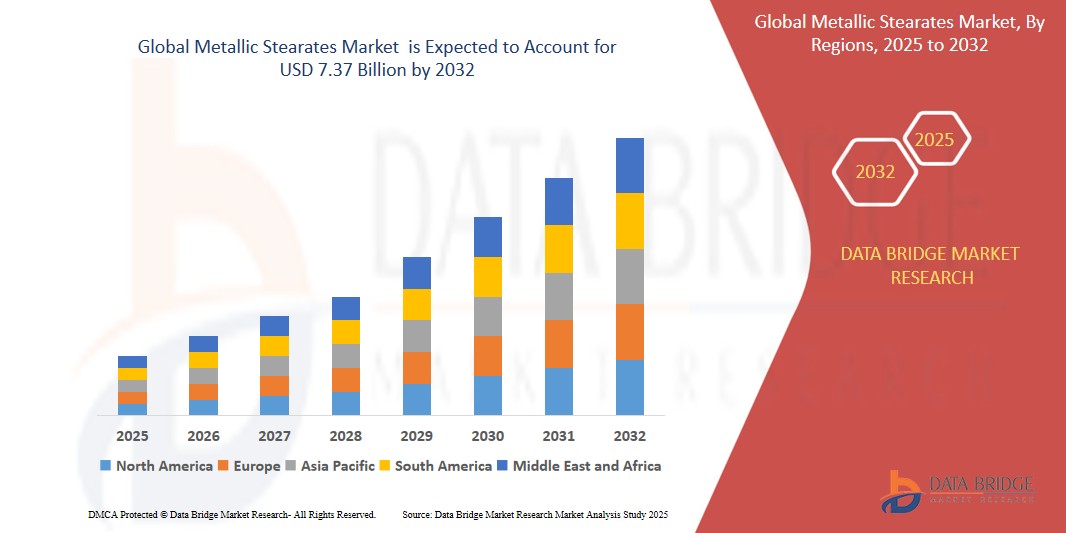
Metallic Stearates Market Size
- The global metallic stearates market was valued atUSD 4.88 billion in 2024 and is expected to reachUSD 7.37 billion by 2032
- During the forecast period of 2025 to 2032 the market is likely to grow at aCAGR of 5.3%, primarily driven by the increasing demand from the plastics and rubber industries
- This growth is driven as metallic stearates serve as acid scavengers and processing aids, improving the thermal stability and mechanical properties of PVC products.
- This application is crucial for producing pipes, profiles, and other construction materials.
Metallic Stearates Market Analysis
- Metallic stearates are widely used across plastics, rubber, pharmaceuticals, cosmetics, and construction due to their lubricating, stabilizing, and water-repelling properties, driving steady demand across sectors.
- Growth in the plastics industry, especially in Asia-Pacific, is boosting the use of metallic stearates as release agents and stabilizers in PVC and other polymers.
- Environmental concerns and regulations are encouraging manufacturers to explore bio-based or sustainable metallic stearate production methods, particularly in Europe and North America.
Report Scope and Metallic Stearates Market Segmentation
|
Attributes |
Metallic Stearates Key Market Insights |
|
Segments Covered |
|
|
Countries Covered |
North America
Europe
Asia-Pacific
Middle East and Africa
South America
|
|
Key Market Players |
|
|
Market Opportunities |
|
|
Value Added Data Infosets |
In addition to the insights on market scenarios such as market value, growth rate, segmentation, geographical coverage, and major players, the market reports curated by the Data Bridge Market Research also include in-depth expert analysis, pricing analysis, brand share analysis, consumer survey, demography analysis, supply chain analysis, value chain analysis, raw material/consumables overview, vendor selection criteria, PESTLE Analysis, Porter Analysis, and regulatory framework. |
Metallic Stearates Market Trends
“Shift Toward Bio-based Metallic Stearates”
- Growing environmental concerns and stringent regulations are prompting industries to seek sustainable alternatives. Bio-based metallic stearates, derived from renewable sources like palm and soy oils, offer biodegradable and non-toxic options aligning with these demands.
- The cosmetics industry is increasingly incorporating bio-based metallic stearates, such as magnesium and zinc stearates, into products like makeup and skincare items. Their properties enhance product texture and stability while meeting consumer expectations for eco-friendly ingredients.
- Bio-based metallic stearates are gaining traction in plastics and rubber manufacturing, especially in regions like Asia-Pacific. They serve as effective lubricants and stabilizers, improving processing efficiency and product quality in applications ranging from automotive parts to construction materials.
- For instance, Evonik's range of bio-based materials also includes biosurfactants like REWOFERM, which are produced using a low-energy fermentation process, making them environmentally friendly.
- The transition to bio-based metallic stearates reflects a broader industry movement toward sustainability. The demand for eco-friendly additives is expected to drive continued growth and innovation in the metallic stearates market.
Metallic Stearates Market Dynamics
Driver
“Increasing Demand from the Plastics and Rubber Industries”
- Metallic stearates, particularly calcium and zinc stearates, are widely utilized as lubricants, stabilizers, and release agents in the plastics and rubber sectors.
- They enhance processing efficiency and product quality, making them indispensable in these industries
- The rubber industry has seen a notable increase in metallic stearate usage. These compounds act as mold release agents and processing aids, facilitating the manufacture of tires and other rubber products.
- Rapid industrialization and urbanization in regions like Asia-Pacific have led to heightened demand for plastics and rubber products. This surge directly boosts the need for metallic stearates in manufacturing processes.
For instance,
- Baerlocher, a leading global supplier of metal stearates, expanded its manufacturing capabilities in the U.S. and Malaysia to meet growing demand from PVC and rubber processing industries. This move reflects the increasing need for high-performance stabilizers and lubricants in these sectors.
- The escalating demand from the plastics and rubber industries underscores the pivotal role of metallic stearates as essential additives. Their multifunctional properties not only enhance product performance but also drive the growth trajectory of the metallic stearates market globally.
Opportunity
“Expansion in the Pharmaceutical and Personal Care Sectors”
- The increasing global demand for medicines and supplements is boosting the need for metallic stearates like magnesium and calcium stearate, which are widely used as lubricants and flow agents in tablet manufacturing.
- Metallic stearates serve as emulsifiers, stabilizers, and thickening agents in personal care products. With the growing preference for skincare and cosmetics, especially in emerging economies, this sector offers strong growth potential.
- The pharmaceutical and personal care industries require high-purity, food-grade metallic stearates. This is driving innovation and specialization in product offerings, opening doors for premium pricing and value-added services.
For instance,
- Peter Greven, a manufacturer of metallic stearates, has expanded its LIGAMED line to include pharmaceutical-grade calcium and magnesium stearates. These stearates are formulated for use in pharmaceuticals and meet pharmacopeia standards, ensuring they are suitable for use in medications. Greven's LIGAMED products are known for their high purity and specific properties tailored to the pharmaceutical industry.
- As health and personal care spending rises globally, manufacturers focusing on high-purity metallic stearates tailored to these sectors can unlock significant revenue streams and long-term partnerships with end-use companies.
Restraint/Challenge
“Volatility in Raw Material Prices”
- Metallic stearates production heavily relies on stearic acid and metal oxides like zinc, calcium, and aluminum. Fluctuations in the availability and cost of these materials can disrupt supply chains and affect pricing strategies.
- Prices of raw materials are susceptible to changes due to supply-demand dynamics, trade policies, and geopolitical events. For instance, disruptions in palm oil supply, a primary source of stearic acid, can lead to significant cost variations.
- Rising raw material costs can erode profit margins for manufacturers, especially when market competition limits the ability to pass these costs onto consumers. This scenario can hinder investments in innovation and expansion.
- Addressing raw material price volatility requires strategic sourcing, diversification of supply chains, and investment in alternative materials. Such measures are essential for ensuring stability and sustained growth in the metallic stearates market.
Metallic Stearates Market Scope
The market is segmented on the basis of type, form, and end user.
|
Segmentation |
Sub-Segmentation |
|
By Type |
|
|
By Form |
|
|
By End-User |
|
Metallic Stearates Market Regional Analysis
“Asia-Pacific is the Dominant Region in the Metallic Stearates Market”
- Asia-Pacific dominates the metallic stearates market, due to rapid industrialization, especially in China and India, fuelling demand in plastics, rubber, and coatings sectors
- China holds a significant share due to cost-effective manufacturing and favorable economic conditions contribute to sustained growth
- The region's booming construction industry, expanding pharmaceutical and cosmetics markets, and availability of raw materials further bolster its leading position
“North America is Projected to Register the Highest Growth Rate”
- North America region is expected to witness the highest growth rate in the Metallic Stearates market, driven by strong demand from the pharmaceutical and cosmetics industries
- U.S. is growing with highest CAGR in the region as these sectors extensively use metallic stearates as lubricants and stabilizers.
- In addition, the region's emphasis on eco-friendly formulations and robust R&D activities further drive market expansion
Metallic Stearates Market Share
The market competitive landscape provides details by competitor. Details included are company overview, company financials, revenue generated, market potential, investment in research and development, new market initiatives, global presence, production sites and facilities, production capacities, company strengths and weaknesses, product launch, product width and breadth, application dominance. The above data points provided are only related to the companies' focus related to market.
The Major Market Leaders Operating in the Market Are:
- DOVER CHEMICAL CORPORATION (U.S.)
- Baerlocher GmbH (Germany)
- FACI SAP (Italy)
- Peter Greven GmbH & Co. KG (Germany)
- Valtris Specialty Chemicals (U.S.)
- Norac Additives LLC (U.S.)
- Sun Ace Kakoh (Pte.) Ltd (Singapore)
- PMC Group, Inc. (U.S.)
- James M. Brown Ltd. (U.K.)
- Nimbasia (India)
- Marathwada Chemicals (India)
- Lumega Industries (India)
- IRRH SPECIALTY CHEMICALS INDIA LIMITED (India)
- PROMAX Industries ApS (Denmark)
- SEOUL FINE CHEMICAL IND. CO., LTD. (South Korea)
- BELIKE (China)
- GOLDSTAB ORGANICS PVT LTD (India)
- Synergy Poly Additives Pvt. Ltd. (India)
- Mallinckrodt (U.S.)
- Himstab, LLC (U.S.)
Latest Developments in Global Metallic Stearates Market
- In October 2021, Baerlocher GmbH (Germany) announced an investment to expand its production facility in Bury. The project involves increasing the capacity of its calcium-based PVC stabilizer plant by over 50% through the addition of new mixing and granulation units, scheduled for installation in 2022.
- In March 2021, Baerlocher GmbH (Germany) further developed its manufacturing site in Dewas, Madhya Pradesh, India. The new facility is dedicated to the production of calcium-based PVC stabilizers and will have an annual capacity of 30,000 tons. This expansion follows a previous one completed in early 2020.
- In September 2020, Kigo Chemical, a distributor of specialty chemicals, entered into an agreement with Valtris Specialty Chemicals, a global manufacturer of specialty additives, to handle the distribution of Synpro Metallic Stearates throughout Mexico.
- In June 2020, Peter Greven GmbH & Co. KG, a prominent producer of oleochemical additives, entered into an exclusive distribution partnership with Solenis Switzerland GmbH, a key player in specialty chemicals.
- In June 2019, PMC Biogenix (US) revealed plans to substantially increase production capacity for specialty chemicals—including fatty acids, esters, and metal soaps—at its Memphis, Tennessee plant.
SKU-
Erhalten Sie Online-Zugriff auf den Bericht zur weltweit ersten Market Intelligence Cloud

- Interaktives Datenanalyse-Dashboard
- Unternehmensanalyse-Dashboard für Chancen mit hohem Wachstumspotenzial
- Zugriff für Research-Analysten für Anpassungen und Abfragen
- Konkurrenzanalyse mit interaktivem Dashboard
- Aktuelle Nachrichten, Updates und Trendanalyse
- Nutzen Sie die Leistungsfähigkeit der Benchmark-Analyse für eine umfassende Konkurrenzverfolgung
Forschungsmethodik
Die Datenerfassung und Basisjahresanalyse werden mithilfe von Datenerfassungsmodulen mit großen Stichprobengrößen durchgeführt. Die Phase umfasst das Erhalten von Marktinformationen oder verwandten Daten aus verschiedenen Quellen und Strategien. Sie umfasst die Prüfung und Planung aller aus der Vergangenheit im Voraus erfassten Daten. Sie umfasst auch die Prüfung von Informationsinkonsistenzen, die in verschiedenen Informationsquellen auftreten. Die Marktdaten werden mithilfe von marktstatistischen und kohärenten Modellen analysiert und geschätzt. Darüber hinaus sind Marktanteilsanalyse und Schlüsseltrendanalyse die wichtigsten Erfolgsfaktoren im Marktbericht. Um mehr zu erfahren, fordern Sie bitte einen Analystenanruf an oder geben Sie Ihre Anfrage ein.
Die wichtigste Forschungsmethodik, die vom DBMR-Forschungsteam verwendet wird, ist die Datentriangulation, die Data Mining, die Analyse der Auswirkungen von Datenvariablen auf den Markt und die primäre (Branchenexperten-)Validierung umfasst. Zu den Datenmodellen gehören ein Lieferantenpositionierungsraster, eine Marktzeitlinienanalyse, ein Marktüberblick und -leitfaden, ein Firmenpositionierungsraster, eine Patentanalyse, eine Preisanalyse, eine Firmenmarktanteilsanalyse, Messstandards, eine globale versus eine regionale und Lieferantenanteilsanalyse. Um mehr über die Forschungsmethodik zu erfahren, senden Sie eine Anfrage an unsere Branchenexperten.
Anpassung möglich
Data Bridge Market Research ist ein führendes Unternehmen in der fortgeschrittenen formativen Forschung. Wir sind stolz darauf, unseren bestehenden und neuen Kunden Daten und Analysen zu bieten, die zu ihren Zielen passen. Der Bericht kann angepasst werden, um Preistrendanalysen von Zielmarken, Marktverständnis für zusätzliche Länder (fordern Sie die Länderliste an), Daten zu klinischen Studienergebnissen, Literaturübersicht, Analysen des Marktes für aufgearbeitete Produkte und Produktbasis einzuschließen. Marktanalysen von Zielkonkurrenten können von technologiebasierten Analysen bis hin zu Marktportfoliostrategien analysiert werden. Wir können so viele Wettbewerber hinzufügen, wie Sie Daten in dem von Ihnen gewünschten Format und Datenstil benötigen. Unser Analystenteam kann Ihnen auch Daten in groben Excel-Rohdateien und Pivot-Tabellen (Fact Book) bereitstellen oder Sie bei der Erstellung von Präsentationen aus den im Bericht verfügbaren Datensätzen unterstützen.











