



Global Micro Services in Healthcare Market Segmentation, By Delivery Model (Cloud-Based and On-Premises), Component (Services and Platforms), End-User (Healthcare Payers, Clinical Laboratories, Healthcare Providers and Life Sciences Organizations), Distribution Channel (Direct Sales and Distributor Sales) - Industry Trends and Forecast to 2032
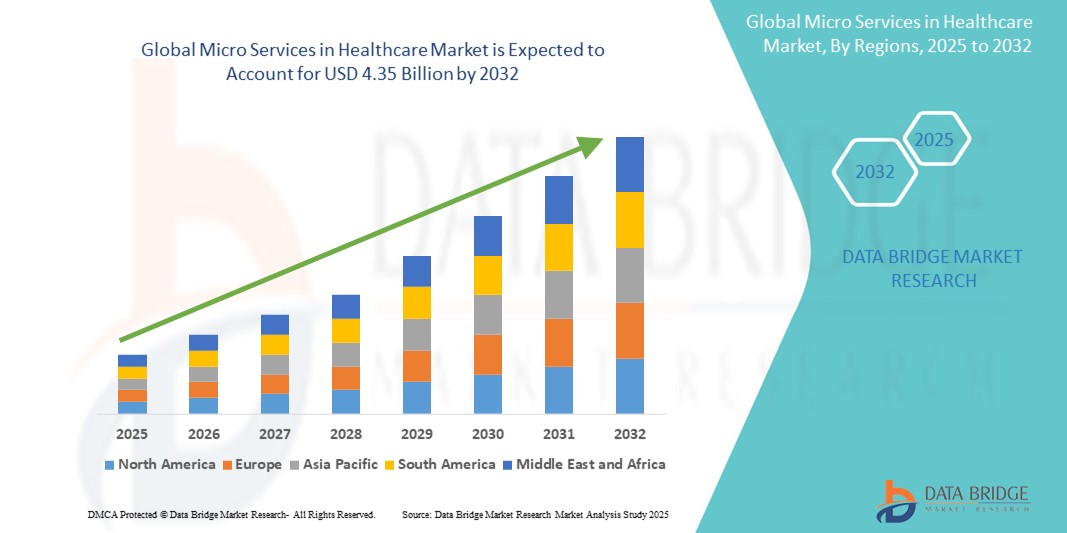
Global Micro Services in Healthcare Market Size
- The global micro services in healthcare size was valued atUSD 457.11 million in 2024and is expected to reachUSD 4.35 billion by 2032, at aCAGR of 32.55%during the forecast period
- This growth is driven by factors such as enhanced interoperability and data exchange and agility and innovation in healthcare delivery
Global Micro Services in Healthcare Market Analysis
- Microservices in healthcare refer to a modular approach to building and managing healthcare software systems, where applications are divided into small, independent services that each perform a specific business function. These services communicate via APIs and can be developed, deployed, and scaled independently
- The demand for microservices in healthcare is significantly driven by the need for enhanced interoperability, real-time patient data exchange, and customized healthcare solutions. With the shift toward value-based care and patient-centric models, microservices enable organizations to break down large monolithic systems into modular components that can be individually managed, scaled, and updated
- North America is expected to dominate the global microservices in healthcare market during the forecast period holding an estimated market share of approximately 47.5%. This dominance is attributed to its advanced IT infrastructure, adoption of digital health technologies, high healthcare spending, and the presence of key market players focused on delivering scalable, cloud-based healthcare solutions.
- Asia-Pacific is projected to be the fastest-growing region in the microservices in healthcare market due to rising investments in healthcare infrastructure, increasing digitalization of healthcare systems, and growing awareness of the benefits of microservice-based healthcare platforms. Countries such as India, China, and Japan are making significant advancements in eHealth and telemedicine, which is further fuelling market expansion
- Platform segment is expected to dominate the micro services in healthcare market with the largest share of 52.22% in 2025 as it offers modular solutions for integrating multiple services (EHRs, telemedicine, diagnostics), enabling rapid innovation and deployment of healthcare applications.
Report Scope and Global Micro Services in Healthcare Market Segmentation
|
Attributes |
Global Micro Services in Healthcare Key Market Insights |
|
Segments Covered |
|
|
Countries Covered |
North America
Europe
Asia-Pacific
Middle East and Africa
South America
|
|
Key Market Players |
|
|
Market Opportunities |
|
|
Value Added Data Infosets |
In addition to the insights on market scenarios such as market value, growth rate, segmentation, geographical coverage, and major players, the market reports curated by the Data Bridge Market Research also include import export analysis, production capacity overview, production consumption analysis, price trend analysis, climate change scenario, supply chain analysis, value chain analysis, raw material/consumables overview, vendor selection criteria, PESTLE Analysis, Porter Analysis, and regulatory framework. |
Global Micro Services in Healthcare Market Trends
“Advancements in Microservices Architecture for Healthcare Digital Transformation”
- One prominent trend in the evolution of healthcare IT is the rapid adoption of microservices architecture, enabling modular, scalable, and independently deployable services that revolutionize healthcare software development
- These advancements enhance agility and efficiency in healthcare systems by allowing real-time integration of clinical data, personalized patient services, and seamless interoperability across platforms. This modularity is crucial for responding to changing healthcare demands, regulatory requirements, and patient needs
- For instance, microservices allow healthcare organizations to independently update components such as electronic health records (EHR), telemedicine platforms, billing systems, or patient portals without disrupting the entire system. This flexibility accelerates digital innovation and supports complex, data-driven applications such as AI-powered diagnostics and real-time patient monitoring
- These innovations are transforming the healthcare delivery model, enabling faster deployment of solutions, improved patient experiences, and cost savings through efficient resource utilization. As a result, the demand for microservices-based healthcare systems is surging globally, especially among providers seeking to modernize legacy systems and implement future-ready digital health infrastructure
Global Micro Services in Healthcare Market Dynamics
Driver
“Surging Demand for Agile, Scalable Digital Healthcare Systems”
- The increasing need for agile and modular healthcare IT infrastructures is a major driver of growth in the global microservices in healthcare market. Microservices enable healthcare organizations to break down large monolithic systems into independently deployable, scalable modules, allowing quicker development and deployment of applications
- With the growing adoption of electronic health records (EHRs), telemedicine platforms, and remote patient monitoring systems, healthcare providers require highly adaptable solutions that can be integrated and updated without causing system-wide disruptions
- Microservices also improve system resilience, fault isolation, and maintenance efficiency, making them particularly appealing for large hospitals and health networks seeking to modernize legacy software and infrastructure
For instance,
- In January 2024, a report by Healthcare IT News highlighted that over 70% of U.S. health systems are planning to adopt microservices-based architectures by 2026 to enhance their digital transformation strategies. The flexibility and cost-efficiency of this model are key reasons behind the shift
- As the demand for real-time healthcare services, such as virtual consultations and instant diagnostics, continues to grow, microservices architecture is becoming essential for future-ready healthcare systems
Opportunity
“Revolutionizing Patient Care through AI-Integrated Microservices”
- The integration of AI with microservices architecture offers significant opportunities for innovation in healthcare. AI-powered modules can be independently deployed and scaled within a microservices framework, facilitating smarter decision-making and personalized treatment recommendations.
- AI-driven microservices can also handle natural language processing (NLP), predictive analytics, and clinical decision support, enabling more accurate diagnoses and proactive interventions.
- In addition, microservices enable continuous updates and integration of AI models across EHRs, imaging systems, and diagnostic platforms, improving system performance without downtime.
For instance,
- According to a study published in Nature Digital Medicine (March 2025), healthcare systems using AI-powered microservices reported up to 25% improvements in clinical workflow efficiency and a 40% reduction in diagnostic errors in radiology and pathology services
- This AI-microservices synergy is paving the way for automated patient triage, real-time clinical alerts, and enhanced remote monitoring, all of which contribute to improved patient outcomes and reduced healthcare costs
Restraint/Challenge
“Complex Implementation and Integration Barriers”
- Despite its advantages, the implementation of microservices in healthcare is often challenged by integration complexity, especially in organizations with legacy systems or outdated IT infrastructures
- The transition from monolithic architectures to microservices requires substantial investment, skilled developers, and coordinated efforts across IT and clinical teams. Without proper management, this can lead to data silos, communication failures, or security vulnerabilities
- Moreover, aligning multiple microservices to function cohesively within strict regulatory environments such as HIPAA or GDPR adds additional layers of compliance complexity
For instance,
- In a 2024 report from Frost & Sullivan, it was found that over 40% of mid-sized healthcare organizations in Europe faced difficulties integrating microservices due to limited technical expertise and inadequate data governance frameworks
- These challenges can delay digital transformation initiatives and widen the technology gap between advanced and resource-constrained healthcare systems, potentially affecting service delivery and patient care continuity
Global Micro Services in Healthcare Market Scope
The market is segmented on the basis of delivery model, component, end user and distribution channel.
|
Segmentation |
Sub-Segmentation |
|
By Delivery Model |
|
|
By Component |
|
|
By End User |
|
|
By Distribution Channel |
|
In 2025, the platform is projected to dominate the market with a largest share in technology segment
The platform segment is expected to dominate the micro services in healthcare market with the largest share of 52.22% in 2025 as it offers modular solutions for integrating multiple services (EHRs, telemedicine, diagnostics), enabling rapid innovation and deployment of healthcare applications. Platforms serve as the foundational infrastructure enabling healthcare organizations to rapidly innovate and deploy digital applications, streamlining clinical workflows and improving patient outcomes. Their flexibility supports the development of personalized care models, real-time data sharing, and automation—key drivers in today’s evolving healthcare environment.
The cloud-based delivery model is expected to account for the largest share during the forecast period in delivery model market
In 2025, the cloud-based delivery model segment is expected to dominate the market with the largest market share of 20.39% due to scalability and flexibility. Reduced infrastructure costs and subscription-based pricing models make cloud solutions more affordable for healthcare providers.
Global Micro Services in Healthcare Market Regional Analysis
“North America Holds the Largest Share in the Global Micro Services in Healthcare Market”
- North America leads the global microservices in healthcare market, holding an estimated 47.5 share, due to its advanced healthcare infrastructure, high technology adoption, and significant investments in healthcare innovation. The region's strong presence of healthcare providers and favorable regulatory environment also contribute to its dominance
- U.S. holds a dominant market share of around 41.5%. attributed to its advanced IT infrastructure, due to adoption of digital health technologies, high healthcare spending, and the presence of key market players focused on delivering scalable, cloud-based healthcare solutions
- The adoption of microservices technologies is fueled by the need for faster, more scalable, and flexible healthcare solutions to manage and treat these conditions. Continuous advancements in medical technologies and improved patient outcomes support the market’s expansion.
- The presence of major healthcare providers, technology companies, and medical device manufacturers fosters rapid innovation and integration of microservices solutions, enhancing healthcare delivery worldwide
“Asia-Pacific is Projected to Register the Highest CAGR in the Global Micro Services in Healthcare Market”
- Asia-Pacific is projected to be the fastest-growing region in the microservices in healthcare market due to rising investments in healthcare infrastructure, increasing digitalization of healthcare systems, and growing awareness of the benefits of microservice-based healthcare platforms
- Countries such as China, India, and Japan are emerging as key markets in the global microservices healthcare sector, driven by their large populations, rapid healthcare digitization, and increasing demand for personalized healthcare services
- Japan, a leader in adopting advanced medical technology, is a key market for microservices in healthcare. The country's healthcare system is highly digitalized, and there is a growing emphasis on improving operational efficiency, patient outcomes, and system interoperability. IT innovations, supports the demand for microservices technologies in the healthcare sector
- China is witnessing rapid growth in the microservices healthcare market due to the country’s large population and increasing prevalence of chronic diseases
- Fastest Growing Country: India is currently the fastest-growing market for microservices in healthcare in the Asia Pacific region. With a growing number of healthcare startups, a focus on healthcare IT adoption, and government-led initiatives to improve healthcare accessibility and affordability, India is rapidly embracing microservices to support scalable, cost-effective healthcare solutions
Global Micro Services in Healthcare Market Share
The market competitive landscape provides details by competitor. Details included are company overview, company financials, revenue generated, market potential, investment in research and development, new market initiatives, global presence, production sites and facilities, production capacities, company strengths and weaknesses, product launch, product width and breadth, application dominance. The above data points provided are only related to the companies' focus related to market.
The Major Market Leaders Operating in the Market Are:
- Amazon Web Services, Inc.(U.S.)
- Microsoft (U.S.)
- Salesforce, Inc.(U.S.)
- Infosys Limited(India)
- IBM Corporation(U.S.)
- NGINX (U.S.)
- Oracle (U.S.)
- Atos SE (U.S.)
- Cognizant (U.S.)
- Datawire, Inc. (U.S.)
- Software GmbH (Germany)
- Red Hat, Inc. (U.S.)
- Cloud Software Group, Inc. (U.S.)
- SAP SE (Germany)
Latest Developments in Global Micro Services in Healthcare Market
- In March 2024, NVIDIA Healthcare launched generative AI microservices to advance drug discovery, MedTech, and digital health, offering a catalog of NVIDIA NIM and GPU-accelerated microservices for biology, chemistry, imaging, and healthcare data running in every NVIDIA DGX Cloud, enabling faster, scalable, and flexible healthcare solutions globally
- In March 2018, DevCool Inc. launched HiPaaS, a next-generation healthcare platform built on microservices and Dell Boomi iPaaS, enabling hospitals and insurance companies to quickly integrate new technologies such as blockchain, AI, telemedicine, and wearable devices while reducing costs by 60%
- In March 2024, Abridge partners with NVIDIA to enhance generative AI-powered clinical documentation, leveraging NVIDIA’s compute resources and NIM inference microservices, while receiving investment from NVentures to scale its AI solutions for clinicians and improve healthcare efficiency
SKU-
Erhalten Sie Online-Zugriff auf den Bericht zur weltweit ersten Market Intelligence Cloud

- Interaktives Datenanalyse-Dashboard
- Unternehmensanalyse-Dashboard für Chancen mit hohem Wachstumspotenzial
- Zugriff für Research-Analysten für Anpassungen und Abfragen
- Konkurrenzanalyse mit interaktivem Dashboard
- Aktuelle Nachrichten, Updates und Trendanalyse
- Nutzen Sie die Leistungsfähigkeit der Benchmark-Analyse für eine umfassende Konkurrenzverfolgung
Forschungsmethodik
Die Datenerfassung und Basisjahresanalyse werden mithilfe von Datenerfassungsmodulen mit großen Stichprobengrößen durchgeführt. Die Phase umfasst das Erhalten von Marktinformationen oder verwandten Daten aus verschiedenen Quellen und Strategien. Sie umfasst die Prüfung und Planung aller aus der Vergangenheit im Voraus erfassten Daten. Sie umfasst auch die Prüfung von Informationsinkonsistenzen, die in verschiedenen Informationsquellen auftreten. Die Marktdaten werden mithilfe von marktstatistischen und kohärenten Modellen analysiert und geschätzt. Darüber hinaus sind Marktanteilsanalyse und Schlüsseltrendanalyse die wichtigsten Erfolgsfaktoren im Marktbericht. Um mehr zu erfahren, fordern Sie bitte einen Analystenanruf an oder geben Sie Ihre Anfrage ein.
Die wichtigste Forschungsmethodik, die vom DBMR-Forschungsteam verwendet wird, ist die Datentriangulation, die Data Mining, die Analyse der Auswirkungen von Datenvariablen auf den Markt und die primäre (Branchenexperten-)Validierung umfasst. Zu den Datenmodellen gehören ein Lieferantenpositionierungsraster, eine Marktzeitlinienanalyse, ein Marktüberblick und -leitfaden, ein Firmenpositionierungsraster, eine Patentanalyse, eine Preisanalyse, eine Firmenmarktanteilsanalyse, Messstandards, eine globale versus eine regionale und Lieferantenanteilsanalyse. Um mehr über die Forschungsmethodik zu erfahren, senden Sie eine Anfrage an unsere Branchenexperten.
Anpassung möglich
Data Bridge Market Research ist ein führendes Unternehmen in der fortgeschrittenen formativen Forschung. Wir sind stolz darauf, unseren bestehenden und neuen Kunden Daten und Analysen zu bieten, die zu ihren Zielen passen. Der Bericht kann angepasst werden, um Preistrendanalysen von Zielmarken, Marktverständnis für zusätzliche Länder (fordern Sie die Länderliste an), Daten zu klinischen Studienergebnissen, Literaturübersicht, Analysen des Marktes für aufgearbeitete Produkte und Produktbasis einzuschließen. Marktanalysen von Zielkonkurrenten können von technologiebasierten Analysen bis hin zu Marktportfoliostrategien analysiert werden. Wir können so viele Wettbewerber hinzufügen, wie Sie Daten in dem von Ihnen gewünschten Format und Datenstil benötigen. Unser Analystenteam kann Ihnen auch Daten in groben Excel-Rohdateien und Pivot-Tabellen (Fact Book) bereitstellen oder Sie bei der Erstellung von Präsentationen aus den im Bericht verfügbaren Datensätzen unterstützen.











