


Global Portable Projector Market Segmentation, By Product (Embedded Projector, USB Projector, and Non-Embedded or Standalone Projector), Dimension (2D and 3D), Lumen (Below 500, 500 to 3,000, and Above 3,000), Resolution (VGA, XGA, HD, and FHD) Technology (Digital Light Processing, Laser Beam Steering, Liquid Crystal on Silicon, and Holographic Laser Projection), Application (Consumer Electronics, Business and Education, and Others) - Industry Trends and Forecast to 2033
Was ist die Portable Projector Market Size und Growth Rate
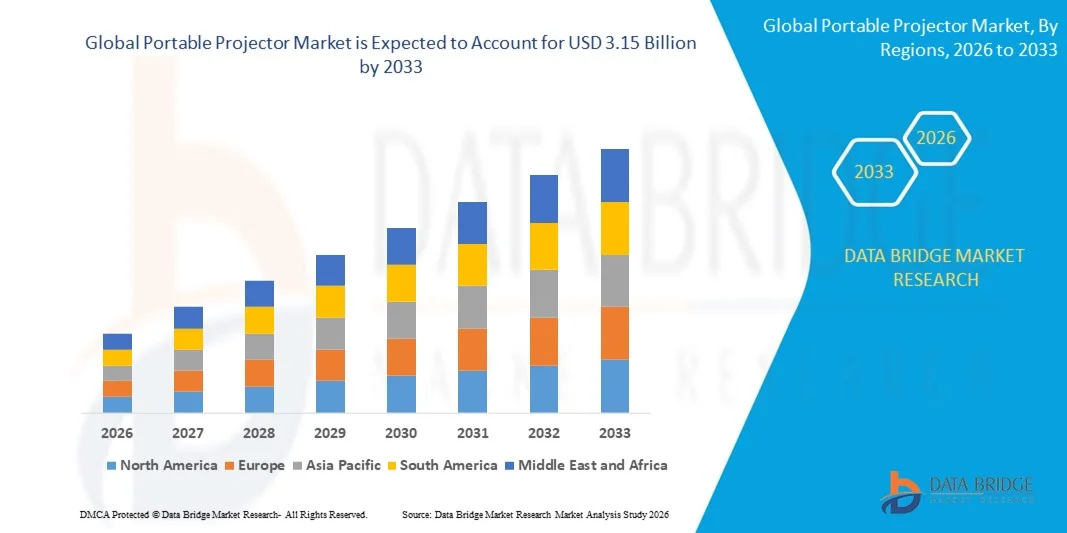
- Wie bei Data Bridge Market Research Analysis wurde die globale tragbare Projektor-Marktgröße bewertet2,29 Milliarden USD im Jahr 2025und wird voraussichtlich erreichen3,15 Milliarden USD bis 2033, beiCAGR von 4,10 %während des Prognosezeitraums
- Das Marktwachstum wird größtenteils durch die zunehmende Übernahme von tragbaren und hochauflösenden Projektoren über Heimunterhaltungs-, Bildungs- und Unternehmensumgebungen, unterstützt durch kontinuierliche technologische Fortschritte in kompakten Projektionssystemen
- Darüber hinaus stellt die steigende Nachfrage nach leichten, benutzerfreundlichen und funktionsreichen Projektoren mit drahtloser Vernetzung, intelligenter Streaming und Portabilität tragbare Projektoren als wesentliche Geräte für den vielseitigen Medienkonsum her. Diese Faktoren beschleunigen die Adoption und erhöhen dadurch das Wachstum des Marktes deutlich
Marktgröße und Prognose
Globaler Marktwert (2025):2,29 Mrd. USD
Voraussichtlicher Marktwert (2033):3,15 Milliarden USD
Wettervorhersage CAGR (2026–2033):4.10%
Was sind die großen Takeaways des Portable Projector Market
- Tragbare Projektoren mit kompakten, mobilen und qualitativ hochwertigen Projektionskapazitäten sind aufgrund ihrer Bequemlichkeit, Mobilität und Integration mit intelligenten Geräten und Streaming-Services immer wichtiger in Heimunterhaltung, Klassenräumen und Unternehmenspräsentationen.
- Die eskalierende Nachfrage nach tragbaren Projektoren wird in erster Linie durch steigende Urbanisierung, zunehmenden digitalen Content-Verbrauch, wachsende Fernarbeit und hybride Lerntrends und Verbraucherpräferenz für flexible, on-the-go Multimedia-Lösungen angetrieben.
- Nordamerika dominierte den tragbaren Projektor-Markt mit einem Anteil von 37,42%im Jahr 2025, aufgrund der wachsenden Annahme von Heim-Entertainment-Systemen, Bildungstechnologie und Corporate Präsentation Tools
- Asia-Pacific wird erwartet, dass die am schnellsten wachsende Region im tragbaren Projektor-Markt während der Prognosezeit durch steigende Einwegeinkommen, Urbanisierung und technologische Fortschritte in Ländern wie China, Japan und Indien
- 2D-Segment dominierte den Markt mit einem Marktanteil von 62,8% im Jahr 2025, aufgrund seiner breiten Anwendung in Klassenzimmern, Heimunterhaltung und Büropräsentationen. 2D-Projektoren werden für ihre Erschwinglichkeit, Zuverlässigkeit und Kompatibilität mit Standard-Videoformaten geschätzt, was sie zu einer Standardauswahl für Mainstream-Benutzer macht. Die Hersteller konzentrieren sich auf die Verbesserung der Auflösung und Helligkeit in 2D-Projektoren, um die Sichterlebnisse zu verbessern, weitere Marktannahme
Report Scope und Portable Projector Market Segmentation
|
Attribute |
Portable Projektor Key Market Insights |
|
Verdeckte Segmente |
|
|
Überarbeitete Länder |
Nordamerika
Europa
Asien-Pazifik
Naher Osten und Afrika
Südamerika
|
|
Key Market Players |
|
|
Marktmöglichkeiten |
|
|
Daten Infos zum Wert hinzugefügt |
Neben den Erkenntnissen zu Marktszenarien wie Marktwert, Wachstumsrate, Segmentierung, geografischer Erfassung und wichtigen Akteuren umfassen die Marktberichte, die von der Data Bridge Market Research kuratiert wurden, auch eine gründliche Expertenanalyse, geographisch vertretene unternehmensweise Produktion und Kapazität, Netzwerklayouts von Distributoren und Partnern, detaillierte und aktualisierte Preistrendanalyse und Defizitanalyse von Angebotskette und Nachfrage. |
Was ist der Haupttrend im Portable Projector Market
Wachsende Annahme von Home Unterhaltung und Bildungsanwendungen
- Ein wesentlicher Trend im tragbaren Projektormarkt ist die zunehmende Nutzung von kompakten Projektoren für Heimunterhaltung und Bildungszwecke, die von der Nachfrage nach immersiven Blickerlebnissen und interaktiven Lernlösungen angetrieben werden. Verbraucher suchen vielseitige Geräte, die Filme, Spiele und Klassenzimmer-Präsentationen mit Leichtigkeit unterstützen können
- Zum Beispiel gewinnen Ankers Nebula-Serie und Epsons EF-100-Modell Popularität für Heimkinos und Online-Learning-Setups, die Portabilität, hohe Helligkeit und drahtlose Vernetzung bieten. Diese Projektoren ermöglichen es Benutzern, Wohnzimmer und Klassenzimmer in interaktive Unterhaltungs- und Bildungsräume zu verwandeln
- Die Nachfrage nach Miniprojektoren steigt in fernen Arbeits- und hybriden Lernumgebungen, in denen Mobilität und Bequemlichkeit unerlässlich sind. Geräte mit eingebauten Lautsprechern und batteriebetriebenem Betrieb ermöglichen eine nahtlose Portabilität für Business-Präsentationen und Vorträge
- Höhere Auflösung und verbesserte Bildqualitätseigenschaften werden zu Standarderwartungen, wodurch die Hersteller in kompakten Formfaktoren innovativ werden. Dieser Trend unterstützt verbesserte visuelle Erfahrungen für Unterhaltungsstreaming und professionelle Präsentationen
- Portable Projektoren werden zunehmend mit intelligenten Technologien integriert, einschließlich Wireless Casting, Android OS und App-Support, so dass Benutzer Inhalte ohne zusätzliche Geräte streamen können. Dies treibt die Verbraucherpräferenz für Geräte, die Multifunktionalität und intelligente Konnektivität bieten
- Die weltweite Expansion des digitalen Content-Verbrauchs treibt das Wachstum weiter voran, da Medien, Bildung und Unternehmensbereiche tragbare Projektionslösungen annehmen. Sensibilisierung und Zugänglichkeit sind die Positionierung von tragbaren Projektoren als wesentliche Werkzeuge für vielseitige visuelle Erfahrungen
Portable Projektor Market Dynamics
Fahrer
steigende Nachfrage nach kompakten, drahtlosen und Feature-Rich-Projektoren
- Die zunehmende Verbraucherpräferenz für leichte, tragbare und einfach zu bedienende Projektoren treibt das Marktwachstum voran. Diese Projektoren ermöglichen es Benutzern, Unterhaltungs- und Präsentationsfunktionen überall zu führen, ohne auf sperrige Setups zu vertrauen
- So bietet die LG’s CineBeam-Serie kompakte Projektoren mit kabelloser Bildschirmspiegelung und langlebiger Batterielebensdauer, die sowohl für Heim- als auch für professionelle Anwender zur Verfügung stehen. Solche Produkte ermöglichen eine nahtlose Kombination von Portabilität, Komfort und erweiterten Funktionen
- Die Integration intelligenter Funktionalitäten, einschließlich Wi-Fi, Bluetooth und mobile App-Kompatibilität, erhöht die Vielseitigkeit und das Nutzerengagement. Dies zieht sowohl einzelne Verbraucher als auch Unternehmen an, um tragbare Lösungen für vielfältige Anwendungen zu übernehmen
- Bildungseinrichtungen übernehmen tragbare Projektoren für interaktive Lehr-, Klassenzimmer-Präsentationen und Fernunterricht. Die Fähigkeit, Projektoren einfach über Klassenräume oder Hörsäle zu bewegen, verbessert die Zugänglichkeit und Lehreffizienz
- Das anhaltende Interesse an hybriden Arbeits- und Lernumgebungen treibt die Adoption weiter voran, da tragbare Projektoren impromptu Präsentationen und Content Sharing ermöglichen. Hersteller investieren in Geräte, die Portabilität, Haltbarkeit und funktionsreichen Betrieb kombinieren
Zurückhaltung/Challenge
Hohe Kosten für fortgeschrittene tragbare Projektoren
- Der Markt konfrontiert Herausforderungen durch die Premium-Preisung von funktionsreichen und hochauflösenden tragbaren Projektoren, die die Zugänglichkeit für preisempfindliche Verbraucher begrenzt. Erweiterte Optik, Batterie Langlebigkeit und intelligente Funktionalitäten tragen zu erhöhten Kosten bei
- So werden Epsons EF-12 und Anker Nebula Cosmos Max, während technologisch fortgeschritten, deutlich höher als Einstiegsmodelle geschätzt, was die Annahme in haushaltsbewussten Segmenten beeinflusst. Solche Preiszwänge schaffen Barrieren für ein breiteres Eindringen in bestimmte Märkte
- Die Entwicklung kompakter Projektoren mit hohen Lumen, 4K Auflösung und langer Akkulaufzeit erfordert erhebliche FuE-Investitionen und erhöht die Produktionskosten. Diese Kosten werden an die Verbraucher weitergegeben, was die Kaufentscheidungen betrifft
- Begrenzte Größenvorteile für leistungsfähige Projektoren machen es schwierig, Fertigungskosten zu reduzieren, ohne die Qualität zu beeinträchtigen. Die Hersteller müssen Innovationen ausgleichen, um wettbewerbsfähig zu bleiben
- Die Herausforderung der Beschaffung von spezialisierten optischen Komponenten und Batterien verschärft die Kostendrucke weiter. Zusammen mit Markterwartungen für kompakte und multifunktionale Geräte verlangsamen diese Zwänge eine rasche Markterweiterung
Wie wird der Portable Projector Market segmentiert
Der Markt ist auf der Grundlage von Produkt, Dimension, Lumen, Auflösung, Technologie und Anwendung segmentiert.
- Nach Produkt
Auf Basis des Produkts wird der tragbare Projektormarkt in Embedded Projektor, USB Projektor und nicht-embedded oder Standalone Projektor segmentiert. Das eigenständige Projektorsegment dominierte den Markt mit dem größten Umsatzanteil im Jahr 2025, angetrieben durch seine Vielseitigkeit, höhere Helligkeit und überlegene Projektionsqualität. Verbraucher und Unternehmen bevorzugen aufgrund ihrer robusten Leistung und Anpassungsfähigkeit oft eigenständige Projektoren für Präsentationen, Heimtheater und große Veranstaltungsorte. Diese Projektoren bieten auch erweiterte Lampenleben, vielfältige Anschlussmöglichkeiten und Kompatibilität mit verschiedenen Inhaltsquellen, so dass sie sehr gefragt. Die Nachfrage wird durch kontinuierliche Weiterentwicklungen in kompakten Designs weiter gestärkt, die eine hohe Leistung erhalten, ohne die Portabilität zu beeinträchtigen.
Das USB-Projektor-Segment wird erwartet, um die schnellste Wachstumsrate von 2026 bis 2033, durch die steigende Nachfrage nach tragbaren, Plug-and-Play-Geräten, die leicht mit Laptops, Tablets und Smartphones zu verbinden. So haben beispielsweise Unternehmen wie Anker und AAXA Technologies leichte USB-Projektoren eingeführt, die eine bequeme On-the-Go-Projektion für den persönlichen und professionellen Einsatz bieten. Die Einfachheit der Einrichtung, Erschwinglichkeit und die Fähigkeit, schnelle Präsentationen ohne sperrige Ausrüstung zu unterstützen, machen USB-Projektoren attraktiv in Bildungs- und Kleinbetriebsumgebungen. Das Segmentwachstum wird auch durch steigende Remote-Work-Trends und mobile Unterhaltungsbedürfnisse unterstützt, wodurch kompakte und effiziente Lösungen gefördert werden.
- Nach Maß
Auf Basis der Dimension wird der tragbare Projektormarkt in 2D- und 3D-Projektoren segmentiert. Das 2D-Projektorsegment dominierte den Markt mit dem größten Anteil von 62,8% im Jahr 2025 aufgrund seiner breiten Anwendung in Klassenräumen, Heimunterhaltung und Büropräsentationen. 2D-Projektoren werden für ihre Erschwinglichkeit, Zuverlässigkeit und Kompatibilität mit Standard-Videoformaten geschätzt, was sie zu einer Standardauswahl für Mainstream-Benutzer macht. Die Hersteller konzentrieren sich auf die Verbesserung der Auflösung und Helligkeit in 2D-Projektoren, um die Sichterlebnisse zu verbessern, weitere Marktannahme zu fahren. Ihre Einfachheit bei der Einrichtung und Wartung trägt zu einer nachhaltigen Präferenz bei den Verbrauchern und Unternehmen bei.
Das 3D-Projektor-Segment soll die schnellste CAGR von 2026 bis 2033 registrieren, die von steigender Nachfrage nach immersiven Unterhaltungserlebnissen und interaktiven Bildungsinhalten angetrieben wird. So haben die 3D-fähigen tragbaren Projektoren von Epson in Heimtheatern und spezialisierten Ausbildungsinstituten Traktion gewonnen. Die Technologie ermöglicht eine realistische Tiefenwahrnehmung und ansprechende Visualisierungen und zieht Anwender an, die eine erweiterte experimentelle Projektion suchen. Die wachsende Popularität in Spielen, Kinoanwendungen und virtuellen Simulationen unterstützt die schnelle Expansion des Segments.
- von Lumen
Auf der Grundlage von Lumen wird der Markt in unter 500, 500 bis 3.000 und über 3.000 Lumen segmentiert. Das Segment 500 bis 3.000 Lumen dominierte den Markt im Jahr 2025 aufgrund seiner idealen Balance zwischen Helligkeit, Portabilität und Energieeffizienz. Projektoren in diesem Bereich sind sowohl für kleine bis mittlere Räume geeignet und bieten eine klare Sichtbarkeit ohne übermäßigen Stromverbrauch. Benutzer priorisieren diese Projektoren für Heim-, Büro- und Klassenräume aufgrund ihrer zuverlässigen Leistung unter Umgebungslichtbedingungen. Die Hersteller konzentrieren sich auf die Erhöhung der Farbgenauigkeit und des Kontrasts in diesem Segment, um den Erwartungen der Verbraucher gerecht zu werden.
Das unter 500 Lumen-Segment wird erwartet, dass das schnellste Wachstum von 2026 bis 2033, angetrieben durch die zunehmende Annahme von ultra-portablen und Pocket-Size-Projektoren für mobile Unterhaltung und impromptu Präsentationen. Zum Beispiel hat Ankers Nebula-Serie Low-Lumen-Projektoren mit kompakten Designs und Smartphone-Konnektivität populär gemacht. Low-lumen Projektoren appellieren an Studenten, Reisende und kleine Büroanwender, die Bequemlichkeit suchen, ohne die Displayqualität in dim Umgebungen zu beeinträchtigen. Die steigende Nachfrage nach leichten und batteriebetriebenen Geräten unterstützt das schnelle Wachstum dieses Segments.
- Auflösung
Auf der Grundlage der Auflösung wird der Markt in VGA, XGA, HD und FHD segmentiert. Das FHD-Segment dominierte den Markt im Jahr 2025 aufgrund der steigenden Nachfrage nach High-Definition-Projektion in Heimkinos, Business-Präsentationen und Digital Signage. FHD-Projektoren bieten scharfe Visualisierungen, verbesserte Farbwiedergabe und immersive Betrachtungserfahrungen, so dass sie von tech-savvy Konsumenten bevorzugt werden. Kontinuierliche Fortschritte bei Projektionslinsen und Displaychips haben eine weitere verbesserte Bildqualität und Zuverlässigkeit. Die Hersteller konzentrieren sich darauf, FHD-Projektoren mit tragbaren Designs und mehreren Verbindungsoptionen anzubieten, um die Anforderungen der Nutzer zu erfüllen.
Das HD-Segment wird voraussichtlich das schnellste Wachstum von 2026 bis 2033 beobachten, das von erschwinglichen hochauflösenden Optionen für kleine und mittlere Setups angetrieben wird. Zum Beispiel, ViewSonic und LG haben HD tragbare Projektoren auf Bildung und kleine Office-Nutzer auf der Suche nach klaren, lebendigen Displays ohne hohe Kosten gestartet. Die Balance zwischen Qualität, Preis und Portabilität macht HD-Projektoren in aufstrebenden Märkten und mobilen Anwendungsfällen attraktiv. Die zunehmende Verfügbarkeit von Inhalten in HD-Formaten unterstützt die Adoption.
- Von der Technik
Auf Basis der Technik wird der Markt in die digitale Lichtverarbeitung (DLP), Laserstrahllenkung, Flüssigkristall auf Silizium (LCoS) und holographische Laserprojektion segmentiert. Das DLP-Segment dominierte den Markt im Jahr 2025 aufgrund seiner bewährten Zuverlässigkeit, scharfer Bildqualität und kompakter Designtauglichkeit für tragbare Geräte. DLP-Projektoren werden in der Unterhaltungselektronik, im Geschäft und in der Ausbildung für ihre hohen Kontrastverhältnisse und minimalen Wartungsanforderungen eingesetzt. Branchenführer optimieren Chipsets und Lichtquellen kontinuierlich, um Helligkeit und Farbleistung zu verbessern und stetige Marktherrschaft zu unterstützen.
Das Segment Laserstrahllenkung wird erwartet, dass das schnellste Wachstum von 2026 bis 2033, angetrieben durch seine Fähigkeit, ultra-portable, hohe Helligkeit und energieeffiziente Lösungen. So haben Unternehmen wie Sony und Epson laserbasierte Projektoren entwickelt, die kompakte Formfaktoren ermöglichen, ohne die Bildqualität zu beeinträchtigen. Die Technologie unterstützt langfristige Haltbarkeit, minimale Wärmeerzeugung und flexible Projektionswinkel, die sowohl kommerzielle als auch Verbrauchernutzer anziehen. Schnelle Übernahme in Heimkinos, Unternehmensaufbauten und Digital Signage propels Segmentwachstum.
- Anwendung
Auf Basis der Anwendung wird der tragbare Projektormarkt in Unterhaltungselektronik, Wirtschaft und Bildung und andere segmentiert. Das Segment Consumer-Elektronik dominierte den Markt im Jahr 2025 aufgrund steigender Heim-Entertainment-Anforderung und zunehmender Durchdringung intelligenter tragbarer Geräte. Portable Projektoren werden in großem Umfang für Filmstreaming, Gaming und persönlichen Medienverbrauch verwendet, angetrieben durch Funktionen wie drahtlose Vernetzung, hohe Auflösung und kompakte Designs. Die Hersteller entwickeln weiterhin integrierte Audio-, KI-basierte Anpassungen und batterieeffiziente Lösungen, um das Nutzererlebnis zu stärken.
Das Geschäfts- und Bildungssegment wird von 2026 bis 2033 am schnellsten CAGR erleben, der durch die zunehmende Übernahme von tragbaren Projektoren für Präsentationen, Klassenräume und Trainingsumgebungen angetrieben wird. So haben Epson und BenQ tragbare Projektoren mit interaktiven Funktionen für Bildungseinrichtungen und Unternehmensbüros gestartet. Die Nachfrage wird durch hybride Lerntrends, mobile Business-Operationen und die Notwendigkeit von schnellen, effektvollen Präsentationen angetrieben. Leichte, einfach einzurichtende Projektoren mit flexibler Vernetzung unterstützen das schnelle Wachstum in diesem Segment.
Welche Region hält den größten Teil des Portable Projector Market
- Nordamerika dominierte den tragbaren Projektormarkt mit dem größten Umsatzanteil von 37,42% im Jahr 2025, angetrieben durch die zunehmende Einführung von Home-Entertainment-Systemen, Bildungstechnologie und Corporate Präsentation Tools
- Verbraucher in der Region hochwertig Portabilität, hochauflösende Projektion und nahtlose Verbindung mit Geräten wie Laptops, Tablets und Smartphones
- Diese weit verbreitete Adoption wird weiter unterstützt durch hohe Einwegeinkommen, fortgeschrittene Infrastruktur und die wachsende Präferenz für kompakte, einfach zu bedienende Projektionslösungen, die Schaffung von tragbaren Projektoren als bevorzugte Wahl in Wohn-, Bildungs- und Geschäftsumgebungen
US Portable Projector Market Insight
Der US-amerikanische tragbare Projektormarkt eroberte 2025 innerhalb Nordamerikas den größten Umsatzanteil, der durch die rasche Übernahme von Heimtheatern, digitalen Klassenräumen und Unternehmenspräsentationen getrieben wurde. Verbraucher priorisieren zunehmend kompakte, hochluminositätsfähige Geräte, die drahtlose Streaming und mobile Konnektivität unterstützen. So hat Anker’s Nebula die Nachfrage nach benutzerfreundlichen, tragbaren Unterhaltungslösungen gestärkt. Die steigende Neigung für Remote-Arbeit, Hybrid-Learning und DIY-Setups erhöht das Marktwachstum weiter. Die Integration mit intelligenten Geräten und Sprachsteuerungsfunktionen trägt auch zur wachsenden Übernahme von tragbaren Projektoren in den USA bei.
Europa Portable Projector Market Insight
Der europaweit tragbare Projektor-Markt wird in der gesamten Vorausschätzungsperiode auf einem beträchtlichen CAGR ausbauen, angetrieben durch wachsende betriebliche Ausbildungsprogramme, Heimkino-Setups und Bildungsanwendungen. Die steigende Urbanisierung und die Nachfrage nach kompakten, leistungsstarken Projektionslösungen sind ermutigend. So sind die tragbaren Projektoren von Epson durch fortschrittliche Bildgebungstechnik in Deutschland und Frankreich stark vertreten. Verbraucher werden an die Bequemlichkeit, Energieeffizienz und vielseitige Bereitstellungsoptionen, die diese Geräte anbieten, angezogen. Der Markt zeigt Wachstum in Wohn-, Gewerbe- und akademischen Segmenten, wobei tragbare Projektoren in neue und renovierte Setups integriert werden.
US Portable Projector Market Insight
Der tragbare Projektor-Markt der USA wird voraussichtlich während der Prognosezeit zu einem bemerkenswerten CAGR wachsen, der durch den zunehmenden Trend von Heimunterhaltung, Bildungsanwendungen und Unternehmensmobilität getrieben wird. Hinsichtlich der Maximierung der Raumeffizienz und der einfachen Bereitstellung sind die Verbraucher ermutigen, kompakte Projektionsgeräte anzunehmen. Zum Beispiel haben die tragbaren Projektoren von LG Traktion in Unternehmens- und Bildungssektoren gewonnen. Die starke E-Commerce-Infrastruktur und das Bewusstsein für intelligente Entertainment-Geräte sollen das Marktwachstum weiter stimulieren.
Deutschland Portable Projector Market Insight
Der deutsche tragbare Projektormarkt soll sich während der Prognosezeit bei einem beträchtlichen CAGR ausweiten, der durch das zunehmende Bewusstsein für hochauflösende Displaytechnologie und die Nachfrage nach vielseitigen, ökobewussten Lösungen getrieben wird. So werden die tragbaren Projektoren von BenQ aufgrund ihrer energieeffizienten Leistung und Portabilität in deutschen Büros und Klassenräumen zunehmend eingesetzt. Deutschlands fortschrittliche Infrastruktur und der Fokus auf technologische Innovation fördern die Einführung von tragbaren Projektoren in Wohn- und Gewerberäumen. Die Integration mit intelligenten Heim- und Bürosystemen unterstützt auch den weit verbreiteten Einsatz, wobei die Verbraucher zuverlässige und kompakte Lösungen priorisieren.
Asien-Pazifik Portable Projector Market Insight
Der asiatisch-pazifische tragbare Projektor-Markt ist bereit, am schnellsten CAGR während der Prognosezeit von 2026 bis 2033 zu wachsen, angetrieben durch steigende Einwegeinkommen, Urbanisierung und technologische Fortschritte in Ländern wie China, Japan und Indien. Die zunehmende Übernahme digitaler Klassenräume, Heimunterhaltungs- und Unternehmensmobilitätslösungen in der Region erhöht die Nachfrage. Zum Beispiel hat die mobile Projektorserie von Xiaomi aufgrund der Erschwinglichkeit und der funktionsreichen Leistung über APAC erhebliche Beliebtheit erlangt. Die Rolle von APAC als Fertigungsdrehscheibe für Projektorkomponenten sorgt auch für kostengünstige und weit zugängliche Optionen für die Verbraucher.
Japan Portable Projector Market Insight
Der japanische tragbare Projektor-Markt gewinnt an Dynamik durch hohe technologische Adoption, urbanisiertes Wohnen und die Notwendigkeit kompakter Unterhaltungs- und Geschäftslösungen. Verbraucher legen großen Wert auf Portabilität, Batterieeffizienz und High-Definition-Projektion. So sind die tragbaren Projektoren von Sony in japanischen Haushalten und Unternehmensbüros weit verbreitet. Die Integration mit intelligenten Geräten und IoT-fähigen Systemen treibt weiteres Wachstum voran. Auch die alternde Bevölkerung Japans wird die Nachfrage nach leicht zu bedienenden, leichten Projektoren sowohl in Wohn- als auch in kommerziellen Anwendungen steigern.
China Portable Projektor Markt Insight
Der China tragbare Projektor-Markt entfiel auf den größten Umsatzanteil im asiatischen Pazifik im Jahr 2025, was einer schnellen Urbanisierung, einer wachsenden Mittelschicht und hohen digitalen Adoptionsraten zuzuschreiben ist. Tragbare Projektoren sind in den Bereichen Bildung, Unterhaltung und Wirtschaft immer beliebter. Zum Beispiel, Xiaomi und Nebula Projektoren sind in Häusern, Klassenzimmern und Büroräumen aufgrund der Erschwinglichkeit und hoher Leistung weit verbreitet. Der Schub für intelligente Klassenräume, Heimkino und digitale Arbeitsplätze, zusammen mit einer starken Inlandsproduktion, treibt den Markt in China weiter voran.
Welche sind die Top-Unternehmen im Portable Projector Market
Die tragbare Projektorindustrie wird in erster Linie von etablierten Unternehmen geleitet, darunter:
- Acer Inc.(Taiwan)
- BenQ(Taiwan)
- Canon Inc.(Japan)
- Dell Inc.(US)
- Koninklijke Philips N.V. (Niederländische)
- LG Electronics (Südkorea)
- Panasonic Corporation (Japan)
- Seiko Epson Corporation (Japan)
- Sony Corporation (Japan)
- Epson India Pvt Ltd. (Indien)
- Optoma Indien (Indien)
- Egate Infotel Private Limited (Indien)
- Vivitek (Taiwan)
Was sind die neuesten Entwicklungen im Portable Projector Market
- Im Mai 2025 stellte Kodak offiziell den von C+A Global produzierten Luma 500 FHD Ultra Smart Pico Projector vor. Der Projektor verfügt über ein schlankes, Palm-Größe-Design und wiegt nur 544 Gramm, so dass es sehr tragbar für den Innen- und Außeneinsatz. Sein kompakter Formfaktor und sein robustes Feature-Set werden erwartet, den tragbaren Projektor-Markt zu erweitern, indem er auf Lifestyle-orientierte Verbraucher, wie die in Outdoor-Filmabenden, Reise- oder Glamping-Setups. Die Luma 500 stärkt die Markenpräsenz von Kodak im kleinen, ultraportablen Projektorsegment und ermutigt Konkurrenten, die Portabilität zu verbessern, ohne die Leistung zu beeinträchtigen
- Im April 2025 startete BenQ seinen Flaggschiff-Portable-Projektor, den GV50, in Indien, einen kompakten intelligenten FHD-Laserprojektor, der für den flexiblen Einsatz und hochwertige Unterhaltung ausgelegt ist. Der GV50 baut auf dem 135° vertikalen Projektionsbereich seines Vorgängers auf, fügt jedoch eine verbesserte Helligkeit und intelligente Autokalibrierungsmerkmale wie Autofokus, Keystone-Korrektur und Hindernisvermeidung hinzu. Diese Innovationen sollen die Position von BenQ im Premium-Portable-Projektor-Segment stärken, da die Verbraucher zunehmend kompakte und leistungsstarke Projektoren sowohl für Heimkino als auch für professionelle Präsentationen benötigen. Die fortschrittliche Funktionalität der GV50 ist wahrscheinlich, die frühen Adopter und Tech-Savvy-Nutzer anzuziehen, den Marktanteil von BenQ zu steigern und die Wettbewerbsvorteile auf dem aufstrebenden tragbaren Projektormarkt Indiens zu beeinflussen.
- Im November 2024 startete TCL seinen ersten tragbaren Heimunterhaltungsprojektor, den Projektor A1, mit einem Full-HD-LCD-Optiksystem und LED-Beleuchtung, die bis zu 360 ISO Lumen liefern kann. Das Gerät umfasst auch dual 8W Stereo-Lautsprecher (16W insgesamt) mit Dolby Digital+-Unterstützung und einem optisch ansprechenden Lichtanimationsdesign. Diese Funktionen positionieren TCL wettbewerbsfähig im verbraucherfreundlichen tragbaren Projektor-Segment und appellieren an Haushalte, die ein integriertes audiovisuelles Erlebnis suchen. Die Kombination von Erschwinglichkeit, Multimedia-Fähigkeit und Design-Ästhetik des Projektors A1 ist wahrscheinlich, die Annahme von Erstprojektor-Nutzern und lässigen Unterhaltungskonsumenten voranzutreiben und TCLs Footprint in der Home-Entertainment-Projektion zu erweitern
- Im September 2024 startete Ankers intelligente Unterhaltungsmarke Nebula zwei neue tragbare Projektoren, die in der Lage sind, Google TV mit integriertem Netflix und einer Reihe von anderen Apps zu betreiben. Diese Geräte stärken Ankers Position im vernetzten, intelligenten tragbaren Projektor-Markt, indem tech-savvy Verbraucher, die Streaming-ready, All-in-One-Geräte schätzen. Die Integration von beliebten Apps direkt in das Projektor-Ökosystem verbessert die Bequemlichkeit und Usability und ermöglicht die Einführung in Heim-, Bildungs- und Kleinbetrieben. Dieser Schritt unterstreicht den wachsenden Trend zu Cloud-verbundenen Projektoren und ermutigt andere Hersteller, intelligente Streaming-Funktionen zu integrieren
- Im Januar 2024 stellte BenQ den tragbaren Projektor GV31 in Indien vor, der eine volle Auflösung von HD 1080p mit bis zu 135° Projektion und 4K-Winkelunterstützung sowie drahtlose Lautsprecher und bis zu 3 Stunden Akkulaufzeit für Video- und Musikwiedergabe bietet. Das GV31 verstärkte die Präsenz von BenQ im tragbaren Projektor-Segment auf mittlerer Ebene, indem es den wachsenden Verbraucherbedarf für kompakte, hochwertige und einfach zu bedienende Projektoren anspricht. Seine Kombination aus Portabilität, Batterieleben und audiovisueller Leistung half, die Annahme von Projektoren für Heimunterhaltung, Reisen und Bildungszwecke zu erweitern, um die Bühne für weitere Innovation im indischen tragbaren Projektor Markt
SKU-
Erhalten Sie Online-Zugriff auf den Bericht zur weltweit ersten Market Intelligence Cloud

- Interaktives Datenanalyse-Dashboard
- Unternehmensanalyse-Dashboard für Chancen mit hohem Wachstumspotenzial
- Zugriff für Research-Analysten für Anpassungen und Abfragen
- Konkurrenzanalyse mit interaktivem Dashboard
- Aktuelle Nachrichten, Updates und Trendanalyse
- Nutzen Sie die Leistungsfähigkeit der Benchmark-Analyse für eine umfassende Konkurrenzverfolgung
Forschungsmethodik
Die Datenerfassung und Basisjahresanalyse werden mithilfe von Datenerfassungsmodulen mit großen Stichprobengrößen durchgeführt. Die Phase umfasst das Erhalten von Marktinformationen oder verwandten Daten aus verschiedenen Quellen und Strategien. Sie umfasst die Prüfung und Planung aller aus der Vergangenheit im Voraus erfassten Daten. Sie umfasst auch die Prüfung von Informationsinkonsistenzen, die in verschiedenen Informationsquellen auftreten. Die Marktdaten werden mithilfe von marktstatistischen und kohärenten Modellen analysiert und geschätzt. Darüber hinaus sind Marktanteilsanalyse und Schlüsseltrendanalyse die wichtigsten Erfolgsfaktoren im Marktbericht. Um mehr zu erfahren, fordern Sie bitte einen Analystenanruf an oder geben Sie Ihre Anfrage ein.
Die wichtigste Forschungsmethodik, die vom DBMR-Forschungsteam verwendet wird, ist die Datentriangulation, die Data Mining, die Analyse der Auswirkungen von Datenvariablen auf den Markt und die primäre (Branchenexperten-)Validierung umfasst. Zu den Datenmodellen gehören ein Lieferantenpositionierungsraster, eine Marktzeitlinienanalyse, ein Marktüberblick und -leitfaden, ein Firmenpositionierungsraster, eine Patentanalyse, eine Preisanalyse, eine Firmenmarktanteilsanalyse, Messstandards, eine globale versus eine regionale und Lieferantenanteilsanalyse. Um mehr über die Forschungsmethodik zu erfahren, senden Sie eine Anfrage an unsere Branchenexperten.
Anpassung möglich
Data Bridge Market Research ist ein führendes Unternehmen in der fortgeschrittenen formativen Forschung. Wir sind stolz darauf, unseren bestehenden und neuen Kunden Daten und Analysen zu bieten, die zu ihren Zielen passen. Der Bericht kann angepasst werden, um Preistrendanalysen von Zielmarken, Marktverständnis für zusätzliche Länder (fordern Sie die Länderliste an), Daten zu klinischen Studienergebnissen, Literaturübersicht, Analysen des Marktes für aufgearbeitete Produkte und Produktbasis einzuschließen. Marktanalysen von Zielkonkurrenten können von technologiebasierten Analysen bis hin zu Marktportfoliostrategien analysiert werden. Wir können so viele Wettbewerber hinzufügen, wie Sie Daten in dem von Ihnen gewünschten Format und Datenstil benötigen. Unser Analystenteam kann Ihnen auch Daten in groben Excel-Rohdateien und Pivot-Tabellen (Fact Book) bereitstellen oder Sie bei der Erstellung von Präsentationen aus den im Bericht verfügbaren Datensätzen unterstützen.











