Global Infantile Apnea Drugs Market Segmentation, By Drug Type (Anesthetics, Calamus, Analgesics, Aminophylline, Xanthine Medication, and Others), Disease Type (Central Apnea, Diaphragmatic Apnea, Mixed Apnea, Obstructive Apnea, and Upper Airway Apnea), Dosage (Tablet, Injection, Capsule, and Others), Route of Administration (Inhalation, Intramuscular, Intravenous, Oral, and Others), End-Users (Clinic, Hospital, and Others), Distribution Channel (Hospital Pharmacy, Retail Pharmacy, and Online Pharmacy)– Industry Trends and Forecast to 2032
Infantile Apnea Drugs Market Analysis
The infantile apnea drugs market is experiencing significant growth driven by recent advancements in medical technology and drug development methods. The latest method includes the development of targeted pharmacological therapies to treat apnea in infants, focusing on enhancing respiratory drive and minimizing side effects. Technologies such as respiratory monitoring devices are now integrated with artificial intelligence (AI), which helps in identifying early symptoms and providing real-time treatment adjustments. These AI-powered systems use algorithms to predict episodes of apnea, improving therapeutic interventions.
In terms of drugs, there is an increased emphasis on neurostimulants and caffeine citrate-based treatments, which have shown positive results in stimulating the central nervous system to regulate breathing. Furthermore, advancements in drug delivery systems, such as inhalable drugs and liquid formulations, are improving medication adherence and ensuring more effective treatment for infants.
This market's growth is propelled by the rising awareness of infantile apnea and advancements in neonatal care, supported by strong clinical research and technological innovations. As the global focus on pediatric health expands, more specialized treatments and drug solutions are expected to emerge, boosting the overall market growth.
Infantile Apnea Drugs Market Size
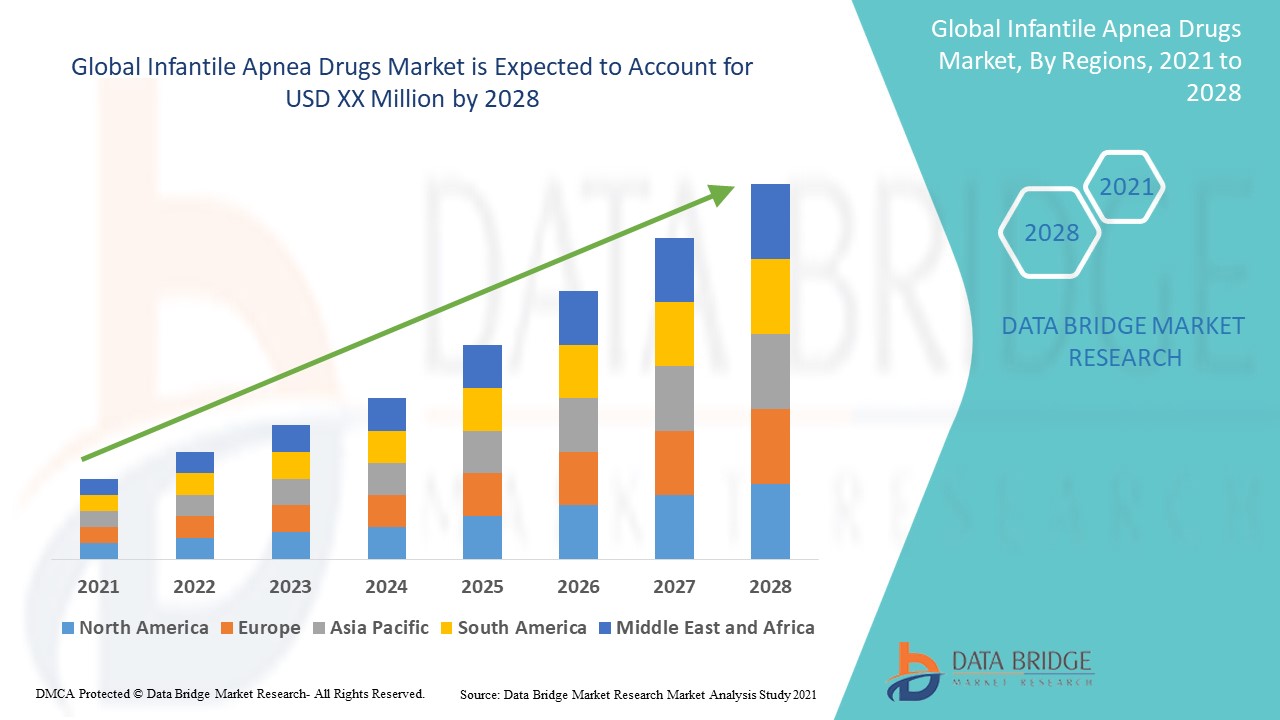
The global infantile apnea drugs market size was valued at USD 42.31 million in 2024 and is projected to reach USD 80.19 million by 2032, with a CAGR of 8.32% during the forecast period of 2025 to 2032. In addition to the insights on market scenarios such as market value, growth rate, segmentation, geographical coverage, and major players, the market reports curated by the Data Bridge Market Research also include depth expert analysis, patient epidemiology, pipeline analysis, pricing analysis, and regulatory framework.
Infantile Apnea Drugs Market Trends
“Increasing Adoption of Non-invasive Ventilation (NIV) in Treatment”
One specific trend driving growth in the infantile apnea drugs market is the increasing adoption of non-invasive ventilation (NIV) methods. NIV devices, such as nasal continuous positive airway pressure (CPAP), are becoming more widely used to manage infantile apnea. These devices help infants maintain adequate oxygen levels without the need for invasive procedures, reducing the risk of complications. The growing preference for less invasive treatments and technological advancements in NIV devices are contributing to a positive market outlook. For instance, the launch of improved CPAP systems for neonates has significantly boosted demand for infantile apnea drugs, as these devices often work in conjunction with pharmacological treatments to enhance outcomes.
Report Scope and Infantile Apnea Drugs Market Segmentation
|
Attributes |
Infantile Apnea Drugs Key Market Insights |
|
Segments Covered |
|
|
Countries Covered |
U.S., Canada and Mexico in North America, Germany, France, U.K., Netherlands, Switzerland, Belgium, Russia, Italy, Spain, Turkey, Rest of Europe in Europe, China, Japan, India, South Korea, Singapore, Malaysia, Australia, Thailand, Indonesia, Philippines, Rest of Asia-Pacific (APAC) in the Asia-Pacific (APAC), Saudi Arabia, U.A.E, South Africa, Egypt, Israel, Rest of Middle East and Africa (MEA) as a part of Middle East and Africa (MEA), Brazil, Argentina and Rest of South America as part of South America |
|
Key Market Players |
Baxter (U.S.), AstraZeneca (U.K.), Abbott (U.S.), F. Hoffmann-La Roche Ltd. (Switzerland), B. Braun Melsungen AG (Germany), Aunutra Industries Inc. (U.S.), Smith & Nephew (U.K.), Stryker (U.S.), Novartis AG (Switzerland), Sanofi (France), Pfizer Inc. (U.S.), Johnson & Johnson Private Limited (U.S.), and Bayer AG (Germany) |
|
Market Opportunities |
|
|
Value Added Data Infosets |
In addition to the insights on market scenarios such as market value, growth rate, segmentation, geographical coverage, and major players, the market reports curated by the Data Bridge Market Research also include depth expert analysis, patient epidemiology, pipeline analysis, pricing analysis, and regulatory framework. |
Infantile Apnea Drugs Market Definition
Infantile apnea refers to the temporary cessation of breathing in newborns, often occurring during sleep. It can be caused by prematurity, neurological disorders, or other underlying health conditions. Drugs used to manage infantile apnea aim to stimulate respiration and prevent episodes. Methylxanthines, such as caffeine citrate and theophylline, are commonly prescribed to help improve breathing patterns by stimulating the central nervous system. These medications can reduce the frequency and duration of apneic episodes. While effective, they are closely monitored for potential side effects. Early diagnosis and treatment are crucial to improving outcomes for affected infants.
Infantile Apnea Drugs Market Dynamics
Drivers
- Increasing Prevalence of Premature Births
The increasing prevalence of premature births is a significant driver of the infantile apnea drugs market. As the number of premature births rises globally, the incidence of conditions such as infantile apnea, which affects preterm infants, also growsAccording to the World Health Organization (WHO), around 15 million babies are born prematurely every year globally, making up approximately 11% of total births. Preterm infants often require specialized care in neonatal intensive care units (NICUs), where respiratory support is critical to their survival and development, highlighting the need for advanced neonatal ventilation solutions. As the preterm birth rate continues to rise, the market for infantile apnea medications is expected to expand.
- High Demand for Safe and Non-Invasive Treatment Options
The growing demand for safe and non-invasive treatment options is significantly driving the infantile apnea drugs market. Parents and healthcare providers are increasingly prioritizing treatments that minimize the need for invasive procedures and reduce the risk of side effects for newborns. For instance, the use of drugs such as caffeine citrate, a non-invasive treatment, has gained popularity for managing apnea of prematurity, as it stimulates the respiratory centers in the brain, reducing the need for mechanical ventilation. As concerns about the long-term effects of invasive treatments rise, there is a shift towards safer alternatives, boosting the adoption of drugs that offer effective, non-invasive solutions for managing infantile apnea.
Opportunities
- Advancements in Pharmaceutical Research
Advancements in pharmaceutical research have created significant opportunities in the infantile apnea drugs market. New drug formulations and innovative drug delivery methods, such as extended-release formulations and targeted therapies, are improving the effectiveness and safety of treatments. For instance, the development of caffeine citrate, a widely used drug for treating apnea of prematurity, has enhanced both the efficacy and safety profile for newborns. These advancements not only offer better clinical outcomes but also reduce the risk of side effects, encouraging adoption by healthcare providers. The continuous research in neonatal drug delivery systems, including non-invasive methods such as nasal spray formulations, further expands opportunities for market growth by meeting the growing demand for safer and more effective treatments.
- Increased Investment in Pediatric Healthcare
The growing focus on pediatric healthcare infrastructure and drug development has created significant opportunities in the infantile apnea drugs market. Governments, private companies, and non-profit organizations are recognizing the importance of specialized pediatric care, leading to increased funding for research and development. For instance, initiatives such as the National Institutes of Health's (NIH) support for neonatal health research have propelled advancements in drug treatments for conditions such as infantile apnea. This investment has spurred the creation of safer, more effective therapies and improved access to treatments, creating a favorable environment for market expansion. In addition, the emergence of new pharmaceutical companies targeting pediatric care further fuels innovation and market growth.
Restraints/Challenges
- High Development Costs
High development costs are a significant restraint in the infantile apnea drugs market. The process of developing drugs for infants involves extensive research, clinical trials, and regulatory approvals, all of which require substantial financial investment. Since infants, particularly premature ones, are a vulnerable population, drugs must undergo rigorous safety and efficacy testing, often prolonging development timelines and increasing costs. Furthermore, the complexity of conducting pediatric trials and ensuring compliance with strict regulatory guidelines further adds to the expenses. These high development costs create financial barriers for pharmaceutical companies, leading to fewer players in the market and a slower introduction of innovative treatments, ultimately hindering market growth.
- Side Effects and Safety Concerns
Side effects and safety concerns are significant restraints in the infantile apnea drugs market. Many drugs designed for this condition can have adverse effects, especially in newborns and preterm infants, whose bodies are more vulnerable to medication. The safety profiles of these drugs are often not fully established, leading to hesitance among healthcare providers in prescribing them. Potential side effects such as respiratory depression, cardiovascular complications, and drug interactions further complicate their use in such sensitive populations. These concerns result in rigorous regulatory scrutiny and lengthy approval processes, limiting the availability of treatments and hindering market growth. The cautious approach from clinicians also contributes to slower adoption rates of these drugs.
This market report provides details of new recent developments, trade regulations, import-export analysis, production analysis, value chain optimization, market share, impact of domestic and localized market players, analyses opportunities in terms of emerging revenue pockets, changes in market regulations, strategic market growth analysis, market size, category market growths, application niches and dominance, product approvals, product launches, geographic expansions, technological innovations in the market. To gain more info on the market contact Data Bridge Market Research for an Analyst Brief, our team will help you take an informed market decision to achieve market growth.
Infantile Apnea Drugs Market Scope
The market is segmented on the basis of drug type, disease type, dosage, route of administration, end-users and distribution channel. The growth amongst these segments will help you analyze meagre growth segments in the industries and provide the users with a valuable market overview and market insights to help them make strategic decisions for identifying core market applications.
Drug Type
- Anesthetics
- Calamus
- Analgesics
- Aminophylline
- Xanthine Medication
- Others
Disease Type
- Central Apnea
- Diaphragmatic Apnea
- Mixed Apnea
- Obstructive Apnea
- Upper Airway Apnea
Dosage
- Tablet
- Injection
- Capsule
- Others
Route of Administration
- Inhalation
- Intramuscular
- Intravenous
- Oral
- Others
End-Users
- Clinic
- Hospital
- Others
Distribution Channel
- Hospital Pharmacy
- Retail Pharmacy
- Online Pharmacy
Infantile Apnea Drugs Market Regional Analysis
The market is analysed and market size insights and trends are provided by country, drug type, disease type, dosage, route of administration, end-users and distribution channelas referenced above.
The countries covered in the market report are U.S., Canada, Mexico in North America, Germany, Sweden, Poland, Denmark, Italy, U.K., France, Spain, Netherland, Belgium, Switzerland, Turkey, Russia, Rest of Europe in Europe, Japan, China, India, South Korea, New Zealand, Vietnam, Australia, Singapore, Malaysia, Thailand, Indonesia, Philippines, Rest of Asia-Pacific (APAC) in Asia-Pacific (APAC), Brazil, Argentina, Rest of South America as a part of South America, U.A.E, Saudi Arabia, Oman, Qatar, Kuwait, South Africa, Rest of Middle East and Africa (MEA) as a part of Middle East and Africa (MEA)
North America is expected to dominate the infantile apnea drugs market due to the presence of major key players, a well-established healthcare infrastructure, and growing awareness regarding infant health. The region benefits from advanced medical research and development, which fuels innovation in treatments for infantile apnea. Furthermore, increasing healthcare investments and government support for pediatric care contribute to the market's growth, making North America a leading player in this sector.
Europe is expected to show significant growth in the infantile apnea drugs market during the forecast period. This growth can be attributed to increasing research and development activities focused on improving treatments for respiratory conditions in infants. In addition, rising investments in the healthcare sector, emerging markets, and growing government support for healthcare innovation will further drive the market expansion. The region's advanced healthcare infrastructure and demand for effective treatments will continue to support market growth.
The country section of the report also provides individual market impacting factors and changes in regulation in the market domestically that impacts the current and future trends of the market. Data points such as down-stream and upstream value chain analysis, technical trends and porter's five forces analysis, case studies are some of the pointers used to forecast the market scenario for individual countries. Also, the presence and availability of global brands and their challenges faced due to large or scarce competition from local and domestic brands, impact of domestic tariffs and trade routes are considered while providing forecast analysis of the country data.
Infantile Apnea Drugs Market Share
The market competitive landscape provides details by competitor. Details included are company overview, company financials, revenue generated, market potential, investment in research and development, new market initiatives, global presence, production sites and facilities, production capacities, company strengths and weaknesses, product launch, product width and breadth, application dominance. The above data points provided are only related to the companies' focus related to market.
Infantile Apnea Drugs Market Leaders Operating in the Market Are:
- Baxter (U.S.)
- AstraZeneca (U.K.)
- Abbott (U.S.)
- F. Hoffmann-La Roche Ltd. (Switzerland)
- B. Braun Melsungen AG (Germany)
- Aunutra Industries Inc. (U.S.)
- Smith & Nephew (U.K.)
- Stryker (U.S.)
- Novartis AG (Switzerland)
- Sanofi (France)
- Pfizer Inc. (U.S.)
- Johnson & Johnson Private Limited (U.S.)
- Bayer AG (Germany)
Latest Developments in Infantile Apnea Drugs Market
- In June 2020, Inspiration Healthcare plc expanded its portfolio by acquiring SLE, a provider of neonatal ventilation products, for £18 million. This strategic acquisition was aimed at enhancing its offerings for neonatal care, particularly for preterm infants. The deal was followed by a successful fundraising round, further bolstering its financial position and growth strategy.
SKU-
احصل على إمكانية الوصول عبر الإنترنت إلى التقرير الخاص بأول سحابة استخبارات سوقية في العالم
- لوحة معلومات تحليل البيانات التفاعلية
- لوحة معلومات تحليل الشركة للفرص ذات إمكانات النمو العالية
- إمكانية وصول محلل الأبحاث للتخصيص والاستعلامات
- تحليل المنافسين باستخدام لوحة معلومات تفاعلية
- آخر الأخبار والتحديثات وتحليل الاتجاهات
- استغل قوة تحليل المعايير لتتبع المنافسين بشكل شامل
منهجية البحث
يتم جمع البيانات وتحليل سنة الأساس باستخدام وحدات جمع البيانات ذات أحجام العينات الكبيرة. تتضمن المرحلة الحصول على معلومات السوق أو البيانات ذات الصلة من خلال مصادر واستراتيجيات مختلفة. تتضمن فحص وتخطيط جميع البيانات المكتسبة من الماضي مسبقًا. كما تتضمن فحص التناقضات في المعلومات التي شوهدت عبر مصادر المعلومات المختلفة. يتم تحليل بيانات السوق وتقديرها باستخدام نماذج إحصائية ومتماسكة للسوق. كما أن تحليل حصة السوق وتحليل الاتجاهات الرئيسية هي عوامل النجاح الرئيسية في تقرير السوق. لمعرفة المزيد، يرجى طلب مكالمة محلل أو إرسال استفسارك.
منهجية البحث الرئيسية التي يستخدمها فريق بحث DBMR هي التثليث البيانات والتي تتضمن استخراج البيانات وتحليل تأثير متغيرات البيانات على السوق والتحقق الأولي (من قبل خبراء الصناعة). تتضمن نماذج البيانات شبكة تحديد موقف البائعين، وتحليل خط زمني للسوق، ونظرة عامة على السوق ودليل، وشبكة تحديد موقف الشركة، وتحليل براءات الاختراع، وتحليل التسعير، وتحليل حصة الشركة في السوق، ومعايير القياس، وتحليل حصة البائعين على المستوى العالمي مقابل الإقليمي. لمعرفة المزيد عن منهجية البحث، أرسل استفسارًا للتحدث إلى خبراء الصناعة لدينا.
التخصيص متاح
تعد Data Bridge Market Research رائدة في مجال البحوث التكوينية المتقدمة. ونحن نفخر بخدمة عملائنا الحاليين والجدد بالبيانات والتحليلات التي تتطابق مع هدفهم. ويمكن تخصيص التقرير ليشمل تحليل اتجاه الأسعار للعلامات التجارية المستهدفة وفهم السوق في بلدان إضافية (اطلب قائمة البلدان)، وبيانات نتائج التجارب السريرية، ومراجعة الأدبيات، وتحليل السوق المجدد وقاعدة المنتج. ويمكن تحليل تحليل السوق للمنافسين المستهدفين من التحليل القائم على التكنولوجيا إلى استراتيجيات محفظة السوق. ويمكننا إضافة عدد كبير من المنافسين الذين تحتاج إلى بيانات عنهم بالتنسيق وأسلوب البيانات الذي تبحث عنه. ويمكن لفريق المحللين لدينا أيضًا تزويدك بالبيانات في ملفات Excel الخام أو جداول البيانات المحورية (كتاب الحقائق) أو مساعدتك في إنشاء عروض تقديمية من مجموعات البيانات المتوفرة في التقرير.