


Global Counter-IED Market Segmentation, By Capability (Detection, Countermeasures, Jammers, Neutralization, Neutralizing Improvised Explosive Devices (NIED), and Explosive Ordnance Disposal (EOD)), Deployment (Vehicle Mounted, Ship Mounted, Airborne Mounted, Handheld, and Others), End User (Military and Homeland Security) - Industry Trends and Forecast to 2033
Was ist die Global Counter-IED Marktgröße und Wachstumsrate
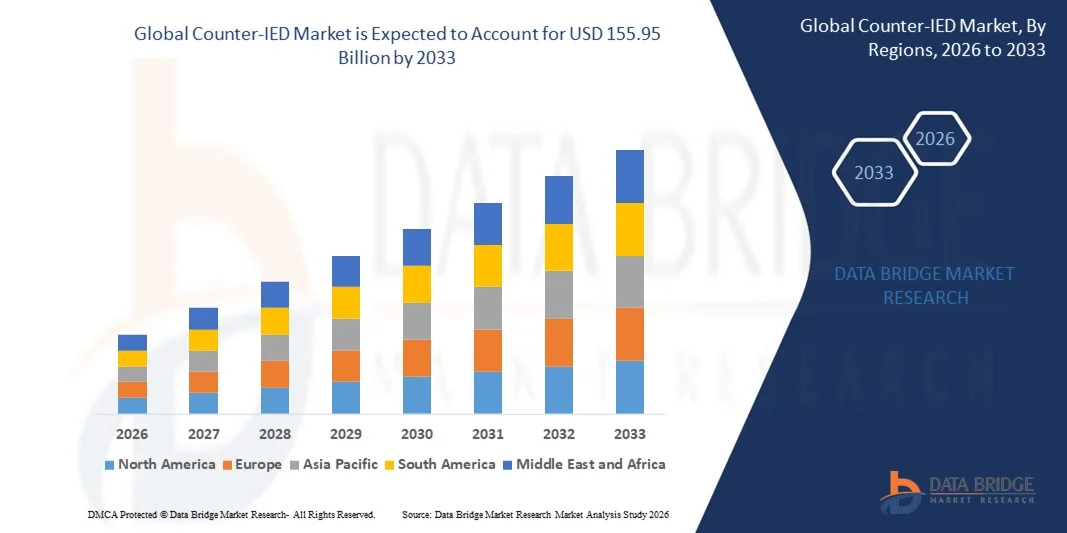
- Wie bei der Data Bridge Market Research Analysis wurde die globale Counter-IED-Marktgröße geschätzt130,01 Milliarden USD in 2025und wird voraussichtlich erreichen155,95 Milliarden USD bis 2033, beiCAGR von 2,30%während des Prognosezeitraums
- Die Zunahme der Zahl der terroristischen Aktivitäten auf der ganzen Welt ist einer der wichtigsten Faktoren, die das Wachstum des Gegenmarktes vorantreiben
- Die steigende Nachfrage nach unbemannten Systemen wie fahrerlosen LKWs und leichteren Robotern und hochentwickelten militärischen und heimischen Sicherheitsorganisationen, hauptsächlich einschließlich Fahrzeugen, Schiffen und Flugzeugen, beschleunigen das Marktwachstum
Marktgröße und Prognose
- Globaler Marktwert (2025):130,01 Mrd. USD
- Voraussichtlicher Marktwert (2033):155,95 Mrd. USD
- Wettervorhersage CAGR (2026–2033):2.30%
Was sind die großen Takeaways des Counter-IED-Marktes
- Die Zunahme der Geräte von elektronischen Spreng-Erkennungsgeräten, Jammern zur Ortsverfolgung und Neutralisation improvisierter Sprengvorrichtungen (NIED) beeinflussen den Markt weiter
- Darüber hinaus wirkt sich der Anstieg der Investitionen, der Ausbau von kommerziellen Flugzeugen, der Anstieg der Sicherheitsregelungen für Flugzeuge und der Anstieg des Verteidigungssektors positiv auf den Gegenmarkt aus. Darüber hinaus erweitert der Nachfrageanstieg von Heimatschutzagenturen profitable Chancen
- Nordamerika dominierte den Counter-IED-Markt mit einem Umsatzanteil von 42,05 % im Jahr 2025, angetrieben durch hohe Verteidigungsausgaben, kontinuierliche militärische Einsätze im Ausland und starke Investitionen in elektronische Kriegsführung und Kraftschutztechnologien in den USA und Kanada
- Asia-Pacific wird die schnellste CAGR von 9,47 % von 2026 bis 2033, angetrieben durch steigende Grenzspannungen, Modernisierung von Streitkräften und zunehmende Gegen-Terrorismus-Initiativen in China, Indien, Japan, Südkorea und Südostasien
- Das Segment Detection dominierte den Markt mit einem Anteil von 34,6% im Jahr 2025, da die frühe Bedrohungsidentifikation die erste und kritischste Verteidigungsschicht bleibt
Report Scope und Counter-IED Marktsegmentierung
|
Attribute |
Counter-IED Key Market Insights |
|
Verdeckte Segmente |
|
|
Überarbeitete Länder |
Nordamerika
Europa
Asien-Pazifik
Naher Osten und Afrika
Südamerika
|
|
Key Market Players |
|
|
Marktmöglichkeiten |
|
|
Daten Infos zum Wert hinzugefügt |
Neben den Erkenntnissen über Marktszenarien wie Marktwert, Wachstumsrate, Segmentierung, geographische Erfassung und wichtige Akteure umfassen die Marktberichte, die von der Data Bridge Market Research kuratiert wurden, auch eingehende Expertenanalyse, Preisanalyse, Markenanteilsanalyse, Verbraucherumfrage, Demographieanalyse, Supply Chain Analyse, Wertschöpfungskettenanalyse, Rohstoff-/Verbrauchsübersicht, Herstellerauswahlkriterien, PESTLE Analyse, Porter Analysis und regulatorische Rahmenbedingungen. |
Was ist der Haupttrend im Counter-IED-Markt
Steigerung von Shift Toward AI-Enabled, Network-Centric und Multi-Layered Counter-IED Lösungen
- Der Counter-IED-Markt zeugt von einer starken Übernahme von KI-gestützten Erkennungs-, elektronischen Jamming- und Fernneutralisationssystemen, die den zunehmend anspruchsvollen improvisierten Sprengstoffanlagen im militärischen und heimischen Sicherheitsbetrieb entgegenwirken.
- Hersteller stellen Multi-Sensor-Plattformen vor, die RF-Jammer, bodendurchdringende Radar-, Robotik- und Signalinformationen integrieren, um die Echtzeit-Drohungserkennung und -Antwort zu verbessern
- Die wachsende Nachfrage nach leichten, fahrzeugmontierten und man-portablen Gegen-IED-Systemen treibt den Einsatz in Grenzschutz-, Konvoischutz- und Stadtkriegsumgebungen voran.
- So erweitern Unternehmen wie Lockheed Martin Corporation, Northrop Grumman, Thales Group und die Rheinmetall AG fortschrittliche Gegen-IED-Technologien mit verbesserter Erkennungsgenauigkeit und elektronischer Kriegsführung
- Ein zunehmender Bedarf an Echtzeit-Kampffeld-Bewusstheit, Konvoi-Überlebensfähigkeit und asymmetrischer Bedrohungsminderung beschleunigt die Innovation in Gegen-IED-Plattformen
- Da sich nichtkonventionelle Bedrohungen entwickeln, werden Counter-IED-Systeme für den Kraftschutz, die Mission Kontinuität und die fortschrittliche Verteidigungsbereitschaft kritisch bleiben
Was sind die Haupttreiber des Counter-IED-Marktes
- Globale Sicherheitsbedrohungen, grenzüberschreitende Insurgenzaktivitäten und die zunehmende Nutzung improvisierter Sprengstoffgeräte in asymmetrischer Kriegsführung treiben die Nachfrage deutlich voran
- So haben beispielsweise im Jahr 2025 Unternehmen wie BAE Systems, L3Harris Technologies, Inc. und Elbit Systems Ltd. ihre elektronischen Warfare- und Gegen-IED-Portfolios verstärkt, um moderne militärische Anforderungen zu unterstützen
- Wachsende Verteidigungsbudgets in den USA, Europa und Asien-Pazifik unterstützen die Beschaffung von fortschrittlichen Erkennungs-, Neutralisations- und Überwachungssystemen
- Technologische Fortschritte in der Robotik, unbemannten Bodenfahrzeugen (UGVs), Signalverklemmung und AI-basierte Mustererkennung haben die betriebliche Effizienz verbessert
- Die zunehmende Einführung integrierter C4ISR-Systeme (Command, Control, Communications, Computers, Intelligence, Surveillance und Reconnaissance) fördert die Interoperabilität von Gegen-IED-Lösungen
- Der Counter-IED-Markt wird durch die kontinuierliche Modernisierung von Streitkräften und Heimatschutzagenturen mit einem anhaltenden langfristigen Wachstum bezeugt.
Welcher Faktor hebt das Wachstum des Gegenmarktes hervor
- Hohe Entwicklungs- und Beschaffungskosten im Zusammenhang mit fortschrittlichen elektronischen Kriegsführungssystemen und Multisensor-Erkennungsplattformen begrenzen die Annahme in haushaltsgebundenen Regionen
- Zum Beispiel, während 2024–2025, Supply Chain Disruptionen in spezialisierte Verteidigungselektronik und Halbleiterbauelemente erhöhte Systemintegrationskosten für mehrere globale Anbieter
- Schnelle Entwicklung von IED-Auslösungsmechanismen, einschließlich verschlüsselter Kommunikation und emissionsarmer Geräte, erhöht die technologische Komplexität
- Regelmäßige Genehmigungen, Exportkontrollen und Compliance-Anforderungen schaffen Verzögerungen bei grenzüberschreitenden Verteidigungsanlagenverkäufen
- Integrationsherausforderungen an ältere Militärfahrzeuge und Kommunikationssysteme fügen zur Komplexität des Einsatzes bei
- Um diese Probleme zu lösen, konzentrieren sich Unternehmen auf modulare Systemarchitekturen, AI-getriebene Bedrohungsanalysen, strategische Verteidigungspartnerschaften und kostenoptimierte Produktionsstrategien, um die globale Einführung von Counter-IED-Lösungen zu verbessern
Wie wird der Counter-IED-Markt segmentiert
Der Markt wird auf der GrundlageFähigkeit, Bereitstellung und Endbenutzer.
- Durch die Fähigkeit
Auf Basis der Fähigkeit wird der Counter-IED-Markt in Erkennung, Gegenmaßnahmen, Jammers, Neutralisation, Neutralisation Improvised Explosive Devices (NIED) und Explosive Ordnance Disposal (EOD) segmentiert. Das Segment Detection dominierte den Markt mit einem Anteil von 34,6% im Jahr 2025, da die frühe Bedrohungsidentifikation die erste und kritischste Verteidigungsschicht bleibt. Fortgeschrittene Detektionssysteme wie bodendurchdringende Radar-, HF-Signaldetektoren und AI-fähige Sensorfusionsplattformen werden weit verbreitet eingesetzt, um verdeckte explosive Bedrohungen in städtischen Kampfzonen und Grenzgebieten zu identifizieren. Die zunehmende Übernahme von Multi-Sensor-Detektions-Suiten, die mit Überwachungs- und Aufklärungssystemen integriert sind, treibt weiterhin starke Beschaffung über Verteidigungsagenturen.
Das Segment Neutralisation und EOD wird mit dem schnellsten CAGR von 2026 bis 2033 wachsen, angetrieben durch den zunehmenden Einsatz von Robotersystemen, unbemannten Bodenfahrzeugen (UGVs) und ferngesteuerten Störtechnologien. Die zunehmende Betonung auf die Minimierung menschlicher Exposition gegenüber explosiven Bedrohungen wird die Nachfrage nach fortschrittlichen Neutralisationsfähigkeiten weltweit beschleunigen.
- Durch die Bereitstellung
Auf Basis des Einsatzes wird der Counter-IED-Markt in Fahrzeug montiert, Schiff montiert, Airborne Mounted, Handheld und andere segmentiert. Das Segment Fahrzeugmontierte dominierte den Markt mit einem Anteil von 38,9% im Jahr 2025, unterstützt durch den weit verbreiteten Einsatz in militärischen Konvois, gepanzerten Fahrzeugen und Patrouilleneinheiten in Hochrisikoregionen. Fahrzeugmontierte Jammer und Erkennungssysteme bieten erweiterte Reichweite, Mobilität und verbesserten Schutz vor funkgesteuerten IEDs während der Troop-Bewegung und Liefermissionen. Die zunehmende Modernisierung der gepanzerten Flotten und die Integration elektronischer Warfare-Suiten stärken die Dominanz dieses Segments weiter.
Das Segment Airborne Mounted wird von 2026 bis 2033 am schnellsten CAGR wachsen, angetrieben durch steigenden Einsatz von Hubschraubern und unbemannten Luftfahrzeugen (UAVs) für die flächendeckende Überwachung und IED-Erkennung. Verbesserte Lufterkundungsfähigkeiten ermöglichen eine schnelle Identifizierung von Straßenverkehrsbedrohungen und unterstützen sicherere Bodenoperationen.
- Mit dem Endbenutzer
Auf Basis des Endverbrauchers wird der Counter-IED-Markt in Militär- und Heimatschutz segmentiert. Das Militärsegment dominierte den Markt mit einem Anteil von 72,4% im Jahr 2025, aufgrund von hohen Verteidigungsbudgets, Übersee-Einsätzen und kontinuierlicher Modernisierung von elektronischen Kriegsführungen und Kraftschutzsystemen. Bewaffnete Kräfte investieren weltweit stark in Erkennungs-, Jamming- und Neutralisationstechnologien, um Personal und Vermögenswerte vor asymmetrischen Bedrohungen zu schützen. Die Integration von Gegen-IED-Lösungen mit C4ISR-Frameworks verbessert die betriebliche Effizienz weiter.
Das Segment Homeland Security wird von 2026 bis 2033 mit dem schnellsten CAGR wachsen, das von zunehmenden Inlands-Terrorismus-Initiativen, Grenzüberwachungsprogrammen und dem Schutz kritischer Infrastrukturen angetrieben wird. Die Stärkung der städtischen Sicherheitsbedenken und die Erweiterung spezialisierter Bombenentsorgungseinheiten beschleunigen die Adoption in nationalen Sicherheitsbehörden.
Welche Region hält den größten Teil des Gegenmarktes
- Nordamerika dominierte den Counter-IED-Markt mit einem Umsatzanteil von 42,05 % im Jahr 2025, angetrieben durch hohe Verteidigungsausgaben, kontinuierliche militärische Einsätze im Ausland und starke Investitionen in elektronische Kriegsführung und Kraftschutztechnologien in den USA und Kanada. Steigende Beschaffung von fortschrittlichen Erkennungssystemen, fahrzeugmontierten Jammern und Roboterneutralisationsplattformen verstärkt weiterhin die regionale Nachfrage
- Führende Verteidigungsunternehmen in Nordamerika stellen AI-fähige Erkennungssysteme, Mehrschicht-Jamming-Technologien und integrierte Gegen-IED-Plattformen, die mit modernen C4ISR-Architekturen kompatibel sind, vor. Die kontinuierliche Modernisierung von gepanzerten Fahrzeugen, Konvoischutzsystemen und unbemannten Plattformen verbessert die regionale technologische Führung
- Starke militärisch-industrielle Infrastruktur, fortschrittliche FuE-Fähigkeiten und nachhaltige staatliche Finanzierungen für heimische Sicherheits- und Gegenterrorismusprogramme verstärken die marktbeherrschende Position Nordamerikas
US Counter-IED Market Insight
Die USA sind der größte Beitrag in Nordamerika, unterstützt durch erhebliche Verteidigungsbudgets und kontinuierliche Modernisierung der elektronischen Kriegsführungsfähigkeiten. Das Verteidigungsministerium priorisiert fortschrittliche Gegen-IED-Technologien für den Katastrophenschutz, Grenzgänge und überseeische Missionen. Die zunehmende Integration von Robotik, unbemannten Bodenfahrzeugen (UGV), luftgestützten Überwachungsplattformen und AI-getriebenen Bedrohungserkennungssystemen beschleunigt die Annahme. Die Präsenz von großen Verteidigungsunternehmern und starken Interoperabilitätsanforderungen in allen Streitkräften treibt die konsequente Beschaffung und technologische Upgrades weiter voran.
Kanada Counter-IED Marktaufsicht
Kanada trägt durch Initiativen zur Verteidigungsmodernisierung und Beteiligung an NATO-geführten Sicherheitsoperationen stetig zum regionalen Wachstum bei. Steigende Investitionen in Panzerfahrzeug-Upgrades, Überwachungssysteme und Bombenentsorgungseinheiten unterstützen die Übernahme von fahrzeugmontierten und tragbaren Gegen-IED-Systemen. Regierungsgestützte Sicherheitsprogramme und Zusammenarbeit mit alliierten Verteidigungspartnern stärken die technologischen Fähigkeiten im ganzen Land.
Asien-Pazifik-Zwischenmarkt
Asia-Pacific wird die schnellste CAGR von 9,47 % von 2026 bis 2033, angetrieben durch steigende Grenzspannungen, Modernisierung von Streitkräften und zunehmende Gegen-Terrorismus-Initiativen in China, Indien, Japan, Südkorea und Südostasien, registrieren. Ausbau der Verteidigungsbudgets und wachsender Fokus auf die indigene Herstellung elektronischer Kriegsführung und Erkennungssysteme erhöhen die regionale Nachfrage deutlich. Die zunehmende Beschaffung von UAV-basierten Überwachungs- und Roboterneutralisationssystemen beschleunigt das Marktwachstum weiter.
China Counter-IED Marktaufsicht
China ist ein wichtiger Beitrag in Asien-Pazifik aufgrund der Erweiterung von Verteidigungsmodernisierungsprogrammen und starken inländischen Produktionskapazitäten. Der Fokus auf elektronische Kriegsführung, Grenzsicherheit und fortschrittliche Überwachungssysteme treibt die Beschaffung integrierter Erkennungs- und Jammingplattformen an. Die staatliche Unterstützung für die Entwicklung der indigenen Verteidigungstechnologie stärkt die heimische Adoption.
Japan Counter-IED Marktaufsicht
Japan zeigt ein stetiges Wachstum, das durch zunehmende Investitionen in heimische Sicherheit, maritime Verteidigung und fortschrittliche Überwachungstechnologien unterstützt wird. Der Schwerpunkt auf hochpräzisen Erkennungssystemen und der Integration mit Katastrophenreaktionsgerüsten erhöht die Einführung von tragbaren und fahrzeugmontierten Gegen-IED-Lösungen.
Indien Counter-IED Markt Einblick
Indien tritt aufgrund der anhaltenden Herausforderungen der Grenzsicherheit und der Anti-Insurgency-Operationen als bedeutendes Wachstumszentrum auf. Die zunehmende Beschaffung von Bombenentsorgungsrobotern, Jammern und Erkennungssystemen durch Verteidigungs- und paramilitärische Kräfte beschleunigt die Annahme. Regierungsinitiativen zur Förderung der häuslichen Verteidigungsproduktion unterstützen die Markterweiterung.
Südkorea Counter-IED Market Insight
Südkorea trägt insbesondere durch nachhaltige militärische Bereitschaftsprogramme und Modernisierung von Panzer- und Überwachungsflotten bei. Der zunehmende Einsatz fortschrittlicher Jamming-Systeme, Aufklärungsdrohnen und Roboterentsorgungseinheiten stärkt die Gegen-IED-Fähigkeiten. Technologische Innovation und regionale Sicherheit treiben weiterhin langfristiges Wachstum voran.
Welche sind die Top-Unternehmen im Gegenmarkt
Die Counter-IED-Industrie wird in erster Linie von etablierten Unternehmen geleitet, darunter:
- General Dynamics Corporation (USA)
- Lockheed Martin Corporation (USA)
- Elbit Systems Ltd. (Israel)
- Raytheon Technologies Corporation (USA)
- Chemring Group PLC (US)
- Thales Group (Frankreich)
- L3Harris Technologies, Inc. (USA)
- Northrop Grumman (USA)
- Allen-Vanguard Corporation (Kanada)
- Netline Communications Technologies (Israel)
- IAI (Israel)
- Sierra Nevada Corporation (USA)
- SRC, Inc. (USA)
- BAE Systems (USA)
- QinetiQ (USA)
- Rheinmetall AG (Deutschland)
Was sind die jüngsten Entwicklungen im globalen Gegenmarkt
- Im Juni 2025 veranstaltete die NATO Istanbul Cooperation Initiative Regional Centre (NIRC) in Kuwait-Stadt ein Mobile Training Team von Allied Joint Force Command Naples, um spezialisierte zähler-improvisierte Explosive Devices (C-IED) Ausbildung an Militärpersonal aus Kuwait, Katar, Oman und Saudi-Arabien zu bieten, die regionale Verteidigungskooperation und operative Bereitschaft gegen die Entwicklung explosiver Bedrohungen zu stärken
- Im Januar 2024 kündigte die United States Navy an, künstliche Intelligenz in das Joint Counter Radio-Controlled Improvised Explosive Device Electronic Warfare (JCREW) Increment One Block One (I1B1) System zu integrieren, das von Northrop Grumman entwickelt wurde, um seine Fähigkeit zu verbessern, IEDs und Drohnen-Bedrohungen zu bekämpfen, erweiterte elektronische Kriegsbereitschaft über US-Kräfte und verwandte Nationen wie Australien
- Im Juni 2020 sicherte die Sierra Nevada Corporation einen Produktionsvertrag mit mehreren Lieferaufträgen, um das Degraded Visual Environment Pilotage System (DVEPS) für das US Special Operations Command (SOCOM) zu liefern und zu unterstützen und die US-Armee-Flugzeuge auszuwählen, die Missionseffizienz und Überlebensfähigkeit in komplexen Betriebsumgebungen zu stärken
SKU-
Erhalten Sie Online-Zugriff auf den Bericht zur weltweit ersten Market Intelligence Cloud

- Interaktives Datenanalyse-Dashboard
- Unternehmensanalyse-Dashboard für Chancen mit hohem Wachstumspotenzial
- Zugriff für Research-Analysten für Anpassungen und Abfragen
- Konkurrenzanalyse mit interaktivem Dashboard
- Aktuelle Nachrichten, Updates und Trendanalyse
- Nutzen Sie die Leistungsfähigkeit der Benchmark-Analyse für eine umfassende Konkurrenzverfolgung
Forschungsmethodik
Die Datenerfassung und Basisjahresanalyse werden mithilfe von Datenerfassungsmodulen mit großen Stichprobengrößen durchgeführt. Die Phase umfasst das Erhalten von Marktinformationen oder verwandten Daten aus verschiedenen Quellen und Strategien. Sie umfasst die Prüfung und Planung aller aus der Vergangenheit im Voraus erfassten Daten. Sie umfasst auch die Prüfung von Informationsinkonsistenzen, die in verschiedenen Informationsquellen auftreten. Die Marktdaten werden mithilfe von marktstatistischen und kohärenten Modellen analysiert und geschätzt. Darüber hinaus sind Marktanteilsanalyse und Schlüsseltrendanalyse die wichtigsten Erfolgsfaktoren im Marktbericht. Um mehr zu erfahren, fordern Sie bitte einen Analystenanruf an oder geben Sie Ihre Anfrage ein.
Die wichtigste Forschungsmethodik, die vom DBMR-Forschungsteam verwendet wird, ist die Datentriangulation, die Data Mining, die Analyse der Auswirkungen von Datenvariablen auf den Markt und die primäre (Branchenexperten-)Validierung umfasst. Zu den Datenmodellen gehören ein Lieferantenpositionierungsraster, eine Marktzeitlinienanalyse, ein Marktüberblick und -leitfaden, ein Firmenpositionierungsraster, eine Patentanalyse, eine Preisanalyse, eine Firmenmarktanteilsanalyse, Messstandards, eine globale versus eine regionale und Lieferantenanteilsanalyse. Um mehr über die Forschungsmethodik zu erfahren, senden Sie eine Anfrage an unsere Branchenexperten.
Anpassung möglich
Data Bridge Market Research ist ein führendes Unternehmen in der fortgeschrittenen formativen Forschung. Wir sind stolz darauf, unseren bestehenden und neuen Kunden Daten und Analysen zu bieten, die zu ihren Zielen passen. Der Bericht kann angepasst werden, um Preistrendanalysen von Zielmarken, Marktverständnis für zusätzliche Länder (fordern Sie die Länderliste an), Daten zu klinischen Studienergebnissen, Literaturübersicht, Analysen des Marktes für aufgearbeitete Produkte und Produktbasis einzuschließen. Marktanalysen von Zielkonkurrenten können von technologiebasierten Analysen bis hin zu Marktportfoliostrategien analysiert werden. Wir können so viele Wettbewerber hinzufügen, wie Sie Daten in dem von Ihnen gewünschten Format und Datenstil benötigen. Unser Analystenteam kann Ihnen auch Daten in groben Excel-Rohdateien und Pivot-Tabellen (Fact Book) bereitstellen oder Sie bei der Erstellung von Präsentationen aus den im Bericht verfügbaren Datensätzen unterstützen.











