


What is the Global Counter-IED Market Size and Growth Rate?
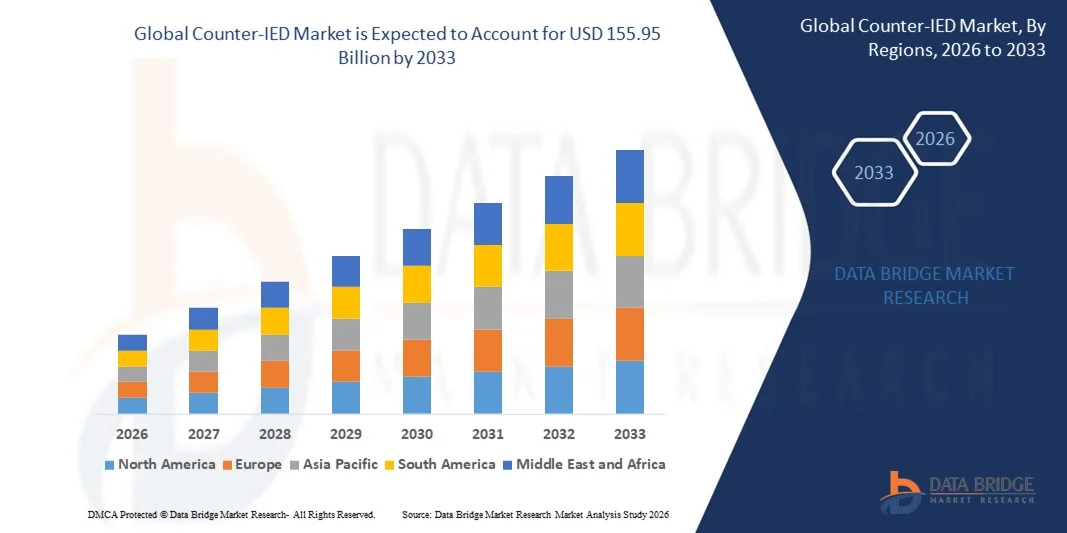
- As per Data Bridge Market Research Analysis the global Counter-IED market size was valued at USD 130.01 billion in 2025 and is expected to reach USD 155.95 billion by 2033, at a CAGR of 2.30% during the forecast period
- The increase in the number of terrorist activities across the globe acts as one of the major factors driving the growth of counter-IED market
- The surge in demand for unmanned systems such as driverless trucks and lighter robots and high deployment military and homeland security organizations, majorly including vehicles, ships, and aircraft, accelerate the market growth
Market Size & Forecast
- Global Market Value (2025): USD 130.01 billion
- Expected Market Value (2033): USD 155.95 billion
- Forecast CAGR (2026–2033): 2.30%
What are the Major Takeaways of Counter-IED Market?
- The increase in the equipment of electronic explosive detection devices, jammers for tracking the location, and neutralizing improvised explosive devices (NIED) further influence the market
- In addition, surge in the investments, expansion of commercial aircraft, rise in in safety regulations for aircraft, and rise in defense sector positively affect the counter-IED market. Furthermore, rise in demand from homeland security agencies extends profitable opportunities
- North America dominated the Counter-IED market with a 42.05% revenue share in 2025, driven by high defense spending, continuous overseas military deployments, and strong investment in electronic warfare and force protection technologies across the U.S. and Canada
- Asia-Pacific is projected to register the fastest CAGR of 9.47% from 2026 to 2033, driven by rising border tensions, modernization of armed forces, and increasing counter-terrorism initiatives across China, India, Japan, South Korea, and Southeast Asia
- The Detection segment dominated the market with a 34.6% share in 2025, as early threat identification remains the first and most critical layer of defense
Report Scope and Counter-IED Market Segmentation
|
Attributes |
Counter-IED Key Market Insights |
|
Segments Covered |
|
|
Countries Covered |
North America
Europe
Asia-Pacific
Middle East and Africa
South America
|
|
Key Market Players |
|
|
Market Opportunities |
|
|
Value Added Data Infosets |
In addition to the insights on market scenarios such as market value, growth rate, segmentation, geographical coverage, and major players, the market reports curated by the Data Bridge Market Research also include in-depth expert analysis, pricing analysis, brand share analysis, consumer survey, demography analysis, supply chain analysis, value chain analysis, raw material/consumables overview, vendor selection criteria, PESTLE Analysis, Porter Analysis, and regulatory framework. |
What is the Key Trend in the Counter-IED Market?
Increasing Shift Toward AI-Enabled, Network-Centric, and Multi-Layered Counter-IED Solutions
- The Counter-IED market is witnessing strong adoption of AI-powered detection, electronic jamming, and remote neutralization systems designed to counter increasingly sophisticated improvised explosive devices across military and homeland security operations
- Manufacturers are introducing multi-sensor platforms integrating RF jammers, ground-penetrating radar, robotics, and signal intelligence capabilities to enhance real-time threat detection and response
- Growing demand for lightweight, vehicle-mounted, and man-portable counter-IED systems is driving deployment across border security, convoy protection, and urban warfare environments
- For instance, companies such as Lockheed Martin Corporation, Northrop Grumman, Thales Group, and Rheinmetall AG are expanding advanced counter-IED technologies with enhanced detection accuracy and electronic warfare integration
- Increasing need for real-time battlefield awareness, convoy survivability, and asymmetric threat mitigation is accelerating innovation in counter-IED platforms
- As non-conventional threats evolve, Counter-IED systems will remain critical for force protection, mission continuity, and advanced defense preparedness
What are the Key Drivers of Counter-IED Market?
- Rising global security threats, cross-border insurgency activities, and increasing use of improvised explosive devices in asymmetric warfare are significantly driving demand
- For instance, in 2025, companies such as BAE Systems, L3Harris Technologies, Inc., and Elbit Systems Ltd. strengthened their electronic warfare and counter-IED portfolios to support modern military requirements
- Growing defense budgets across the U.S., Europe, and Asia-Pacific are supporting procurement of advanced detection, neutralization, and surveillance systems
- Technological advancements in robotics, unmanned ground vehicles (UGVs), signal jamming, and AI-based pattern recognition have enhanced operational efficiency
- Increasing adoption of integrated C4ISR (Command, Control, Communications, Computers, Intelligence, Surveillance, and Reconnaissance) systems is boosting interoperability of counter-IED solutions
- Supported by continuous modernization of armed forces and homeland security agencies, the Counter-IED market is expected to witness sustained long-term growth
Which Factor is Challenging the Growth of the Counter-IED Market?
- High development and procurement costs associated with advanced electronic warfare systems and multi-sensor detection platforms limit adoption in budget-constrained regions
- For instance, during 2024–2025, supply chain disruptions in specialized defense electronics and semiconductor components increased system integration costs for several global vendors
- Rapid evolution of IED triggering mechanisms, including encrypted communications and low-signature devices, increases technological complexity
- Strict regulatory approvals, export controls, and compliance requirements create delays in cross-border defense equipment sales
- Integration challenges with legacy military vehicles and communication systems add to operational deployment complexity
- To address these issues, companies are focusing on modular system architectures, AI-driven threat analytics, strategic defense partnerships, and cost-optimized production strategies to enhance global adoption of Counter-IED solutions
How is the Counter-IED Market Segmented?
The market is segmented on the basis of capability, deployment, and end user.
- By Capability
On the basis of capability, the Counter-IED market is segmented into Detection, Countermeasures, Jammers, Neutralization, Neutralizing Improvised Explosive Devices (NIED), and Explosive Ordnance Disposal (EOD). The Detection segment dominated the market with a 34.6% share in 2025, as early threat identification remains the first and most critical layer of defense. Advanced detection systems such as ground-penetrating radar, RF signal detectors, and AI-enabled sensor fusion platforms are widely deployed to identify concealed explosive threats in urban combat zones and border areas. Rising adoption of multi-sensor detection suites integrated with surveillance and reconnaissance systems continues to drive strong procurement across defense agencies.
The Neutralization and EOD segment is expected to grow at the fastest CAGR from 2026 to 2033, driven by increasing use of robotic systems, unmanned ground vehicles (UGVs), and remote-controlled disruption technologies. Growing emphasis on minimizing human exposure to explosive threats is accelerating demand for advanced neutralization capabilities worldwide.
- By Deployment
On the basis of deployment, the Counter-IED market is segmented into Vehicle Mounted, Ship Mounted, Airborne Mounted, Handheld, and Others. The Vehicle Mounted segment dominated the market with a 38.9% share in 2025, supported by widespread deployment in military convoys, armored vehicles, and patrol units operating in high-risk regions. Vehicle-mounted jammers and detection systems provide extended coverage range, mobility, and enhanced protection against radio-controlled IEDs during troop movement and supply missions. Increasing modernization of armored fleets and integration of electronic warfare suites further strengthen this segment’s dominance.
The Airborne Mounted segment is projected to grow at the fastest CAGR from 2026 to 2033, driven by rising use of helicopters and unmanned aerial vehicles (UAVs) for wide-area surveillance and IED detection. Enhanced aerial reconnaissance capabilities enable rapid identification of roadside threats and support safer ground operations.
- By End User
On the basis of end user, the Counter-IED market is segmented into Military and Homeland Security. The Military segment dominated the market with a 72.4% share in 2025, owing to high defense budgets, overseas deployments, and continuous modernization of electronic warfare and force protection systems. Armed forces globally invest heavily in detection, jamming, and neutralization technologies to safeguard personnel and assets from asymmetric threats. Integration of counter-IED solutions with C4ISR frameworks further enhances operational efficiency.
The Homeland Security segment is expected to grow at the fastest CAGR from 2026 to 2033, driven by increasing domestic counter-terrorism initiatives, border surveillance programs, and protection of critical infrastructure. Rising urban security concerns and expansion of specialized bomb disposal units are accelerating adoption across national security agencies.
Which Region Holds the Largest Share of the Counter-IED Market?
- North America dominated the Counter-IED market with a 42.05% revenue share in 2025, driven by high defense spending, continuous overseas military deployments, and strong investment in electronic warfare and force protection technologies across the U.S. and Canada. Rising procurement of advanced detection systems, vehicle-mounted jammers, and robotic neutralization platforms continues to strengthen regional demand
- Leading defense contractors in North America are introducing AI-enabled detection systems, multi-layered jamming technologies, and integrated counter-IED platforms compatible with modern C4ISR architectures. Continuous modernization of armored vehicles, convoy protection systems, and unmanned platforms further enhances regional technological leadership
- Strong military-industrial infrastructure, advanced R&D capabilities, and sustained government funding for homeland security and counter-terrorism programs reinforce North America’s dominant market position
U.S. Counter-IED Market Insight
The U.S. is the largest contributor within North America, supported by substantial defense budgets and continuous modernization of electronic warfare capabilities. The Department of Defense prioritizes advanced counter-IED technologies for troop protection, border operations, and overseas missions. Increasing integration of robotics, unmanned ground vehicles (UGVs), airborne surveillance platforms, and AI-driven threat detection systems accelerates adoption. Presence of major defense contractors and strong interoperability requirements across armed forces further drive consistent procurement and technological upgrades.
Canada Counter-IED Market Insight
Canada contributes steadily to regional growth through defense modernization initiatives and participation in NATO-led security operations. Rising investments in armored vehicle upgrades, surveillance systems, and bomb disposal units are supporting adoption of vehicle-mounted and portable counter-IED systems. Government-backed security programs and collaboration with allied defense partners strengthen technological capabilities across the country.
Asia-Pacific Counter-IED Market
Asia-Pacific is projected to register the fastest CAGR of 9.47% from 2026 to 2033, driven by rising border tensions, modernization of armed forces, and increasing counter-terrorism initiatives across China, India, Japan, South Korea, and Southeast Asia. Expanding defense budgets and growing focus on indigenous manufacturing of electronic warfare and detection systems significantly boost regional demand. Increasing procurement of UAV-based surveillance and robotic neutralization systems further accelerates market growth.
China Counter-IED Market Insight
China represents a major contributor in Asia-Pacific due to expanding defense modernization programs and strong domestic manufacturing capabilities. Rising focus on electronic warfare, border security, and advanced surveillance systems drives procurement of integrated detection and jamming platforms. Government support for indigenous defense technology development further strengthens domestic adoption.
Japan Counter-IED Market Insight
Japan demonstrates steady growth supported by increasing investment in homeland security, maritime defense, and advanced surveillance technologies. Emphasis on high-precision detection systems and integration with disaster response frameworks enhances adoption of portable and vehicle-mounted counter-IED solutions.
India Counter-IED Market Insight
India is emerging as a significant growth hub due to ongoing border security challenges and counter-insurgency operations. Rising procurement of bomb disposal robots, jammers, and detection systems by defense and paramilitary forces accelerates adoption. Government initiatives promoting domestic defense manufacturing further support market expansion.
South Korea Counter-IED Market Insight
South Korea contributes notably due to sustained military readiness programs and modernization of armored and surveillance fleets. Increasing deployment of advanced jamming systems, reconnaissance drones, and robotic disposal units strengthens counter-IED capabilities. Technological innovation and regional security concerns continue to drive long-term growth.
Which are the Top Companies in Counter-IED Market?
The Counter-IED industry is primarily led by well-established companies, including:
- General Dynamics Corporation (U.S.)
- Lockheed Martin Corporation (U.S.)
- Elbit Systems Ltd. (Israel)
- Raytheon Technologies Corporation (U.S.)
- Chemring Group PLC (U.K.)
- Thales Group (France)
- L3Harris Technologies, Inc. (U.S.)
- Northrop Grumman (U.S.)
- Allen-Vanguard Corporation (Canada)
- Netline Communications Technologies (Israel)
- IAI (Israel)
- Sierra Nevada Corporation (U.S.)
- SRC, Inc. (U.S.)
- BAE Systems (U.K.)
- QinetiQ (U.K.)
- Rheinmetall AG (Germany)
What are the Recent Developments in Global Counter-IED Market?
- In June 2025, the NATO Istanbul Cooperation Initiative Regional Centre (NIRC) in Kuwait City hosted a Mobile Training Team from Allied Joint Force Command Naples to provide specialized Counter-Improvised Explosive Devices (C-IED) training to military personnel from Kuwait, Qatar, Oman, and Saudi Arabia, strengthening regional defense collaboration and operational readiness against evolving explosive threats
- In January 2024, the United States Navy announced plans to integrate artificial intelligence into the Joint Counter Radio-Controlled Improvised Explosive Device Electronic Warfare (JCREW) Increment One Block One (I1B1) system, developed by Northrop Grumman, to enhance its capability to counter IEDs and drone threats, reinforcing advanced electronic warfare preparedness across U.S. forces and allied nations such as Australia
- In June 2020, Sierra Nevada Corporation secured a production contract with multiple delivery orders to supply and support the Degraded Visual Environment Pilotage System (DVEPS) for the U.S. Special Operations Command (SOCOM) and select U.S. Army aircraft, strengthening mission effectiveness and survivability in complex operational environments

- Interactive Data Analysis Dashboard
- Company Analysis Dashboard for high growth potential opportunities
- Research Analyst Access for customization & queries
- Competitor Analysis with Interactive dashboard
- Latest News, Updates & Trend analysis
- Harness the Power of Benchmark Analysis for Comprehensive Competitor Tracking
Data collection and base year analysis are done using data collection modules with large sample sizes. The stage includes obtaining market information or related data through various sources and strategies. It includes examining and planning all the data acquired from the past in advance. It likewise envelops the examination of information inconsistencies seen across different information sources. The market data is analysed and estimated using market statistical and coherent models. Also, market share analysis and key trend analysis are the major success factors in the market report. To know more, please request an analyst call or drop down your inquiry.
The key research methodology used by DBMR research team is data triangulation which involves data mining, analysis of the impact of data variables on the market and primary (industry expert) validation. Data models include Vendor Positioning Grid, Market Time Line Analysis, Market Overview and Guide, Company Positioning Grid, Patent Analysis, Pricing Analysis, Company Market Share Analysis, Standards of Measurement, Global versus Regional and Vendor Share Analysis. To know more about the research methodology, drop in an inquiry to speak to our industry experts.
Data Bridge Market Research is a leader in advanced formative research. We take pride in servicing our existing and new customers with data and analysis that match and suits their goal. The report can be customized to include price trend analysis of target brands understanding the market for additional countries (ask for the list of countries), clinical trial results data, literature review, refurbished market and product base analysis. Market analysis of target competitors can be analyzed from technology-based analysis to market portfolio strategies. We can add as many competitors that you require data about in the format and data style you are looking for. Our team of analysts can also provide you data in crude raw excel files pivot tables (Fact book) or can assist you in creating presentations from the data sets available in the report.













