


Globale GM Field Crops Market Segmentation, By Trait (Herbicide Tolerance (HT), Insect Resistance (IR), Stacked Traits (ST), and Other Traits), Crop (Sojabohnen, Baumwolle, Maize, Ölsaaten und andere Kropfen), Technik (Gene Guns, Electroporation, Microinjection, Agrobacterium, and Other Techniques), Art of Modification
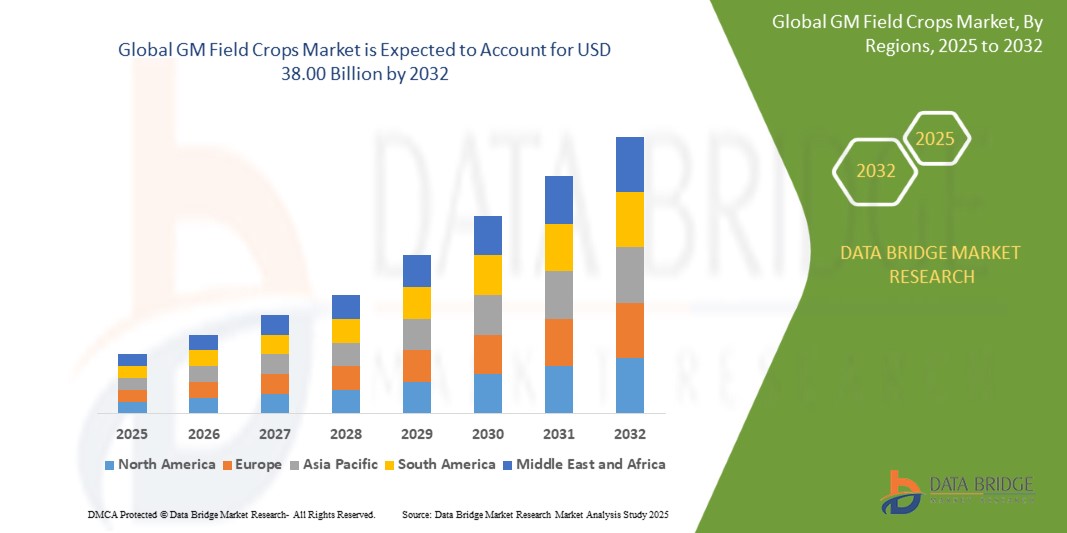
GM Field Crops Marktanalyse
Der globale Markt für GM-Feldkulturen erlebt ein beträchtliches Wachstum, das durch Fortschritte in der Biotechnologie, die zunehmende Übernahme von genetisch veränderten (GM-)Pflanzen und die steigende Nachfrage nach hochertragsfähigen, schädigenden landwirtschaftlichen Lösungen getrieben wird. GM-Feldkulturen wie Soja, Mais, Baumwolle und Raps wurden entwickelt, um Eigenschaften wie Herbizidtoleranz (HT), Insektenbeständigkeit (IR) und gestapelte Eigenschaften (ST) zu zeigen, die Produktivität zu verbessern und die Abhängigkeit vonChemikaliePestizide. Innovationen in Gentechnologie, einschließlichCRISPRund RNA-Interferenz, haben die Präzision und Effizienz von genetischen Modifikationen weiter verbessert, was zur Entwicklung von trockenen-resistenten und nährstoffangereicherten Kulturen führt. Länder wie die USA, China, Brasilien und Argentinien dominieren weiterhin den Markt, der durch starke regulatorische Rahmenbedingungen und den groß angelegten kommerziellen Anbau von GM-Pflanzen getrieben wird. Darüber hinaus Zulassungen von neuen GM-Samensorten, wie Chinas 81 GM-Saatgutzulassungen im Jahr 2024 und Italiens erste Gen-BewertungReisdie rasche Entwicklung der Industrie hervorheben. Trotz regulatorischer Herausforderungen und öffentlicher Besorgnisse in bestimmten Regionen wird der zunehmende Schwerpunkt auf Ernährungssicherheit, nachhaltiger Landwirtschaft und klimabeständigen Kulturen erwartet, dass der GM-Feldkulturmarkt vorangetrieben wird.
GM Field Crops Marktgröße
Die globale GM-Feldfrüchtemarktgröße wurde 2024 auf 27,55 Mrd. USD geschätzt und wird bis 2032 auf 38,00 Mrd. USD prognostiziert, während der Prognosezeit 2025 bis 2032 ein CAGR von 4,10 %. Neben den Erkenntnissen über Marktszenarien wie Marktwert, Wachstumsrate, Segmentierung, geographische Erfassung und wichtige Akteure umfassen die Marktberichte, die von der Data Bridge Market Research kuratiert wurden, auch Importexportanalyse, Produktionskapazitätsübersicht, Produktionsverbrauchsanalyse, Preistrendanalyse, Klimaveränderungsszenario, Supply Chain Analyse, Wertschöpfungskettenanalyse, Rohstoff-/Verbrauchsübersicht, Herstellerauswahlkriterien, PESTLE Analyse, Porter Analysis und regulatorische Rahmenbedingungen.
GM Field Crops MarktEntwicklung
„Erweiterung von Gen-Edited Crops mit CRISPR-Technologie“
Ein prominenter Trend im GM-Feldkulturmarkt ist die Erweiterung von Gen-Edifizierten Kulturen mit CRISPR-Technologie zur Steigerung von Ertrag, Widerstandsfähigkeit und Nährwert. Im Gegensatz zu herkömmlichen genetisch veränderten (GM) Kulturen bieten CRISPR-basierte Modifikationen präzise Genbearbeitungen, ohne fremde DNA einzuführen, die sie in regulatorischen Rahmenbedingungen und unter den Verbrauchern akzeptabeler machen. Ein bemerkenswertes Beispiel ist die erste Feldstudie Italiens von genergetischen Reis, RIS8imo, initiiert im Juni 2024, zur Verbesserung der Getreidequalität und Krankheitsresistenz. Auch Chinas Genehmigung von 81 GM-Samensorten im April 2024 spiegelt den Vorstoß des Landes auf biotechnologisch angetriebene landwirtschaftliche Innovation wider. Diese Fortschritte richten sich an die steigende Nachfrage nach klimabeständigen Kulturen, die extremen Wetterbedingungen, Dürre und Schädlingsbefall standhalten können. Da die globale Ernährungssicherheit zunimmt, sind Gen-Editierungstechniken bereit, den GM-Feldkulturmarkt zu revolutionieren und nachhaltige Lösungen anzubieten, während sie die öffentlichen Bedenken gegenüber konventionellen GM-Pflanzen ansprechen.
Geltungsbereich undGM Field Crops Marktsegmentierung
| Attribute | GM Field Crops SchlüsselMarkteinsichten |
| Verdeckte Segmente |
|
| Überarbeitete Länder | U.S., Kanada und Mexiko in Nordamerika, Deutschland, Frankreich, U.K., Niederlande, Schweiz, Belgien, Russland, Italien, Spanien, Türkei, Rest Europas in Europa, China, Japan, Indien, Südkorea, Singapur, Malaysia, Australien, Thailand, Indonesien, Philippinen, Rest Asia-Pacific (APAC) in the Asia-Pacific (APAC), Saudi-Arabien, U.A.E. |
| Key Market Players | BASF (Deutschland), Syngenta Crop Protection AG (Schweiz), Corteva (U.S), Dow (U.S), DuPont (U.S.), J.R. Simplot Company (U.S.), Mahyco (India), JK Agri Genetics Limited (India), KWS SAAT SE & Cotral KGaA (Deutschland), Land O'Lakes, Inc. |
| Marktmöglichkeiten |
|
| Daten Infos zum Wert hinzugefügt | Neben den Erkenntnissen über Marktszenarien wie Marktwert, Wachstumsrate, Segmentierung, geographische Erfassung und wichtige Akteure umfassen die Marktberichte, die von der Data Bridge Market Research kuratiert wurden, auch Importexportanalyse, Produktionskapazitätsübersicht, Produktionsverbrauchsanalyse, Preistrendanalyse, Klimaveränderungsszenario, Supply Chain Analyse, Wertschöpfungskettenanalyse, Rohstoff-/Verbrauchsübersicht, Herstellerauswahlkriterien, PESTLE Analyse, Porter Analysis und regulatorische Rahmenbedingungen. |
GM Field Crops MarktBegriff
Genetisch veränderte (GM) Feldfrüchte beziehen sich auf landwirtschaftliche Kulturen, die mit Biotechnologie-Techniken gentechnisch entwickelt wurden, um spezifische Eigenschaften wie Herbizidtoleranz, Insektenresistenz, Trockenresistenz und verbesserte Ernährung zu verbessern. Diese Modifikationen werden durch die Insertion, Deletion oder Veränderung spezifischer Gene erreicht, um Ertrag zu verbessern, Ernteverluste zu reduzieren und die Nachhaltigkeit in der Landwirtschaft zu verbessern.
GM Field Crops Marktdynamik
Fahrer
- steigende Nachfrage nach High-Yield Crops
Mit der weltweit prognostizierten Bevölkerung über 9 Milliarden bis 2050 steigt die Nachfrage nach Lebensmitteln exponentiell. Allein traditionelle landwirtschaftliche Methoden sind nicht ausreichend, um diesem wachsenden Bedarf gerecht zu werden, die Landwirte und Betriebe in Richtung genetisch veränderter (GM) Feldfrüchte zu treiben. GM-Pflanzen wie Mais, Soja und Baumwolle werden entwickelt, um Schädlinge zu widerstehen, raue Klimazonen zu tolerieren und das Ertragspotenzial zu verbessern. So hat Bt-Baumwolle, die seinen eigenen Insektizid zur Abwehr von Bollworms produziert, den Landwirten in Indien und China geholfen, deutlich höhere Erträge zu erzielen und gleichzeitig den Einsatz von Pestiziden zu reduzieren. Diese Steigerung der Produktivität trägt direkt zur Ernährungssicherheit und zur Rentabilität der Landwirte bei, wodurch hochertragreiche GM-Pflanzen ein entscheidender Markttreiber sind. Da mehr Länder GM-Pflanzen für die Nachhaltigkeit von Lebensmitteln genehmigen, steigt die Annahme dieser erweiterten Sorten weiter an, was die Marktausweitung stärkt.
- Erhöhung der Adoption von Herbizid-Tolerant (HT) Crops
Effiziente Unkrautbekämpfung ist für die Maximierung der Ernteerträge unerlässlich, und Herbizid-tolerante (HT) Kulturen haben Unkrautmanagement-Praktiken revolutioniert. Mit Herbizidtoleranz konstruierte GM-Pflanzen, wie z.B. HT-Sojabohnen und Mais, ermöglichen es Landwirten, breitgefächerte Herbizide wieGlyphosatohne ihre Ernten zu schädigen. Dies vereinfacht die Unkrautbekämpfung, reduziert die Notwendigkeit der mechanischen Bearbeitung und minimiert die Arbeits- und Kraftstoffkosten, wodurch die Landwirtschaft effizienter und nachhaltig wird. Länder wie die USA, Brasilien und Argentinien haben eine weit verbreitete Einführung von HT-Pflanzen gesehen, wobei die Landwirte von niedrigeren Eingangskosten und höheren Nettorenditen profitieren. Darüber hinaus unterstützen herbizid-resistente Kulturen die Erhaltung der Landwirtschaft durch die Verringerung der Bodenerosion durch übermäßiges Vermahlen. Die zunehmende Vorliebe für effiziente und kostengünstige landwirtschaftliche Lösungen treibt die Nachfrage nach HT GM-Kulturen weiter voran und verstärkt ihre Rolle als Schlüsseltreiber in der globalen GM-Feldkulturindustrie.
Möglichkeiten
- Erhöhung der staatlichen Unterstützung und Regulierungsgenehmigungen
Regierungen weltweit unterstützen zunehmend genetisch veränderte (GM) Kulturen zur Verbesserung der Ernährungssicherheit und der landwirtschaftlichen Produktivität. Mehrere Länder haben kürzlich neue GM-Sorten für den kommerziellen Anbau zugelassen und den Weg für eine verstärkte Marktdurchdringung geebnet. So genehmigte Indien im Jahr 2023 GM Senf (DMH-11) zur Verbesserung der Ölsaatenproduktion, während die Philippinen grüne GM-Baumwolle für den kommerziellen Gebrauch. In ähnlicher Weise hat China schnell verfolgte Zulassungen für mehrere GM-Samen, um Soja- und Maisproduktion zu steigern. Regulierungsbehörden wie die US-amerikanische Lebensmittel- und Drogenbehörde (FDA) und die Europäische Behörde für Lebensmittelsicherheit (EFSA) lindern ebenfalls Genehmigungsverfahren, fördern Innovation und Investitionen inBiotechnologieDiese starke staatliche Unterstützung beschleunigt die GM-Kreatisierung und zieht Betriebe und Biotech-Firmen an, um in die Forschung zu investieren, wodurch Regulierung eine zentrale Marktchance für den Ausbau des GM-Feldkultursektors unterstützt.
- Erhöhung der Widerstandsfähigkeit des Klimawandels und widerstandsfähiger Kropfen
Mit zunehmendem Klimawandel bedrohen extreme Wettermuster, längere Dürre und steigende Temperaturen die globale landwirtschaftliche Produktion. Um diese Herausforderungen zu bewältigen, entwickeln Biotech-Unternehmen GM-Pflanzen mit erhöhter Widerstandsfähigkeit gegenüber rauen Klimabedingungen. So haben z.B. Dürre-tolerante Maissorten, wie sie unter dem Projekt Water Efficient Maize for Africa (WEMA) eingeführt wurden, den Landwirten in Subsahara-Afrika geholfen, trotz Wassermangel Erträge zu erhalten. Ebenso gewinnen wärmeverträgliche Weizensorten in Regionen mit extremen Temperaturschwankungen an Traktion. Diese Innovationen ermöglichen es den Landwirten, die pflanzliche Erzeugung unter ungünstigen Bedingungen zu erhalten, wodurch die Risiken von Lebensmittelknappheit und wirtschaftlichen Verlusten verringert werden. Der wachsende Bedarf an klimaverträglicher Landwirtschaft stellt eine bedeutende Marktchance dar, da die Nachfrage nach GM-Kulturen, die Umweltbelastungen widerstehen sollen, zunehmen, Investitionen und Expansion im GM-Feldkulturmarkt vorantreiben wird.
Zurückhaltungen/Herausforderungen
- Risiko des Schädlings- und Unkrautwiderstands
Eine der größten Herausforderungen im GM-Feldkulturmarkt ist die wachsende Resistenz von Schädlingen und Unkräutern gegenüber genetisch veränderten Eigenschaften, wodurch die langfristige Wirksamkeit dieser Kulturen reduziert wird. GM-Pflanzen wie Bt Mais und Bt-Baumwolle, die zur Herstellung von insektiziden Proteinen aus Bacillus thuringiensis (Bt) entwickelt werden, waren zunächst erfolgreich bei der Bekämpfung von Schädlingen wie Maiswurzelwürmer und Bollworm. Im Laufe der Zeit haben sich jedoch einige Schädlinge Widerstand entwickelt, die Landwirte dazu zwingen, zusätzliche Insektizide zu verwenden oder alternative Schädlingsbekämpfungsstrategien zu ergreifen. In ähnlicher Weise haben Herbizid-tolerante Kulturen, wie z.B. Glyphosat-resistente Sojabohnen und Mais, dazu geführt, dass "superweeds" entstehen, die nicht mehr auf Glyphosat reagieren und die Landwirte dazu verpflichten, höhere Dosen von Herbiziden anzuwenden oder auf giftigere Chemikalien umzuschalten. So hat Palmer amaranth (Pigweed) in den USA eine starke Beständigkeit gegen Glyphosat entwickelt, was eine erhebliche Bedrohung für Ernteerträge und steigende Produktionskosten darstellt. Da der Schädling und Unkrautwiderstand weiter ansteigt, fordert er die Nachhaltigkeit der GM-Kulturtechnologie heraus und zwingt die Industrie, in neue Traitentwicklungen zu investieren, die Forschungs- und Regulierungskosten zu erhöhen.
- Hohe Forschungs- und Entwicklungskosten
Die Entwicklung von GM-Feldkulturen erfordert intensive Investitionen in die Biotechnologie-Forschung, Gentechnik und Feldversuche, was sie zu einer der teuersten landwirtschaftlichen Innovationen macht. Eine einzige GM-Pflanze auf den Markt zu bringen, beinhaltet hohe Kosten durch Generkennung, Labortests, Gewächshausversuche, Feldversuche, regulatorische Compliance und Post-Commercialization Monitoring. So investieren Unternehmen wie Bayer (früher Monsanto), Syngenta und Corteva stark in die Entwicklung von GM-Pflanzen, aber nur ein Bruchteil gentechnischer Eigenschaften erreicht erfolgreich den Markt. Darüber hinaus erhöhen Patentschutz- und Lizenzgebühren die Kostenbelastung für Saatgutunternehmen und Landwirte weiter. Die hohen RandD-Kosten schaffen eine Barriere für kleinere Biotech-Unternehmen und Entwicklungsländer, begrenzen Innovation und begrenzen den Wettbewerb auf dem GM-Pflanzenmarkt.
Dieser Marktbericht enthält Details zu neuen Entwicklungen, Handelsregelungen, Import-Export-Analyse, Produktionsanalyse, Wertschöpfungskettenoptimierung, Marktanteil, Auswirkungen von inländischen und lokalisierten Marktteilnehmern, Analysen von Möglichkeiten in Bezug auf neue Einnahmetaschen, Änderungen der Marktordnung, strategische Marktwachstumsanalyse, Marktgröße, Kategorie Marktwachstum, Anwendungsnischen und Dominanz, Produktzulassungen, Produkteinführungen, geographische Erweiterungen, technologische Innovationen auf dem Markt. Um weitere Informationen zum Marktkontakt Data Bridge Market Research für einen Analyst Brief zu gewinnen, wird unser Team Ihnen dabei helfen, eine fundierte Marktentscheidung zur Erreichung des Marktwachstums zu treffen.
Auswirkungen und aktueller Marktszenario von Rohstoffverknappungen und Versandverzögerungen
Data Bridge Market Research bietet eine hochrangige Analyse des Marktes und liefert Informationen, indem die Auswirkungen und aktuelle Marktumgebung von Rohstoffknappheit und Lieferverzögerungen berücksichtigt werden. Damit werden strategische Möglichkeiten bewertet, effektive Aktionspläne erstellt und Unternehmen bei wichtigen Entscheidungen unterstützt. Neben dem Standardbericht bieten wir auch eine gründliche Analyse des Beschaffungsniveaus von prognostizierten Versandverzögerungen, Vertriebsmapping nach Regionen, Rohstoffanalysen, Produktionsanalysen, Preismapping-Trends, Beschaffung, Kategorie-Performance-Analysen, Supply-Chain-Risikomanagement-Lösungen, erweiterte Benchmarking und andere Dienstleistungen für Beschaffung und strategische Unterstützung.
Erwartete Auswirkungen der Konjunkturabschwächung auf den Preis und die Verfügbarkeit von Produkten
Wenn die Wirtschaftstätigkeit verlangsamt, beginnen die Industrien zu leiden. Die prognostizierten Auswirkungen des Konjunkturabschwungs auf die Preis- und Zugänglichkeit der Produkte werden in den Markteinsichtsberichten und Geheimdiensten von DBMR berücksichtigt. Damit können unsere Kunden in der Regel einen Schritt vor ihren Konkurrenten halten, ihre Verkäufe und Einnahmen projizieren und ihre Gewinn- und Verlustausgaben schätzen.
GM Field Crops Markt Scope
Der Markt wird auf der Grundlage von Trait, Kultur, Technik und Art der Modifikation und Anwendung segmentiert. Das Wachstum unter diesen Segmenten hilft Ihnen dabei, einige Wachstumssegmente in den Branchen zu analysieren und den Anwendern einen wertvollen Marktüberblick und Markteinsichten zu bieten, um ihnen dabei zu helfen, strategische Entscheidungen zur Identifizierung von Kernmarktanwendungen zu treffen.
Traktion
- Herbizidtoleranz (HT)
- Insektenwiderstand (IR)
- Gestapelte Züge (ST)
- Sonstige Merkmale
Korn
- Sojabohnen
- Baumwolle
- Mais
- Ölsaat Raps
- andere Kropfen
Technik
- Gene Guns
- Elektroporation
- Mikroinjektion
- Agrobacterium
- Andere Techniken
Art der Änderung
- Transgen
- Cis-genic
- Subgenic
- Mehrfach-Trait-Integration
Anwendung
- Wissenschaftliche Forschung
- Landwirtschaft Kropfen
GM Field Crops Markt Regionale Analyse
Der Markt wird analysiert und die Marktgrößeneinsichten und -trends nach Ländern, Trait, Kultur, Technik und Art der Modifikation und Anwendung wie oben beschrieben.
Die in den Marktbericht einbezogenen Länder sind U.S., Kanada und Mexiko in Nordamerika, Deutschland, Frankreich, U.K., Niederlande, Schweiz, Belgien, Russland, Italien, Spanien, Türkei, Rest von Europa in Europa, China, Japan, Indien, Südkorea, Singapur, Malaysia, Australien, Thailand, Indonesien, Philippinen, Rest von Asien-Pazifik (APAC) in Asien-Pazifik (APAC), Saudi-Arabien, USA.
Nordamerika dominiert den globalen GM-Feldkulturmarkt aufgrund der weit verbreiteten Annahme genetisch veränderter Kulturen in Ländern wie den USA und Kanada. Die Region profitiert von fortschrittlicher landwirtschaftlicher Biotechnologie, starker staatlicher Unterstützung und günstigen regulatorischen Rahmenbedingungen, die Innovation in der Kulturwandel fördern. Darüber hinaus hat die hohe Nachfrage nach herbizid-toleranten und insektenbeständigen Kulturen eine erhöhte Kultivierung von GM Soja, Mais und Baumwolle angetrieben. Die Präsenz führender Biotech-Firmen und umfangreicher Forschungsinitiativen stärken die Führung Nordamerikas auf diesem Markt.
Asia-Pacific ist die am schnellsten wachsende Region im globalen Markt für GM-Feldkulturen, die durch die zunehmende Annahme von genetisch veränderten Kulturen zur Steigerung der landwirtschaftlichen Produktivität angetrieben wird. Länder wie China, Indien und die Philippinen investieren in den Ausbau der Biotechnologie, um die Ernteerträge, die Schädlingsbekämpfung und die Anpassungsfähigkeit des Klimas zu verbessern. Regierungsinitiativen zur Unterstützung der GM-Kulturforschung und der günstigen Politiken für die Kommerzialisierung beschleunigen die Markterweiterung. Die steigende Ernährungsnachfrage, verbunden mit einem wachsenden Fokus auf nachhaltige Landwirtschaftspraktiken, positioniert Asia-Pacific als Schlüsselfaktor für das zukünftige Wachstum der Branche.
Der Länderteil des Berichts liefert auch individuelle Marktbeeinflussungsfaktoren und Regulierungsänderungen im Inland, die die aktuellen und zukünftigen Trends des Marktes beeinflussen. Datenpunkte wie Downstream- und Upstream-Wert-Kettenanalyse, technische Trends und Porter fünf Kräfteanalysen, Fallstudien sind einige der Pointer, die verwendet werden, um das Marktszenario für einzelne Länder zu prognostizieren. Auch die Präsenz und Verfügbarkeit globaler Marken und deren Herausforderungen, die sich aufgrund eines großen oder knappen Wettbewerbs von lokalen und inländischen Marken stellen, werden die Auswirkungen von Inlandstarifen und Handelsrouten in Betracht gezogen und bieten eine Prognoseanalyse der Länderdaten.
GM Field Crops Marktanteil
Die Marktkonkurrenzlandschaft bietet Details von Wettbewerbern. Details enthalten sind Unternehmensübersicht, Unternehmensfinanzen, Umsatzerzeugnis, Marktpotenzial, Investitionen in Forschung und Entwicklung, neue Marktinitiativen, globale Präsenz, Produktionsstandorte und Anlagen, Produktionskapazitäten, Unternehmensstärken und Schwächen, Produktstart, Produktbreite und Breite, Anwendungs Dominanz. Die oben genannten Datenpunkte beziehen sich nur auf den Marktfokus der Unternehmen.
GM Field Crops Marktführer im Markt sind:
- BASF (Deutschland)
- Syngenta Crop Protection AG (Schweiz)
- Corteva (USA)
- Dow (USA)
- DuPont (USA)
- J.R. Simplot Company (USA)
- Mahyco (Indien)
- JK Agri Genetics Limited (Indien)
- KWS SAAT SE & Co. KGaA (Deutschland)
- Land O'Lakes, Inc. (USA)
- Limagrain (Frankreich)
- Cibus Inc. (USA)
- FMC Corporation (USA)
- GenTech Seeds (Australien)
- Laredo Trl (USA)
- Nuseed Global (Australien)
- Beijing Dabeinong Biotechnology Co., Ltd. (China)
- Origin Agritech, Ltd. (China)
- Genesis Seeds Ltd (Brasilien)
- MEAC (Mitte Osten)
- SENSAKO (Südafrika)
- Cie (Frankreich)
- Rijk Zwaan Zaadteelt en Zaadhandel B.V. (Niederlands)
- Sakata Seed America (USA)
- Yuan Long Ping High-Tech Agriculture Co Ltd (China)
Neueste Entwicklungen im GM Field Crops Market
- Im Juni 2024 initiierten Forscher der Universität Mailand Italiens erste Feldstudie von genergetischen Kulturen und testeten eine neue Reissorte namens „RIS8imo“, eine modifizierte Version des italienischen Arborio-Reis, der häufig in risotto verwendet wird.
- Im April 2024 genehmigte China 81 gentechnisch veränderte (GM)-Samen, um die Mais- und Sojaproduktion zu verbessern, während indische Biotech-Erhöhungen Beschränkungen ausgesetzt waren, was zu einer Stagnation der Ernteerträge führte.
- Im September 2023 genehmigten die Philippinen die Canola-Veranstaltung LBFLFK für Lebensmittel, Futtermittel und Verarbeitung, und im März 2023 gewährte sie eine kommerzielle Anbaugenehmigung für das Baumwoll-Veranstaltung GFM cry1A
- Im Oktober 2022 genehmigte das Genetic Engineering Appraisal Committee (GEAC) die Umweltfreigabe von GM Senf (Dhara Mustard Hybrid/DMH-11), der im Jahr 2002 zunächst entwickelt wurde, zusammen mit seinen Stammfrüchten aus indischen und osteuropäischen Linien, um höhere Erträge zu erzielen als bestehende Senfsorten
- Im September 2020 genehmigte das Genetic Engineering Approval Committee (GEAC) Feldversuche für neue Bt-brinjal-Sorten in acht indischen Staaten, nach der ersten Genehmigung von frucht- und langwierig-resistentem Bt-brinjal für den kommerziellen Anbau im Jahr 2009, das später unter einem 10-jährigen Moratorium aufgrund öffentlicher Bedenken platziert wurde
SKU-
Erhalten Sie Online-Zugriff auf den Bericht zur weltweit ersten Market Intelligence Cloud

- Interaktives Datenanalyse-Dashboard
- Unternehmensanalyse-Dashboard für Chancen mit hohem Wachstumspotenzial
- Zugriff für Research-Analysten für Anpassungen und Abfragen
- Konkurrenzanalyse mit interaktivem Dashboard
- Aktuelle Nachrichten, Updates und Trendanalyse
- Nutzen Sie die Leistungsfähigkeit der Benchmark-Analyse für eine umfassende Konkurrenzverfolgung
Forschungsmethodik
Die Datenerfassung und Basisjahresanalyse werden mithilfe von Datenerfassungsmodulen mit großen Stichprobengrößen durchgeführt. Die Phase umfasst das Erhalten von Marktinformationen oder verwandten Daten aus verschiedenen Quellen und Strategien. Sie umfasst die Prüfung und Planung aller aus der Vergangenheit im Voraus erfassten Daten. Sie umfasst auch die Prüfung von Informationsinkonsistenzen, die in verschiedenen Informationsquellen auftreten. Die Marktdaten werden mithilfe von marktstatistischen und kohärenten Modellen analysiert und geschätzt. Darüber hinaus sind Marktanteilsanalyse und Schlüsseltrendanalyse die wichtigsten Erfolgsfaktoren im Marktbericht. Um mehr zu erfahren, fordern Sie bitte einen Analystenanruf an oder geben Sie Ihre Anfrage ein.
Die wichtigste Forschungsmethodik, die vom DBMR-Forschungsteam verwendet wird, ist die Datentriangulation, die Data Mining, die Analyse der Auswirkungen von Datenvariablen auf den Markt und die primäre (Branchenexperten-)Validierung umfasst. Zu den Datenmodellen gehören ein Lieferantenpositionierungsraster, eine Marktzeitlinienanalyse, ein Marktüberblick und -leitfaden, ein Firmenpositionierungsraster, eine Patentanalyse, eine Preisanalyse, eine Firmenmarktanteilsanalyse, Messstandards, eine globale versus eine regionale und Lieferantenanteilsanalyse. Um mehr über die Forschungsmethodik zu erfahren, senden Sie eine Anfrage an unsere Branchenexperten.
Anpassung möglich
Data Bridge Market Research ist ein führendes Unternehmen in der fortgeschrittenen formativen Forschung. Wir sind stolz darauf, unseren bestehenden und neuen Kunden Daten und Analysen zu bieten, die zu ihren Zielen passen. Der Bericht kann angepasst werden, um Preistrendanalysen von Zielmarken, Marktverständnis für zusätzliche Länder (fordern Sie die Länderliste an), Daten zu klinischen Studienergebnissen, Literaturübersicht, Analysen des Marktes für aufgearbeitete Produkte und Produktbasis einzuschließen. Marktanalysen von Zielkonkurrenten können von technologiebasierten Analysen bis hin zu Marktportfoliostrategien analysiert werden. Wir können so viele Wettbewerber hinzufügen, wie Sie Daten in dem von Ihnen gewünschten Format und Datenstil benötigen. Unser Analystenteam kann Ihnen auch Daten in groben Excel-Rohdateien und Pivot-Tabellen (Fact Book) bereitstellen oder Sie bei der Erstellung von Präsentationen aus den im Bericht verfügbaren Datensätzen unterstützen.











