



Europe Non-Small Cell Lung Cancer Market Segmentation, By Cancer Type (Lung Adenocarcinoma (LUAD), Lung Squamous Cell Carcinoma (LUSC), Large Cell Carcinoma And Others), Product (Reagents and Kits, Instruments, And Services And Softwares), Test (Imaging Test, Molecular Test, Biopsy, Sputum Cytology, Thoracentesis, Immunohistochemistry, And Others), End-User (Hospital, Clinical Laboratories, Academics And Others) - Industry Trends and Forecast to 2033
¿Cuál es el diagnóstico del cáncer de pulmón de células no pequeñas en Europa de tamaño y tasa de crecimiento del mercado
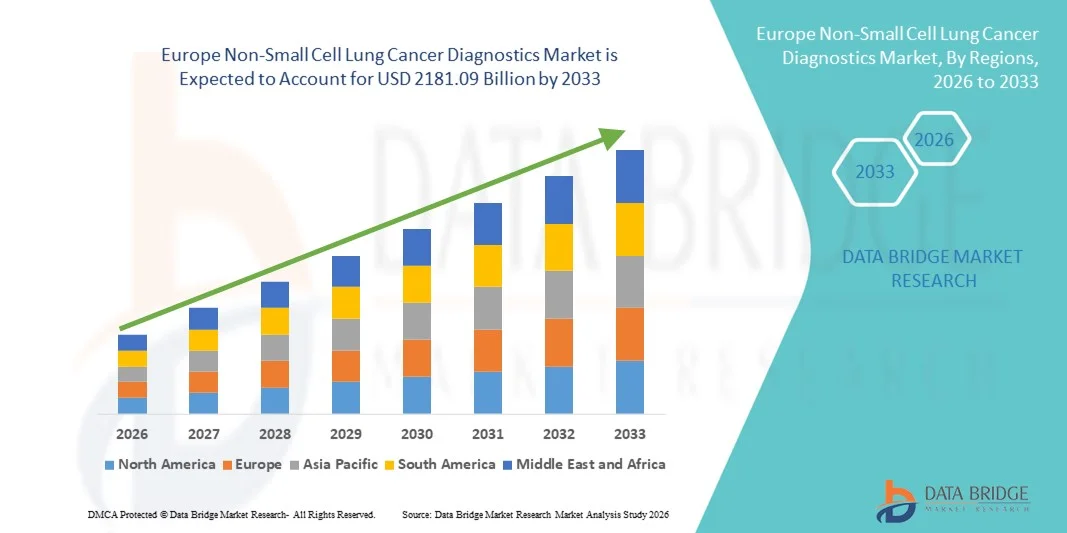
- Según el análisis del mercado del puente de datos, el tamaño del mercado del diagnóstico de cáncer de pulmón de células no pequeñas en Europa fue valoradoUSD 850.07 billion in 2025y se espera que alcanceUSD 2181.09 billion by 2033, aCAGR of 12.50%durante el período previsto
- El crecimiento del mercado se alimenta en gran medida por el aumento de la prevalencia del cáncer de pulmón en todo el mundo, los avances en el diagnóstico molecular, y la creciente conciencia de los enfoques de detección temprana y tratamiento personalizado
- Además, el aumento de la demanda de soluciones de diagnóstico rápidas, precisas y no invasivas en entornos clínicos está estableciendo diagnósticos de cáncer de pulmón de células no pequeñas (NSCLC) como componente crítico en la atención de oncología. Estos factores convergentes están acelerando la captación de soluciones de diagnóstico NSCLC, lo que aumenta significativamente el crecimiento de la industria
Tamaño del mercado
- Valor mundial del mercado (2025):USD 850.07 billion
- Valor de mercado esperado (2033):USD 2181.09 billion
- CAGR prefabricado (2026–2033):12.50%
¿Cuáles son los principales Takeaways of Europe Non-Small Cell Lung Diagnostics Market
- Cáncer de pulmón de células no pequeñas (NSCLC), son cada vez más vitales en la atención oncológica debido a su capacidad para permitir la detección temprana, guiar terapias dirigidas y mejorar los resultados de los pacientes
- La creciente demanda de diagnóstico de NSCLC se alimenta principalmente por el aumento de la prevalencia del cáncer de pulmón, el aumento de la conciencia de la medicina personalizada y el aumento de la adopción de tecnologías avanzadas de ensayo molecular en el entorno clínico
- U.K. dominó el mercado de diagnósticos de cáncer de pulmón de células no pequeñas con la mayor proporción de ingresos de aproximadamente 39,8% en 2025, apoyado por infraestructura médica avanzada, programas fuertes de investigación oncológica y la presencia de compañías de diagnóstico líderes. La adopción generalizada de soluciones de diagnóstico de vanguardia, incluyendo la biopsia líquida, el NGS y la inmunohistoquímica, junto con innovaciones continuas, impulsa un crecimiento sustancial del mercado en el país
- Se espera que Alemania sea el país de más rápido crecimiento en el mercado de diagnósticos de cáncer de pulmón de células no pequeñas durante el período de previsión, registrando un CAGR de alrededor del 12,9%, alimentado por el aumento de la incidencia de cáncer de pulmón, el aumento del gasto sanitario, la ampliación de la infraestructura de oncología y la concienciación creciente para la detección temprana de enfermedades
- El segmento de Adenocarcinoma Lung (LUAD) dominó la mayor proporción de ingresos del mercado del 46,5% en 2025, debido a su mayor prevalencia entre los pacientes de NSCLC a nivel mundial, especialmente en América del Norte y Asia-Pacífico
Informe Scope and Non-Small Cell Lung Cancer Diagnostics Market Segmentation
|
Atributos |
Diagnósticos de cáncer de pulmón de células no pequeñas |
|
Segmentos cubiertos |
|
|
Países cubiertos |
Europa
|
|
Principales jugadores del mercado |
|
|
Oportunidades de mercado |
|
|
Valor añadido Data Infosets |
Además de las ideas sobre escenarios de mercado como el valor de mercado, la tasa de crecimiento, la segmentación, la cobertura geográfica y los principales actores, los informes de mercado comisariados por Data Bridge Market Research también incluyen análisis profundos de expertos, epidemiología de pacientes, análisis de tuberías, análisis de precios y marco regulatorio. |
¿Cuál es la tendencia clave en el mercado de diagnósticos de cáncer de pulmón de células no pequeñas de Europa
Avances en Diagnósticos dirigidos y Medicina de Precisión
- Una tendencia clave en el mercado europeo de diagnósticos NSCLC es la creciente adopción de técnicas avanzadas de pruebas moleculares y genómicas para permitir la medicina de precisión
- Tecnologías como secuenciación de próxima generación (GNS), biopsia líquida y PCR múltiple se están integrando cada vez más en flujos de trabajo clínicos para permitir la detección temprana y precisa de mutaciones genéticas, biomarcadores accionables y objetivos terapéuticos
- Por ejemplo, en marzo de 2023, Guardant Health lanzó su prueba de biopsia líquida Guardant360® CDx en Europa, proporcionando una solución de perfil genómico integral y mínimamente invasiva para pacientes con NSCLC avanzada. Este desarrollo subraya el cambio hacia diagnósticos no invasivos y estrategias de tratamiento personalizadas
- Además, se centra cada vez más en la integración de diagnósticos de acompañantes con terapias específicas, permitiendo a los oncólogos a tratamientos a medida basados en biomarcadores específicos como las mutaciones EGFR, ALK, KRAS y ROS1. La tendencia hacia los dispositivos de diagnóstico de multiplex y punto de atención está acelerando la detección temprana, reduciendo los tiempos de rotación y mejorando los resultados del tratamiento
- La colaboración entre empresas de diagnóstico, hospitales e institutos de investigación está fomentando el desarrollo de pruebas y paneles innovadores diseñados específicamente para pacientes de NSCLC, garantizando mayor sensibilidad y especificidad en la detección de biomarcadores
Europa Cáncer de pulmón de células no pequeñas diagnostica dinámicas de mercado
Conductor
Inciso creciente de cáncer de pulmón y demanda de detección temprana
- La prevalencia creciente del cáncer de pulmón en todo el mundo, en particular el NSCLC, es un factor primario para el crecimiento del mercado. Aumentar la conciencia entre los profesionales de la salud y los pacientes acerca de los beneficios del diagnóstico precoz y el tratamiento personalizado está impulsando la adopción generalizada de herramientas avanzadas de diagnóstico
- Por ejemplo, en julio de 2022, Roche amplió su test de mutación EGFR cobas v2 en Asia-Pacífico, facilitando la detección rápida y precisa de mutaciones de EGFR en pacientes de NSCLC. Se espera que esas expansiones de los actores clave impulsen la adopción y el crecimiento del mercado
- La demanda se ve reforzada por el aumento de las iniciativas gubernamentales y los programas de atención médica destinados a la detección temprana del cáncer de pulmón. Las autoridades sanitarias de América del Norte, Europa y Asia-Pacífico están implementando programas nacionales de detección, a menudo incorporando escaneos de dosis bajas combinados con pruebas moleculares para la población de alto riesgo
- El aumento de las inversiones en R plagaD para la identificación de biomarcadores, así como el lanzamiento de kits y plataformas de diagnóstico innovadores, están mejorando la precisión y eficiencia de la detección de NSCLC. La creciente integración de la biopsia líquida y los métodos de biopsia tisular proporciona a los clínicos opciones flexibles y menos invasivas para el diagnóstico y monitoreo de pacientes
Restraint/Challenge
High Costs of Advanced Diagnostic Tests and Limited Accessibility
- A pesar de los avances tecnológicos, el alto costo de las pruebas de diagnóstico molecular sigue siendo un obstáculo importante para la adopción generalizada, especialmente en las regiones en desarrollo
- Equipos, reactivos y personal especializado de laboratorio contribuyen a elevar los precios, dificultando el acceso a instalaciones sanitarias más pequeñas y pacientes de bajos ingresos
- Por ejemplo, los informes de 2023 pusieron de relieve que los paneles NGS amplios podrían costar más de USD3.000 por prueba en los Estados Unidos, limitando la adopción entre clínicas ambulatorias y hospitales comunitarios. Tales consideraciones de costos pueden dificultar la penetración rápida del mercado en regiones sensibles a los precios
- Además, las aprobaciones reglamentarias y los problemas de reembolso en diferentes países pueden frenar la adopción de nuevos diagnósticos. La variabilidad de la cobertura de los seguros, la falta de directrices estandarizadas y las políticas limitadas de reembolso de los exámenes moleculares avanzados pueden desalentar a los hospitales a aplicar plataformas de diagnóstico de alta gama
- Hacer frente a estos obstáculos mediante asociaciones estratégicas, modelos de fijación de precios, expansión de la distribución regional e iniciativas gubernamentales para realizar ensayos subvencionados será crucial para asegurar una adopción más amplia y un crecimiento sostenido del mercado
¿Cómo se aumenta el mercado de diagnóstico de cáncer de pulmón de células no pequeñas en Europa
El mercado se segmenta sobre la base del tipo de cáncer, producto, prueba y usuario final.
- Por tipo de cáncer
Sobre la base del tipo de cáncer, el mercado de cáncer de pulmón de células no pequeñas se segmenta en Adenocarcinoma pulmonar (LUAD), Carcinoma de células escamosas pulmonares (LUSC), Carcinoma de células grandes y otros. El segmento de Adenocarcinoma Lung (LUAD) dominó la mayor parte de ingresos del mercado del 46,5% en 2025, debido a su mayor prevalencia entre los pacientes de NSCLC a nivel mundial, especialmente en América del Norte y Asia-Pacífico. El dominio se apoya además en una amplia investigación y enfoque clínico en LUAD debido a la disponibilidad de terapias específicas como los inhibidores EGFR y ALK. El aumento de la conciencia sobre el diagnóstico precoz, apoyado por programas gubernamentales de detección y cobertura de seguros, ha aumentado la adopción de kits de pruebas moleculares específicos de LUAD. Hospitales y laboratorios clínicos están invirtiendo en soluciones avanzadas de diagnóstico, como secuenciación de próxima generación (NGS) y ensayos basados en PCR, para detectar LUAD en etapas tempranas. El aumento de la incidencia en los no fumadores también ha ampliado la necesidad de realizar un diagnóstico de rutina. Además, la mayor prevalencia de LUAD entre las mujeres y su asociación con terapias personalizadas contribuyen a una demanda robusta. La disponibilidad de biomarcadores validados, junto con la adopción de biopsias líquidas, refuerza aún más el crecimiento de los ingresos.
Se espera que el segmento de Carcinoma Celular Grande sea testigo de la CAGR más rápida de 22,1% de 2026 a 2033, impulsada por la creciente identificación de subtipos NSCLC raros y agresivos. Las técnicas avanzadas de profilado molecular, incluyendo NGS e inmunohistoquímica, están permitiendo la detección precisa de Carcinoma de células grandes, lo que conduce a una mayor adopción en la investigación y la configuración clínica. Las empresas farmacéuticas colaboran con laboratorios de diagnóstico para desarrollar terapias específicas específicamente para pacientes de carcinoma de células grandes. El crecimiento del segmento se alimenta de la creciente conciencia de los raros subtipos NSCLC, el aumento de la financiación para la investigación oncológica y el creciente uso de la medicina personalizada. La detección temprana, junto con mejores resultados de los pacientes, estimula a los proveedores de atención médica a invertir en infraestructura de diagnóstico. Los mercados emergentes están presenciando una mayor absorción debido a la creciente prevalencia e iniciativas gubernamentales de salud.
- Por producto
Sobre la base del producto, el mercado de cáncer de pulmón de células no pequeñas se segmenta en Reagents y kits, instrumentos y softwares de servicios. El segmento Reagents and Kits mantuvo la mayor cuota de ingresos del mercado del 48,7% en 2025, impulsada por la adopción generalizada de paneles de diagnóstico molecular, kits PCR y reactivos inmunohistoquímicos para pruebas NSCLC. La alta demanda recurrente de estos consumibles garantiza ingresos constantes, especialmente en hospitales y laboratorios clínicos. El segmento se beneficia de los flujos de trabajo estandarizados y la compatibilidad de la automatización, que mejoran el rendimiento y reducen los errores manuales. El enfoque creciente en la selección de terapia dirigida para pacientes con NSCLC, junto con la creciente prevalencia del cáncer de pulmón en estadio temprano, aumenta aún más la demanda. El crecimiento del mercado está respaldado por la ampliación de la cobertura de reembolsos, el aumento de la conciencia del tratamiento basado en biomarcadores y la integración con plataformas de diagnóstico automatizadas. El segmento también se beneficia de la disponibilidad de soluciones de pruebas multiplex que permiten la detección simultánea de múltiples mutaciones, mejorando la eficiencia y la precisión del diagnóstico.
Se prevé que el segmento de Servicios & Softwares será testigo de la CAGR más rápida del 23,5% entre 2026 y 2033, impulsada por la adopción creciente de soluciones diagnósticas habilitadas por AI, plataformas basadas en la nube y servicios de telepatología. Los hospitales y laboratorios están aprovechando el software de patología digital para una interpretación más rápida de los datos moleculares y la información automatizada. Las colaboraciones entre las empresas de TI y los laboratorios de diagnóstico para el apoyo a la bioinformática y el monitoreo en tiempo real de los datos de los pacientes están impulsando el crecimiento del segmento. Aumentar la demanda de diagnósticos remotos y plataformas de consulta virtual en oncología también alimenta la adopción. Además, las aprobaciones reglamentarias y el aumento de las inversiones en iniciativas de medicina de precisión aumentan la captación de soluciones de software avanzadas. El segmento está ganando tracción tanto en mercados desarrollados como en mercados emergentes, apoyados por el creciente enfoque en análisis de datos, planificación personalizada del tratamiento y mejores resultados de los pacientes.
- Por prueba
Sobre la base de la prueba, el mercado de cáncer de pulmón de células no pequeñas se segmenta en pruebas de imágenes, pruebas moleculares, biopsia, ciclotología de esputo, toracentesis, inmunohistoquímica y otros. El segmento de Pruebas Moleculares dominó la mayor parte de ingresos del mercado del 45,3% en 2025, debido a la creciente adopción de NGS, diagnósticos basados en PCR y tecnologías de biopsia líquida. Las pruebas moleculares son fundamentales para identificar las mutaciones EGFR, ALK, KRAS y ROS1, que guían las decisiones de terapia dirigida. Los hospitales y laboratorios clínicos están implementando cada vez más pruebas moleculares como práctica estándar para el diagnóstico de NSCLC. El crecimiento se apoya además en iniciativas de medicina personalizadas, reembolso de seguros y estímulo regulatorio para el diagnóstico de acompañantes. Las pruebas moleculares también ofrecen alta sensibilidad y especificidad, facilitando la detección temprana y la vigilancia de la respuesta al tratamiento.
Se espera que la subsección de la biopsia líquida " Thoracentesis sea testigo de la CAGR más rápida del 24,1% de 2026 a 2033, impulsada por la naturaleza no invasiva de estos procedimientos, permitiendo el monitoreo en tiempo real y la mínima incomodidad de los pacientes. La adopción está respaldada por avances en el análisis del ADN del tumor (ctDNA), la interpretación asistida por AI y la integración con programas de tratamiento personalizados. Las compañías farmacéuticas y diagnósticas están invirtiendo fuertemente en el desarrollo de biopsia líquida, especialmente para pacientes con tumores difíciles de biopsia. El segmento se está expandiendo rápidamente en ensayos clínicos y centros de oncología, especialmente en regiones centradas en la medicina de precisión y detección precoz del cáncer.
- Por Final-User
Sobre la base del usuario final, el mercado de cáncer de pulmón de células no pequeñas se segmenta en hospitales, laboratorios clínicos, institutos académicos y otros. El segmento de Hospitales representó la mayor cuota de ingresos del mercado del 50,2% en 2025, debido a servicios de diagnóstico integral, integración de imágenes avanzadas, biopsia y pruebas moleculares, y disponibilidad de oncólogos y patólogos expertos. Los hospitales son la opción preferida para los pacientes que buscan un diagnóstico oportuno y preciso del NSCLC, así como para los programas de detección en estadio temprano. La presencia de equipos avanzados de diagnóstico y laboratorios internos permite una rápida planificación de pruebas y tratamientos, mejorando los resultados de los pacientes. Aumentar las iniciativas gubernamentales y las inversiones en infraestructura de atención de la salud aumentan aún más la adopción hospitalaria.
Se espera que el segmento de Institutos Académicos sea testigo de la CAGR más rápida del 21,8% entre 2026 y 2033, impulsada por iniciativas crecientes de investigación en diagnósticos, ensayos clínicos y desarrollo de soluciones innovadoras de pruebas. Los centros académicos están colaborando cada vez más con empresas biotecnológicas y farmacéuticas para la investigación traslacional, descubrimiento de biomarcadores y programas de oncología de precisión. El aumento de la financiación para la investigación del cáncer de pulmón, junto con subvenciones gubernamentales, ha acelerado significativamente la adopción académica de plataformas de diagnóstico molecular. Los institutos académicos también desempeñan un papel crucial en el desarrollo de nuevos kits de diagnóstico y programas de capacitación para profesionales de la salud.
¿Qué región tiene la mayor parte del mercado de diagnósticos de cáncer de pulmón de células no pequeñas de Europa
- Se proyecta que el mercado de diagnóstico de cáncer de pulmón de células no pequeñas de Europa se expanda en un CAGR sustancial durante el período de pronóstico, impulsado principalmente por el aumento de la incidencia del cáncer de pulmón, el aumento de la conciencia para el diagnóstico precoz, y las políticas gubernamentales de salud de apoyo
- Países como el Reino Unido y Alemania están presenciando una fuerte adopción de pruebas moleculares, perfiles de biomarcadores
- Soluciones de oncología de precisión en laboratorios clínicos, hospitales y centros de investigación, mejorando la demanda general de tecnologías de diagnóstico NSCLC
Cáncer de pulmón de células no pequeñas diagnostica la visión del mercado
El mercado de diagnóstico de cáncer de pulmón de células no pequeñas dominaba Europa con la mayor proporción de ingresos de aproximadamente 39,8% en 2025, con el apoyo de infraestructuras sanitarias avanzadas, programas fuertes de investigación oncológica y la presencia de las principales empresas de diagnóstico. La adopción generalizada de soluciones de diagnóstico de vanguardia, incluyendo la biopsia líquida, secuenciación de próxima generación (GNS) e inmunohistoquímica, junto con innovaciones continuas, impulsa un crecimiento sustancial del mercado en el país. Los programas nacionales de detección del cáncer y la creciente implementación de enfoques de tratamiento impulsados por biomarcadores alientan aún más a los proveedores de atención médica públicos y privados a adoptar soluciones de diagnóstico NSCLC de última generación.
Alemania Cáncer de pulmón de células no pequeñas diagnostica la visión del mercado
Se espera que el mercado de diagnóstico de cáncer de pulmón de células pequeñas de Alemania sea el país de más rápido crecimiento en Europa durante el período de previsión, registrando una CAGR de alrededor12.9%El crecimiento se alimenta por el aumento de la incidencia del cáncer de pulmón, el aumento del gasto sanitario, la ampliación de la infraestructura oncológica y la sensibilización creciente para la detección temprana de enfermedades. La adopción de diagnósticos avanzados como NGS, biopsia líquida y inmunoensayos múltiples en hospitales e instituciones de investigación está acelerando la detección temprana y mejorando los resultados de los pacientes. Además, el fuerte énfasis de Alemania en la medicina de precisión y la inversión en investigación de oncología apoya la rápida captación de tecnologías de diagnóstico NSCLC en todo el país.
¿Cuál es el mercado de diagnósticos de cáncer de pulmón de células no pequeñas en Europa
La industria de diagnóstico de cáncer de pulmón de células no pequeñas está dirigida principalmente por empresas bien establecidas, incluyendo:
- Roche Diagnostics (Suiza)
- Thermo Fisher Scientific (Estados Unidos)
- Abbott (U.S.)
- F. Hoffmann-La Roche Ltd (Suiza)
- Qiagen (Países Bajos)
- Illumina (U.S.)
- Agilent Technologies (U.S.)
- Hologic (Estados Unidos)
- Bio-Rad Laboratories (U.S.)
- Siemens Healthineers (Alemania)
- Becton Dickinson (Estados Unidos)
- PerkinElmer (U.S.)
- Guardant Health (U.S.)
- Foundation Medicine (U.S.)
- Myriad Genetics (U.S.)
- Laboratory Corporation of America (U.S.)
- Salud genómica (EE.UU.)
- Epigenomics AG (Alemania)
- Luminex Corporation (Estados Unidos)
- Invitae Corporation (Estados Unidos)
¿Cuáles son los últimos desarrollos en Europa de diagnósticos de cáncer de pulmón de células no pequeñas
- En mayo de 2025, el NHS de Inglaterra se convirtió en el primer servicio de salud del mundo en realizar un análisis de sangre de “biopsia de líquido” rutinario para pacientes con cáncer de pulmón, lo que permitió realizar pruebas genómicas de ADN de tumor circulante (ctDNA) para orientar las decisiones de tratamiento personalizado y acelerar el acceso a terapia dirigida en comparación con los flujos de trabajo tradicionales de biopsia. La prueba detecta fragmentos de ADN tumoral en sangre y se ha puesto a disposición en los hospitales del NHS después de estudios piloto que muestran que puede producir resultados significativamente más rápidos que las biopsias de tejido, ayudando a hasta 15.000 pacientes con cáncer de pulmón anualmente reciben tratamiento oportuno y específico
- En junio de 2025, la biopsia líquida para el cáncer de pulmón y de mama se puso a disposición rutinariamente a través del Servicio Nacional de Salud (NHS) en Inglaterra, ofreciendo amplio acceso a pruebas de ctDNA como parte de diagnósticos genómicos estándar para NSCLC y otros cánceres. Este enfoque de “prueba de sangre primero” permite a los clínicos detectar mutaciones factibles antes, a menudo reduciendo la necesidad de biopsias de tejido invasivo y apoyando decisiones de tratamiento más rápidas para pacientes con cáncer de pulmón sospechoso
- En noviembre de 2025, la FDA despejó el Test Oncomine Dx Target de Thermo Fisher Scientific como un diagnóstico de acompañante para identificar pacientes con HER2 TKD-mutant NSCLC elegibles para sevabertinib (HYRNUOTM), reforzando aún más el papel crítico de los exámenes basados en NGS en la combinación de pacientes con terapias específicas en cáncer de pulmón avanzado. Esta decisión regulatoria subraya la creciente dependencia de las plataformas de secuenciación genómica en los flujos de trabajo diagnósticos NSCLC rutinarios
- En noviembre de 2025, Thermo Fisher Scientific recibió la aprobación de la FDA para su Prueba Oncomine Dx Target como un diagnóstico acompañante para apoyar la terapia Bayer recientemente aprobada HYRNUO (sevabertinib) para pacientes avanzados de NSCLC con mutaciones HER2, permitiendo la identificación precisa de pacientes y planes de tratamiento personalizados basados en perfiles genéticos tumorales. Este uso ampliado de la plataforma Oncomine Dx amplía el acceso a atención específica para un subconjunto de pacientes de NSCLC
SKU-
Obtenga acceso en línea al informe sobre la primera nube de inteligencia de mercado del mundo

- Panel de análisis de datos interactivo
- Panel de análisis de empresas para oportunidades con alto potencial de crecimiento
- Acceso de analista de investigación para personalización y consultas
- Análisis de la competencia con panel interactivo
- Últimas noticias, actualizaciones y análisis de tendencias
- Aproveche el poder del análisis de referencia para un seguimiento integral de la competencia
Metodología de investigación
La recopilación de datos y el análisis del año base se realizan utilizando módulos de recopilación de datos con muestras de gran tamaño. La etapa incluye la obtención de información de mercado o datos relacionados a través de varias fuentes y estrategias. Incluye el examen y la planificación de todos los datos adquiridos del pasado con antelación. Asimismo, abarca el examen de las inconsistencias de información observadas en diferentes fuentes de información. Los datos de mercado se analizan y estiman utilizando modelos estadísticos y coherentes de mercado. Además, el análisis de la participación de mercado y el análisis de tendencias clave son los principales factores de éxito en el informe de mercado. Para obtener más información, solicite una llamada de un analista o envíe su consulta.
La metodología de investigación clave utilizada por el equipo de investigación de DBMR es la triangulación de datos, que implica la extracción de datos, el análisis del impacto de las variables de datos en el mercado y la validación primaria (experto en la industria). Los modelos de datos incluyen cuadrícula de posicionamiento de proveedores, análisis de línea de tiempo de mercado, descripción general y guía del mercado, cuadrícula de posicionamiento de la empresa, análisis de patentes, análisis de precios, análisis de participación de mercado de la empresa, estándares de medición, análisis global versus regional y de participación de proveedores. Para obtener más información sobre la metodología de investigación, envíe una consulta para hablar con nuestros expertos de la industria.
Personalización disponible
Data Bridge Market Research es líder en investigación formativa avanzada. Nos enorgullecemos de brindar servicios a nuestros clientes existentes y nuevos con datos y análisis que coinciden y se adaptan a sus objetivos. El informe se puede personalizar para incluir análisis de tendencias de precios de marcas objetivo, comprensión del mercado de países adicionales (solicite la lista de países), datos de resultados de ensayos clínicos, revisión de literatura, análisis de mercado renovado y base de productos. El análisis de mercado de competidores objetivo se puede analizar desde análisis basados en tecnología hasta estrategias de cartera de mercado. Podemos agregar tantos competidores sobre los que necesite datos en el formato y estilo de datos que esté buscando. Nuestro equipo de analistas también puede proporcionarle datos en archivos de Excel sin procesar, tablas dinámicas (libro de datos) o puede ayudarlo a crear presentaciones a partir de los conjuntos de datos disponibles en el informe.











