



Global Cholesterol Testing Market Segmentation, By Product Type (Test Kits and Testing Strips), Test (Total Cholesterol Test, High-Density Lipoprotein (HDL) Cholesterol, and Low-Density Lipoprotein (LDL), Test Type (Non-Invasive and Invasive), Prescription Mode (Over The Counter and Prescription Based), End-Users (Clinics, Hospitals, Ambulatory Centers, Homecare, and Diagnostic Centers)- Industry Trends and Forecast to 2033
¿Cuál es la tasa de tamaño y crecimiento del mercado de pruebas colesterol
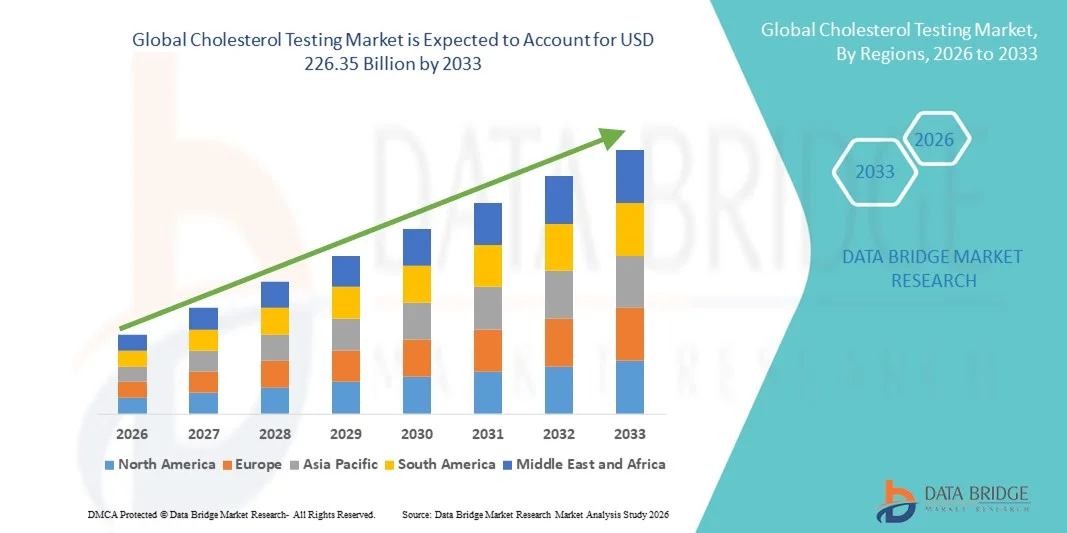
- Según Data Bridge Market Research Analysis, el tamaño del mercado mundial de pruebas de colesterol se valoró enUSD 118.99 billion in 2025y se espera que alcanceUSD 226.35 billion by 2033, aCAGR of 8.37%durante el período previsto
- El crecimiento del mercado se ve alimentado en gran medida por la creciente prevalencia de enfermedades cardiovasculares, el aumento de la conciencia sobre la salud y la creciente adopción de controles preventivos de la salud en las regiones desarrolladas y en desarrollo
- Además, los avances en tecnologías de diagnóstico, incluidosPruebas de punto de atencióny soluciones de monitoreo de colesterol en el hogar, junto con la creciente preferencia de los consumidores por resultados rápidos y precisos, están posicionando las pruebas de colesterol como un componente esencial de la gestión de la salud rutinaria. Estos factores convergentes están acelerando la adopción de soluciones de pruebas de colesterol, lo que aumenta significativamente el crecimiento de la industria
Tamaño del mercado
Valor mundial del mercado (2025):USD 118.99 billion
Valor de mercado esperado (2033):USD 226.35 billion
CAGR prefabricado (2026–2033):8.37%
¿Cuáles son los principales Takeaways del mercado de pruebas de colesterol
- Las pruebas de colesterol, que abarcan pruebas diagnósticas basadas en la sangre para monitorear el colesterol total, LDL, HDL y los niveles de triglicéridos, son cada vez más vitales para la detección temprana y la gestión de enfermedades cardiovasculares en entornos clínicos, diagnósticos y de atención en el hogar debido a su precisión, valor preventivo y facilidad de integración en las revisiones de salud de rutina
- La creciente demanda de pruebas de colesterol se alimenta principalmente de la creciente prevalencia de enfermedades cardiovasculares, el aumento de la conciencia sobre la salud y la ampliación de la adopción de prácticas de salud preventiva en mercados tanto desarrollados como emergentes
- América del Norte dominaba el mercado de pruebas de colesterol con la mayor cuota de ingresos del 38,5% en 2025, impulsada por infraestructuras sanitarias avanzadas, alta adopción de diagnósticos de punto de atención, e iniciativas gubernamentales proactivas que promueven la salud cardiovascular, con los EE.UU. liderando el uso de kits de prueba y tiras de diagnóstico en hospitales, clínicas y establecimientos de atención en casa
- Se espera que Asia-Pacífico sea la región de mayor crecimiento en el mercado de pruebas de colesterol durante el período previsto debido al aumento de los ingresos desechables, la creciente urbanización, la creciente prevalencia de trastornos relacionados con el estilo de vida, y la ampliación del acceso a clínicas, centros de diagnóstico y servicios de atención a domicilio en países como China y la India
- Los kits de prueba dominaron el mercado de pruebas de colesterol con una cuota de mercado del 42,3% en 2025, impulsada por su conveniencia, fiabilidad y creciente preferencia por métodos de prueba de colesterol invasivos y no invasivos en hospitales, centros de diagnóstico y entornos de cuidado en el hogar
Report Scope and Cholesterol Testing Market Segmentation
|
Atributos |
Comprobación del mercado clave |
|
Segmentos cubiertos |
|
|
Países cubiertos |
América del Norte
Europa
Asia y el Pacífico
Oriente Medio y África
América del Sur
|
|
Principales jugadores del mercado |
|
|
Oportunidades de mercado |
|
|
Valor añadido Data Infosets |
Además de las ideas sobre escenarios de mercado como el valor de mercado, la tasa de crecimiento, la segmentación, la cobertura geográfica y los principales actores, los informes de mercado comisariados por Data Bridge Market Research también incluyen análisis profundos de expertos, epidemiología de pacientes, análisis de tuberías, análisis de precios y marco regulatorio |
¿Cuál es la tendencia clave en el mercado de pruebas de colesterol
Avances en tecnologías de ensayo no invasivas y rápidas
- Una tendencia significativa y acelerante en el mercado mundial de pruebas de colesterol es la creciente adopción de medidas no invasivas yPruebas rápidastecnologías que permiten a los usuarios controlar los niveles de colesterol de forma rápida y conveniente sin visitas frecuentes de laboratorio
- Por ejemplo, el sistema CardioChek Plus proporciona pruebas portátiles de punto de cuidado para niveles totales de colesterol, HDL y LDL, proporcionando resultados precisos en minutos y permitiendo tanto el monitoreo clínico como en casa
- La integración con plataformas de salud digital y aplicaciones móviles permite a los usuarios seguir las tendencias a lo largo del tiempo, recibir alertas para lecturas anormales y compartir resultados con los proveedores de atención médica para recomendaciones personalizadas
- Cada vez más se están diseñando dispositivos de prueba no invasivos y kits de prueba basados en el hogar con interfaces fáciles de usar y requisitos mínimos de muestra, haciendo que las pruebas de colesterol sean accesibles para una población más amplia
- Aumentar las colaboraciones entre las empresas de diagnóstico y los proveedores de telemedicinas están permitiendo el control remoto del colesterol, permitiendo a los profesionales de la salud proporcionar intervenciones oportunas
- Esta tendencia hacia la prueba rápida, conveniente y conectada del colesterol está redefinindo las expectativas de los pacientes para la atención médica preventiva y la gestión crónica de enfermedades
- La demanda de soluciones innovadoras, fáciles de usar y precisas de pruebas de colesterol está creciendo rápidamente en clínicas, hospitales y centros de atención a domicilio, ya que los consumidores priorizan cada vez más el monitoreo dinámico de la salud cardiovascular
Dinámicas del mercado de pruebas de colesterol
Conductor
Aumentar la prevalencia de las enfermedades cardiovasculares y la conciencia de la salud preventiva
- La creciente prevalencia de enfermedades cardiovasculares, junto con la creciente conciencia acerca de las revisiones preventivas de la salud, es un factor importante para la creciente demanda de pruebas de colesterol
- Por ejemplo, en marzo de 2025, Roche lanzó una plataforma avanzada de pruebas de lípidos para mejorar la detección temprana de la dislipidemia en las poblaciones en riesgo, destacando el impulso hacia la atención cardiovascular proactiva
- A medida que los proveedores de atención médica hacen hincapié en la vigilancia rutinaria del colesterol para gestionar los riesgos de enfermedades cardíacas, se alienta cada vez más a los pacientes a someterse a exámenes regulares, impulsando el crecimiento del mercado
- La expansión de iniciativas de salud preventiva y programas de bienestar en las regiones desarrolladas y en desarrollo contribuye a una mayor adopción de soluciones de pruebas de colesterol
- El aumento de la preferencia de los consumidores por opciones de pruebas prácticas, de punto de atención y basadas en el hogar impulsa aún más la demanda de control de colesterol en clínicas, centros de diagnóstico y establecimientos de atención en el hogar
- Aumentar los programas de salud corporativa y la cobertura de seguros para diagnósticos preventivos están incentivando pruebas regulares de colesterol entre los empleados, aumentando la penetración del mercado
- Aumentar las campañas de sensibilización de las autoridades sanitarias y las ONG sobre reducción del riesgo cardiovascular están motivando a las poblaciones a supervisar activamente sus niveles de colesterol, apoyando aún más el crecimiento del mercado
Restraint/Challenge
Accuracy Concerns and Regulatory Compliance Hurdles
- Las preocupaciones acerca de la exactitud y fiabilidad de los métodos de prueba de colesterol rápidos y basados en el hogar plantean un reto significativo para una adopción más amplia en los mercados clínicos y de consumo
- Por ejemplo, los informes que destacan las discrepancias entre algunos kits de prueba de punto de atención y los resultados de laboratorio han hecho que ciertos proveedores de atención médica sean cautelosos al confiar exclusivamente en pruebas de colesterol no invasivas o en el hogar
- Garantizar el cumplimiento de normas reglamentarias estrictas y obtener las aprobaciones de autoridades como la FDA o CE es crucial para fomentar la confianza y la credibilidad del mercado
- Además, los altos costos de las plataformas avanzadas de diagnóstico en comparación con las tiras básicas de prueba pueden limitar la adopción, especialmente en los mercados emergentes o las poblaciones sensibles a los precios
- El conocimiento limitado de los pacientes y el uso indebido de kits de prueba basados en el hogar pueden resultar en lecturas inexactas, lo que impacta la confianza en soluciones de auto-prueba
- Las políticas de reembolso fragmentadas en todas las regiones pueden restringir la accesibilidad y la asequibilidad de las pruebas de colesterol, en particular en los países en desarrollo
- Superar estos desafíos mediante una mejor precisión del dispositivo, una rigurosa validación clínica y la educación del paciente será vital para un crecimiento sostenido en el mercado mundial de pruebas de colesterol
¿Cómo se aumenta el mercado de pruebas de colesterol
El mercado se segmenta sobre la base del tipo de producto, prueba, tipo de prueba, modo de prescripción y usuarios finales.
- Por tipo de producto
Sobre la base del tipo de producto, el mercado de pruebas de colesterol se segmenta en kits de prueba y tiras de prueba. El segmento de los kits de prueba dominaba el mercado con la mayor cuota de ingresos del mercado del 42,3% en 2025, impulsado por sus capacidades de prueba integrales, capacidad para medir el colesterol total, LDL, HDL ytriglicéridos,y la idoneidad para el uso clínico y doméstico. Los kits de prueba ofrecen mayor precisión en comparación con las tiras y a menudo son preferidos por los proveedores de atención médica en hospitales y centros de diagnóstico para la detección y monitoreo de rutina. La creciente conciencia de la salud cardiovascular y el diagnóstico preventivo ha fortalecido aún más la demanda de kits de prueba, especialmente en América del Norte y Europa. Además, los fabricantes están desarrollando cada vez más kits avanzados compatibles con plataformas digitales y dispositivos de punto de atención, mejorando su conveniencia y usabilidad.
Se prevé que el segmento de las tiras de prueba será testigo de la tasa de crecimiento más rápida del 20,8% entre 2026 y 2033, alimentada por la creciente adopción de soluciones portátiles, caseras y de detección de puntos de atención. Las tiras de prueba son rentables, fáciles de usar y requieren un volumen mínimo de muestra, lo que las hace atractivas para la autocontrolación frecuente por pacientes con alto colesterol o riesgos cardiovasculares. Su diseño compacto y compatibilidad con analizadores portátiles permiten a los usuarios rastrear los niveles de lípidos convenientemente fuera de la configuración clínica. Los mercados emergentes, en particular en Asia y el Pacífico, están siendo testigos de una creciente penetración de las tiras de ensayo debido a la concienciación, la asequibilidad y la expansión de los canales de distribución en las farmacias y los centros de salud minoristas.
- Por prueba
Sobre la base del tipo de prueba, el mercado se segmenta en colesterol total, colesterol HDL y pruebas de colesterol LDL. El segmento total de prueba de colesterol dominaba el mercado con una cuota de ingresos del 45,6% en 2025, ya que proporciona un indicador amplio de riesgo cardiovascular y es ampliamente recomendado durante las revisiones rutinarias de salud. Los proveedores de atención médica y los centros de diagnóstico dependen en gran medida de las pruebas totales de colesterol para las pruebas iniciales, lo que permite la identificación temprana de la dislipidemia y la intervención preventiva. El segmento se beneficia de avances tecnológicos que permiten la integración con analizadores de puntos de atención y soluciones rápidas de prueba de hogar, proporcionando resultados precisos en cuestión de minutos. La creciente prevalencia de enfermedades cardíacas y el creciente enfoque del consumidor en la atención preventiva han reforzado el dominio de las pruebas totales de colesterol.
Se espera que el segmento de prueba de colesterol HDL sea testigo de la CAGR más rápida de 19,3% de 2026 a 2033, impulsada por la creciente comprensión del papel protector de HDL en la salud cardiovascular. A medida que crece la conciencia acerca de la importancia de mantener una relación HDL-to-LDL saludable, tanto los médicos como los usuarios domésticos están monitoreando cada vez más los niveles de HDL junto con el colesterol total. Las innovaciones tecnológicas como kits de prueba HDL basados en el hogar y analizadores no invasivos están permitiendo una medición fácil, fomentando pruebas frecuentes. La adopción está aumentando particularmente en regiones como Asia-Pacífico, donde la concienciación preventiva en materia de salud aumenta rápidamente.
- Por tipo de prueba
Sobre la base del tipo de prueba, el mercado de pruebas de colesterol se segmenta en pruebas no invasivas e invasivas. El segmento invasivo dominaba el mercado con una cuota de ingresos del 47,1% en 2025, principalmente debido a su mayor precisión y fiabilidad en entornos clínicos. Las pruebas invasivas basadas en la sangre siguen siendo el estándar de oro para la evaluación del riesgo cardiovascular y se utilizan ampliamente en hospitales, clínicas y centros de diagnóstico para pruebas de detección y seguimiento. Su integración con analizadores avanzados y sistemas de información de laboratorio garantiza un perfil preciso de lípidos, contribuyendo a su liderazgo en el mercado.
Se prevé que el segmento no invasivo será testigo de la tasa de crecimiento más rápida del 21,5% entre 2026 y 2033, impulsada por el aumento de la demanda de soluciones de monitoreo de colesterol indoloros, rápidos y convenientes en el hogar. Dispositivos no invasivos como analizadores de puntillas y sistemas de escaneo digital permiten a los pacientes rastrear los niveles de lípidos sin visitas hospitalarias frecuentes. Aumentar la conciencia de la salud preventiva, junto con la integración de la salud digital, está ampliando la adopción entre consumidores con tecnología y usuarios de atención a domicilio.
- Por modo de inscripción
Sobre la base del modo de prescripción, el mercado de pruebas de colesterol se segmenta en pruebas de venta libre (OTC) y basadas en recetas. El segmento basado en recetas dominaba el mercado con una cuota de ingresos del 49% en 2025, ya que la mayoría de las pruebas clínicas requieren supervisión profesional para un diagnóstico e interpretación precisos. Las pruebas de prescripción se utilizan principalmente en hospitales, clínicas y centros de diagnóstico, asegurando el cumplimiento de normas regulatorias y mejores prácticas clínicas. Su dominio está respaldado por cobertura de seguros y programas de atención preventiva rutinaria que fomentan las pruebas supervisadas por médicos.
Se espera que el segmento OTC sea testigo de la CAGR más rápida de 2026 a 2033, impulsada por la creciente popularidad de los kits de autoprueba y las soluciones de atención a domicilio. Las pruebas de OTC proporcionan comodidad, privacidad y accesibilidad, permitiendo a los pacientes monitorizar los niveles de colesterol sin visitar las instalaciones sanitarias. El aumento de la conciencia sobre la salud de los consumidores y la proliferación de aplicaciones digitales fáciles de utilizar que rastrean los resultados están alimentando la demanda, en particular en mercados desarrollados como América del Norte y Europa.
- Por End-Users
Sobre la base de los usuarios finales, el mercado de pruebas de colesterol se segmenta en clínicas, hospitales, centros ambulatorios, atención a domicilio y centros de diagnóstico. El segmento de hospitales dominó el mercado con una cuota de ingresos del 44.8% en 2025, debido al alto volumen de pruebas rutinarias, acceso a infraestructuras avanzadas de laboratorio e integración de pruebas de colesterol en programas integrales de atención cardiovascular. Los hospitales siguen siendo compradores primarios de kits y analizadores de prueba de grado clínico, impulsando la demanda constante del mercado.
Se prevé que el segmento de atención en el hogar sea testigo de la tasa de crecimiento más rápida del 22,1% de 2026 a 2033, alimentada por la creciente adopción de soluciones de ensayo en el hogar y prácticas de salud preventiva. El aumento de la conciencia de salud, la comodidad de la autovigilancia y la integración con las aplicaciones móviles de salud están alentando a los consumidores a adoptar pruebas de colesterol en casa. El crecimiento es particularmente notable en regiones con alta penetración de smartphones y servicios de telemedicina en expansión, como Asia-Pacífico y Norteamérica.
¿Qué región posee la mayor parte del mercado de pruebas de colesterol
- América del Norte dominaba el mercado de pruebas de colesterol con la mayor cuota de ingresos del 38,5% en 2025, impulsada por infraestructuras sanitarias avanzadas, alta adopción de diagnósticos de punto de atención e iniciativas gubernamentales proactivas que promueven la salud cardiovascular
- Los consumidores y proveedores de atención médica de la región priorizan soluciones precisas, rápidas y convenientes para la prueba de colesterol, incluyendo pruebas de grado clínico en hospitales y kits de pruebas caseras para la autocontrolación
- Esta fuerte presencia de mercado está respaldada por infraestructuras de salud avanzadas, altos ingresos desechables, redes de diagnóstico bien establecidas e iniciativas gubernamentales proactivas que promueven la salud cardiovascular, estableciendo pruebas de colesterol como componente crítico de la gestión de la salud rutinaria tanto en entornos clínicos como en el hogar
US Cholesterol Testing Market Insight
El mercado estadounidense de pruebas de colesterol capturó la mayor cuota de ingresos del 79% en 2025 dentro de América del Norte, alimentada por la creciente prevalencia de enfermedades cardiovasculares y la creciente conciencia de la salud preventiva. Los consumidores y proveedores de atención médica están priorizando cada vez más la detección temprana y el monitoreo rutinario de los niveles de colesterol a través de pruebas clínicas y kits caseros. La tendencia creciente de diagnósticos de puntos de atención, junto con la adopción de aplicaciones móviles de salud y reportaje digital, impulsa aún más el mercado de pruebas de colesterol. Además, la cobertura de seguros y los programas de bienestar empresarial que fomentan los exámenes regulares de salud contribuyen significativamente a la expansión del mercado.
Europa Mercado de pruebas de colesterol
Se prevé que el mercado europeo de pruebas de colesterol se expanda en un CAGR sustancial durante todo el período previsto, impulsado principalmente por el aumento de la prevalencia de enfermedades cardiovasculares y las iniciativas gubernamentales que promueven el control preventivo de la salud. La creciente urbanización de la región, junto con la creciente conciencia de la salud, está fomentando la adopción de soluciones de prueba de colesterol tanto basadas en clínicas como en el hogar. Los consumidores europeos están cada vez más atraídos a métodos de prueba convenientes, rápidos y precisos. El mercado está presenciando un crecimiento significativo en hospitales, centros de diagnóstico y aplicaciones de atención a domicilio, con pruebas integradas en programas de salud rutinarios e iniciativas de bienestar.
U.K. Cholesterol Testing Market Insight
Se prevé que el mercado de pruebas de colesterol de los Estados Unidos crezca en un CAGR notable durante el período previsto, impulsado por aumentar la conciencia de la salud preventiva y aumentar los casos de trastornos relacionados con el estilo de vida. Además, las preocupaciones relativas a los riesgos cardiovasculares alientan tanto a las personas como a los proveedores de atención médica a adoptar un control regular del colesterol. Se espera que la robusta infraestructura sanitaria del Reino Unido, junto con la adopción generalizada de soluciones de salud digital y kits de prueba de vivienda, siga estimulando el crecimiento del mercado. El aumento de las campañas gubernamentales y las iniciativas de bienestar empresarial apoyan aún más la adopción de pruebas de colesterol en diversos segmentos de usuarios finales.
Alemania Mercado de pruebas de colesterol
Se espera que el mercado de pruebas de colesterol de Alemania se expanda en un CAGR considerable durante el período de pronóstico, alimentado por el aumento de la conciencia sobre la salud cardiovascular y la demanda de soluciones de diagnóstico tecnológicamente avanzadas. La infraestructura sanitaria bien desarrollada de Alemania, el énfasis en la innovación y la alta conciencia de salud del consumidor promueven la adopción de métodos de prueba de colesterol invasivos y no invasivos. La integración con las plataformas de salud digital y los analizadores de puntos de atención se está volviendo cada vez más frecuente, especialmente en los hospitales y centros de diagnóstico, mientras que la vigilancia basada en el hogar está ganando tracción entre las poblaciones conscientes de la salud.
Mercado de pruebas de colesterol Asia-Pacífico
El mercado de pruebas de colesterol Asia-Pacífico está preparado para crecer en la CAGR más rápida del 23% durante el período de previsión de 2026 a 2033, impulsado por el aumento de la urbanización, el aumento de los ingresos desechables y la creciente prevalencia de trastornos relacionados con el estilo de vida en países como China, Japón y la India. La creciente conciencia de salud y las iniciativas gubernamentales que promueven la salud preventiva están impulsando la adopción de pruebas de colesterol. Además, a medida que el APAC emerge como centro de fabricación de kits y dispositivos de diagnóstico, la accesibilidad y la accesibilidad de soluciones de pruebas de colesterol se están expandiendo a una población más amplia.
Japón Mercado de pruebas de colesterol
El mercado de pruebas de colesterol de Japón está cobrando impulso debido a la infraestructura sanitaria avanzada del país, la conciencia de la salud y el envejecimiento de la población. El mercado japonés hace hincapié en la detección temprana y la atención preventiva, lo que conduce a una mayor adopción de soluciones clínicas y basadas en el colesterol. La integración con plataformas de salud digital y aplicaciones móviles permite un seguimiento y un intercambio convenientes de resultados con proveedores de atención médica. Además, aumenta la demanda de opciones no invasivas y rápidas de ensayo, en particular para los pacientes de edad que requieren un seguimiento regular.
Mercado de pruebas de colesterol India
El mercado de pruebas de colesterol de la India representó la mayor cuota de ingresos del mercado en Asia-Pacífico en 2025, atribuida a la creciente clase media del país, la urbanización rápida y el aumento de la conciencia de salud. India está presenciando una fuerte adopción de soluciones clínicas y caseras de pruebas de colesterol en hospitales, centros de diagnóstico y entornos de cuidado en casa. Los programas gubernamentales que promueven la salud preventiva, el impulso hacia iniciativas inteligentes y digitales de salud, y la disponibilidad de kits de pruebas asequibles son factores clave que impulsan el mercado. Aumentar la prevalencia de enfermedades cardiovasculares relacionadas con el estilo de vida acelera aún más la adopción de pruebas de colesterol en Indi
¿Cuáles son las mejores empresas del mercado de pruebas de colesterol
La industria del ensayo de colesterol está dirigida principalmente por empresas bien establecidas, incluyendo:
- Abbott (U.S.)
- Siemens Healthineers AG (Alemania)
- Beckman Coulter, Inc. (U.S.)
- Thermo Fisher Scientific Inc. (U.S.)
- Diagnósticos de Búsqueda Incorporados (U.S.)
- Randox Laboratories Ltd. (Reino Unido)
- PerkinElmer, Inc.
- Eurofins Scientific (Luxemburgo)
- DiaSorin S.p.A. (Italia)
- Diagnósticos de PTS (U.S.)
- ACON Laboratories, Inc. (U.S.)
- Nova Biomedical (U.S.)
- Labcorp (U.S.)
- Sekisui Diagnostics LLC (U.S.)
- Trinity Biotech plc (Irlanda)
- Diagnósticos Clínicas Ortho (Estados Unidos)
- Cell Biolabs, Inc. (U.S.)
- Clinical Reference Laboratory, Inc. (U.S.)
- BioReference Health, LLC (Estados Unidos)
¿Cuáles son los avances recientes en el mercado mundial de pruebas de colesterol
- En agosto de 2025, un estudio dirigido por la Universidad Monash encontró que la detección rutinaria de lipoproteína(a), una variante de colesterol genético no medida en los paneles estándar, podría reducir significativamente los ataques cardíacos y las incidencias de accidentes cerebrovasculares si se adopta ampliamente en adultos mayores de 40
- En agosto de 2025, un estudio internacional dirigido por la Universidad Monash mostró que las pruebas rutinarias para la lipoproteína elevada (a), un factor de riesgo de colesterol genético a menudo no incluido en los paneles estándar, podrían prevenir docenas de ataques cardíacos y derrames cerebrales y agregar años de vida saludable, reforzando las llamadas para ampliar los protocolos de detección de colesterol a nivel mundial
- En mayo de 2025, los cardiólogos destacaron que las pruebas tradicionales de perfil lípido pueden ser insuficientes solos e instaron a los médicos a incluir marcadores de inflamación (como hs‐CRP) e indicadores de riesgo genético para evaluar mejor la salud cardiovascular y prevenir la progresión de enfermedades
- En mayo de 2024, Roche Diagnostics anunció que su ensayo Tina‐quant® lipoproteína (a) RxDx recibió la designación de dispositivos de avanzada de la FDA estadounidense para medir Lp(a), un marcador de riesgo cardiovascular hereditario emergente que complementa las pruebas tradicionales de colesterol y puede ayudar a identificar pacientes que pueden beneficiarse de terapias selectivas.
- En marzo de 2025, una revisión bibliográfica de las pruebas de punto de cuidado del colesterol encontró que sólo dos de cada seis dispositivos ampliamente utilizados cumplieron los requisitos de precisión necesarios para su uso en el programa de salud de NHS, destacando las preocupaciones sobre la fiabilidad de las pruebas comunitarias rápidas y la necesidad de mejorar la garantía de calidad y la supervisión reglamentaria
SKU-
Obtenga acceso en línea al informe sobre la primera nube de inteligencia de mercado del mundo

- Panel de análisis de datos interactivo
- Panel de análisis de empresas para oportunidades con alto potencial de crecimiento
- Acceso de analista de investigación para personalización y consultas
- Análisis de la competencia con panel interactivo
- Últimas noticias, actualizaciones y análisis de tendencias
- Aproveche el poder del análisis de referencia para un seguimiento integral de la competencia
Metodología de investigación
La recopilación de datos y el análisis del año base se realizan utilizando módulos de recopilación de datos con muestras de gran tamaño. La etapa incluye la obtención de información de mercado o datos relacionados a través de varias fuentes y estrategias. Incluye el examen y la planificación de todos los datos adquiridos del pasado con antelación. Asimismo, abarca el examen de las inconsistencias de información observadas en diferentes fuentes de información. Los datos de mercado se analizan y estiman utilizando modelos estadísticos y coherentes de mercado. Además, el análisis de la participación de mercado y el análisis de tendencias clave son los principales factores de éxito en el informe de mercado. Para obtener más información, solicite una llamada de un analista o envíe su consulta.
La metodología de investigación clave utilizada por el equipo de investigación de DBMR es la triangulación de datos, que implica la extracción de datos, el análisis del impacto de las variables de datos en el mercado y la validación primaria (experto en la industria). Los modelos de datos incluyen cuadrícula de posicionamiento de proveedores, análisis de línea de tiempo de mercado, descripción general y guía del mercado, cuadrícula de posicionamiento de la empresa, análisis de patentes, análisis de precios, análisis de participación de mercado de la empresa, estándares de medición, análisis global versus regional y de participación de proveedores. Para obtener más información sobre la metodología de investigación, envíe una consulta para hablar con nuestros expertos de la industria.
Personalización disponible
Data Bridge Market Research es líder en investigación formativa avanzada. Nos enorgullecemos de brindar servicios a nuestros clientes existentes y nuevos con datos y análisis que coinciden y se adaptan a sus objetivos. El informe se puede personalizar para incluir análisis de tendencias de precios de marcas objetivo, comprensión del mercado de países adicionales (solicite la lista de países), datos de resultados de ensayos clínicos, revisión de literatura, análisis de mercado renovado y base de productos. El análisis de mercado de competidores objetivo se puede analizar desde análisis basados en tecnología hasta estrategias de cartera de mercado. Podemos agregar tantos competidores sobre los que necesite datos en el formato y estilo de datos que esté buscando. Nuestro equipo de analistas también puede proporcionarle datos en archivos de Excel sin procesar, tablas dinámicas (libro de datos) o puede ayudarlo a crear presentaciones a partir de los conjuntos de datos disponibles en el informe.











