



Global Diameter Interworking Function (IWF) Market Segmentation, By Offering (Hardware, Software and Solutions), Connectivity Technology (2G, 3G,4G, 5G, and Others), Application (LTE Broadcast, Policy Management, Mobility, and Voice Over LTE [VoLTE])- Industry Trends and Forecast to 2033
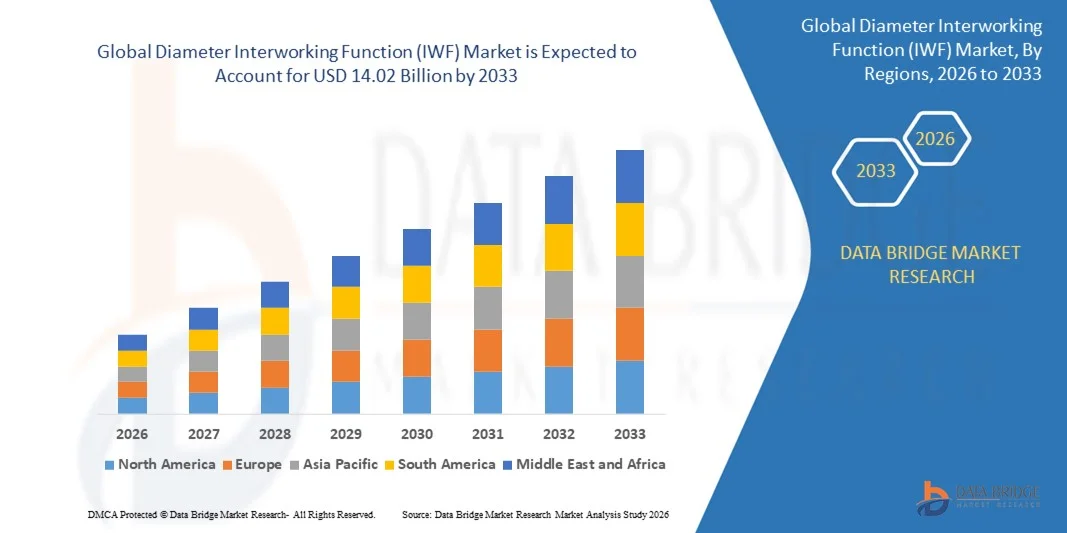
Diameter Interworking Function (IWF) Market Size
- The global diameter interworking function (IWF) market size was valued at USD 2.62 billion in 2025 and is expected to reach USD 14.02 billion by 2033, at a CAGR of 23.30% during the forecast period
- The market growth is largely fuelled by the increasing deployment of 4G LTE and 5G networks, rising demand for seamless roaming and interoperability between legacy and next-generation networks, and the need for efficient signaling and session management in telecom infrastructure
- Growing adoption of IP Multimedia Subsystem (IMS) architecture, network virtualization, and cloud-based telecom solutions is further driving market expansion
Diameter Interworking Function (IWF) Market Analysis
- The diameter interworking function market is witnessing strong growth due to increasing network densification, expansion of mobile broadband services, and the evolution of telecom networks from 4G to 5G
- Key market players are focusing on partnerships, collaborations, and product innovations to provide high-performance IWF solutions that support scalability, interoperability, and secure signaling
- North America dominated the diameter interworking function (IWF) market with the largest revenue share of 36.50% in 2025, driven by rapid adoption of 4G LTE and 5G networks, as well as increasing demand for seamless network interoperability and signaling management
- Asia-Pacific region is expected to witness the highest growth rate in the global diameter interworking function (IWF) market, driven by rising network modernization, smart city initiatives, rapid urbanization, and increasing demand for efficient and reliable telecom interworking solutions
- The Solutions segment held the largest market revenue share in 2025, driven by the increasing adoption of end-to-end IWF platforms that provide signaling management, protocol conversion, and seamless interworking across 4G and 5G networks. IWF solutions often offer scalability, centralized control, and integration with telecom network management systems, making them a preferred choice for operators
Report Scope and Diameter Interworking Function (IWF) Market Segmentation
|
Attributes |
Diameter Interworking Function (IWF) Key Market Insights |
|
Segments Covered |
|
|
Countries Covered |
North America
Europe
Asia-Pacific
Middle East and Africa
South America
|
|
Key Market Players |
• Dialogic Corporation (U.S.) |
|
Market Opportunities |
|
|
Value Added Data Infosets |
In addition to the market insights such as market value, growth rate, market segments, geographical coverage, market players, and market scenario, the market report curated by the Data Bridge Market Research team includes in-depth expert analysis, import/export analysis, pricing analysis, production consumption analysis, and pestle analysis. |
Diameter Interworking Function (IWF) Market Trends
Rising Demand for Seamless 4G and 5G Network Interoperability
- The growing focus on advanced telecom networks is significantly shaping the diameter interworking function (IWF) market, as operators increasingly prefer solutions that ensure seamless communication between legacy 3G/4G networks and next-generation 5G networks. IWF solutions are gaining traction due to their ability to handle signaling, session management, and protocol translation efficiently without compromising network performance. This trend strengthens their adoption across mobile operators, service providers, and enterprise networks, encouraging vendors to innovate with scalable and high-performance solutions
- Increasing deployment of IP Multimedia Subsystem (IMS), network virtualization, and cloud-based telecom architectures has accelerated the demand for IWF solutions. Telecom operators are actively seeking solutions that provide interoperability, low latency, and reliable session management, prompting collaborations between IWF providers and network equipment manufacturers to enhance functionality and ensure seamless roaming experiences
- Network performance and interoperability trends are influencing purchasing decisions, with operators emphasizing network reliability, low latency, and support for high-traffic scenarios. These factors are helping vendors differentiate products in a competitive market and build trust with telecom clients, while also driving the adoption of standards-compliant and certified IWF solutions. Companies are increasingly using marketing campaigns to highlight these benefits to reinforce positioning and appeal to network operators
- For instance, in 2024, Ericsson in Sweden and Huawei in China expanded their IWF product portfolios by incorporating advanced signaling, session management, and cloud-based features. These launches were introduced in response to rising operator demand for seamless network interworking, with deployment across telecom, enterprise, and managed service environments. The solutions were also marketed as reliable and scalable, enhancing operator confidence and repeat adoption
- While demand for diameter interworking function solutions is growing, sustained market expansion depends on continuous R&D, cost-effective deployment, and maintaining high performance in complex network environments. Vendors are also focusing on improving scalability, security, and interoperability to balance cost, quality, and functionality for broader adoption
Diameter Interworking Function (IWF) Market Dynamics
Driver
Growing Need for Seamless 4G/5G Network Integration
- Rising demand for seamless interworking between legacy and next-generation networks is a major driver for the diameter interworking function market. Telecom operators are increasingly implementing IWF solutions to support protocol conversion, signaling management, and interoperability across multi-generation networks. This trend is also encouraging innovation in cloud-native and virtualized IWF architectures, supporting service diversification
- Expanding applications in mobile networks, enterprise communication systems, and managed services are influencing market growth. IWF solutions help ensure uninterrupted session continuity, low-latency signaling, and efficient handling of subscriber data while maintaining network reliability, enabling operators to meet growing consumer and enterprise expectations for high-quality services
- Network equipment manufacturers and service providers are actively promoting IWF-based solutions through product innovation, certifications, and strategic partnerships. These efforts are supported by growing operator demand for high-performance, scalable, and secure solutions, and they also encourage collaborations between vendors and telecom operators to optimize network efficiency and reduce operational costs
- For instance, in 2023, Huawei in China and Ericsson in Sweden reported increased incorporation of IWF solutions in LTE and 5G network deployments. This expansion followed higher demand for seamless roaming, protocol interworking, and reliable session management, driving repeat adoption and service differentiation. Both companies also highlighted scalability and compliance with global telecom standards in marketing campaigns to strengthen operator trust
- Although rising network modernization and interworking trends support growth, wider adoption depends on cost optimization, integration complexity, and operator awareness. Investment in network automation, cloud-native architectures, and standardized deployment practices will be critical for meeting global demand and maintaining competitive advantage
Restraint/Challenge
High Deployment Costs And Integration Complexity
- The relatively higher deployment cost of IWF solutions compared to traditional network elements remains a key challenge, limiting adoption among cost-sensitive operators. Complex integration with existing network infrastructure, along with the need for specialized hardware and skilled workforce, contributes to elevated implementation costs
- Operator awareness and technical expertise remain uneven, particularly in developing regions where network modernization is still emerging. Limited understanding of IWF functionality and benefits restricts adoption across certain telecom segments. This also leads to slower uptake in emerging markets where educational initiatives on advanced signaling and interworking solutions are minimal
- Supply chain, network compatibility, and certification challenges also impact market growth, as IWF solutions require adherence to strict telecom standards and high-performance requirements. Logistical and deployment complexities increase operational costs. Vendors must invest in training, support, and efficient implementation practices to maintain solution reliability
- For instance, in 2024, telecom operators in India and Southeast Asia reported slower adoption of IWF solutions due to higher costs and limited awareness of functional advantages compared to conventional interworking solutions. Integration with legacy systems and adherence to global standards were additional barriers. These factors also prompted some operators to delay network upgrades, affecting market penetration
- Overcoming these challenges will require cost-efficient deployment, operator education, and simplified integration processes. Collaboration with standards bodies, network integrators, and training providers can help unlock the long-term growth potential of the global diameter interworking function market. Furthermore, developing scalable, standardized, and interoperable solutions will be essential for widespread adoption
Diameter Interworking Function (IWF) Market Scope
The market is segmented on the basis of offering, connectivity technology, and application.
- By Offering
On the basis of offering, the diameter interworking function (IWF) market is segmented into Hardware, Software, and Solutions. The Solutions segment held the largest market revenue share in 2025, driven by the increasing adoption of end-to-end IWF platforms that provide signaling management, protocol conversion, and seamless interworking across 4G and 5G networks. IWF solutions often offer scalability, centralized control, and integration with telecom network management systems, making them a preferred choice for operators.
The Hardware segment is expected to witness the fastest growth rate from 2026 to 2033, driven by the rising demand for dedicated IWF appliances that ensure low-latency processing, high reliability, and enhanced network performance. Hardware-based IWF deployments are particularly popular for mission-critical telecom infrastructure where performance and compliance with global standards are essential.
- By Connectivity Technology
On the basis of connectivity technology, the market is segmented into 2G, 3G, 4G, 5G, and Others. The 4G segment held the largest market share in 2025, owing to the widespread global deployment of LTE networks and the need for interworking with legacy systems to maintain uninterrupted services and seamless roaming.
The 5G segment is expected to register the fastest growth from 2026 to 2033, driven by rapid 5G network rollouts and increasing demand for high-speed, low-latency communication. IWF solutions supporting 5G enable operators to manage signaling, mobility, and policy control efficiently while ensuring interoperability with existing 4G infrastructure.
- By Application
On the basis of application, the market is segmented into LTE Broadcast, Policy Management, Mobility, and Voice Over LTE (VoLTE). The Policy Management segment held the largest market share in 2025, fueled by telecom operators’ focus on optimizing network traffic, subscriber experience, and resource allocation.
The VoLTE segment is expected to witness the fastest growth rate from 2026 to 2033, driven by the increasing adoption of voice over LTE services, enhanced call quality requirements, and the need for seamless interworking with legacy voice networks. VoLTE-focused IWF deployments are critical for ensuring uninterrupted voice communication and subscriber satisfaction across evolving mobile networks.
Diameter Interworking Function (IWF) Market Regional Analysis
- North America dominated the diameter interworking function (IWF) market with the largest revenue share of 36.50% in 2025, driven by rapid adoption of 4G LTE and 5G networks, as well as increasing demand for seamless network interoperability and signaling management
- Telecom operators in the region highly value the reliability, scalability, and low-latency performance offered by IWF solutions, which enable seamless interworking between legacy and next-generation networks
- This widespread adoption is further supported by advanced telecom infrastructure, high investments in network modernization, and the growing preference for cloud-native and virtualized solutions, establishing IWF as a critical component for efficient network operation
U.S. Diameter Interworking Function (IWF) Market Insight
The U.S. IWF market captured the largest revenue share in 2025 within North America, fueled by the swift rollout of LTE and 5G networks and increasing demand for uninterrupted roaming and session continuity. Telecom operators are prioritizing signaling efficiency, protocol conversion, and low-latency interworking between multi-generation networks. The integration of cloud-based and virtualized IWF solutions, along with operator focus on service quality and network reliability, is significantly contributing to market expansion.
Europe Diameter Interworking Function (IWF) Market Insight
The Europe IWF market is expected to witness the fastest growth rate from 2026 to 2033, primarily driven by strict telecom regulations, increasing network upgrades, and the demand for enhanced interoperability across mobile and enterprise networks. The rise in urbanization and deployment of smart infrastructure is fostering the adoption of IWF solutions. Operators in Europe are leveraging IWF to ensure seamless network integration and improved service quality across residential, commercial, and industrial applications.
U.K. Diameter Interworking Function (IWF) Market Insight
The U.K. IWF market is expected to witness the fastest growth rate from 2026 to 2033, driven by rapid 5G deployment, network modernization initiatives, and the need for reliable, scalable interworking solutions. Telecom operators are increasingly adopting IWF for session management, signaling, and protocol translation, while also emphasizing efficient network traffic handling and compliance with international standards.
Germany Diameter Interworking Function (IWF) Market Insight
The Germany IWF market is expected to witness the fastest growth rate from 2026 to 2033, fueled by increasing awareness of network efficiency, digital transformation in telecom infrastructure, and rising demand for secure, low-latency interworking solutions. Germany’s advanced network infrastructure and focus on innovation promote the adoption of IWF, particularly across enterprise and commercial networks. Integration with cloud-based and virtualized telecom systems is also becoming increasingly prevalent.
Asia-Pacific Diameter Interworking Function (IWF) Market Insight
The Asia-Pacific IWF market is expected to witness the fastest growth rate from 2026 to 2033, driven by expanding mobile broadband infrastructure, increasing 4G/5G network deployments, and rising telecom investments in countries such as China, Japan, and India. Government initiatives promoting digitalization, smart city projects, and enhanced network performance are driving adoption. Furthermore, APAC’s role as a manufacturing and technology hub for telecom equipment is improving affordability and accessibility of IWF solutions for operators.
Japan Diameter Interworking Function (IWF) Market Insight
The Japan IWF market is expected to witness the fastest growth rate from 2026 to 2033, supported by the country’s advanced telecom ecosystem, high 5G adoption, and demand for low-latency, high-reliability network interworking solutions. The integration of IWF with enterprise networks and IoT systems, along with the increasing number of connected devices, is fueling market growth. Moreover, Japan’s focus on efficient and secure network communication is likely to drive adoption across mobile operators and enterprise segments.
China Diameter Interworking Function (IWF) Market Insight
The China IWF market accounted for the largest revenue share in Asia-Pacific in 2025, attributed to rapid network expansion, high mobile broadband penetration, and government-led 5G initiatives. China represents one of the largest telecom markets globally, and IWF solutions are increasingly deployed to ensure seamless interoperability between 4G LTE and 5G networks. The push towards smart cities, growing demand for high-quality data services, and strong domestic vendors are key factors propelling the market in China.
Diameter Interworking Function (IWF) Market Share
The Diameter Interworking Function (IWF) industry is primarily led by well-established companies, including:
• Dialogic Corporation (U.S.)
• Diametriq (U.S.)
• F5, Inc. (U.S.)
• Huawei Technologies Co., Ltd. (China)
• Nokia (Finland)
• Oracle (U.S.)
• Ribbon Communications Operating Company, Inc. (U.S.)
• Sandvine (Canada)
• Squire Technologies Ltd. (U.K.)
• Telefonaktiebolaget LM Ericsson (Sweden)
• Cisco Systems, Inc. (U.S.)
• Broad Forward BV (Netherlands)
• EXFO Inc. (Canada)
• Marben Products (U.K.)
• Computaris (U.K.)
• TNS Inc. (U.S.)
• Packet Force Pvt. Ltd. (India)
• NEXNET SOLUTIONS (U.S.)
• Enghouse Systems (Canada)
• Cellusys (Ireland)
SKU-
Obtenga acceso en línea al informe sobre la primera nube de inteligencia de mercado del mundo

- Panel de análisis de datos interactivo
- Panel de análisis de empresas para oportunidades con alto potencial de crecimiento
- Acceso de analista de investigación para personalización y consultas
- Análisis de la competencia con panel interactivo
- Últimas noticias, actualizaciones y análisis de tendencias
- Aproveche el poder del análisis de referencia para un seguimiento integral de la competencia
Metodología de investigación
La recopilación de datos y el análisis del año base se realizan utilizando módulos de recopilación de datos con muestras de gran tamaño. La etapa incluye la obtención de información de mercado o datos relacionados a través de varias fuentes y estrategias. Incluye el examen y la planificación de todos los datos adquiridos del pasado con antelación. Asimismo, abarca el examen de las inconsistencias de información observadas en diferentes fuentes de información. Los datos de mercado se analizan y estiman utilizando modelos estadísticos y coherentes de mercado. Además, el análisis de la participación de mercado y el análisis de tendencias clave son los principales factores de éxito en el informe de mercado. Para obtener más información, solicite una llamada de un analista o envíe su consulta.
La metodología de investigación clave utilizada por el equipo de investigación de DBMR es la triangulación de datos, que implica la extracción de datos, el análisis del impacto de las variables de datos en el mercado y la validación primaria (experto en la industria). Los modelos de datos incluyen cuadrícula de posicionamiento de proveedores, análisis de línea de tiempo de mercado, descripción general y guía del mercado, cuadrícula de posicionamiento de la empresa, análisis de patentes, análisis de precios, análisis de participación de mercado de la empresa, estándares de medición, análisis global versus regional y de participación de proveedores. Para obtener más información sobre la metodología de investigación, envíe una consulta para hablar con nuestros expertos de la industria.
Personalización disponible
Data Bridge Market Research es líder en investigación formativa avanzada. Nos enorgullecemos de brindar servicios a nuestros clientes existentes y nuevos con datos y análisis que coinciden y se adaptan a sus objetivos. El informe se puede personalizar para incluir análisis de tendencias de precios de marcas objetivo, comprensión del mercado de países adicionales (solicite la lista de países), datos de resultados de ensayos clínicos, revisión de literatura, análisis de mercado renovado y base de productos. El análisis de mercado de competidores objetivo se puede analizar desde análisis basados en tecnología hasta estrategias de cartera de mercado. Podemos agregar tantos competidores sobre los que necesite datos en el formato y estilo de datos que esté buscando. Nuestro equipo de analistas también puede proporcionarle datos en archivos de Excel sin procesar, tablas dinámicas (libro de datos) o puede ayudarlo a crear presentaciones a partir de los conjuntos de datos disponibles en el informe.











