



Global Metabolic Testing Market Segmentation, By Product (CPET Systems, Metabolic Carts, ECG and EKG Systems, Body Composition Analyzers, and Software), Application (Lifestyle Diseases, Critical Care, Human Performance Testing, Dysmetabolic Syndrome X, and Metabolic Disorders), Technology (VO2 Max Analysis, RMR Analysis, and Body Composition Analysis), End User (Hospitals, Laboratories, Sports Training Centers, and Gyms) - Industry Trends and Forecast to 2032
¿Cuál es la tasa de tamaño y crecimiento del mercado de pruebas metabólicas
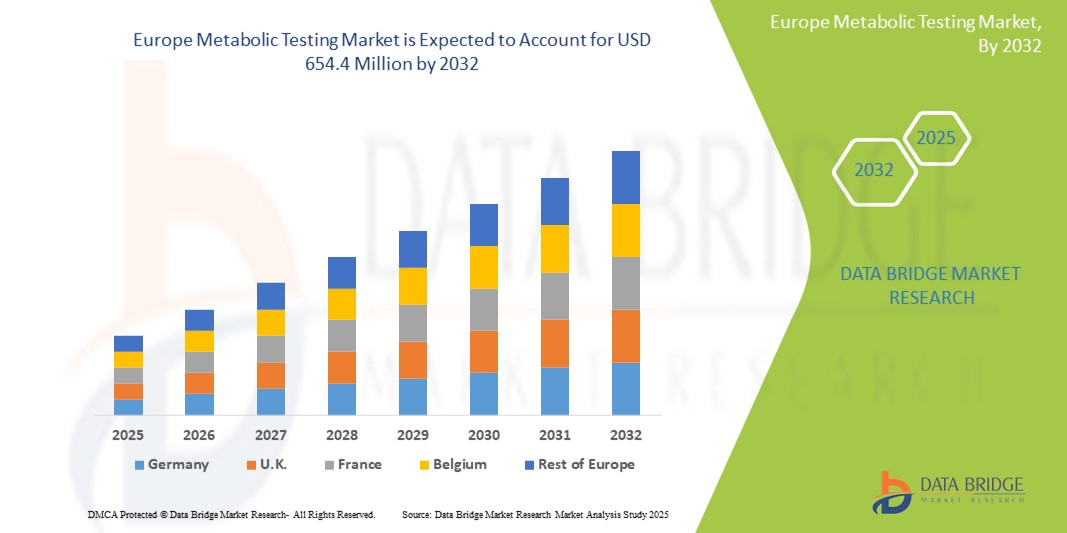
- Según Data Bridge Market Research Analysis global metabólica test market size was valued atUSD 726.20 millones en 2024y se espera que alcanceUSD 1339.18 millones en 2032, aCAGR of 7.95%durante el período previsto
- Este crecimiento se debe a factores como el envejecimiento de la población, el aumento de la prevalencia de enfermedades oculares y los avances enoftalmológicotecnología
Tamaño del mercado
- Valor mundial del mercado (2024):USD 726,20 millones
- Valor de mercado esperado (2032):USD 1339,18 millones
- CAGR prefabricado (2024–2032):7.95%
¿Cuáles son los principales Takeaways of Metabolic Testing Market
- Las pruebas metabólicas implica evaluar la tasa metabólica de un individuo, que es la tasa a la que su cuerpo quema calorías y convierte los alimentos en energía
- Esta prueba puede proporcionar información sobre la eficacia de las funciones del metabolismo de alguien, ayudando a adaptar planes de nutrición y ejercicio paraGestión del peso, optimización del rendimiento atlético o condiciones médicas como trastornos metabólicos
- Se espera que América del Norte predomine el mercado de pruebas metabólicas con 47,2% debido a los fuertes resultados comerciales de los diagnósticos de la CP/RP en la carga de la alta enfermedad de Estados Unidos, el aumento de la conciencia de los consumidores, los avances tecnológicos, las medidas gubernamentales proactivas y las mejoras en la infraestructura sanitaria son algunos de los principales contribuyentes del crecimiento del mercado
- Se espera que Asia-Pacífico sea la región de mayor crecimiento en el mercado de pruebas metabólicas durante el período previsto debido al aumento del gasto sanitario y el desarrollo de la infraestructura
- Se espera que el segmento de Enfermedades de Estilo de Vida prevalezca el mercado debido a su alta prevalencia de enfermedades y la máxima utilización de analitos. Las anomalías renales podrían surgir de otras comorbilidades, como la diabetes y la presión arterial alta
Report Scope and Metabolic Testing Market Segmentation
|
Atributos |
Pruebas metabólicas del mercado clave |
|
Segmentos cubiertos |
|
|
Países cubiertos |
América del Norte
Europa
Asia y el Pacífico
Oriente Medio y África
América del Sur
|
|
Principales jugadores del mercado |
|
|
Oportunidades de mercado |
|
|
Valor añadido Data Infosets |
|
¿Cuál es la tendencia clave en el mercado de pruebas metabólicas
“Integration with Digital Health Solutions”
- La integración de las pruebas metabólicas con dispositivos portátiles y aplicaciones móviles permite un seguimiento continuo de los parámetros metabólicos, permitiendo un seguimiento de salud en tiempo real y una retroalimentación personalizada
- Se están utilizando análisis avanzados de datos e inteligencia artificial (AI) para analizar grandes conjuntos de datos de pruebas metabólicas, proporcionando información que informa las decisiones sanitarias y optimiza los planes de tratamiento
- Los consumidores están adoptando cada vez más soluciones de salud digital, buscando un mayor control sobre su salud y bienestar, lo que impulsa la demanda de herramientas integradas de prueba metabólica
- Las plataformas digitales facilitan el acceso a servicios de pruebas metabólicas en áreas remotas o insuficientes, superando brechas en la prestación de atención médica
- La convergencia de las pruebas metabólicas con las tecnologías de salud digital está expandiendo el mercado más allá de los entornos clínicos tradicionales en la gestión de la salud personal y los dominios de fitness.
Dinámica del mercado de pruebas metabólicas
Conductor
“Rising Prevalence of Chronic Diseases”
- El aumento global en condiciones crónicas como la diabetes, la obesidad y las enfermedades cardiovasculares está impulsando significativamente la demanda de pruebas metabólicas
- Las pruebas metabólicas permiten la identificación temprana de los trastornos metabólicos, permitiendo la intervención oportuna y la gestión de enfermedades crónicas
- La intensificación de los costos de salud asociados a enfermedades crónicas está impulsando a los sistemas de atención médica a adoptar medidas preventivas como las pruebas metabólicas para reducir los gastos a largo plazo
- Las iniciativas gubernamentales y los programas de salud pública están incorporando cada vez más pruebas metabólicas para vigilar y controlar la propagación de enfermedades crónicas
- El aumento de la conciencia pública sobre los riesgos de las enfermedades crónicas está llevando a las personas a buscar pruebas metabólicas como parte de la gestión proactiva de la salud
Oportunidad
“Expansión en mercados emergentes”
- Los mercados emergentes presentan importantes oportunidades de crecimiento para las pruebas metabólicas debido al aumento de las inversiones sanitarias y el desarrollo de la infraestructura
- A medida que crece la conciencia de la salud metabólica en estas regiones, existe una creciente demanda de herramientas de diagnóstico como la prueba metabólica
- Los gobiernos de las economías emergentes están aplicando programas de salud que incorporan pruebas metabólicas para combatir el aumento de las tasas de trastornos metabólicos
- La adopción de tecnologías móviles de salud y plataformas digitales en mercados emergentes facilita la prestación de servicios de pruebas metabólicas a una población más amplia
- Las empresas que se expanden en estos mercados pueden aprovechar la creciente demanda de servicios y productos de prueba metabólica
Restraint/Challenge
“Cumplimiento normativo y estandarización”
- La falta de normas reglamentarias uniformes en diferentes regiones complica la aprobación y aplicación de dispositivos de ensayo metabólicos
- Los estrictos requisitos regulatorios pueden conducir a demoras en la introducción de nuevas tecnologías de ensayo metabólico al mercado
- Garantizar una calidad y precisión consistentes en dispositivos de prueba metabólica es un reto sin protocolos estandarizados
- La navegación por paisajes regulatorios complejos puede dificultar el acceso al mercado de las empresas que buscan introducir soluciones innovadoras de pruebas metabólicas
- La falta de estandarización puede afectar la confianza del consumidor en la fiabilidad y eficacia de los productos de prueba metabólica
¿Cómo se aumenta el mercado de pruebas metabólicas
El mercado se segmenta sobre la base de productos, aplicaciones, tecnología y usuario final
|
Segmentation |
Subsegmentation |
|
Por producto |
|
|
By Application |
|
|
By Technology |
|
|
Por Usuario final |
|
En 2025, se proyecta que la enfermedad de Lifestyle dominará el mercado con una mayor participación en el segmento de aplicaciones
Se espera que el segmento de la enfermedad renal predomine el mercado de pruebas metabólicas debido a su alta prevalencia de enfermedades y la máxima utilización de analitos. Las anomalías renales podrían surgir de otras comorbilidades, como la diabetes y la presión arterial alta.
Se espera que los analizadores de composición corporal tengan en cuenta la mayor parte durante el período de pronóstico en el mercado de productos
En 2025, se espera que el segmento de analizadores de composición corporal domine el mercado con la mayor cuota de mercado del 78,2% debido a su conciencia y versatilidad. Se trata de sistemas modulares equipados con una variedad de instrumentos de prueba metabólicos que pueden llegar fácilmente a las ubicaciones de los pacientes.
¿Qué región posee la mayor parte del mercado de pruebas metabólicas
“América del Norte mantiene la mayor participación en el mercado de pruebas metabólicas”
- América del Norte tiene la mayor parte del mercado mundial de pruebas metabólicas con 47,2%, impulsado por la infraestructura sanitaria avanzada y altos niveles de conciencia sobre la salud
- La región exhibe una alta incidencia de condiciones relacionadas con el estilo de vida, como la obesidad, la diabetes y las enfermedades cardiovasculares, aumentando la demanda de pruebas metabólicas
- América del Norte se beneficia de la adopción de tecnologías de vanguardia, incluyendo monitores metabólicos utilizables y plataformas de salud digital, mejorando la accesibilidad y exactitud de las evaluaciones metabólicas
- Las políticas que promueven la asistencia sanitaria preventiva y el apoyo al reembolso de los servicios de diagnóstico han reforzado el crecimiento del mercado de pruebas metabólicas en la región
- La presencia de empresas líderes como GE HealthCare, Abbott y KORR Medical Technologies contribuye al dominio del mercado de la región
“Asia-Pacífico está proyectado para registrar la CAGR más alta en el mercado de pruebas metabólicas”
- Países como China, India y Japón están experimentando un crecimiento económico significativo, lo que lleva a un aumento del gasto sanitario y el desarrollo de la infraestructura
- Existe una conciencia cada vez mayor de los problemas de salud metabólica, lo que impulsa a las personas a buscar medidas preventivas y servicios de diagnóstico
- Las iniciativas encaminadas a modernizar los sistemas sanitarios y promover la atención preventiva están acelerando la adopción de tecnologías de ensayo metabólico
- La integración de soluciones de salud digital y dispositivos utilizables está mejorando la accesibilidad y comodidad de las pruebas metabólicas en la región
- Se prevé que la región de Asia y el Pacífico será testigo de la tasa de crecimiento más alta del mercado de pruebas metabólicas, impulsada por estos factores
¿Cuáles son las mejores empresas del mercado de pruebas metabólicas
El mercado competitivo paisaje proporciona detalles por competidor. Los detalles incluidos son la visión general de las empresas, las finanzas de las empresas, los ingresos generados, el potencial de mercado, la inversión en investigación y desarrollo, las nuevas iniciativas de mercado, la presencia mundial, los sitios e instalaciones de producción, las capacidades de producción, las fortalezas y debilidades de las empresas, el lanzamiento de productos, la anchura y amplitud de los productos, el dominio de las aplicaciones. Los puntos de datos arriba proporcionados sólo están relacionados con el enfoque de las empresas relacionados con el mercado.
Los principales líderes del mercado que operan en el mercado son:
- KORR Medical Technologies(U.S.)
- GE HealthCare(U.S.)
- Geratherm Medical AG(Alemania)
- MGC Diagnostics Corporation(U.S.)
- AEI Technologies, Inc(U.S.)
- COSMED srl (Italia)
- Microlife Medical Home Solutions (Suiza)
- Parvo Medics (U.S.)
- Cortex Biophysik GmbH (Alemania)
- VacuMed (U.S.)
- Abbott (U.S.)
- Promega Corporation (Estados Unidos)
- VYAIRE (U.S.)
- Koninklijke Philips N.V. (Países Bajos)
¿Cuáles son los últimos desarrollos en el mercado de pruebas metabólicas
- En mayo de 2024,Nova BiomédicoFDA recibió autorización para su analizador Stat Profile Prime Plus, mejorando las pruebas de diagnóstico de atención crítica. Este analizador ahora soporta el modo de muestra microcapillada, que requiere sólo 90 microlitros de sangre capilar para un panel de 11 pruebas o 135 microlitros para un perfil de 22 pruebas
- En diciembre de 2022,Rutgers UniversityyHeartScienceslanzó una colaboración multianual para desarrollar algoritmos ECG basados en IA para mejorar la detección de enfermedades cardíacas y ampliar el valor clínico de un ECG para la detección de enfermedades cardíacas de bajo costo
- En septiembre de 2022,Fitbitlanzó sus tres nuevos monitores de fitness, Fitbit Versa 4, Fitbit Sense 2 relojes de fitness, y el Fitbit Inspire 4 pista de fitness en India. Los tres modelos ofrecen un diseño mejorado y prometen ofrecer un mejor rendimiento. Los wearables tienen un sensor de frecuencia cardíaca, monitor SpO2, monitor de estrés y más
- En diciembre de 2021,Diagnósticos de Búsquedael proveedor líder de servicios de información diagnóstica de la nación anunció que ha adquirido sustancialmente todos los activos de Diagnóstico Labtech, un proveedor de laboratorio clínico independiente que atiende médicos y pacientes principalmente en Carolina del Sur y del Norte, Georgia y Florida. Con la adquisición, Quest amplía el acceso a la innovación diagnóstica y los conocimientos que potencian una mejor salud para más comunidades del sureste
- En abril de 2020,Nova Biomedicalanunció que la Administración de Alimentos y Medicamentos de EE.UU. (FDA) ha limpiado su analizador de gas de sangre Stat Profile Prime Plus para uso de punta de atención (POC). Esta autorización permite al personal de la POC realizar pruebas de cuidados críticos en la cama con resultados de calidad en tan solo un minuto. Prime Plus cuenta con tecnología de sensores sin mantenimiento para proporcionar 19 pruebas esenciales de atención crítica incluyendo gases de sangre, electrolitos, metabolitos, hematología y co-oximetría, proporcionando a los clínicos un perfil diagnóstico rápido y detallado, incluyendo un panel metabólico completo
SKU-
Obtenga acceso en línea al informe sobre la primera nube de inteligencia de mercado del mundo

- Panel de análisis de datos interactivo
- Panel de análisis de empresas para oportunidades con alto potencial de crecimiento
- Acceso de analista de investigación para personalización y consultas
- Análisis de la competencia con panel interactivo
- Últimas noticias, actualizaciones y análisis de tendencias
- Aproveche el poder del análisis de referencia para un seguimiento integral de la competencia
Metodología de investigación
La recopilación de datos y el análisis del año base se realizan utilizando módulos de recopilación de datos con muestras de gran tamaño. La etapa incluye la obtención de información de mercado o datos relacionados a través de varias fuentes y estrategias. Incluye el examen y la planificación de todos los datos adquiridos del pasado con antelación. Asimismo, abarca el examen de las inconsistencias de información observadas en diferentes fuentes de información. Los datos de mercado se analizan y estiman utilizando modelos estadísticos y coherentes de mercado. Además, el análisis de la participación de mercado y el análisis de tendencias clave son los principales factores de éxito en el informe de mercado. Para obtener más información, solicite una llamada de un analista o envíe su consulta.
La metodología de investigación clave utilizada por el equipo de investigación de DBMR es la triangulación de datos, que implica la extracción de datos, el análisis del impacto de las variables de datos en el mercado y la validación primaria (experto en la industria). Los modelos de datos incluyen cuadrícula de posicionamiento de proveedores, análisis de línea de tiempo de mercado, descripción general y guía del mercado, cuadrícula de posicionamiento de la empresa, análisis de patentes, análisis de precios, análisis de participación de mercado de la empresa, estándares de medición, análisis global versus regional y de participación de proveedores. Para obtener más información sobre la metodología de investigación, envíe una consulta para hablar con nuestros expertos de la industria.
Personalización disponible
Data Bridge Market Research es líder en investigación formativa avanzada. Nos enorgullecemos de brindar servicios a nuestros clientes existentes y nuevos con datos y análisis que coinciden y se adaptan a sus objetivos. El informe se puede personalizar para incluir análisis de tendencias de precios de marcas objetivo, comprensión del mercado de países adicionales (solicite la lista de países), datos de resultados de ensayos clínicos, revisión de literatura, análisis de mercado renovado y base de productos. El análisis de mercado de competidores objetivo se puede analizar desde análisis basados en tecnología hasta estrategias de cartera de mercado. Podemos agregar tantos competidores sobre los que necesite datos en el formato y estilo de datos que esté buscando. Nuestro equipo de analistas también puede proporcionarle datos en archivos de Excel sin procesar, tablas dinámicas (libro de datos) o puede ayudarlo a crear presentaciones a partir de los conjuntos de datos disponibles en el informe.











