



Global Security Analytics Zero Security Market Segmentation, By Deployment Mode (Cloud and On-Premises), Authentication Type (Single-Factor Authentication and Multi-Factor Authentication), Organization Size (Small and Medium-Sized Enterprises and Large Enterprises), End User (IT and ITES, Finance and Insurance, Healthcare and Social Assistance, Retail Trade, Utilities, and Others) - Industry Trends and Forecast to 2033
¿Cuál es la tasa de tamaño y crecimiento del mercado de seguridad cero de Global Security Analytics
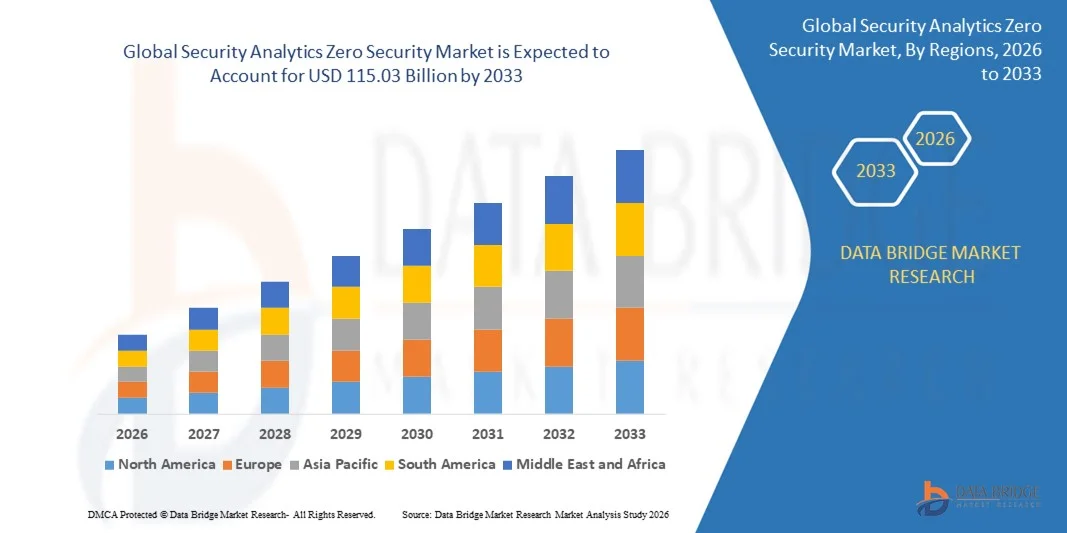
- Según Data Bridge Market Research Analysis, el tamaño del mercado de la seguridad global se valoró en los análisis de seguridad ceroUSD 38.39 billion in 2025y se espera que alcanceUSD 115.03 billion by 2033, aCAGR of 14.70%durante el período previsto
- El mercado de seguridad cero tiene un potencial enorme y se espera que crezca debido al aumento de las normas para la protección de datos y la seguridad de la información
- Además, la alta frecuencia de ataques cibernéticos basados en objetivos en todo el mundo y el aumento de las amenazas cibernéticas agrícolas de ataques avanzados (ATA) o amenazas persistentes avanzadas (APT) también influyen en gran medida en el crecimiento del mercado de seguridad de análisis cero
Tamaño del mercado
- Valor mundial del mercado (2025):USD 38.39 billion
- Valor de mercado esperado (2033):USD 115.03 billion
- CAGR prefabricado (2026–2033):14.70%
¿Cuáles son los principales Takeaways of Security Analytics Zero Security Market
- El aumento en la adopción de dispositivos móviles es otro conductor previsto para florecer el crecimiento del mercado de seguridad de la analítica cero
- Además, se espera que la alta demanda de tecnologías de computación en la nube e Internet de las cosas aumente el crecimiento del mercado de seguridad de análisis cero en el período de previsión mencionado anteriormente
- América del Norte dominaba el mercado de seguridad cero con una cuota de ingresos estimada del 43,2% en 2025, impulsada por la presencia de empresas líderes de TI, infraestructura avanzada de seguridad cibernética y rápida adopción de soluciones de seguridad impulsadas por AI en Estados Unidos y Canadá
- Se prevé que Asia-Pacífico registrará el CAGR más rápido del 8,18% entre 2026 y 2033, impulsado por la rápida digitalización, la creciente infraestructura de TI, el despliegue de 5G y la creciente adopción de soluciones de análisis de seguridad basadas en la nube y impulsadas por AI en China, Japón, India, Corea del Sur y Asia Sudoriental
- El segmento de despliegue de Cloud dominaba el mercado con una cuota estimada del 45,2% en 2025, impulsada por la creciente preferencia de las empresas por plataformas de seguridad escalables, flexibles y accesibles a distancia
Informe Ámbito de aplicación y seguridad Análisis del mercado de seguridad cero
|
Atributos |
Security Analytics Zero Security Key Market Insights |
|
Segmentos cubiertos |
|
|
Países cubiertos |
América del Norte
Europa
Asia y el Pacífico
Oriente Medio y África
América del Sur
|
|
Principales jugadores del mercado |
|
|
Oportunidades de mercado |
|
|
Valor añadido Data Infosets |
Además de las ideas sobre escenarios de mercado como el valor de mercado, la tasa de crecimiento, la segmentación, la cobertura geográfica y los principales actores, los informes de mercado comisariados por el Data Bridge Market Research también incluyen análisis profundos de expertos, análisis de precios, análisis de acciones de la marca, análisis de la demografía, análisis de la cadena de suministro, análisis de la cadena de valor, visión general de materias primas/consumibles, criterios de selección de proveedores, análisis de PESTLE Analysis, análisis de PESTLE, análisis, análisis de Porter, análisis de Porter y marco regulador. |
¿Cuál es la tendencia clave en el mercado de seguridad Zero Security Analytics
Increasing Shift Toward Cloud-Enabled, Multi-Factor, and AI-Integrated Security Analytics Solutions
- El mercado de seguridad de análisis cero es testigo de una fuerte adopción de plataformas de monitoreo basadas en la nube, impulsadas por IA y en tiempo real diseñadas para apoyardetección de amenazas, gestión de la identidad y cumplimiento en las redes empresariales
- Los proveedores están introduciendo autenticación multifactorial, analítica basada en el comportamiento y plataformas de seguridad definidas por software que ofrecen alertas automatizadas, visibilidad profunda e integración con los ecosistemas modernos de TI
- La creciente demanda de soluciones de seguridad rentables, escalables y fáciles de usar está impulsando la adopción en operaciones de TI, finanzas, salud, retail y organizaciones gubernamentales
- Por ejemplo, empresas como Cisco Systems, IBM, Okta, Trend Micro y Check Point Software han mejorado sus plataformas con mayor inteligencia de amenazas, soporte multiteniente y detección de anomalías impulsadas por AI
- Aumentar la necesidad de una respuesta rápida a incidentes, un seguimiento continuo y una gestión centralizada de la identidad está acelerando el cambio hacia plataformas integradas por la nube y mejoradas por la IA
- A medida que se intensifica la transformación digital, las soluciones de seguridad Zero Security Analytics siguen siendo vitales para la prevención de amenazas en tiempo real, la gestión del cumplimiento y las operaciones de seguridad a escala empresarial
¿Cuáles son los principales impulsores del mercado de seguridad Análisis Zero Security
- Aumentar la demanda de gestión avanzada de la identidad, detección de amenazas y soluciones de cumplimiento en todas las empresas de todos los tamaños está impulsando el crecimiento del mercado
- Por ejemplo, en 2025, empresas líderes como Okta, IBM y Trend Micro ampliaron sus carteras de análisis de seguridad con autenticación multifactorial, detección de anomalías basadas en AI y capacidades de gestión nativas en la nube
- La creciente adopción de computación en la nube, redes de IoT, configuraciones remotas de la fuerza de trabajo y sistemas de automatización inteligente está impulsando la demanda de análisis de seguridad centralizado en Estados Unidos, Europa y Asia-Pacífico
- Los avances en las plataformas de vigilancia impulsadas por AI, inteligencia de amenazas en tiempo real y respuesta automatizada han fortalecido la eficiencia operacional, la escalabilidad y la velocidad de adopción de decisiones
- Aumentar los riesgos cibernéticos, ataques de ransomware y entornos de red complejos están creando demanda de plataformas de análisis de seguridad integradas y de alto rendimiento
- Con el apoyo de inversiones estables en ciberseguridad empresarial, infraestructura en la nube e iniciativas de cumplimiento, se espera que el mercado de seguridad cero sea testigo de un fuerte crecimiento a largo plazo
¿Qué factor está reforzando el crecimiento del mercado de seguridad Zero Security Analytics
- Los elevados costos asociados con las plataformas de seguridad integradas por empresas, por IA y por la nube restringen la adopción entre las pequeñas organizaciones y los mercados emergentes
- Por ejemplo, durante 2024–2025, las fluctuaciones de los precios del software de ciberseguridad, los modelos de licencias y los costos de suscripción a la nube aumentaron los gastos totales de despliegue de varios proveedores mundiales
- Complejidad en la integración de la autenticación multifactorial, monitoreo de IA y análisis basados en la nube aumenta la necesidad de profesionales calificados de TI y programas de capacitación
- Sensibilización limitada en los mercados emergentes sobre la capacidad de análisis de seguridad, los requisitos de cumplimiento y las mejores prácticas retrasan la adopción
- Competencia de cortafuegos independientes, software antivirus, herramientas SIEM y soluciones de gestión de identidad crea presión de precios y reduce la diferenciación de productos
- Para hacer frente a estos desafíos, las empresas se centran en modelos de suscripción optimizados en función de los costos, arquitecturas nativas en la nube, detección de amenazas asistidas por AI y recursos de capacitación integrados para aumentar la adopción mundial de soluciones de seguridad cero de análisis
¿Cómo se aumenta el mercado de seguridad Zero Security Analytics
El mercado se segmenta sobre la base detipo, modo de implementación, tipo de autenticación, tamaño de organización y usuario final.
- Por Modo de Despliegue
Sobre la base del modo de implementación, el mercado de seguridad de análisis cero se segmenta en Cloud y On-Premises. El segmento de implementación de Cloud dominaba el mercado con una cuota estimada del 45,2% en 2025, impulsada por la creciente preferencia de las empresas por plataformas de seguridad escalables, flexibles y de acceso remoto. Las soluciones basadas en la nube ofrecen la detección de amenazas en tiempo real, actualizaciones automatizadas e integración con la analítica impulsada por AI, lo que permite un rápido despliegue en entornos de TI y OT. La alta adopción en los sectores de finanzas, atención de la salud y tecnología de la información está impulsando aún más el dominio del mercado.
Se espera que el segmento de despliegue de los locales crezca en el CAGR más rápido de 2026 a 2033, apoyado por organizaciones que requieren soberanía de datos, control mejorado y cumplimiento de marcos regulatorios estrictos. Aumentar la demanda del gobierno, la defensa y las grandes empresas para soluciones altamente seguras y gestionadas localmente está impulsando una rápida adopción mundial.
- Por tipo de autenticación
Sobre la base del tipo de autenticación, el mercado de seguridad cero se segmenta en la autenticación de un solo actor (SFA) y la autenticación multifactor (MFA). El segmento de Autenticación Multifactor (MFA) dominaba el mercado con una participación del 52,6% en 2025, debido al aumento de las amenazas de ciberseguridad, los mandatos reglamentarios y la necesidad de mejorar la protección de la identidad en las empresas. El MFA combina contraseñas, biometrías y verificación basada en token, reduciendo significativamente el riesgo de incumplimientos.
Se prevé que el segmento de autenticación de un solo actor crecerá en la CAGR más rápida de 2026 a 2033, especialmente entre las PYME y los mercados emergentes, donde cada vez se adoptan más soluciones de identidad rentables y fáciles de implementar para asegurar aplicaciones en la nube, acceso remoto a la fuerza de trabajo y plataformas SaaS.
- Por tamaño de organización
Sobre la base del tamaño de la organización, el mercado de seguridad cero de análisis se segmenta en pequeñas y medianas empresas (PYME) y grandes empresas. El segmento de la Gran Empresa dominaba el mercado con una participación del 49,8% en 2025, impulsada por una infraestructura de TI extensa, redes multilocalización y dependencia crítica en plataformas de análisis de seguridad robustas. Las grandes empresas están adoptando cada vez más soluciones integradas por la nube y habilitadas para la detección de amenazas, el cumplimiento y la respuesta a incidentes.
Se espera que el segmento de PYME crezca en la CAGR más rápida de 2026 a 2033, alimentada por el aumentociberseguridadSensibilización, despliegues asequibles basados en la nube y requisitos reglamentarios para la protección de datos. Las PYMES están invirtiendo en plataformas de análisis de seguridad escalables para salvaguardar aplicaciones en la nube, acceso remoto y ecosistemas de IoT.
- Por Usuario final
Sobre la base del usuario final, el mercado de seguridad de análisis cero se segmenta en TI e ITES, Finanzas y Seguros, Salud y Asistencia Social, Comercio al por menor, Utilidades y Otros. El segmento de Finanzas y Seguros dominaba el mercado con una participación del 38,4% en 2025, impulsada por la necesidad crítica de detección de amenazas en tiempo real, protección de identidad y cumplimiento regulatorio. La alta adopción de plataformas de seguridad basadas en la nube y la IA garantiza una banca digital segura, servicios de fintech y operaciones de seguros.
Se proyecta que el segmento de atención de salud y asistencia social crezca en la CAGR más rápida de 2026 a 2033, con el apoyo de una mayor digitalización de registros médicos, plataformas de telemedicina y dispositivos de salud conectados. El aumento de las amenazas cibernéticas en la salud y las estrictas normas de privacidad de datos impulsan la adopción de soluciones avanzadas de seguridad Zero Security en el sector.
¿Qué región tiene la mayor parte del mercado de seguridad Análisis Zero Security
- América del Norte dominaba el mercado de seguridad cero con una cuota de ingresos estimada del 43,2% en 2025, impulsada por la presencia de las principales empresas de tecnología de la información, la infraestructura avanzada de seguridad cibernética y la rápida adopción de soluciones de seguridad impulsadas por AI en Estados Unidos y Canadá. El alto despliegue de plataformas de nube, gestión de identidad empresarial y herramientas de monitoreo de redes sigue alimentando la demanda de soluciones de Seguridad Análisis Zero Security en sectores financieros, informáticos, sanitarios y gubernamentales
- Las empresas líderes en América del Norte están introduciendo plataformas de análisis de seguridad integradas por IA, autenticación multifactorial y cloud, fortaleciendo la ventaja tecnológica de la región. La inversión continua en ciberseguridad R plagaD, infraestructura IoT, y la computación de alto rendimiento impulsa la expansión del mercado a largo plazo
- Los sólidos ecosistemas de innovación, una mano de obra calificada de TI y una amplia inversión en iniciativas de ciberseguridad empresarial refuerzan aún más el liderazgo del mercado de América del Norte
Estados Unidos Security Analytics Zero Security Market Insight
Estados Unidos es el mayor contribuyente de América del Norte, apoyado por la adopción generalizada de analíticas de seguridad basadas en la nube, detección de amenazas de IA y soluciones de autenticación multifactorial en los sectores de TI, finanzas, salud, telecomunicaciones y industriales. El aumento de las amenazas de seguridad cibernética, los mandatos de cumplimiento reglamentario y la demanda de plataformas avanzadas de respuesta a incidentes intensifican la adopción. La presencia de líderes mundiales de ciberseguridad y alta actividad de arranque impulsa aún más el crecimiento del mercado.
Canadá Security Analytics Zero Security Market Insight
El Canadá contribuye constantemente al crecimiento regional, impulsado por iniciativas de ciberseguridad respaldadas por el Gobierno, la adopción empresarial de la gestión de la identidad basada en la nube y la digitalización industrial. Empresas y universidades aprovechan cada vez más soluciones avanzadas de Seguridad Análisis Zero Security para operaciones seguras de TI, gestión de cumplimiento y monitoreo de amenazas. La disponibilidad de mano de obra y el enfoque de las tecnologías emergentes, como la IA y la robótica, refuerzan aún más la adopción.
Asia-Pacific Security Analytics Zero Security Market
Se prevé que Asia-Pacífico registrará el CAGR más rápido del 8,18% entre 2026 y 2033, impulsado por la rápida digitalización, la creciente infraestructura de TI, el despliegue de 5G y la creciente adopción de soluciones de análisis de seguridad basadas en la nube y impulsadas por IA en China, Japón, India, Corea del Sur y Asia sudoriental. El aumento de los riesgos de ciberseguridad en las redes empresariales, fintech y automatización industrial están impulsando la demanda.
China Security Analytics Zero Security Market Insight
China es el mayor contribuyente de Asia-Pacífico debido a las enormes inversiones en infraestructura de TI, la fuerte adopción empresarial de plataformas de nube e iniciativas de ciberseguridad impulsadas por el gobierno. El creciente despliegue de soluciones de detección de amenazas basadas en AI, autenticación de múltiples factores y cumplimiento acelera la demanda de plataformas de Seguridad Análisis Zero Security con una alta escalabilidad y capacidad de monitoreo en tiempo real.
Japón Security Analytics Zero Security Market Insight
Japón muestra un crecimiento constante apoyado por infraestructura avanzada de TI, fabricación de precisión y transformación digital en empresas. La adopción de soluciones de análisis de seguridad de alto rendimiento para la gestión de la identidad, la seguridad en la nube y la detección de amenazas basadas en la inteligencia artificial refuerza la demanda de segmentos premium.
India Security Analytics Zero Security Market Insight
La India está surgiendo como un centro de crecimiento clave, impulsado por la rápida expansión de los sectores informáticos y fintech, programas de digitalización respaldados por el gobierno y la creciente adopción de la ciberseguridad de las PYMES. El aumento del uso de soluciones de seguridad basadas en la nube, integradas por IA y multifactoriales en las empresas acelera la penetración del mercado.
Corea del Sur Security Analytics Zero Security Market Insight
Corea del Sur contribuye significativamente debido a la fuerte demanda de plataformas en la nube, soluciones de seguridad impulsadas por AI y infraestructura de TI empresarial de alto rendimiento. La creciente adopción de procesadores avanzados, la automatización industrial y los servicios digitales impulsa la necesidad de plataformas de seguridad Zero Security Analytics de alta precisión. La innovación tecnológica y la expansión de los ecosistemas digitales apoyan el crecimiento sostenido del mercado.
¿Cuáles son las mejores empresas de Security Analytics Zero Security Market
La industria de la seguridad cero de la seguridad está dirigida principalmente por empresas bien establecidas, incluyendo:
- Cisco Systems, Inc. (U.S.)
- Akamai Technologies(U.S.)
- Okta.U.S.)
- Trend Micro Incorporated (Japón)
- IBM (Estados Unidos)
- Check Point Software Technologies Ltd. (Israel)
- Broadcom (Estados Unidos)
- FireEye, Inc. (U.S.)
- McAfee, LLC (U.S.)
- RSA Security LLC (Estados Unidos)
- Punto de fuerza(U.S.)
- Centrify Corporation (U.S.)
- Cyxtera Technologies, Inc. (U.S.)
- Illumio(U.S.)
- Sophos Ltd. (Reino Unido)
- Qnext Corp. (U.S.)
- Google (U.S.)
- Microsoft (Estados Unidos)
- Cloudflare, Inc. (U.S.)
- VMware, Inc (U.S.)
SKU-
Obtenga acceso en línea al informe sobre la primera nube de inteligencia de mercado del mundo

- Panel de análisis de datos interactivo
- Panel de análisis de empresas para oportunidades con alto potencial de crecimiento
- Acceso de analista de investigación para personalización y consultas
- Análisis de la competencia con panel interactivo
- Últimas noticias, actualizaciones y análisis de tendencias
- Aproveche el poder del análisis de referencia para un seguimiento integral de la competencia
Metodología de investigación
La recopilación de datos y el análisis del año base se realizan utilizando módulos de recopilación de datos con muestras de gran tamaño. La etapa incluye la obtención de información de mercado o datos relacionados a través de varias fuentes y estrategias. Incluye el examen y la planificación de todos los datos adquiridos del pasado con antelación. Asimismo, abarca el examen de las inconsistencias de información observadas en diferentes fuentes de información. Los datos de mercado se analizan y estiman utilizando modelos estadísticos y coherentes de mercado. Además, el análisis de la participación de mercado y el análisis de tendencias clave son los principales factores de éxito en el informe de mercado. Para obtener más información, solicite una llamada de un analista o envíe su consulta.
La metodología de investigación clave utilizada por el equipo de investigación de DBMR es la triangulación de datos, que implica la extracción de datos, el análisis del impacto de las variables de datos en el mercado y la validación primaria (experto en la industria). Los modelos de datos incluyen cuadrícula de posicionamiento de proveedores, análisis de línea de tiempo de mercado, descripción general y guía del mercado, cuadrícula de posicionamiento de la empresa, análisis de patentes, análisis de precios, análisis de participación de mercado de la empresa, estándares de medición, análisis global versus regional y de participación de proveedores. Para obtener más información sobre la metodología de investigación, envíe una consulta para hablar con nuestros expertos de la industria.
Personalización disponible
Data Bridge Market Research es líder en investigación formativa avanzada. Nos enorgullecemos de brindar servicios a nuestros clientes existentes y nuevos con datos y análisis que coinciden y se adaptan a sus objetivos. El informe se puede personalizar para incluir análisis de tendencias de precios de marcas objetivo, comprensión del mercado de países adicionales (solicite la lista de países), datos de resultados de ensayos clínicos, revisión de literatura, análisis de mercado renovado y base de productos. El análisis de mercado de competidores objetivo se puede analizar desde análisis basados en tecnología hasta estrategias de cartera de mercado. Podemos agregar tantos competidores sobre los que necesite datos en el formato y estilo de datos que esté buscando. Nuestro equipo de analistas también puede proporcionarle datos en archivos de Excel sin procesar, tablas dinámicas (libro de datos) o puede ayudarlo a crear presentaciones a partir de los conjuntos de datos disponibles en el informe.











