


Middle East and Africa Computer Vision Market Segmentation, By Component (Hardware and Software), Application (Predictive Maintenance, Identification, Positioning & Guidance, and Quality Assurance & Inspection), Vertical (Industrial Vertical and Non-industrial Vertical), Product (Smart Camera-based Computer Vision Systems, and PC-based Computer Vision Systems)- Industry Trends and Forecast to 2033
¿Cuál es el tamaño y la tasa de crecimiento del mercado de visión informática en Oriente Medio y África
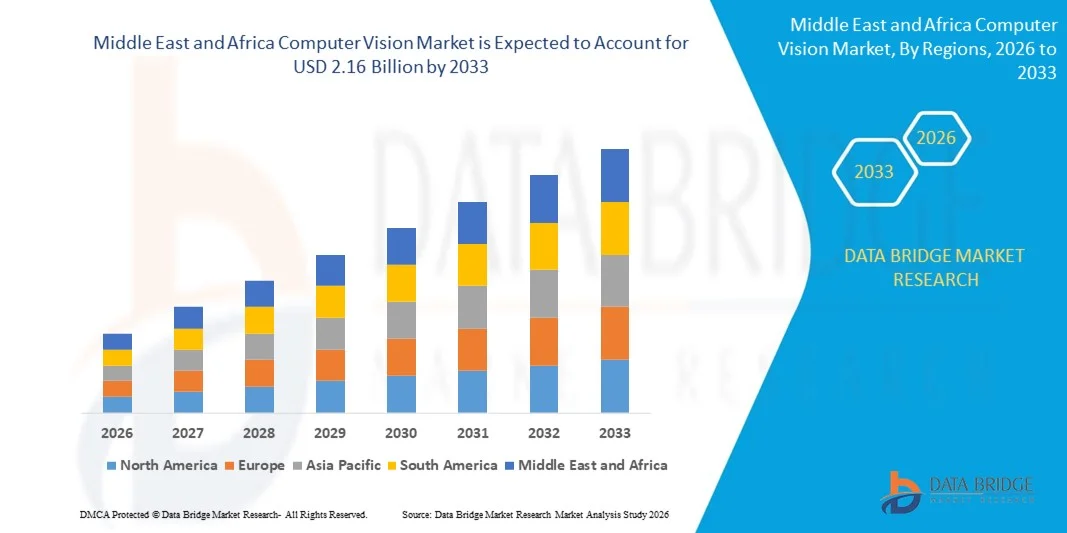
- De acuerdo con el análisis del mercado de datos Bridge, el tamaño del mercado de la visión informática de Oriente Medio y África fue valorado enUSD 1.51 billion in 2025y se espera que alcanceUSD 2.16 billion by 2033, aCAGR of 4.60%durante el período previsto
- El crecimiento del mercado se ve impulsado en gran medida por la creciente adopción de tecnologías de inteligencia artificial y aprendizaje profundo para permitir la inspección visual automatizada, la detección de objetos y la adopción de decisiones en tiempo real
- La creciente demanda de automatización para mejorar la eficiencia operacional, reducir el error humano y aumentar la productividad en industrias como la fabricación, la atención sanitaria y el comercio minorista está acelerando aún más la expansión del mercado
Tamaño del mercado
- Valor mundial del mercado (2025):USD 1.51 billion
- Valor de mercado esperado (2033):USD 2.16 billion
- CAGR prefabricado (2026–2033):4.60%
¿Cuáles son los principales Takeaways de Medio Oriente y África Computer Vision Market
- El mercado es testigo de un fuerte impulso impulsado por la creciente integración de la visión informática con modelos avanzados de IA, permitiendo un reconocimiento de imagen más preciso, análisis predictivo y automatización inteligente
- Las organizaciones están invirtiendo cada vez más en soluciones de visión informática para mejorar el control de calidad, mejorar la seguridad y optimizar los procesos institucionales, lo que está acelerando la adopción de tecnología
- Arabia Saudita dominaba el mercado de la visión informática en el Oriente Medio y África con la mayor cuota de ingresos en 2025, impulsada por el aumento de la inversión en infraestructuras inteligentes e iniciativas de transformación digital
- U.A.E. is expected to witness the highest compound annual growth rate (CAGR)Medio Oriente y África visión informáticamercado debido a la fuerte atención en la transformación digital, la ampliación de la adopción de tecnologías impulsadas por IA, y el aumento de la aplicación de soluciones de visión informática en infraestructura inteligente, seguridad y aplicaciones empresariales
- El segmento Hardware mantuvo la mayor cuota de ingresos del mercado en 2025 impulsado por el creciente despliegue de cámaras, sensores, procesadores y dispositivos de borde necesarios para capturar y procesar imágenes. Los componentes de hardware forman la base de los sistemas de visión informática, permitiendo la adquisición y análisis de datos en tiempo real, haciéndolos esenciales para la automatización industrial y aplicaciones inteligentes de monitoreo
Informe Scope and Middle East and Africa Computer Vision Market Segmentation
|
Atributos |
Medio Oriente y África Insights del mercado clave de visión informática |
|
Segmentos cubiertos |
|
|
Países cubiertos |
Oriente Medio y África
|
|
Principales jugadores del mercado |
|
|
Oportunidades de mercado |
|
|
Valor añadido Data Infosets |
Además de las ideas sobre escenarios de mercado, como el valor de mercado, la tasa de crecimiento, la segmentación, la cobertura geográfica y los principales actores, los informes de mercado comisariados por el Data Bridge Market Research también incluyen análisis profundos de expertos, producción y capacidad geográficamente representados por empresas, diseños de redes de distribuidores y socios, análisis detallados y actualizados de tendencias de precios y análisis del déficit de la cadena de suministro y la demanda. |
¿Cuál es la tendencia clave en el mercado de visión informática de Oriente Medio y África
Integración de la visión de la computadora con la AA avanzada y el aprendizaje profundo
- El rápido avance de las tecnologías de inteligencia artificial y aprendizaje profundo está dando forma significativa al mercado de la visión informática, ya que las organizaciones adoptan cada vez más sistemas inteligentes de reconocimiento visual para automatizar el análisis y la toma de decisiones. Las soluciones de visión informática están ganando tracción debido a su capacidad de ofrecer alta precisión en detección de objetos, reconocimiento facial y análisis de patrones, fortaleciendo su adopción en industrias tales como fabricación, salud, automoción y retail y fomentando la innovación continua en modelos de visión impulsados por AI
- El aumento de la demanda de automatización, inspección de calidad y vigilancia en tiempo real ha acelerado la adopción de la visión informática en entornos industriales y comerciales. Las empresas están implementando activamente la visión informática para aumentar la productividad, reducir los errores operacionales y mejorar la seguridad y el cumplimiento. This trend has also led to collaboration between technology providers and enterprises to develop custom and scale computer vision solutions that improve operational efficiency and business intelligence
- La creciente disponibilidad de grandes conjuntos de datos visuales y mejoras en el poder de cálculo están influyendo en las decisiones de compra, con organizaciones que hacen hincapié en el procesamiento de alto rendimiento, el despliegue escalable y la integración perfecta con la infraestructura digital existente. Estos factores están ayudando a las empresas a aumentar la visibilidad operacional y a obtener ventajas competitivas, al tiempo que impulsan inversiones en infraestructura de IA y capacidades avanzadas de análisis. Las empresas promueven cada vez más estas capacidades mediante alianzas estratégicas y lanzamientos de productos para fortalecer su presencia en el mercado y su propuesta de valor al cliente
- Por ejemplo, en 2024, Microsoft y NVIDIA ampliaron sus plataformas de visión AI introduciendo herramientas de visión informática mejoradas integradas con capacidades de aprendizaje profundo y computación de bordes. Estas soluciones fueron lanzadas para apoyar la inspección automatizada, la vigilancia inteligente y la analítica en tiempo real en entornos empresariales. Las plataformas también se posicionaron como soluciones escalables y eficientes, fortaleciendo la adopción de clientes y el compromiso a largo plazo
- Aunque la adopción de la visión informática está aumentando, la expansión sostenida del mercado depende de avances continuos en la precisión del algoritmo, la optimización de costos y modelos de implementación eficientes. Las empresas se centran en mejorar la velocidad de procesamiento, reducir la dependencia de hardware y mejorar la fiabilidad de los modelos para garantizar una adopción más amplia y una escalabilidad a largo plazo en todas las industrias
Medio Oriente y África dinámicas del mercado de visión informática
Conductor
Aumentar la adopción de la automatización impulsada por AI y el análisis inteligente
- Aumentar la demanda empresarial para la automatización y la analítica inteligente es un importante controlador para el mercado de visión informática. Las organizaciones están implementando activamente la visión informática para automatizar la inspección, supervisar las operaciones y mejorar la exactitud de la toma de decisiones. This trend is also encouraging research and development into advanced AI models that enhance recognition capabilities and support new application areas
- La ampliación del uso de la visión informática en aplicaciones como mantenimiento predictivo, garantía de calidad y operaciones autónomas influye en el crecimiento del mercado. La visión informática permite la vigilancia en tiempo real y un análisis preciso, ayudando a las organizaciones a mejorar la eficiencia y reducir los riesgos operacionales al tiempo que apoya las iniciativas de transformación digital
- Los proveedores de tecnología y las empresas están promoviendo activamente soluciones de visión informática mediante la innovación de productos, la integración de plataformas y las colaboraciones estratégicas. Estos esfuerzos están respaldados por el creciente interés en la eficiencia operacional, la reducción de los costos y la automatización inteligente, y también alientan las asociaciones entre los desarrolladores de IA y los usuarios finales para mejorar el rendimiento y la escalabilidad del sistema
- Por ejemplo, en 2023, IBM y Google aumentaron su enfoque en tecnologías de visión de IA mediante la introducción de soluciones avanzadas de inspección visual y análisis integrados en sus plataformas de IA. Esta expansión se debió al aumento de la demanda empresarial de automatización y supervisión inteligente, la mejora de la eficiencia operacional y el fortalecimiento de la adopción de los clientes. Ambas empresas también hicieron hincapié en la escalabilidad y las mejoras de rendimiento para mejorar la satisfacción del cliente y el valor a largo plazo
- Si bien el aumento de la automatización apoya el crecimiento del mercado, la adopción generalizada depende de mejorar la asequibilidad, simplificar el despliegue y asegurar una integración perfecta con los sistemas institucionales existentes. La inversión continua en las plataformas de investigación, infraestructura y de fácil manejo de IA será esencial para mantener la expansión del mercado a largo plazo
Restraint/Challenge
Alto costo de aplicación y preocupaciones de privacidad de datos
- El elevado costo de la aplicación de los sistemas de visión informática sigue siendo un reto fundamental, que limita la adopción entre las organizaciones pequeñas y medianas. Los gastos relacionados con el hardware, el desarrollo de programas informáticos y la integración del sistema contribuyen a sufragar los gastos generales de ejecución. Además, el mantenimiento y las mejoras en curso aumentan aún más los gastos operacionales, afectando las tasas de adopción
- Las preocupaciones en materia de privacidad y seguridad de los datos también restringen el crecimiento del mercado, en particular en las aplicaciones relacionadas con el reconocimiento facial y la vigilancia. Las organizaciones deben cumplir estrictamente las normas de protección de datos y garantizar una gestión segura de los datos, lo que aumenta la complejidad y el tiempo de despliegue. Esto también crea dudas entre las empresas al adoptar tecnologías de visión informática para aplicaciones sensibles
- La complejidad técnica y el requisito para los profesionales cualificados también afectan la adopción, ya que los sistemas de visión informática requieren conocimientos especializados en IA, ciencia de datos e integración de sistemas. La disponibilidad limitada de personal calificado puede retrasar los plazos de ejecución y aumentar los costos operacionales. Las empresas deben invertir en capacitación, adquisición de talentos y apoyo técnico para asegurar el éxito del despliegue
- Por ejemplo, en 2024, Amazon e Intel informaron de problemas entre los clientes empresariales relacionados con los costos de despliegue, la complejidad de la integración del sistema y el cumplimiento de la seguridad de los datos al implementar soluciones de visión informática. These factors affected adoption timelines and increased total cost of ownership, prompting organizations to evaluate deployment strategies more careful
- Para superar estos problemas se necesitarán tecnologías eficientes en función de los costos, marcos de gestión de datos seguros y modelos de despliegue simplificados. La colaboración entre proveedores de tecnología, empresas y organismos reguladores puede ayudar a desbloquear el potencial de crecimiento a largo plazo del mercado mundial de visión informática. Además, el mejoramiento de la asequibilidad, la mejora de la protección de la privacidad y el desarrollo de plataformas fáciles de utilizar serán esenciales para la adopción generalizada
¿Cómo se aumenta el mercado de visión informática en Oriente Medio y África
El mercado se segmenta sobre la base de componente, aplicación, vertical y producto.
- Por componente
Sobre la base del componente, el mercado de visión informática de Oriente Medio y África se segmenta en Hardware y Software. El segmento Hardware mantuvo la mayor cuota de ingresos del mercado en 2025 impulsado por el creciente despliegue de cámaras, sensores, procesadores y dispositivos de borde necesarios para capturar y procesar imágenes. Los componentes de hardware forman la base de sistemas de visión informática, permitiendo la adquisición y análisis de datos en tiempo real, haciéndolos esenciales para la automatización industrial y aplicaciones inteligentes de monitoreo.
Se espera que el segmento de Software sea testigo de la tasa de crecimiento más rápida de 2026 a 2033, impulsada por la creciente adopción de algoritmos de visión basados en AI y plataformas de análisis que permiten el procesamiento avanzado de imágenes, el reconocimiento de objetos y las ideas predictivas. Las soluciones de software proporcionan flexibilidad, escalabilidad e integración con los sistemas institucionales, haciéndolos cada vez más importantes a medida que las organizaciones se centran en la automatización inteligente y la adopción de decisiones basadas en datos.
- By Application
Sobre la base de la aplicación, el mercado de visión informática del Oriente Medio y África se segmenta en la inspección de mantenimiento predictivo, identificación, determinación de posición y garantía de calidad. El segmento de inspección de garantía de calidad mantuvo la mayor cuota de ingresos del mercado en 2025 impulsada por la creciente necesidad de sistemas automatizados de inspección para mejorar la calidad de los productos, reducir los defectos y aumentar la eficiencia operacional. Los sistemas de visión informática permiten una inspección precisa y coherente, ayudando a las organizaciones a minimizar el error humano y garantizar el cumplimiento de normas de calidad.
Se espera que el segmento de mantenimiento predictivo sea testigo de la tasa de crecimiento más rápida de 2026 a 2033, impulsada por la creciente demanda de detección temprana de fallas de equipo y problemas de rendimiento. La visión informática permite la vigilancia y el análisis continuos de las condiciones de maquinaria, ayudando a las organizaciones a reducir el tiempo de inactividad, ampliar la vida útil del equipo y mejorar la fiabilidad operacional general.
- Por Vertical
Sobre la base de verticales, el mercado de visión informática de Oriente Medio y África se segmenta en verticales industriales y no industriales. El segmento vertical industrial mantuvo la mayor cuota de ingresos del mercado en 2025 impulsada por la adopción generalizada de la visión informática para la automatización, inspección y optimización de procesos. Las industrias utilizan cada vez más la visión informática para mejorar la productividad, mejorar la seguridad y mantener una calidad de producción coherente, apoyando las iniciativas de transformación digital.
Se espera que el segmento vertical no industrial sea testigo de la tasa de crecimiento más rápida de 2026 a 2033, impulsada por la creciente adopción de la visión informática en aplicaciones como la imagen sanitaria, la vigilancia inteligente y la analítica minorista. El aumento de la demanda de automatización y análisis visual en tiempo real en las industrias de servicios contribuye al crecimiento de segmentos.
- Por producto
Sobre la base del producto, el mercado de visión informática de Oriente Medio y África se segmenta en Smart Camera-based Computer Vision Systems y PC-based Computer Vision Systems. El segmento de Sistemas de Visión Computarizada basado en PC mantuvo la mayor cuota de ingresos del mercado en 2025 impulsado por su alta potencia de procesamiento, flexibilidad y capacidad para manejar tareas de visión complejas. Estos sistemas son ampliamente utilizados en aplicaciones que requieren análisis avanzados, personalización e integración con múltiples dispositivos.
Se espera que el segmento Smart Camera-based Computer Vision Systems sea testigo de la tasa de crecimiento más rápida de 2026 a 2033, impulsado por su diseño compacto, facilidad de despliegue y capacidades de procesamiento integradas. Las cámaras inteligentes permiten el procesamiento de imágenes en tiempo real sin necesidad de sistemas de computación externos, haciéndolos adecuados para aplicaciones modernas automatizadas y basadas en bordes.
¿Qué región tiene la mayor parte del mercado de visión informática de Oriente Medio y África
- Arabia Saudita dominaba el mercado de la visión informática en el Oriente Medio y África con la mayor cuota de ingresos en 2025, impulsada por el aumento de la inversión en infraestructuras inteligentes e iniciativas de transformación digital
- Las organizaciones del país están adoptando cada vez más tecnologías de visión informática para mejorar la seguridad, la vigilancia y la eficiencia operacional en diversos sectores
- Esta adopción cuenta con el apoyo de iniciativas gubernamentales centradas en el adelanto tecnológico, la creciente inversión en tecnologías de inteligencia artificial y la creciente demanda de automatización inteligente, el establecimiento de la visión informática como componente fundamental de los esfuerzos de modernización
U.A.E. Computer Vision Market Insight
Se espera que el mercado de visión computarizada de los EE.UU. sea testigo de la tasa de crecimiento más rápida de 2026 a 2033, alimentada por la rápida adopción de inteligencia artificial y el creciente enfoque en el desarrollo inteligente de la ciudad. Las empresas están implementando cada vez más soluciones de visión informática para mejorar la automatización, mejorar la seguridad y optimizar las operaciones. El fuerte énfasis en la innovación, apoyado por el aumento de la inversión tecnológica y la expansión de la infraestructura digital, está impulsando aún más el crecimiento del mercado. Además, la creciente integración de la visión informática en sistemas inteligentes de vigilancia y automatización contribuye significativamente a la expansión del mercado.
¿Cuáles son las mejores empresas en Oriente Medio y África Computer Vision Market
La industria de la visión informática en Oriente Medio y África está dirigida principalmente por empresas bien establecidas, entre ellas:
- G42 (E.U.)
- Presight AI Holding PLC (U.A.E.)
- InstaDeep Ltd (U.K.)
- Viso.ai (U.A.E.)
- Smart Vision Works (Arabia Saudita)
- Falcon Eye Technology LLC (U.A.E.)
- AxxonSoft MEA (E.U.)
- Intellivision Technologies (U.A.E.)
- iOmniscient Pty MEA (U.A.E).
- NNTC (Arabia Saudita)
- Alcatraz AI ME (U.A.E.)
- DigiSmart Solutions (U.A.E.)
- Technopark Vision Systems (Sudáfrica)
- Irisity AB MEA (U.A.E.)
- Datakloud Africa (Sudáfrica)
SKU-
Obtenga acceso en línea al informe sobre la primera nube de inteligencia de mercado del mundo

- Panel de análisis de datos interactivo
- Panel de análisis de empresas para oportunidades con alto potencial de crecimiento
- Acceso de analista de investigación para personalización y consultas
- Análisis de la competencia con panel interactivo
- Últimas noticias, actualizaciones y análisis de tendencias
- Aproveche el poder del análisis de referencia para un seguimiento integral de la competencia
Metodología de investigación
La recopilación de datos y el análisis del año base se realizan utilizando módulos de recopilación de datos con muestras de gran tamaño. La etapa incluye la obtención de información de mercado o datos relacionados a través de varias fuentes y estrategias. Incluye el examen y la planificación de todos los datos adquiridos del pasado con antelación. Asimismo, abarca el examen de las inconsistencias de información observadas en diferentes fuentes de información. Los datos de mercado se analizan y estiman utilizando modelos estadísticos y coherentes de mercado. Además, el análisis de la participación de mercado y el análisis de tendencias clave son los principales factores de éxito en el informe de mercado. Para obtener más información, solicite una llamada de un analista o envíe su consulta.
La metodología de investigación clave utilizada por el equipo de investigación de DBMR es la triangulación de datos, que implica la extracción de datos, el análisis del impacto de las variables de datos en el mercado y la validación primaria (experto en la industria). Los modelos de datos incluyen cuadrícula de posicionamiento de proveedores, análisis de línea de tiempo de mercado, descripción general y guía del mercado, cuadrícula de posicionamiento de la empresa, análisis de patentes, análisis de precios, análisis de participación de mercado de la empresa, estándares de medición, análisis global versus regional y de participación de proveedores. Para obtener más información sobre la metodología de investigación, envíe una consulta para hablar con nuestros expertos de la industria.
Personalización disponible
Data Bridge Market Research es líder en investigación formativa avanzada. Nos enorgullecemos de brindar servicios a nuestros clientes existentes y nuevos con datos y análisis que coinciden y se adaptan a sus objetivos. El informe se puede personalizar para incluir análisis de tendencias de precios de marcas objetivo, comprensión del mercado de países adicionales (solicite la lista de países), datos de resultados de ensayos clínicos, revisión de literatura, análisis de mercado renovado y base de productos. El análisis de mercado de competidores objetivo se puede analizar desde análisis basados en tecnología hasta estrategias de cartera de mercado. Podemos agregar tantos competidores sobre los que necesite datos en el formato y estilo de datos que esté buscando. Nuestro equipo de analistas también puede proporcionarle datos en archivos de Excel sin procesar, tablas dinámicas (libro de datos) o puede ayudarlo a crear presentaciones a partir de los conjuntos de datos disponibles en el informe.











