North America Dosage Cups Market Segmentation By, Product Type (Printed Cups, Non-Printed, and Embossed Cups), Type (Disposable and Reusable), Capacity (25 ml), End-User (Pharmaceutical Manufacturer and Health care Packaging Companies), Distribution Channel (Direct Tenders and Retail) - Industry Trends and Forecast to 2033
North America Dosage Cups Market Size
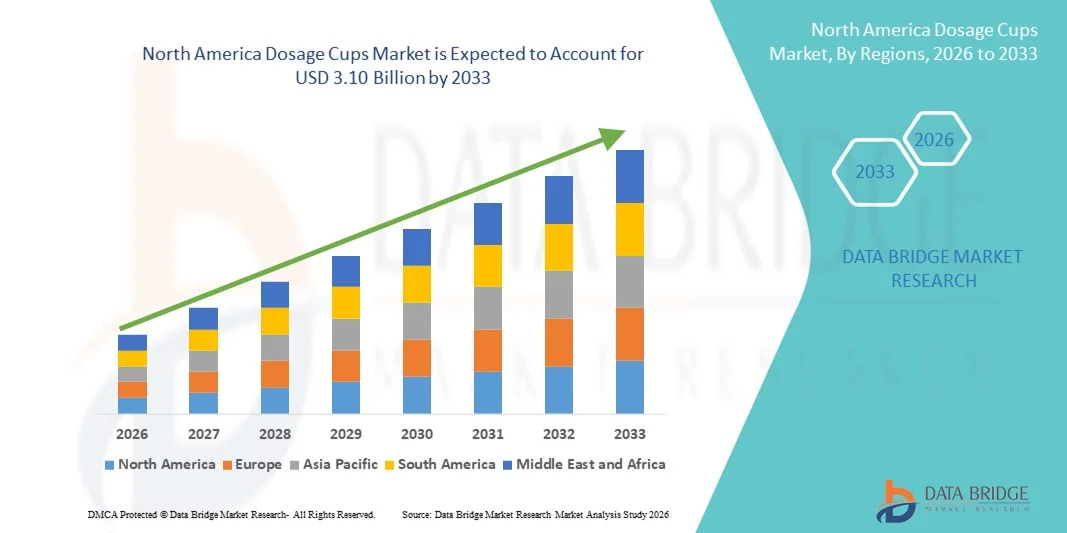
- The North America dosage cups market size was valued at USD 1.86 billion in 2025 and is expected to reach USD 3.10 billion by 2033, at a CAGR of 6.60% during the forecast period
- The market growth is largely fueled by the increasing demand for accurate medication dosing and the rising use of liquid pharmaceutical formulations in both pediatric and geriatric populations, leading to higher adoption of dosage cups across healthcare and pharmaceutical settings
- Furthermore, growing awareness regarding proper medication administration and the expansion of pharmaceutical manufacturing are establishing dosage cups as essential tools for precise liquid medicine measurement. These converging factors are accelerating the uptake of Dosage Cups solutions, thereby significantly boosting the industry's growth
North America Dosage Cups Market Analysis
- Dosage cups, designed to provide accurate measurement for liquid medications, are increasingly vital components of pharmaceutical packaging and healthcare practices in both clinical and homecare settings due to their convenience, cost-effectiveness, and ability to ensure precise dosing.
- The escalating demand for dosage cups is primarily fueled by the growing consumption of liquid pharmaceuticals, increasing pediatric and geriatric patient populations, and rising awareness regarding safe and accurate medication administration.
- U.S. dominated the Dosage Cups market with the largest revenue share of 37.9% in 2025, characterized by advanced pharmaceutical manufacturing infrastructure, strict regulatory standards for medication dosing, and a strong presence of key packaging solution providers, with the U.S. experiencing substantial growth in dosage cup adoption across pharmaceutical and over-the-counter medicine packaging
- Canada is expected to be the fastest growing region in the Dosage Cups market during the forecast period due to expanding pharmaceutical production, increasing healthcare expenditure, and growing demand for cost-effective medical packaging solutions, with a projected market share of 29.4% in 2025
- The Disposable Dosage Cups segment dominated the largest market revenue share of 62.3% in 2025, primarily due to the growing emphasis on hygiene and infection control in healthcare settings
Report Scope and Dosage Cups Market Segmentation
|
Attributes |
Dosage Cups Key Market Insights |
|
Segments Covered |
|
|
Countries Covered |
North America
|
|
Key Market Players |
|
|
Market Opportunities |
|
|
Value Added Data Infosets |
In addition to the insights on market scenarios such as market value, growth rate, segmentation, geographical coverage, and major players, the market reports curated by the Data Bridge Market Research also include in-depth expert analysis, patient epidemiology, pipeline analysis, pricing analysis, and regulatory framework. |
North America Dosage Cups Market Trends
Growing Emphasis on Accurate Medication Dosing and Patient Safety
- A significant and accelerating trend in the global Dosage Cups market is the increasing emphasis on accurate medication dosing and improved patient safety across healthcare systems. Dosage cups are widely used in hospitals, clinics, pharmacies, and homecare settings to ensure precise measurement of liquid medications
- The growing awareness regarding medication errors and the need for standardized dosing tools is encouraging healthcare providers and pharmaceutical companies to adopt high-quality, clearly calibrated dosage cups that support accurate administration of medicines
- For instance, several pharmaceutical companies are increasingly packaging liquid medications with pre-calibrated dosage cups that provide clear measurement markings, enabling patients and caregivers to administer the correct amount of medicine. This practice has become common in cough syrups, pediatric medications, and nutritional supplements, helping reduce dosing inaccuracies and improving treatment outcomes
- The rising demand for pediatric and geriatric medications is also contributing significantly to the adoption of dosage cups. These patient groups often rely on liquid formulations due to difficulties in swallowing solid dosage forms, which increases the need for reliable and easy-to-use measurement devices
- In addition, healthcare providers are focusing on improving medication adherence and minimizing dosing errors in homecare environments. Dosage cups offer a simple and cost-effective solution for accurately measuring liquid medicines, particularly for patients managing chronic conditions that require regular medication intake
- Manufacturers are also introducing dosage cups made from medical-grade materials that are lightweight, durable, and designed with easy-to-read measurement scales to enhance usability for both healthcare professionals and patients
- As pharmaceutical companies continue to expand liquid drug formulations globally, the demand for standardized and reliable dosing accessories such as dosage cups is expected to grow steadily during the forecast period
North America Dosage Cups Market Dynamics
Driver
Rising Demand for Liquid Medications and Expanding Pharmaceutical Industry
- The increasing demand for liquid medications across global healthcare systems is a major driver supporting the growth of the Dosage Cups market. Liquid formulations are widely used in pediatric, geriatric, and critical care treatments due to their ease of administration and faster absorption compared to some solid dosage forms. This growing reliance on liquid medicines has significantly increased the demand for accurate dosing tools such as dosage cups
- For instance, in 2025 several pharmaceutical manufacturers expanded the production of pediatric syrups and oral liquid formulations, leading to higher demand for calibrated dosage cups included within medication packaging. Such initiatives by pharmaceutical companies are expected to contribute significantly to the expansion of the Dosage Cups industry in the coming years
- The continuous growth of the global pharmaceutical sector and the rising prevalence of chronic diseases are further increasing the need for liquid medications that require precise measurement. As a result, healthcare providers are prioritizing the use of reliable dosing accessories to ensure accurate treatment administration
- Hospitals and pharmacies are also emphasizing the use of standardized dosing tools to reduce medication errors and improve patient safety. Dosage cups provide a simple yet effective solution that supports consistent dosing practices across healthcare settings
- Furthermore, the growing expansion of home healthcare services is increasing the need for user-friendly dosing devices that allow patients and caregivers to administer medications correctly outside hospital environments
- Increasing investments in pharmaceutical manufacturing and packaging innovations are also encouraging the development of improved dosage cup designs with enhanced readability, durability, and safety features
Restraint/Challenge
Availability of Alternative Dosing Devices and Environmental Concerns
- Despite steady market growth, the availability of alternative dosing devices such as oral syringes, droppers, and measuring spoons presents a challenge for the Dosage Cups market. Many healthcare professionals prefer oral syringes for pediatric medications due to their higher dosing accuracy, which can reduce reliance on traditional dosage cups in certain applications
- For instance, pediatric healthcare providers frequently recommend oral dosing syringes instead of dosage cups for infants and young children to ensure precise medication delivery and minimize the risk of incorrect dosing.
- Environmental concerns related to single-use plastic products also present a challenge for dosage cup manufacturers. Many dosage cups are made from plastic materials, and increasing regulatory pressure to reduce plastic waste is encouraging the development of more sustainable packaging solutions
- In addition, improper usage or misinterpretation of measurement markings on dosage cups may lead to dosing inaccuracies if patients or caregivers are not adequately informed about proper usage. This has prompted healthcare providers to emphasize patient education regarding medication administration
- Regulatory standards related to pharmaceutical packaging and medical accessories can also increase compliance costs for manufacturers, particularly when introducing dosage cups across multiple global markets with different regulatory frameworks
- Addressing these challenges through the development of eco-friendly materials, improved calibration clarity, and patient education initiatives will be essential for sustaining long-term growth in the global Dosage Cups market
North America Dosage Cups Market Scope
The market is segmented on the basis of product type, type, capacity, end-user, and distribution channel.
- By Product Type
On the basis of product type, the Dosage Cups market is segmented into Printed Cups, Non-Printed Cups, and Embossed Cups. The Printed Cups segment dominated the largest market revenue share of 41.6% in 2025, primarily due to their ability to display clear measurement markings and dosage instructions. Pharmaceutical manufacturers and healthcare facilities widely prefer printed dosage cups because they help reduce medication errors during administration. These cups are commonly used in hospitals, clinics, and pharmacies where accurate dosing is critical for patient safety. The printed markings allow healthcare professionals and patients to easily identify the correct dosage levels. Increasing regulatory emphasis on patient safety and accurate medication dispensing has further strengthened the adoption of printed dosage cups. Pharmaceutical companies also use printed cups for brand identification and labeling purposes. Growing demand for liquid medications in pediatric and geriatric care is further supporting the segment's growth. Manufacturers are introducing high-quality printing technologies that ensure durable and easy-to-read measurement scales. Hospitals prefer these cups because they improve medication management and compliance. In addition, printed dosage cups are widely used in packaged pharmaceutical syrups and liquid drugs. Their convenience and safety features continue to drive strong demand globally.
The Embossed Cups segment is expected to witness the fastest CAGR of 6.8% from 2026 to 2033, driven by their durability and resistance to fading measurement markings. Embossed cups feature raised measurement markings molded directly into the cup structure, ensuring long-term readability. Healthcare professionals prefer embossed dosage cups because the measurements remain visible even after repeated use or washing. This makes them particularly suitable for reusable medication administration systems in hospitals and clinics. Increasing demand for durable and sustainable healthcare packaging solutions is also supporting the growth of embossed cups. These cups reduce the risk of misreading dosage measurements caused by worn-out printed scales. Pharmaceutical companies are increasingly adopting embossed designs to improve product quality and reliability. Advances in plastic molding technologies are enabling manufacturers to produce highly precise embossed measurement scales. Growing awareness about medication accuracy and patient safety is further driving demand. The segment is also benefiting from rising adoption in home healthcare settings where durability and ease of use are important. As healthcare systems focus more on reliable dosing tools, embossed dosage cups are expected to experience significant growth.
- By Type
On the basis of type, the Dosage Cups market is segmented into Disposable Dosage Cups and Reusable Dosage Cups. The Disposable Dosage Cups segment dominated the largest market revenue share of 62.3% in 2025, primarily due to the growing emphasis on hygiene and infection control in healthcare settings. Hospitals and clinics prefer disposable cups because they eliminate the need for cleaning and sterilization after each use. This helps reduce the risk of cross-contamination between patients. Disposable cups are widely used in pharmaceutical packaging for liquid medicines such as cough syrups and pediatric formulations. Healthcare professionals favor these cups because they offer convenience and improve workflow efficiency in busy hospital environments. The increasing prevalence of infectious diseases has further reinforced the demand for single-use medical products. Pharmaceutical manufacturers also prefer disposable cups for packaging because they ensure accurate dosing and improved patient compliance. These cups are typically made from lightweight plastic materials that are cost-effective and easy to produce in large volumes. Growing demand for over-the-counter liquid medications is further supporting this segment’s dominance. As patient safety and hygiene standards continue to rise globally, disposable dosage cups remain the most widely used option.
The Reusable Dosage Cups segment is expected to witness the fastest CAGR of 6.5% from 2026 to 2033, driven by increasing awareness about environmental sustainability and healthcare waste reduction. Reusable cups are designed with durable materials that allow them to be cleaned and used multiple times. Hospitals and healthcare facilities seeking to reduce plastic waste are gradually adopting reusable dosage cups. Advances in material technologies have improved the durability and chemical resistance of reusable cups. These cups are particularly useful in long-term care facilities where patients require regular medication administration. Healthcare providers are also promoting reusable medical devices as part of sustainability initiatives. Many reusable cups are designed with embossed measurement markings that remain visible over long periods. The cost advantages associated with repeated usage also encourage healthcare facilities to adopt reusable options. Growing environmental regulations regarding plastic waste management are further influencing market trends. Manufacturers are focusing on producing high-quality reusable dosage cups that meet strict healthcare standards. As sustainability becomes a priority for healthcare institutions, reusable dosage cups are expected to gain stronger market traction.
- By Capacity
On the basis of capacity, the Dosage Cups market is segmented into <5 ml, 5–15 ml, 15–25 ml, and >25 ml. The 5–15 ml segment dominated the largest market revenue share of 37.8% in 2025, mainly due to its widespread use in measuring standard doses of liquid medications. Many pharmaceutical syrups and oral solutions require dosage measurements within this range, making these cups highly practical for everyday medical use. Hospitals, clinics, and pharmacies frequently use 5–15 ml cups for administering cough syrups, antibiotics, and pediatric medications. These cups offer an ideal balance between precision and convenience, allowing accurate measurement for common drug formulations. Pharmaceutical manufacturers often package liquid medications with cups in this capacity range to ensure consistent dosing. The segment also benefits from growing demand for pediatric medicines where precise dosing is essential. Measurement scales within this range are easy for both healthcare professionals and patients to read. Increasing global consumption of liquid medications is further driving demand. The versatility of this capacity size makes it suitable for both prescription and over-the-counter drugs. As medication accuracy remains a key priority, the 5–15 ml capacity segment continues to lead the market.
The <5 ml segment is expected to witness the fastest CAGR of 6.9% from 2026 to 2033, driven by the increasing use of highly concentrated medications and pediatric drug formulations. Small-capacity dosage cups allow extremely precise measurement of small doses required for infants and specialized treatments. Hospitals and pediatric clinics increasingly rely on smaller cups to avoid overdosing risks. Pharmaceutical companies are also introducing highly potent formulations that require small-volume dosing. This trend is contributing to rising demand for <5 ml measurement cups. These cups are particularly important in neonatal care units where precise medication administration is critical. Advances in manufacturing technologies have improved the accuracy and readability of small-capacity dosage cups. Growing awareness about medication safety is also influencing the adoption of precise dosing tools. Home healthcare providers increasingly use these cups for administering liquid medicines to children. As pediatric and specialized therapies expand globally, demand for small-capacity dosage cups is expected to grow rapidly.
- By End User
On the basis of end user, the Dosage Cups market is segmented into Pharmaceutical Manufacturers and Healthcare Packaging Companies. The Pharmaceutical Manufacturers segment dominated the largest market revenue share of 65.7% in 2025, driven by the widespread use of dosage cups in pharmaceutical packaging. Many liquid medications are packaged with dosage cups to help patients measure accurate doses. Pharmaceutical manufacturers integrate these cups into product packaging for syrups, suspensions, and oral solutions. Regulatory guidelines often require clear dosing tools to accompany liquid medicines. The increasing production of liquid pharmaceuticals globally is further boosting demand. Pharmaceutical companies also use dosage cups as part of patient-friendly packaging solutions. Growing demand for pediatric and geriatric medications is increasing the need for precise dosage tools. Pharmaceutical manufacturers benefit from bulk production and integration of cups into medicine packaging lines. These companies also work closely with packaging suppliers to ensure quality and compliance. As pharmaceutical production continues to grow globally, manufacturers remain the largest consumers of dosage cups.
The Healthcare Packaging Companies segment is expected to witness the fastest CAGR of 6.7% from 2026 to 2033, supported by increasing outsourcing of pharmaceutical packaging services. Many pharmaceutical firms are partnering with specialized packaging companies to improve efficiency and reduce operational costs. Healthcare packaging companies provide customized dosage cups tailored to specific drug formulations. These companies also focus on innovative designs that improve measurement accuracy and patient convenience. Growing demand for contract packaging services in the pharmaceutical industry is contributing to this segment’s growth. Packaging companies are investing in advanced molding and printing technologies to produce high-quality dosage cups. Sustainability initiatives are also encouraging packaging firms to develop eco-friendly dosage cup solutions. Increasing global pharmaceutical production is driving higher demand for packaging materials. As outsourcing becomes more common in the pharmaceutical industry, healthcare packaging companies are expected to play an increasingly important role in the dosage cups market.
- By Distribution Channel
On the basis of distribution channel, the Dosage Cups market is segmented into Direct Tenders and Retail. The Direct Tenders segment dominated the largest market revenue share of 60.9% in 2025, primarily due to bulk procurement by hospitals, pharmaceutical companies, and healthcare institutions. Direct tender systems allow large healthcare organizations to purchase dosage cups directly from manufacturers at competitive prices. This procurement method ensures a consistent supply of dosage cups for large-scale pharmaceutical production and hospital use. Pharmaceutical companies frequently use tender-based procurement to source packaging components for liquid medicines. Hospitals also rely on tenders to maintain sufficient inventories for medication administration. Government healthcare systems often prefer tender-based purchasing to control costs and ensure quality compliance. Manufacturers benefit from long-term supply contracts through direct tenders. Growing demand from large healthcare institutions continues to support this distribution channel. Efficient supply chain management and bulk purchasing advantages make direct tenders the preferred procurement method.
The Retail segment is expected to witness the fastest CAGR of 6.4% from 2026 to 2033, driven by the growing availability of dosage cups in pharmacies, medical stores, and online healthcare platforms. Consumers increasingly purchase dosage cups separately for home medication use. Retail pharmacies often provide dosage cups as accessories for liquid medications. The expansion of e-commerce healthcare platforms is also increasing accessibility for consumers. Home healthcare trends are further contributing to rising retail demand. Patients managing chronic conditions at home often require additional dosage cups for accurate medication measurement. Retail distribution also supports smaller healthcare facilities that purchase limited quantities of dosage cups. Manufacturers are expanding retail packaging options to meet consumer demand. As home-based healthcare continues to grow, the retail segment is expected to witness steady expansion in the coming years.
North America Dosage Cups Market Regional Analysis
- North America dominated the dosage cups market with a significant revenue share in 2025, supported by the region’s well-established pharmaceutical manufacturing ecosystem, strong healthcare infrastructure, and strict regulatory standards governing medication dosing and packaging. The increasing demand for accurate dosing tools in pharmaceutical products, particularly liquid medications, has encouraged widespread adoption of calibrated dosage cups across hospitals, pharmacies, and homecare settings
- For instance, pharmaceutical manufacturers in the region commonly include clearly marked dosage cups with over-the-counter cough syrups, pediatric medicines, and nutritional liquid formulations to ensure safe and precise medication administration. This practice has significantly improved dosing accuracy and patient compliance, especially among pediatric and geriatric populations
- The region also benefits from the presence of several leading pharmaceutical packaging solution providers and advanced manufacturing facilities that continuously develop high-quality dosing accessories. Rising awareness about medication safety, along with regulatory emphasis on standardized dosing tools, further strengthens the demand for dosage cups across pharmaceutical packaging applications in North America
U.S. Dosage Cups Market Insight
The U.S. dosage cups market dominated the regional market with the largest revenue share of 37.9% in 2025, characterized by advanced pharmaceutical manufacturing infrastructure, strict regulatory standards for medication dosing, and a strong presence of key packaging solution providers. The country has a highly developed pharmaceutical sector that extensively utilizes dosage cups as part of liquid medication packaging to ensure safe and accurate dosing for consumers. The growing demand for pediatric and over-the-counter medicines is further contributing to the increased use of dosage cups in pharmaceutical packaging. In addition, strict guidelines related to medication labeling and dosing accuracy encourage pharmaceutical manufacturers to incorporate standardized dosing accessories with their products. As a result, dosage cups are widely distributed through pharmacies, hospitals, and retail healthcare channels, supporting consistent growth of the market across the United States.
Canada Dosage Cups Market Insight
The Canada dosage cups market is expected to be the fastest growing market in North America during the forecast period, supported by expanding pharmaceutical production, rising healthcare expenditure, and increasing demand for cost-effective medical packaging solutions. Canada accounted for a projected market share of 29.4% in 2025, reflecting the growing importance of accurate medication dosing in both prescription and over-the-counter pharmaceutical products. The country’s healthcare system continues to emphasize patient safety and proper medication administration, which is encouraging pharmaceutical manufacturers to incorporate calibrated dosage cups with liquid drug formulations. In addition, increasing investments in pharmaceutical research, manufacturing facilities, and healthcare infrastructure are further supporting the demand for reliable dosing accessories. The growing availability of liquid medicines across pharmacies, hospitals, and homecare settings is expected to drive continued adoption of dosage cups throughout the Canadian healthcare sector.
North America Dosage Cups Market Share
The Dosage Cups industry is primarily led by well-established companies, including:
- Comar LLC (U.S.)
- Origin Pharma Packaging (U.K.)
- SGD Pharma (France)
- Gerresheimer AG (Germany)
- AptarGroup, Inc. (U.S.)
- Amcor Plc (Switzerland)
- SCHOTT AG (Germany)
- West Pharmaceutical Services, Inc. (U.S.)
- Drug Plastics Group (U.S.)
- Clariant AG (Switzerland)
- Weener Plastics Group (Netherlands)
- Reynolds Group Holdings (New Zealand)
- SteriPack Group (Ireland)
- Pact Group Holdings Ltd. (Australia)
- Alpha Packaging (U.S.)
- Bormioli Pharma S.p.A. (Italy)
- Plastipak Holdings, Inc. (U.S.)
- RPC Group Plc (U.K.)
- Alpla Group (Austria)
Latest Developments in North America Dosage Cups Market
- In February 2023, Berry Global Healthcare introduced a new pharmaceutical packaging bundle for liquid medications, including PET bottles, closures, and compatible dosing accessories such as dosage cups designed for accurate liquid drug administration. The solution features tamper-evident and child-resistant designs to improve medication safety and compliance in pharmaceutical syrup packaging. This development highlights Berry Global’s commitment to patient-centric drug delivery packaging solutions
- In October 2023, Berry Global announced the launch of a new range of reusable polypropylene plastic cups, developed to meet growing demand for sustainable alternatives to single-use packaging products. The lightweight and durable cup design supports reuse and recyclability, reflecting the broader packaging industry trend toward sustainable material innovation that also influences pharmaceutical dosing accessories such as dosage cups
- In November 2023, Berry Global demonstrated its innovative healthcare packaging and dispensing solutions at the CPHI India exhibition, showcasing advanced patient-centric pharmaceutical packaging technologies designed to improve medication delivery accuracy and safety. The showcase emphasized dispensing and dosing solutions such as pharmaceutical dosing accessories and cups used in liquid medication packaging
- In January 2024, Berry Global Healthcare presented new pharmaceutical packaging innovations at Pharmapack Europe, highlighting developments in patient-safety-focused packaging and dosing technologies for drug delivery systems. The event demonstrated industry efforts to improve medication accuracy, dosing convenience, and packaging sustainability across pharmaceutical accessories such as dosing cups and dispensers
- In January 2025, Berry Global Healthcare announced plans to showcase its latest circular and sustainable pharmaceutical packaging technologies at Pharmapack 2025 in Paris, emphasizing advancements in environmentally responsible drug-delivery packaging systems. These innovations reflect increasing industry focus on sustainable materials and improved dosing solutions for liquid medications
SKU-
Obtenga acceso en línea al informe sobre la primera nube de inteligencia de mercado del mundo
- Panel de análisis de datos interactivo
- Panel de análisis de empresas para oportunidades con alto potencial de crecimiento
- Acceso de analista de investigación para personalización y consultas
- Análisis de la competencia con panel interactivo
- Últimas noticias, actualizaciones y análisis de tendencias
- Aproveche el poder del análisis de referencia para un seguimiento integral de la competencia
Metodología de investigación
La recopilación de datos y el análisis del año base se realizan utilizando módulos de recopilación de datos con muestras de gran tamaño. La etapa incluye la obtención de información de mercado o datos relacionados a través de varias fuentes y estrategias. Incluye el examen y la planificación de todos los datos adquiridos del pasado con antelación. Asimismo, abarca el examen de las inconsistencias de información observadas en diferentes fuentes de información. Los datos de mercado se analizan y estiman utilizando modelos estadísticos y coherentes de mercado. Además, el análisis de la participación de mercado y el análisis de tendencias clave son los principales factores de éxito en el informe de mercado. Para obtener más información, solicite una llamada de un analista o envíe su consulta.
La metodología de investigación clave utilizada por el equipo de investigación de DBMR es la triangulación de datos, que implica la extracción de datos, el análisis del impacto de las variables de datos en el mercado y la validación primaria (experto en la industria). Los modelos de datos incluyen cuadrícula de posicionamiento de proveedores, análisis de línea de tiempo de mercado, descripción general y guía del mercado, cuadrícula de posicionamiento de la empresa, análisis de patentes, análisis de precios, análisis de participación de mercado de la empresa, estándares de medición, análisis global versus regional y de participación de proveedores. Para obtener más información sobre la metodología de investigación, envíe una consulta para hablar con nuestros expertos de la industria.
Personalización disponible
Data Bridge Market Research es líder en investigación formativa avanzada. Nos enorgullecemos de brindar servicios a nuestros clientes existentes y nuevos con datos y análisis que coinciden y se adaptan a sus objetivos. El informe se puede personalizar para incluir análisis de tendencias de precios de marcas objetivo, comprensión del mercado de países adicionales (solicite la lista de países), datos de resultados de ensayos clínicos, revisión de literatura, análisis de mercado renovado y base de productos. El análisis de mercado de competidores objetivo se puede analizar desde análisis basados en tecnología hasta estrategias de cartera de mercado. Podemos agregar tantos competidores sobre los que necesite datos en el formato y estilo de datos que esté buscando. Nuestro equipo de analistas también puede proporcionarle datos en archivos de Excel sin procesar, tablas dinámicas (libro de datos) o puede ayudarlo a crear presentaciones a partir de los conjuntos de datos disponibles en el informe.