


Asia-Pacific Drug Delivery Devices Market Segmentation, By Product Type (Oral Drug Delivery, Injectable Drug Delivery, Topical Drug Delivery, Ophthalmic Drug Delivery, Nasal Drug Delivery, Pulmonary Drug Delivery, Transmucosal Drug Delivery, and Implantable Drug Delivery), End User (Hospitals, Home Healthcare, Clinics, Community Healthcare, and Others), Distribution Channel (Direct Tenders, Hospital Pharmacies, Pharmacy Stores, and Online Pharmacy)- Industry Trends and Forecast to 2032
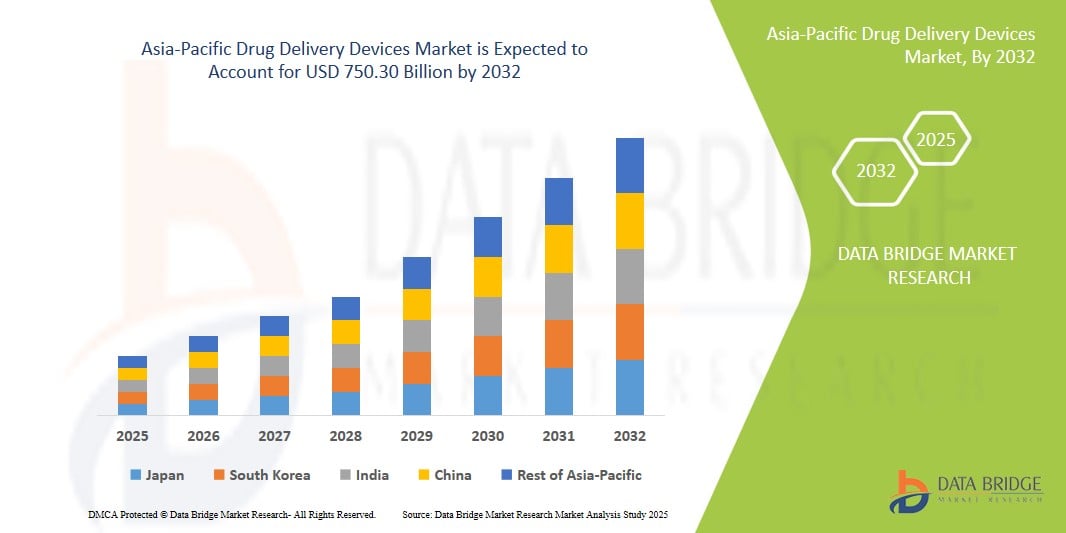
Asia-Pacific Drug Delivery Devices Market Size
- The Asia-Pacific drug delivery devices market size was valued atUSD 352.58 billion in 2024 and is expected to reachUSD 750.30 billion by 2032, at aCAGR of 9.90%during the forecast period
- This growth is driven by factors such as the increasing burden of chronic diseases, growing elderly population, rapid urbanization, and improved healthcare access across emerging economies such as China, India, and Southeast Asian countries
Asia-Pacific Drug Delivery Devices Market Analysis
- The Asia-Pacific drug delivery devices market is experiencing steady expansion supported by rising healthcare investments and increased demand for advanced treatment solutions across diverse therapeutic areas
- Manufacturers are focusing on user-centric innovations such as painless drug delivery and compact, easy-to-use devices, which are gaining popularity among both patients and healthcare providers
- China is expected to dominate the Asia-Pacific drug delivery devices market due to its large patient population, rapid healthcare infrastructure development, and increasing adoption of advanced drug delivery technologies
- India is expected to be the fastest growing region in the Asia-Pacific drug delivery devices market during the forecast period due to its expanding healthcare sector, rising prevalence of chronic diseases, and increasing demand for affordable and innovative drug delivery solutions
- The injectable drug delivery segment is expected to dominate the Asia-Pacific drug delivery devices market with the largest share of 64.8% in 2025 due to its growing use in the administration of biologics, vaccines, and chronic disease management, offering higher precision and faster therapeutic effects compared to other delivery methods
Report Scope and Asia-Pacific Drug Delivery Devices Market Segmentation
|
Attributes |
Asia-Pacific Drug Delivery Devices Key Market Insights |
|
Segments Covered |
|
|
Countries Covered |
Asia-Pacific
|
|
Key Market Players |
|
|
Market Opportunities |
|
|
Value Added Data Infosets |
In addition to the insights on market scenarios such as market value, growth rate, segmentation, geographical coverage, and major players, the market reports curated by the Data Bridge Market Research also include depth expert analysis, patient epidemiology, pipeline analysis, pricing analysis, and regulatory framework. |
Asia-Pacific Drug Delivery Devices Market Trends
“Growing Adoption of Wearable Drug Delivery Devices in Asia-Pacific”
- The Asia-Pacific region is witnessing a surge in wearable drug delivery devices due to their ability to provide precise, continuous, and user-friendly medication for long-term conditions such as diabetes and cancer
- These devices enable at-home treatment, minimizing the need for hospital visits
- For instance, wearable insulin injectors allow diabetes patients to self-administer doses conveniently
- Japan and South Korea are integrating wearable drug devices into mobile health platforms, with companies such as Omron Healthcare offering connected wearable solutions to track adherence
- Government-backed digital health initiatives across Asia, including remote monitoring programs in South Korea and Japan, are encouraging widespread adoption of smart wearable injectors
- Startups in China and India, such as Ypsomed and Healthium Medtech, are creating affordable wearable delivery technologies, catering to tech-savvy urban populations and boosting local innovation
Asia-Pacific Drug Delivery Devices Market Dynamics
Driver
“Rising Prevalence of Chronic Diseases and the Need for Self-Administration”
- The increasing prevalence of chronic diseases such as diabetes, cancer, and cardiovascular conditions across Asia-Pacific is fueling the demand for advanced drug delivery devices
- For instance, India and China have witnessed a sharp rise in diabetes cases, making insulin pens and wearable injectors essential for effective disease management
- Urban lifestyle changes and rising non-communicable diseases are creating a need for long-term home-based therapy solutions
- For instance, Countries such as Thailand and Malaysia are seeing higher demand for inhalers and patches to support outpatient care and reduce hospital load
- Drug delivery devices such as transdermal patches, injectors, and inhalers offer patient-friendly options to administer medication efficiently and independently
- Asia-Pacific's aging population in nations such as Japan, South Korea, and China increases demand for ergonomic devices that cater to mobility and memory-related challenges
- The inclusion of digital features such as dosage reminders, tracking, and data transfer is improving patient outcomes and compliance
Opportunity
“Expansion of Digital Health Ecosystems and Smart Devices”
- The Asia-Pacific region is swiftly adopting digital healthcare technologies, driving demand for smart and connected drug delivery devices
- For instance, India’s growing mobile health ecosystem supports devices such as Bluetooth-enabled glucose monitors that sync with patient apps
- The popularity of telemedicine and remote monitoring is increasing the need for drug delivery systems with embedded sensors and tracking features
- For instance, connected inhalers used in asthma and COPD management are gaining ground in China due to their ability to transmit dosage data to healthcare providers
- These smart devices enhance personalized medicine by ensuring accurate drug dosage, monitoring usage, and providing health analytics
- This personalization supports better patient engagement, adherence, and outcomes across varied treatment plans
- Government initiatives and a surge in health-tech startups across countries such as India and China are catalyzing the development of digital drug delivery platforms
- Pharmaceutical and tech company collaborations are accelerating innovation, creating scalable solutions tailored to diverse populations and healthcare needs
Restraint/Challenge
“High Cost of Advanced Drug Delivery Devices”
- The high cost of advanced drug delivery devices remains a significant barrier to widespread adoption across the Asia-Pacific region
- For instance, many patients, especially in low- and middle-income countries, struggle to afford premium devices such as wearable injectors or smart inhalers
- Limited reimbursement policies and lack of universal healthcare coverage in several countries further intensify the affordability issue
- For instance, in parts of Southeast Asia, patients often pay out-of-pocket for modern drug delivery systems, restricting market penetration
- Manufacturing and R&D costs for technologically advanced devices add to the final price, making them accessible mainly to urban, affluent populations
- Healthcare infrastructure gaps in rural regions hinder distribution and servicing of high-end drug delivery technologies
- Price-sensitive markets in Asia-Pacific demand cost-effective solutions, urging companies to balance innovation with affordability
Asia-Pacific Drug Delivery Devices Market Scope
The market is segmented on the basis of product type, end user, and distribution channel.
|
Segmentation |
Sub-Segmentation |
|
By Product Type |
|
|
By End User |
|
|
ByDistribution Channel |
|
In 2025, the injectable drug delivery is projected to dominate the market with a largest share in product type segment
The injectable drug delivery segment is expected to dominate the Asia-Pacific drug delivery devices market with the largest share of 64.8% in 2025 due to its growing use in the administration of biologics, vaccines, and chronic disease management, offering higher precision and faster therapeutic effects compared to other delivery methods.
The oral drug delivery is expected to account for the largest share during the forecast period in product type market
In 2025, the oral drug delivery segment is expected to dominate the market with the largest market share of 41.07% due to its non-invasive nature, patient convenience, lower cost of manufacturing, and high acceptance among patients for daily medication, making it the preferred choice for chronic disease management.
Asia-Pacific Drug Delivery Devices Market Regional Analysis
“China Holds the Largest Share in the Asia-Pacific Drug Delivery Devices Market”
- China is the dominating country in the Asia-Pacific drug delivery devices market holding a market share of 38.5%.
- China’s leadership stems from its advanced pharmaceutical manufacturing capacity, high investments in drug delivery innovation, and supportive government healthcare reforms
- With a vast aging population and increasing rates of chronic diseases, the demand for efficient, self-administered drug delivery devices such as injectors and inhalers is on the rise
- China's push toward digital health integration has enhanced the adoption of smart drug delivery technologies across urban and rural areas
- The presence of global and local MedTech companies establishing R&D and production units in China supports its dominant market position
“India is Projected to Register the Highest CAGR in the Asia-Pacific Drug Delivery Devices Market”
- India is the fastest-growing country in the Asia-Pacific drug delivery devices market
- India’s growth is fuelled by a rising middle-class population, expanding healthcare access, and an increase in non-communicable diseases requiring long-term drug delivery solutions
- The Indian government’s digital health initiatives and Ayushman Bharat scheme are accelerating adoption of advanced healthcare technologies including drug delivery systems
- Local start-ups and global pharmaceutical firms are investing in India’s MedTech ecosystem, promoting the availability of affordable, innovative drug delivery devices
- Urbanization and a shift toward preventive healthcare are increasing awareness and demand for user-friendly devices such as insulin pens, transdermal patches, and wearable injectors
Asia-Pacific Drug Delivery Devices Market Share
The market competitive landscape provides details by competitor. Details included are company overview, company financials, revenue generated, market potential, investment in research and development, new market initiatives, global presence, production sites and facilities, production capacities, company strengths and weaknesses, product launch, product width and breadth, application dominance. The above data points provided are only related to the companies' focus related to market.
The Major Market Leaders Operating in the Market Are:
- Terumo Corporation (Japan)
- Nipro Corporation (Japan)
- Ypsomed (Singapore)
- Shinva Medical Instrument Co., Ltd. (China)
- Jiangsu Yuyue Medical Equipment & Supply Co., Ltd. (China)
Latest Developments in Asia-Pacific Drug Delivery Devices Market
- In January 2025, Phillips Medisize, a subsidiary of Molex, completed the acquisition of Vectura Group Ltd., enhancing its capabilities in inhalation drug delivery. This strategic move integrates Vectura's expertise in dry powder inhalers, metered dose inhalers, nebulizers, and nasal inhalers, including proprietary platforms such as the Gyrohaler and FOX devices. The acquisition also brings Vectura's strengths in pharmaceutical analysis, process development, and regulatory services, bolstering Phillips Medisize's end-to-end development and manufacturing services. By adding approximately 350 employees to its global team, Phillips Medisize aims to meet the growing global demand for innovative therapies targeting chronic respiratory diseases such as asthma and chronic obstructive pulmonary disease (COPD), as well as non-respiratory conditions
- In January 2025, Nipro PharmaPackaging (Japan) and Nemera (France) successfully completed compatibility testing between Nemera’s UniSpray and Nipro’s unit-dose microvials. This collaboration aims to accelerate the time to market for combination products, particularly those used for rescue and crisis intervention. The rigorous testing confirmed that the combination product meets required dose delivery and reliability standards, ensuring its safety and performance. This development enhances the reliability of systemic drug administration via nasal delivery, benefiting patients requiring rapid treatment in emergency situations. The impact on the market includes the introduction of a reliable and efficient drug delivery system, potentially improving patient outcomes in critical care scenarios
SKU-
Accédez en ligne au rapport sur le premier cloud mondial de veille économique

- Tableau de bord d'analyse de données interactif
- Tableau de bord d'analyse d'entreprise pour les opportunités à fort potentiel de croissance
- Accès d'analyste de recherche pour la personnalisation et les requêtes
- Analyse de la concurrence avec tableau de bord interactif
- Dernières actualités, mises à jour et analyse des tendances
- Exploitez la puissance de l'analyse comparative pour un suivi complet de la concurrence
Méthodologie de recherche
La collecte de données et l'analyse de l'année de base sont effectuées à l'aide de modules de collecte de données avec des échantillons de grande taille. L'étape consiste à obtenir des informations sur le marché ou des données connexes via diverses sources et stratégies. Elle comprend l'examen et la planification à l'avance de toutes les données acquises dans le passé. Elle englobe également l'examen des incohérences d'informations observées dans différentes sources d'informations. Les données de marché sont analysées et estimées à l'aide de modèles statistiques et cohérents de marché. De plus, l'analyse des parts de marché et l'analyse des tendances clés sont les principaux facteurs de succès du rapport de marché. Pour en savoir plus, veuillez demander un appel d'analyste ou déposer votre demande.
La méthodologie de recherche clé utilisée par l'équipe de recherche DBMR est la triangulation des données qui implique l'exploration de données, l'analyse de l'impact des variables de données sur le marché et la validation primaire (expert du secteur). Les modèles de données incluent la grille de positionnement des fournisseurs, l'analyse de la chronologie du marché, l'aperçu et le guide du marché, la grille de positionnement des entreprises, l'analyse des brevets, l'analyse des prix, l'analyse des parts de marché des entreprises, les normes de mesure, l'analyse globale par rapport à l'analyse régionale et des parts des fournisseurs. Pour en savoir plus sur la méthodologie de recherche, envoyez une demande pour parler à nos experts du secteur.
Personnalisation disponible
Data Bridge Market Research est un leader de la recherche formative avancée. Nous sommes fiers de fournir à nos clients existants et nouveaux des données et des analyses qui correspondent à leurs objectifs. Le rapport peut être personnalisé pour inclure une analyse des tendances des prix des marques cibles, une compréhension du marché pour d'autres pays (demandez la liste des pays), des données sur les résultats des essais cliniques, une revue de la littérature, une analyse du marché des produits remis à neuf et de la base de produits. L'analyse du marché des concurrents cibles peut être analysée à partir d'une analyse basée sur la technologie jusqu'à des stratégies de portefeuille de marché. Nous pouvons ajouter autant de concurrents que vous le souhaitez, dans le format et le style de données que vous recherchez. Notre équipe d'analystes peut également vous fournir des données sous forme de fichiers Excel bruts, de tableaux croisés dynamiques (Fact book) ou peut vous aider à créer des présentations à partir des ensembles de données disponibles dans le rapport.











