



Asia-Pacific Canned Meat Market, By Meat Type (Poultry, Pork, Beef, Seafood, Goat (Mutton), Lamb (Mutton) and Others), Nature (Organic and Conventional), Application (Horeca Industry and Household/Retail), Distribution Channel (Store-Based Retailing and Non-Store-Based Retailing/Online Retailers) - Industry Trends and Forecast to 2029.
Asia-Pacific Canned Meat Market Analysis and Insights
Canned meat products are made by hermetically sealing (preventing air from escaping or entering) the product in a container (usually tin-coated steel cans) and thermally processing it to kill spoilage microorganisms. Canned meat is a high-quality, protein-rich food that remains stable at room temperature and is extremely convenient. Consumers can choose from a wide variety of meat-based products. Whole muscles, meat stews, luncheon meat, sausages, sauces with meat pieces, and paste products are instances of canned meat products.
The majority of canned meats are 'commercially' sterilized, which means they have been processed to kill most microorganisms and their spores. They are of good quality and have proper labelling. However, the high investment costs of canned meat and its products are expected to restrain the market growth of canned meat during the forecasted period.
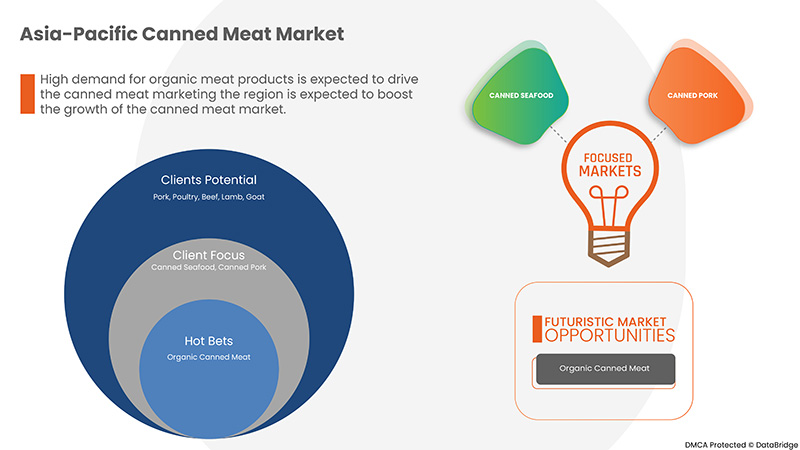
The increase in the demand for organic meat products and rising health awareness among people, coupled with urbanization, are expected to create immense opportunities for manufacturers of canned meat. On the other hand, the lack of uniform food safety standards may challenge the market's growth.
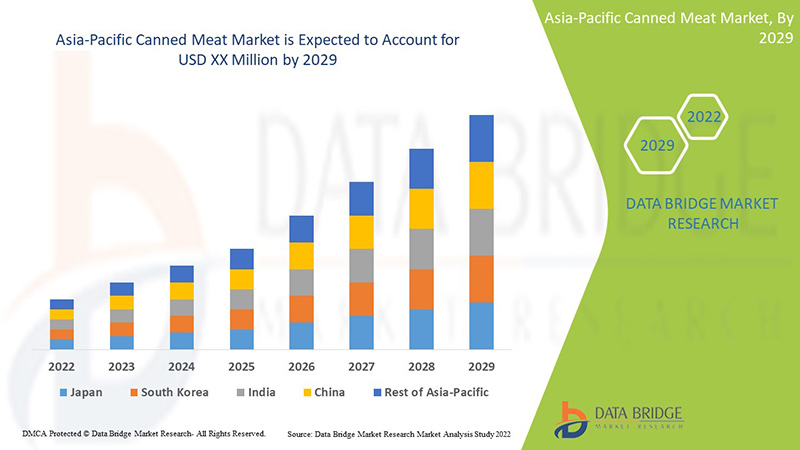
Data Bridge Market Research analyses that the Asia-Pacific canned meat market will grow at a CAGR of 3.3% during the forecast period of 2022 to 2029.
|
Report Metric |
Details |
|
Forecast Period |
2022 to 2029 |
|
Base Year |
2021 |
|
Historic Years |
2020 (Customizable to 2019 - 2015) |
|
Quantitative Units |
Revenue in USD Million, Pricing in USD |
|
Segments Covered |
By Meat Type (Poultry, Pork, Beef, Seafood, Goat, Lamb, and Others), Nature (Organic and Conventional), Application (Horeca Industry and Household/Retail), Distribution Channel (Store-Based Retailing and Non-Store-Based Retailing/Online Retailers) |
|
Regions Covered |
China, Japan, Vietnam, India, Indonesia, South Korea, Philippines, Australia, Malaysia, Thailand, New Zealand, Singapore and Rest of Asia-Pacific |
|
Market Players Covered |
JBS Foods, Danish Crown A.M.B.A., Oceans Secret, China Kuyu, Industrial Co. Ltd., Pronas, Bejing Yuanyoung Hongxing Food Co. Ltd., Conagra Brands, Inc., Zwanenberg Food Group |
Market Definition
Canned meat is a high-quality, protein-rich food that remains stable at room temperature and is extremely convenient. Consumers can choose from a wide variety of meat-based products. Meat is a low-acid food that must be sterilized unless other precautions are taken. Most countries have specific food and hygiene regulations governing meat slaughter and processing, and these and the relevant regulatory bodies must be followed before any meat products are produced.
Asia-Pacific Canned Meat Market Dynamics
Drivers
-
Growth in investments & collaborations in meat processing and canning business
The rising demand for different meat products leads to increasing investments and collaborations in the meat processing and canning market. Many investors have a number of approaches, such as joint venture, acquisition, new product launch, and acquisition, among others. For the meat canning market investments. Many meat companies choose to analyze from a sustainability perspective, considering the future scenario. Many companies use a range of water, climate, and land indicators to calculate their environmental and carbon footprints to inform their investment decisions. Moreover, companies are also tying up with various food research institutes for product development in the meat canning market. Companies are investing in the meat market due to the increased popularity of healthy protein source meat products. Moreover, there has been a key understanding of the health benefits of various meat products arising from poultry, and so on.
As a result, companies are continuously acquiring, obtaining funding, and investing in new products, which is expected to propel market growth.
-
Preference for animal-based proteins over plant-based proteins
Adapting plant-based proteins as an alternative to meat proteins has increased allergies among some consumers. It disproportionately affects children, which considers for meat products to grow in the forecast period.
The allergies to vegan food products increase the risk of nutritional deficiencies that can cause severe effects on the health of individuals. The immunoglobulin-E-mediated food allergy rate has peaked, especially in high-income countries. The high amount of macro- and micro-nutrients present in legumes, pulses, and whole grains, among others, are one of the prime reasons that cause allergies and side effects such as bloating, nausea, and improper digestion. Due to growing allergies from the consumption of plant-based meat, consumers may tend and divert their attention back to conventional meat products due to various allergies associated with plant-based meat consumption. This is driving the market growth.
Opportunities
Growing preference for organic meat
Organic farming not only helps small farmers to get a fair price for their produce but it also benefits the environment by encouraging the growth of a number of natural varieties of food. Organic food contains no chemical pesticides and fertilizers and are grown naturally with the help of manure or compost. Organic food does not contains growth hormones or antibiotic residues, which therefore do not threaten a child’s future.
Restraints/Challenges
- High investment costs in the poultry business
Poultry manufacturers face several adversities in terms of transportation, inadequate storage, and wastage of products which lead to loss of value of end products.
The equipment involved in the poultry business, such as high-pressure processing, refrigeration equipment, massaging equipment, and injectors, increases the efficiency of food production by reducing wastage.
However, poultry processing units require high capital investments in terms of massive requirements for infrastructure. This includes pack houses, cold storage facilities across the value chain, the latest technology equipment for processing processed meats that maintain their nutritional values, infrastructure at port gateways with phytosanitary facilitation, and multi-modal logistics.
Post COVID-19 Impact on Asia-Pacific Canned Meat Market
COVID-19 has affected the market to some extent. Due to the lockdown, the manufacturing and production of many small and large companies were halted, and the demand for canned meat also increased, influencing the market. Due to the change in many mandates and regulations, manufacturers can design and launch new products in the market, which will help the market's growth.
Recent Developments
- In December 2021, Tyson Foods Inc. planned to spend more than $1.3 billion to increase automation in meat plants over the next three years. This will help the company grow and increase its production capacity
Asia-Pacific Canned Meat Market Scope
The Asia-Pacific canned meat market is segmented into notable segments based on meat type, nature, application, and distribution channel. The growth amongst these segments will help you analyze major growth segments in the industries and provide the users with a valuable market overview and market insights to make strategic decisions to identify core market applications.
Meat Type
- Poultry
- Pork
- Beef
- Seafood
- Goat (Mutton)
- Lamb (Mutton)
- Others
Based on meat type, the canned meat market is further segmented into poultry, pork, beef, seafood, goat (mutton), lamb (mutton) and others.
Nature
- Conventional
- Organic
Based on meat type, the canned meat market is further segmented into organic and conventional.
Application
- Horeca Industry
- Household/Retail
Based on application, the canned meat market is further segmented into horeca industry and household/retail.
Distribution Channel
- Store-based retailing
- Non-Store-Based Retailing/Online Retailers
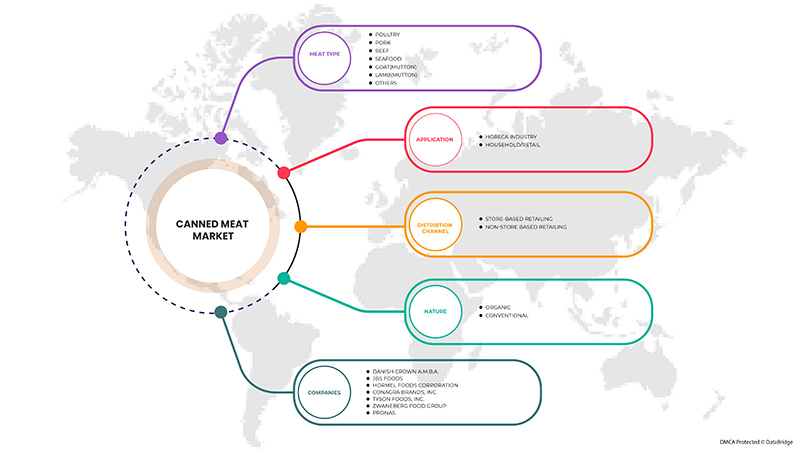
Based on distribution channel, the canned meat market is further segmented into store-based retailing and non-store-based retailing/online retailers.
Asia-Pacific Canned Meat Market Regional Analysis/Insights
The Asia-Pacific canned meat market is analyzed, and market size insights and trends are provided based on as referenced above.
The countries covered in the Asia-Pacific canned meat market report are China, Japan, Vietnam, India, Indonesia, South Korea, Philippines, Australia, Malaysia, Thailand, New Zealand, Singapore and Rest of Asia-Pacific.
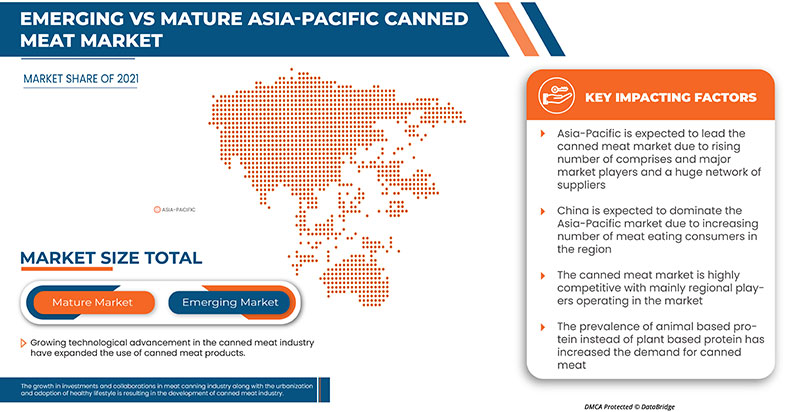
China is expected to dominate the Asia-Pacific canned meat market in terms of market share and revenue and is estimated to maintain its dominance during the forecast period due to the growing surge for canned meat in various industries and growing consumer demand from end users.
The region section of the report also provides individual market-impacting factors and changes in regulations in the market that impact the current and future trends of the market. Data points, such as new and replacement sales, country demographics, disease epidemiology, and import-export tariffs, are some of the major pointers used to forecast the market scenario for individual countries. In addition, the presence and availability of global brands and their challenges faced due to high competition from local and domestic brands and the impact of sales channels are considered while providing forecast analysis of the country data.
Competitive Landscape and Asia-Pacific Canned Meat Market Share Analysis
The Asia-Pacific canned meat market competitive landscape provides details about the competitors. Details included are company overview, company financials, revenue generated, market potential, investment in research and development, new market initiatives, Asia-Pacific presence, production sites and facilities, production capacities, company strengths and weaknesses, product launch, product width and breadth, and application dominance. The above data points are only related to the companies focus on the Asia-Pacific canned meat market.
Some of the major players operating in the Asia-Pacific canned meat market are JBS Foods, Danish Crown A.M.B.A., Oceans Secret, China Kuyu, Industrial Co. Ltd., Pronas, Bejing Yuanyoung Hongxing Food Co. Ltd. Conagra Brands, Inc., Zwanenberg Food Group among others.
Research Methodology
Data collection and base year analysis are done using data collection modules with large sample sizes. The market data is analyzed and estimated using market statistical and coherent models. In addition, market share analysis and key trend analysis are the major success factors in the market report. The key research methodology used by the DBMR research team is data triangulation which involves data mining, analysis of the impact of data variables on the market, and primary (industry expert) validation. Apart from this, data models include the Vendor Positioning Grid, Market Time Line Analysis, Market Overview and Guide, Company Positioning Grid, Company Market Share Analysis, Standards of Measurement, Asia-Pacific Vs Regional, and Vendor Share Analysis. Please request an analyst call in case of further inquiry.
SKU-
Accédez en ligne au rapport sur le premier cloud mondial de veille économique

- Tableau de bord d'analyse de données interactif
- Tableau de bord d'analyse d'entreprise pour les opportunités à fort potentiel de croissance
- Accès d'analyste de recherche pour la personnalisation et les requêtes
- Analyse de la concurrence avec tableau de bord interactif
- Dernières actualités, mises à jour et analyse des tendances
- Exploitez la puissance de l'analyse comparative pour un suivi complet de la concurrence
Table des matières
1 INTRODUCTION
1.1 OBJECTIFS DE L'ÉTUDE
1.2 DÉFINITION DU MARCHÉ
1.3 LIMITATIONS
1.4 MARCHÉS COUVERTS
2 SEGMENTATION DU MARCHÉ
2.1 MARCHÉS COUVERTS
2.2 PORTÉE GÉOGRAPHIQUE
2,3 ANS CONSIDÉRÉS POUR L'ÉTUDE
2.4 MONNAIE ET TARIFS
2.5 MODÈLE DE VALIDATION DES DONNÉES DU TRÉPIED DBMR
2.6 COURBE DE LIGNE DE VIE DE TYPE VIANDE
2.7 ENTRETIENS PRIMAIRES AVEC DES LEADERS D'OPINION CLÉS
2.8 GRILLE DE POSITIONNEMENT DU MARCHÉ DBMR
2.9 SOURCES SECONDAIRES
2.1 HYPOTHÈSES
3 RÉSUMÉ EXÉCUTIF
4 INFORMATIONS PREMIUM
5 APERÇU DU MARCHÉ
5.1 PILOTES
5.1.1 CROISSANCE DES INVESTISSEMENTS ET DES COLLABORATIONS DANS LES SECTEURS DE LA TRANSFORMATION ET DE LA MISE EN CONSERVE DE LA VIANDE
5.1.2 PRÉFÉRENCE POUR LES PROTÉINES D'ORIGINE ANIMALE PAR RAPPORT AUX PROTÉINES D'ORIGINE VÉGÉTALE
5.1.3 URBANISATION CROISSANTE ET ADOPTION ACCRUE D'UN MODE DE VIE SAIN
5.2 RESTRICTIONS
5.2.1 COÛT D'INVESTISSEMENT ÉLEVÉ DANS L'ÉLEVAGE DE VOLAILLE
5.2.2 AUGMENTATION DE LA POPULATION VÉGÉTALIENNE ET DEMANDE CROISSANTE D'ALTERNATIVES À LA VIANDE
5.3 OPPORTUNITÉS
5.3.1 CROISSANCE DES CHAÎNES DE RESTAURATION RAPIDE ET DE RESTAURATION
5.3.2 AUTOMATISATION CROISSANTE DANS L'INDUSTRIE DE LA TRANSFORMATION DE LA VIANDE
5.3.3 PRÉFÉRENCE CROISSANTE POUR LA VIANDE BIOLOGIQUE
5.4 DÉFIS
5.4.1 RÉGLEMENTATIONS GOUVERNEMENTALES STRICTES
5.4.2 PERTURBATION DE LA CHAÎNE D'APPROVISIONNEMENT EN RAISON DE LA PANDÉMIE DE COVID-19
6 MARCHÉ DE LA VIANDE EN CONSERVE EN ASIE-PACIFIQUE, PAR TYPE DE VIANDE
6.1 APERÇU
6.2 VOLAILLE
6.3 PORC
6.4 BOEUF
6.5 FRUITS DE MER
6.6 CHÈVRE (MOUTON)
6.7 AGNEAU (MOUTON)
6.8 AUTRES
7 MARCHÉ DE LA VIANDE EN CONSERVE EN ASIE-PACIFIQUE, PAR NATURE
7.1 APERÇU
7.2 CONVENTIONNEL
7.3 BIOLOGIQUE
8 MARCHÉ DE LA VIANDE EN CONSERVE EN ASIE-PACIFIQUE, PAR APPLICATION
8.1 APERÇU
8.2 SECTEUR HORECA
8.3 MÉNAGE/DÉTAIL
9 MARCHÉ DE LA VIANDE EN CONSERVE EN ASIE-PACIFIQUE, PAR CANAL DE DISTRIBUTION
9.1 APERÇU
9.2 VENTE AU DÉTAIL EN MAGASIN
9.3 VENTE AU DÉTAIL HORS MAGASIN/DÉTAILLANTS EN LIGNE
10 MARCHÉ DE LA VIANDE EN CONSERVE EN ASIE-PACIFIQUE, PAR RÉGION
10.1 ASIE-PACIFIQUE
10.1.1 CHINE
10.1.2 JAPON
10.1.3 VIETNAM
10.1.4 INDE
10.1.5 INDONÉSIE
10.1.6 CORÉE DU SUD
10.1.7 PHILIPPINES
10.1.8 AUSTRALIE
10.1.9 MALAISIE
10.1.10 THAÏLANDE
10.1.11 NOUVELLE-ZÉLANDE
10.1.12 SINGAPOUR
10.1.13 RESTE DE L'ASIE-PACIFIQUE
11 PAYSAGE D'ENTREPRISE
11.1 ANALYSE DES ACTIONS DE L'ENTREPRISE : ASIE-PACIFIQUE
12 ANALYSE SWOT
13 PROFIL DE L'ENTREPRISE
13.1 DANISH CROWN AMBA
13.1.1 INSTANTANÉ DE L'ENTREPRISE
13.1.2 ANALYSE DES ACTIONS DE LA SOCIÉTÉ
13.1.3 PORTEFEUILLE DE PRODUITS
13.1.4 ÉVOLUTIONS RÉCENTES
13.2 JBS FOODS
13.2.1 INSTANTANÉ DE L'ENTREPRISE
13.2.2 ANALYSE DES REVENUS
13.2.3 ANALYSE DES ACTIONS DE L'ENTREPRISE
13.2.4 PORTEFEUILLE DE PRODUITS
13.2.5 ÉVOLUTIONS RÉCENTES
13.3 HORMEL FOODS CORPORATION
13.3.1 INSTANTANÉ DE L'ENTREPRISE
13.3.2 ANALYSE DES REVENUS
13.3.3 ANALYSE DES ACTIONS DE L'ENTREPRISE
13.3.4 PORTEFEUILLE DE PRODUITS
13.3.5 ÉVOLUTION RÉCENTE
13.4 CONAGRA BRANDS, INC
13.4.1 INSTANTANÉ DE L'ENTREPRISE
13.4.2 ANALYSE DES REVENUS
13.4.3 ANALYSE DES ACTIONS DE L'ENTREPRISE
13.4.4 PORTEFEUILLE DE PRODUITS
13.4.5 ÉVOLUTION RÉCENTE
13,5 TYSON FOODS, INC.
13.5.1 INSTANTANÉ DE L'ENTREPRISE
13.5.2 ANALYSE DES REVENUS
13.5.3 ANALYSE DES ACTIONS DE L'ENTREPRISE
13.5.4 PORTEFEUILLE DE PRODUITS
13.5.5 ÉVOLUTIONS RÉCENTES
13.6 BÉJING YUANYOUNG HONGXING FOOD CO., LTD
13.6.1 INSTANTANÉ DE L'ENTREPRISE
13.6.2 PORTEFEUILLE DE PRODUITS
13.6.3 ÉVOLUTIONS RÉCENTES
13.7 CHINE KUNYU INDUSTRIAL CO. LTD.
13.7.1 INSTANTANÉ DE L'ENTREPRISE
13.7.2 PORTEFEUILLE DE PRODUITS
13.7.3 ÉVOLUTIONS RÉCENTES
13,8 VIANDES KEYSTONE
13.8.1 INSTANTANÉ DE L'ENTREPRISE
13.8.2 PORTEFEUILLE DE PRODUITS
13.8.3 ÉVOLUTIONS RÉCENTES
13.9 LE SECRET DES OCÉANS
13.9.1 INSTANTANÉ DE L'ENTREPRISE
13.9.2 PORTEFEUILLE DE PRODUITS
13.9.3 ÉVOLUTIONS RÉCENTES
13.1 PRONAS
13.10.1 INSTANTANÉ DE L'ENTREPRISE
13.10.2 PORTEFEUILLE DE PRODUITS
13.10.3 ÉVOLUTIONS RÉCENTES
13.11 ALIMENTS DE LA PLANÈTE SAUVAGE
13.11.1 INSTANTANÉ DE L'ENTREPRISE
13.11.2 PORTEFEUILLE DE PRODUITS
13.11.3 ÉVOLUTIONS RÉCENTES
13.12 GROUPE ALIMENTAIRE ZWANENBERG
13.12.1 INSTANTANÉ DE L'ENTREPRISE
13.12.2 PORTEFEUILLE DE PRODUITS
13.12.3 ÉVOLUTION RÉCENTE
14 QUESTIONNAIRE
15 RAPPORTS CONNEXES
Liste des figures
FIGURE 1 MARCHÉ DE LA VIANDE EN CONSERVE EN ASIE-PACIFIQUE : SEGMENTATION
FIGURE 2 MARCHÉ DE LA VIANDE EN CONSERVE EN ASIE-PACIFIQUE : TRIANGULATION DES DONNÉES
FIGURE 3 MARCHÉ DE LA VIANDE EN CONSERVE EN ASIE-PACIFIQUE : ANALYSE DROC
FIGURE 4 MARCHÉ DE LA VIANDE EN CONSERVE EN ASIE-PACIFIQUE : ANALYSE DU MARCHÉ ASIE-PACIFIQUE PAR RAPPORT AU MARCHÉ RÉGIONAL
FIGURE 5 MARCHÉ DE LA VIANDE EN CONSERVE EN ASIE-PACIFIQUE : ANALYSE DE RECHERCHE DES ENTREPRISES
FIGURE 6 MARCHÉ DE LA VIANDE EN CONSERVE EN ASIE-PACIFIQUE : DONNÉES DÉMOGRAPHIQUES DES ENTRETIENS
FIGURE 7 MARCHÉ DE LA VIANDE EN CONSERVE EN ASIE-PACIFIQUE : GRILLE DE POSITIONNEMENT DU MARCHÉ DBMR
FIGURE 8 MARCHÉ DE LA VIANDE EN CONSERVE EN ASIE-PACIFIQUE : SEGMENTATION
FIGURE 9 L'AUGMENTATION DE LA DEMANDE DE PROTÉINES D'ORIGINE ANIMALE AU LIEU DE PROTÉINES D'ORIGINE VÉGÉTALE STIMULE LA CROISSANCE DU MARCHÉ DE LA VIANDE EN CONSERVE EN ASIE-PACIFIQUE AU COURS DE LA PÉRIODE DE PRÉVISION DE 2022 À 2029
FIGURE 10 LE SEGMENT DE LA VOLAILLE DEVRAIT REPRÉSENTER LA PLUS GRANDE PART DU MARCHÉ DE LA VIANDE EN CONSERVE EN ASIE-PACIFIQUE EN 2022 ET 2029
FIGURE 11 MOTEURS, CONTRAINTES, OPPORTUNITÉS ET DÉFIS DU MARCHÉ DE LA VIANDE EN CONSERVE EN ASIE-PACIFIQUE
FIGURE 12 MARCHÉ DE LA VIANDE EN CONSERVE EN ASIE-PACIFIQUE : PAR TYPE DE VIANDE (2021)
FIGURE 13 MARCHÉ DE LA VIANDE EN CONSERVE EN ASIE-PACIFIQUE : PAR NATURE, (2021)
FIGURE 14 MARCHÉ DE LA VIANDE EN CONSERVE EN ASIE-PACIFIQUE : PAR APPLICATION (2021)
FIGURE 15 MARCHÉ DE LA VIANDE EN CONSERVE EN ASIE-PACIFIQUE : PAR CANAL DE DISTRIBUTION (2021)
FIGURE 16 MARCHÉ DE LA VIANDE EN CONSERVE EN ASIE-PACIFIQUE : PAR INSTANTANÉ (2021)
FIGURE 17 MARCHÉ DE LA VIANDE EN CONSERVE EN ASIE-PACIFIQUE : PAR PAYS (2021)
FIGURE 18 MARCHÉ DE LA VIANDE EN CONSERVE EN ASIE-PACIFIQUE : PAR PAYS (2022-2029)
FIGURE 19 MARCHÉ DE LA VIANDE EN CONSERVE EN ASIE-PACIFIQUE : PAR PAYS (2021-2029)
FIGURE 20 MARCHÉ DE LA VIANDE EN CONSERVE EN ASIE-PACIFIQUE : PAR TYPE DE VIANDE (2022-2029)
FIGURE 21 MARCHÉ DE LA VIANDE EN CONSERVE EN ASIE-PACIFIQUE : PART DE L'ENTREPRISE EN 2021 (%)

Méthodologie de recherche
La collecte de données et l'analyse de l'année de base sont effectuées à l'aide de modules de collecte de données avec des échantillons de grande taille. L'étape consiste à obtenir des informations sur le marché ou des données connexes via diverses sources et stratégies. Elle comprend l'examen et la planification à l'avance de toutes les données acquises dans le passé. Elle englobe également l'examen des incohérences d'informations observées dans différentes sources d'informations. Les données de marché sont analysées et estimées à l'aide de modèles statistiques et cohérents de marché. De plus, l'analyse des parts de marché et l'analyse des tendances clés sont les principaux facteurs de succès du rapport de marché. Pour en savoir plus, veuillez demander un appel d'analyste ou déposer votre demande.
La méthodologie de recherche clé utilisée par l'équipe de recherche DBMR est la triangulation des données qui implique l'exploration de données, l'analyse de l'impact des variables de données sur le marché et la validation primaire (expert du secteur). Les modèles de données incluent la grille de positionnement des fournisseurs, l'analyse de la chronologie du marché, l'aperçu et le guide du marché, la grille de positionnement des entreprises, l'analyse des brevets, l'analyse des prix, l'analyse des parts de marché des entreprises, les normes de mesure, l'analyse globale par rapport à l'analyse régionale et des parts des fournisseurs. Pour en savoir plus sur la méthodologie de recherche, envoyez une demande pour parler à nos experts du secteur.
Personnalisation disponible
Data Bridge Market Research est un leader de la recherche formative avancée. Nous sommes fiers de fournir à nos clients existants et nouveaux des données et des analyses qui correspondent à leurs objectifs. Le rapport peut être personnalisé pour inclure une analyse des tendances des prix des marques cibles, une compréhension du marché pour d'autres pays (demandez la liste des pays), des données sur les résultats des essais cliniques, une revue de la littérature, une analyse du marché des produits remis à neuf et de la base de produits. L'analyse du marché des concurrents cibles peut être analysée à partir d'une analyse basée sur la technologie jusqu'à des stratégies de portefeuille de marché. Nous pouvons ajouter autant de concurrents que vous le souhaitez, dans le format et le style de données que vous recherchez. Notre équipe d'analystes peut également vous fournir des données sous forme de fichiers Excel bruts, de tableaux croisés dynamiques (Fact book) ou peut vous aider à créer des présentations à partir des ensembles de données disponibles dans le rapport.











