



Asia-Pacific Healthcare Information Technology (IT) Market Segmentation, By Solutions and Services (Solutions, HCIT Outsourcing Services and Others), Component Type (Software and Hardware), Delivery Mode (On-Premise and Cloud-Based), End-Users (Providers and Payers) - Industry Trends and Forecast to 2033
Asia-Pacific Healthcare Information Technology (IT) Market Size
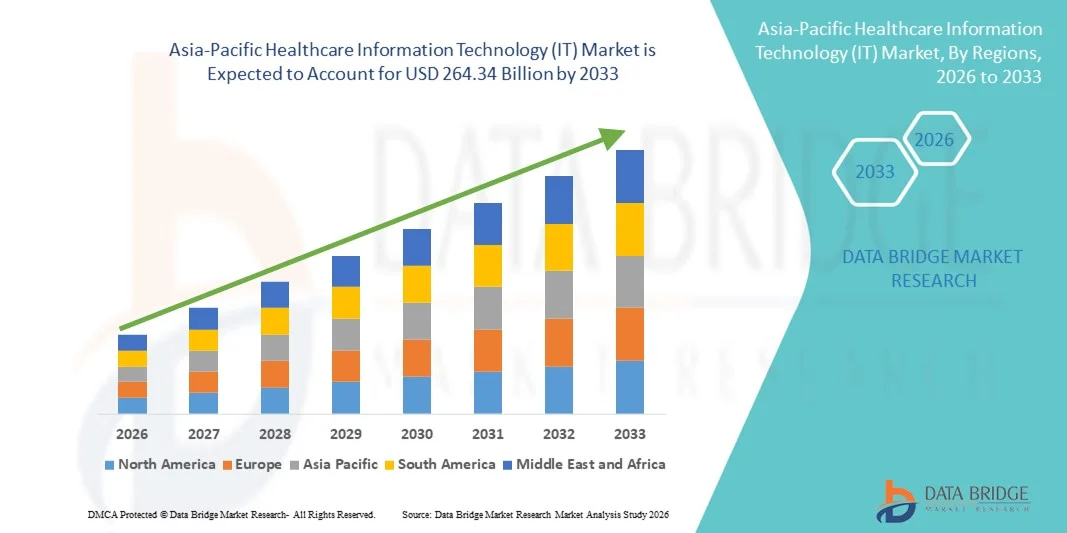
- The Asia-Pacific Healthcare Information Technology (IT) market size was valued at USD 81.19 billion in 2025 and is expected to reach USD 264.34 billion by 2033, at a CAGR of 15.90% during the forecast period
- The market growth is largely fueled by the increasing adoption of digital health systems, electronic health records (EHRs), telehealth platforms, and cloud-based healthcare solutions, leading to enhanced digital transformation across hospitals, clinics, and other healthcare facilities. Continuous technological advancements in data analytics, artificial intelligence, and interoperability solutions are further accelerating the modernization of healthcare infrastructure
- Furthermore, rising demand for efficient patient data management, improved clinical outcomes, regulatory compliance, and cost optimization is establishing Healthcare Information Technology (IT) solutions as a critical component of modern healthcare delivery. These converging factors are accelerating the widespread implementation of Healthcare IT systems, thereby significantly boosting the industry’s growth
Asia-Pacific Healthcare Information Technology (IT) Market Analysis
- Healthcare Information Technology (IT) solutions, encompassing electronic health records (EHR), hospital information systems (HIS), telemedicine platforms, and health data analytics, are increasingly becoming integral to modern healthcare delivery in both public and private healthcare institutions due to their ability to enhance operational efficiency, improve patient outcomes, and enable data-driven decision-making
- The escalating demand for Healthcare IT systems is primarily driven by government-led digital health initiatives, rising patient volumes, increasing need for accurate medical documentation, and the growing adoption of cloud-based and AI-enabled healthcare solutions across hospitals and diagnostic centers
- China dominated the healthcare information technology (IT) market with the largest revenue share of 37.1% in 2025, driven by rapid digital transformation across hospitals, expanding adoption of electronic health records (EHRs), telemedicine platforms, and AI-based healthcare solutions, along with strong government initiatives promoting smart hospital infrastructure
- India is expected to be the fastest-growing region in the healthcare information technology (IT) market during the forecast period, expanding at a CAGR of 13.4% from 2026 to 2033, supported by increasing healthcare digitalization, rising investments in health-tech startups, government programs promoting digital health ecosystems, and growing demand for cloud-based hospital management and telehealth solutions
- The On-Premises segment dominated the largest market revenue share of 55.3% in 2025, primarily due to data security concerns and established IT infrastructure in large hospitals
Report Scope and Healthcare Information Technology (IT) Market Segmentation
|
Attributes |
Healthcare Information Technology (IT) Key Market Insights |
|
Segments Covered |
|
|
Countries Covered |
Asia-Pacific
|
|
Key Market Players |
|
|
Market Opportunities |
|
|
Value Added Data Infosets |
In addition to the insights on market scenarios such as market value, growth rate, segmentation, geographical coverage, and major players, the market reports curated by the Data Bridge Market Research also include in-depth expert analysis, patient epidemiology, pipeline analysis, pricing analysis, and regulatory framework. |
Asia-Pacific Healthcare Information Technology (IT) Market Trends
Accelerating Digital Transformation and Interoperability in Healthcare Systems
- A significant and accelerating trend in the India healthcare information technology (IT) market is the rapid digital transformation of healthcare infrastructure, including the adoption of electronic health records (EHRs), hospital information systems (HIS), telemedicine platforms, and health data interoperability frameworks. This transformation is enhancing operational efficiency, improving patient care coordination, and enabling data-driven clinical decision-making across hospitals and clinics
- For instance, the Government of India’s Ayushman Bharat Digital Mission (ABDM) is actively promoting the creation of digital health IDs and integrated health records, enabling seamless data exchange across healthcare providers and strengthening nationwide healthcare connectivity
- The increasing integration of cloud-based healthcare IT solutions is enabling hospitals and diagnostic centers to store, access, and analyze patient information securely and efficiently. Healthcare providers are leveraging advanced analytics tools to improve disease surveillance, optimize hospital workflows, and reduce administrative burdens
- The shift toward paperless healthcare environments is also improving transparency, reducing medical errors, and enhancing patient engagement through digital appointment scheduling, e-prescriptions, and remote consultations
- Private hospitals and diagnostic chains are investing heavily in integrated IT platforms to streamline billing, claims management, laboratory information systems, and radiology information systems. This integration supports improved turnaround times and better financial management
- The growing demand for data standardization, interoperability, and centralized healthcare information exchange is reshaping the healthcare delivery landscape in India, positioning Healthcare IT as a critical backbone of modern medical infrastructure
Asia-Pacific Healthcare Information Technology (IT) Market Dynamics
Driver
Increasing Healthcare Digitization and Government Initiatives
- The rising emphasis on healthcare digitization, supported by strong government initiatives and regulatory driver propelling the growth of the India Healthcare Information Technology (IT) market
- Programs focused on universal health coverage and digital health ecosystems are encouraging hospitals and clinics to modernize their IT infrastructure
- For instance, initiatives under the National Digital Health Blueprint and Ayushman Bharat Digital Mission are facilitating the integration of digital health records, telemedicine services, and centralized health data repositories, significantly accelerating Healthcare IT adoption across public and private sectors
- The growing burden of chronic diseases, increasing patient volumes, and demand for efficient healthcare delivery systems are compelling providers to adopt automated workflow management, digital documentation, and advanced analytics tools
- Furthermore, the rapid expansion of private healthcare facilities and multispecialty hospitals in tier II and tier III cities is driving the need for scalable and cost-effective IT solutions to manage clinical and administrative operations efficiently
- The increasing penetration of smartphones and internet connectivity in rural and semi-urban regions is also supporting telehealth expansion, remote monitoring solutions, and digital consultation services, further contributing to market growth. reforms, is a major
Restraint/Challenge
Data Privacy Concerns and High Implementation Costs
- Concerns regarding data privacy, cybersecurity risks, and regulatory compliance pose significant challenges to the widespread adoption of Healthcare Information Technology solutions in Asia Pacific. As healthcare institutions digitize sensitive patient information, risks related to data breaches and unauthorized access remain critical concerns
- For instance, reported incidents of hospital data breaches and ransomware attacks in the healthcare sector have heightened awareness around the need for stronger cybersecurity frameworks, making some smaller healthcare providers cautious about rapid digital adoption
- Ensuring compliance with data protection regulations, implementing robust encryption systems, and maintaining secure cloud environments require substantial investment, which can be challenging for small and mid-sized healthcare facilities. In addition, the high initial cost of implementing comprehensive hospital information systems, including hardware infrastructure, software licensing, and staff training, may limit adoption in resource-constrained settings
- Resistance to change among healthcare professionals and lack of technical expertise in certain regions further slowdown implementation and optimal utilization of Healthcare IT systems
- Overcoming these challenges through improved cybersecurity standards, government incentives, training programs, and the development of affordable, scalable Healthcare IT platforms will be essential to ensure sustained and inclusive market growth across India
Asia-Pacific Healthcare Information Technology (IT) Market Scope
The market is segmented on the basis of product and services, components, delivery mode, and end-users.
- By Product and Services
On the basis of product and services, the Healthcare Information Technology (IT) market is segmented into Healthcare Provider Solutions, Healthcare Payer Solutions, and HCIT Outsourcing Services. The Healthcare Provider Solutions segment dominated the largest market revenue share of 46.8% in 2025, driven by the widespread adoption of electronic health records (EHRs), clinical decision support systems, and hospital information systems. Hospitals and physician practices are increasingly investing in digital platforms to enhance patient care, streamline workflows, and improve clinical outcomes. Regulatory mandates promoting EHR adoption further strengthen segment dominance. Integration of telehealth, e-prescribing, and population health management tools supports comprehensive care delivery. Growing patient volumes and the need for data-driven decision-making accelerate solution deployment. Interoperability requirements encourage healthcare facilities to upgrade IT infrastructure. Rising focus on value-based care models further fuels demand. Provider solutions also enable real-time analytics and reporting capabilities. Strong government funding initiatives support digital transformation in hospitals. Continuous innovation in AI-powered diagnostics enhances provider efficiency. Overall, healthcare provider solutions maintain leadership due to high adoption across hospitals and clinics and continuous regulatory support.
The HCIT Outsourcing Services segment is anticipated to witness the fastest CAGR of 13.4% from 2026 to 2033, fueled by the increasing need to reduce operational costs and improve IT efficiency. Healthcare organizations are outsourcing IT management, revenue cycle management, and infrastructure services to specialized vendors. Growing complexity of regulatory compliance drives demand for third-party expertise. Cloud migration initiatives further boost outsourcing partnerships. Smaller hospitals and clinics prefer outsourcing to avoid high capital expenditure. Demand for cybersecurity and data protection services accelerates segment growth. Expansion of telehealth platforms increases reliance on managed IT services. Outsourcing also enhances scalability and flexibility for healthcare providers. Globalization of healthcare services supports offshore IT support models. Continuous technological upgrades necessitate expert external support. Rising adoption of subscription-based service models further strengthens demand. Overall, HCIT outsourcing services represent the fastest-growing segment due to cost-efficiency, scalability, and rising digital complexity.
- By Components
On the basis of components, the Healthcare Information Technology (IT) market is segmented into Services, Software, and Hardware. The Services segment dominated the largest market revenue share of 41.9% in 2025, driven by the growing demand for implementation, maintenance, consulting, and training services. Healthcare institutions require continuous support for system integration and upgrades. Increasing cybersecurity threats necessitate ongoing monitoring and risk assessment services. Regulatory compliance requirements push hospitals to seek professional IT advisory services. Expansion of digital health platforms demands technical support and customization. Interoperability challenges further strengthen reliance on service providers. Healthcare facilities prioritize workflow optimization and data analytics services. Managed services contracts ensure long-term revenue streams. Growing complexity of IT ecosystems increases service dependency. Rising telemedicine adoption requires continuous system support. Overall, the services component leads the market due to sustained demand for technical expertise and system management.
The Software segment is expected to witness the fastest CAGR of 12.7% from 2026 to 2033, driven by advancements in AI-based analytics, electronic medical records, and cloud-native healthcare platforms. Demand for patient engagement solutions and remote monitoring software accelerates growth. Software upgrades enable predictive analytics and personalized medicine initiatives. Expansion of digital therapeutics and mobile health applications strengthens adoption. Healthcare providers increasingly invest in integrated platforms for seamless operations. Automation of administrative workflows boosts efficiency and reduces errors. Growth in big data analytics enhances population health management capabilities. Favorable regulatory frameworks encourage digital innovation. Increasing interoperability standards support software expansion. Rising investments in health-tech startups further stimulate development. Overall, software emerges as the fastest-growing component due to innovation, scalability, and expanding digital healthcare ecosystems.
- By Delivery Mode
On the basis of delivery mode, the Healthcare Information Technology (IT) market is segmented into On-Premises and Cloud-Based. The On-Premises segment dominated the largest market revenue share of 55.3% in 2025, primarily due to data security concerns and established IT infrastructure in large hospitals. Healthcare organizations prefer on-premises systems for better control over sensitive patient information. Regulatory compliance requirements support in-house data storage. Large-scale hospitals invest in customized IT environments tailored to operational needs. Integration with legacy systems further sustains demand. High-volume institutions require robust internal servers for data processing. Concerns about cyber threats encourage controlled infrastructure management. Established procurement frameworks favor traditional deployment models. Long-term contracts with IT vendors reinforce adoption. On-premises systems also ensure uninterrupted access in low-connectivity regions. Overall, on-premises deployment leads due to security, control, and infrastructure stability.
The Cloud-Based segment is projected to register the fastest CAGR of 15.1% from 2026 to 2033, driven by scalability, cost-effectiveness, and remote accessibility. Cloud platforms enable real-time data sharing across multiple healthcare facilities. Smaller clinics adopt cloud solutions to reduce upfront investment costs. Growing telehealth adoption accelerates demand for cloud integration. Advanced encryption and security enhancements increase confidence in cloud systems. Subscription-based pricing models support budget flexibility. Interoperability and seamless updates enhance operational efficiency. Rising mobile health applications depend heavily on cloud infrastructure. Disaster recovery and backup capabilities strengthen adoption. Expansion of AI-driven analytics platforms further boosts cloud utilization. Overall, cloud-based delivery is the fastest-growing mode due to flexibility, innovation, and digital transformation initiatives.
- By End-Users
On the basis of end-users, the Healthcare Information Technology (IT) market is segmented into Providers and Payers. The Providers segment accounted for the largest market revenue share of 63.7% in 2025, driven by increasing adoption of EHRs, telemedicine platforms, and clinical workflow management systems. Hospitals and clinics require integrated IT systems for efficient patient management. Growing patient volumes demand streamlined digital solutions. Regulatory mandates for digital record-keeping strengthen provider investments. Providers adopt analytics tools to improve care quality and reduce readmissions. Integration of AI-based diagnostics enhances treatment accuracy. Expansion of outpatient and specialty clinics increases IT spending. Government funding initiatives promote healthcare digitization. Continuous upgrades of hospital information systems sustain revenue generation. Overall, providers dominate due to extensive IT deployment across clinical settings.
The Payers segment is expected to witness the fastest CAGR of 11.8% from 2026 to 2033, driven by the growing need for claims management automation and fraud detection systems. Insurance companies invest in advanced analytics to optimize risk assessment. Digital platforms enhance customer engagement and policy management. Increasing regulatory compliance requirements drive IT adoption among payers. Automation of reimbursement processes improves operational efficiency. Rising healthcare expenditure necessitates cost-containment strategies supported by IT solutions. Integration of AI for predictive modeling strengthens competitiveness. Expansion of value-based reimbursement models accelerates digital transformation. Collaboration between payers and providers enhances data exchange platforms. Overall, the payers segment is growing rapidly due to digital modernization and efficiency-driven strategies.
Asia-Pacific Healthcare Information Technology (IT) Market Regional Analysis
- The Asia-Pacific healthcare information technology (IT) market is poised to grow at a significant CAGR during the forecast period of 2026 to 2033, driven by rapid healthcare digitalization, increasing government initiatives promoting e-health infrastructure, and rising investments in hospital information systems across countries such as China, Japan, and India
- The region’s strong focus on expanding digital health ecosystems, improving patient data management, and integrating AI-driven healthcare solutions is accelerating the adoption of Healthcare IT platforms
- Furthermore, the expansion of telemedicine services and cloud-based healthcare management systems is contributing substantially to regional market growth
China Healthcare Information Technology (IT) Market Insight
China healthcare information technology (IT) market dominated the Healthcare Information Technology (IT) market with the largest revenue share of 37.1% in 2025, driven by rapid digital transformation across hospitals, expanding adoption of electronic health records (EHRs), telemedicine platforms, and AI-based healthcare solutions, along with strong government initiatives promoting smart hospital infrastructure. Increasing healthcare expenditure, large patient population, and strong domestic technology providers are further strengthening China’s leadership position in the regional market.
India Healthcare Information Technology (IT) Market Insight
India healthcare information technology (IT) market is expected to be the fastest-growing region in the Healthcare Information Technology (IT) market during the forecast period, expanding at a CAGR of 13.4% from 2026 to 2033, supported by increasing healthcare digitalization, rising investments in health-tech startups, government programs promoting digital health ecosystems such as national health ID initiatives, and growing demand for cloud-based hospital management systems and telehealth services.
Asia-Pacific Healthcare Information Technology (IT) Market Share
The Healthcare Information Technology (IT) industry is primarily led by well-established companies, including:
- Epic Systems Corporation (U.S.)
- Allscripts Healthcare Solutions (U.S.)
- McKesson Corporation (U.S.)
- GE HealthCare (U.S.)
- Philips Healthcare (Netherlands)
- Siemens Healthineers (Germany)
- Oracle Health (U.S.)
- Cognizant Technology Solutions (U.S.)
- Wipro (India)
- Tata Consultancy Services (India)
- Infosys (India)
- Optum (U.S.)
- Athenahealth (U.S.)
- eClinicalWorks (U.S.)
- NextGen Healthcare (U.S.)
- IBM Watson Health (U.S.)
- Intersystems (U.S.)
- Change Healthcare (U.S.)
- HCL Technologies (India)
Latest Developments in Asia-Pacific Healthcare Information Technology (IT) Market
- In December 2021, Oracle announced its agreement to acquire Cerner Corporation, one of the largest suppliers of electronic health records (EHR) and healthcare IT solutions worldwide. This strategic acquisition (completed in July 2022) marked one of the largest healthcare IT consolidations, aimed at modernizing EHR systems and expanding cloud-based healthcare IT infrastructure globally
- In January 2025, Veradigm launched its Ambient Scribe platform, an AI-enabled ambient scribing solution designed to automatically transcribe clinical encounters and reduce the documentation burden on healthcare professionals. This launch represents a major step forward in AI-driven automation for clinician workflow in healthcare IT
- In May 2025, Innovaccer unveiled the ‘Gravity’ healthcare intelligence platform, a cloud-agnostic data integration solution that aggregates data from EHRs, claims, and other systems to power AI-driven population health and interoperability efforts. This platform launch represents a significant push toward accelerated AI adoption and data unification in healthcare IT
- In June 2025, Relatient introduced Dash Voice AI, an advanced conversational AI agent integrated into patient scheduling systems to automate appointment management, confirmations, and cancellations, showcasing a trend toward AI enhancements in administrative healthcare IT functions
- In September 2025, market research highlighted that the global healthcare IT market growth was being driven by telemedicine and EHR innovations, forecasting a 16 % CAGR through 2030, underlining the continued expansion and importance of healthcare IT solutions such as telehealth, mobile health, and clinical decision support systems in care delivery
- In January 2025, healthcare IT providers such as Healthcare Triangle, Inc. secured major health system contracts to expand AI and EHR integration services nationwide, reinforcing the commercial demand for integrated cloud, managed services, and automation solutions in U.S. healthcare systems
SKU-
Accédez en ligne au rapport sur le premier cloud mondial de veille économique

- Tableau de bord d'analyse de données interactif
- Tableau de bord d'analyse d'entreprise pour les opportunités à fort potentiel de croissance
- Accès d'analyste de recherche pour la personnalisation et les requêtes
- Analyse de la concurrence avec tableau de bord interactif
- Dernières actualités, mises à jour et analyse des tendances
- Exploitez la puissance de l'analyse comparative pour un suivi complet de la concurrence
Méthodologie de recherche
La collecte de données et l'analyse de l'année de base sont effectuées à l'aide de modules de collecte de données avec des échantillons de grande taille. L'étape consiste à obtenir des informations sur le marché ou des données connexes via diverses sources et stratégies. Elle comprend l'examen et la planification à l'avance de toutes les données acquises dans le passé. Elle englobe également l'examen des incohérences d'informations observées dans différentes sources d'informations. Les données de marché sont analysées et estimées à l'aide de modèles statistiques et cohérents de marché. De plus, l'analyse des parts de marché et l'analyse des tendances clés sont les principaux facteurs de succès du rapport de marché. Pour en savoir plus, veuillez demander un appel d'analyste ou déposer votre demande.
La méthodologie de recherche clé utilisée par l'équipe de recherche DBMR est la triangulation des données qui implique l'exploration de données, l'analyse de l'impact des variables de données sur le marché et la validation primaire (expert du secteur). Les modèles de données incluent la grille de positionnement des fournisseurs, l'analyse de la chronologie du marché, l'aperçu et le guide du marché, la grille de positionnement des entreprises, l'analyse des brevets, l'analyse des prix, l'analyse des parts de marché des entreprises, les normes de mesure, l'analyse globale par rapport à l'analyse régionale et des parts des fournisseurs. Pour en savoir plus sur la méthodologie de recherche, envoyez une demande pour parler à nos experts du secteur.
Personnalisation disponible
Data Bridge Market Research est un leader de la recherche formative avancée. Nous sommes fiers de fournir à nos clients existants et nouveaux des données et des analyses qui correspondent à leurs objectifs. Le rapport peut être personnalisé pour inclure une analyse des tendances des prix des marques cibles, une compréhension du marché pour d'autres pays (demandez la liste des pays), des données sur les résultats des essais cliniques, une revue de la littérature, une analyse du marché des produits remis à neuf et de la base de produits. L'analyse du marché des concurrents cibles peut être analysée à partir d'une analyse basée sur la technologie jusqu'à des stratégies de portefeuille de marché. Nous pouvons ajouter autant de concurrents que vous le souhaitez, dans le format et le style de données que vous recherchez. Notre équipe d'analystes peut également vous fournir des données sous forme de fichiers Excel bruts, de tableaux croisés dynamiques (Fact book) ou peut vous aider à créer des présentations à partir des ensembles de données disponibles dans le rapport.











