


Asia-Pacific Proximity Sensor Market Segmentation, By Technology (Inductive, Capacitive, Photoelectric, Magnetic, Ultrasonic, and Others), Product (Fixed Distance and Adjustable Distance), Sensing Range (0mm-10mm, 10mm-40mm, 40mm-60mm, 60mm-80mm, and Greater than 80mm), Channel Type (Single Channel and Multi-Channel), Application (Ground Proximity Warning System, Parking Sensor Systems, Assembly Line Automation, Anti-Aircraft Warfare, Roller Coasters, Vibration Monitoring System, Mobile Devices, Conveyor Systems, Detection of Object, Position, Inspection and Counting, and Others), Type (Rectangular Inductive Sensor, Cylindrical Inductive Sensor, Ring Inductive Sensor, and Slot Inductive Sensor), End-User (Aerospace and Defense, Automotive, Building Automation, Industrial, Consumer Electronics, Food and Beverage, Pharmaceutical, Construction, Energy, and Other) - Industry Trends and Forecast to 2033
What is the Asia-Pacific Proximity Sensor Market Size and Growth Rate?
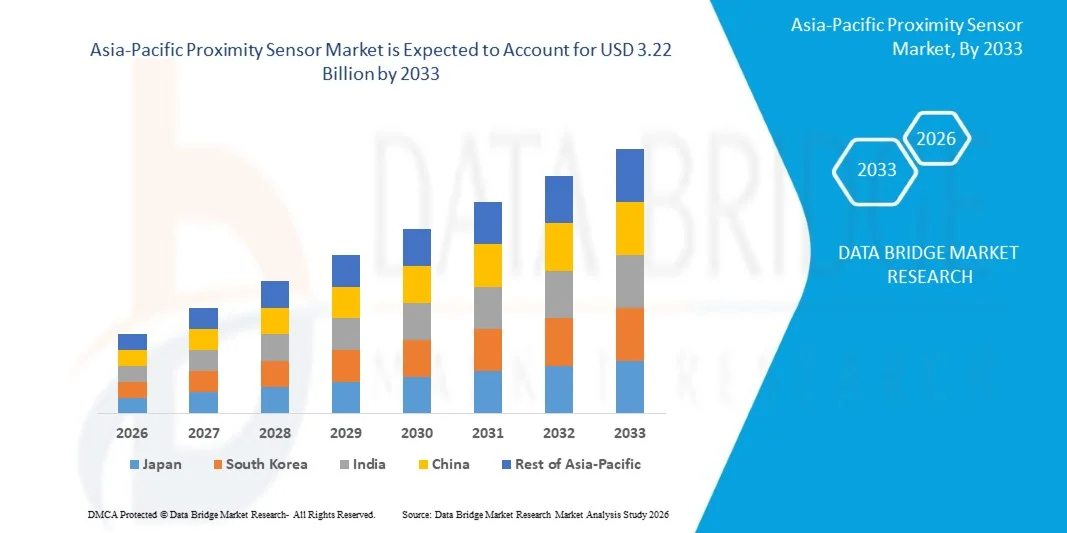
- The Asia-Pacific proximity sensor market size was valued at USD 1.81 billion in 2025 and is expected to reach USD 3.22 billion by 2033, at a CAGR of 7.50% during the forecast period
- Increasing adoption of the proximity sensors for automobile industry is acting as a driving factor for the growth of the proximity sensor market
- Proximity sensor has certain limitation in the sensing capabilities which restricts the adoption of sensors and acts as a restraining factor for the growth of the proximity sensor market
What are the Major Takeaways of Proximity Sensor Market?
- Increasing use of automation across various industries such as manufacturing, power and others were also increasing the need to adopt proximity sensors and creating a window of opportunity for the growth of the proximity sensor market
- Designing miniaturized sensors without compromising on quality acts as a challenge for the proximity sensor market growth
- The China dominated the Asia-Pacific proximity sensor market with the largest revenue share of 52.8% in 2024, driven by massive electronics manufacturing, automotive production, and industrial automation investments
- The India proximity sensor market is witnessing fastest growth rate of 10.36%, due to expanding manufacturing under initiatives such as Make in India, rising adoption of automation in automotive, food processing, packaging, and pharmaceuticals, and increasing investments in smart factories and logistics infrastructure
- The Inductive proximity sensor segment dominated the market with an estimated 34.6% share in 2024, owing to its extensive use in industrial automation, automotive manufacturing, and metal object detection applications
Report Scope and Proximity Sensor Market Segmentation
|
Attributes |
Proximity Sensor Key Market Insights |
|
Segments Covered |
|
|
Countries Covered |
Asia-Pacific
|
|
Key Market Players |
|
|
Market Opportunities |
|
|
Value Added Data Infosets |
In addition to the insights on market scenarios such as market value, growth rate, segmentation, geographical coverage, and major players, the market reports curated by the Data Bridge Market Research also include in-depth expert analysis, pricing analysis, brand share analysis, consumer survey, demography analysis, supply chain analysis, value chain analysis, raw material/consumables overview, vendor selection criteria, PESTLE Analysis, Porter Analysis, and regulatory framework. |
What is the Key Trend in the Proximity Sensor Market?
“Increasing Integration of Proximity Sensors with IoT, Automation, and Smart Systems”
- The global proximity sensor market is witnessing a strong trend toward integration with IoT-enabled, automated, and smart manufacturing systems across industrial, automotive, and consumer electronics sectors
- Connected proximity sensors enable real-time object detection, position monitoring, and process automation, improving system intelligence, safety, and operational efficiency
- IoT-enabled proximity sensors support predictive maintenance by detecting abnormal vibrations, misalignment, or component wear before equipment failure occurs, reducing downtime and maintenance costs
- For instance, manufacturers are deploying smart proximity sensors in automated assembly lines, robotics, and conveyor systems to enable adaptive control, real-time diagnostics, and remote monitoring
- This trend enhances production accuracy, energy efficiency, and system reliability, making proximity sensors more valuable in Industry 4.0 environments
- Advanced automation platforms analyze sensor data related to distance, speed, presence detection, and motion, enabling consistent quality control and safer machine operation
What are the Key Drivers of Proximity Sensor Market?
- Rising adoption of industrial automation, robotics, and smart manufacturing is a key driver boosting global demand for proximity sensors
- Increasing use of proximity sensors in automotive applications, including ADAS, parking assistance, collision avoidance, and electric vehicle systems, is accelerating market growth
- Growing deployment of consumer electronics, smartphones, wearables, and smart home devices is driving demand for compact and high-precision proximity sensors
- Technological advancements in inductive, capacitive, ultrasonic, and optical sensing technologies are improving detection accuracy, durability, and response time
- Expanding investments in IoT infrastructure, smart factories, and digital transformation initiatives across the U.S., Europe, and Asia-Pacific are further supporting long-term market expansion
Which Factor is Challenging the Growth of the Proximity Sensor Market?
- High initial costs associated with advanced, high-precision, and IoT-enabled proximity sensors can limit adoption among small and medium-sized enterprises
- Integration challenges related to sensor calibration, system compatibility, and signal interference increase deployment complexity in existing industrial setups
- Data security and reliability concerns arise as connected proximity sensors transmit operational data across industrial networks, increasing exposure to cyber risks
- Performance limitations in harsh environments, including extreme temperatures, dust, moisture, and electromagnetic interference, can affect sensor accuracy and lifespan
- To overcome these challenges, manufacturers are focusing on ruggedized designs, cost optimization, enhanced cybersecurity features, and improved sensor miniaturization to expand global adoption of proximity sensors
How is the Proximity Sensor Market Segmented?
The market is segmented on the basis of technology, product, sensing range, channel type, application, type, and end-user.
• By Technology
On the basis of technology, the global proximity sensor market is segmented into Inductive, Capacitive, Photoelectric, Magnetic, Ultrasonic, and Others. The Inductive proximity sensor segment dominated the market with an estimated 34.6% share in 2024, owing to its extensive use in industrial automation, automotive manufacturing, and metal object detection applications. Inductive sensors are highly preferred due to their robustness, reliability in harsh environments, resistance to dust and moisture, and long operational life. Their widespread adoption across conveyor systems, machine tools, and robotics continues to support market leadership.
The Photoelectric proximity sensor segment is expected to register the fastest CAGR from 2025 to 2032, driven by rising demand for long sensing ranges, high precision, and non-contact detection capabilities. Increasing deployment in smart factories, packaging lines, warehouse automation, and safety systems further accelerates growth, making photoelectric sensors a key focus area for manufacturers.
• By Product
On the basis of product, the proximity sensor market is segmented into Fixed Distance and Adjustable Distance sensors. The Fixed Distance segment dominated the market with a revenue share of approximately 57.2% in 2024, supported by its simplicity, cost-effectiveness, and wide usage in standardized industrial and automotive applications. Fixed distance sensors are commonly integrated into assembly lines, conveyor belts, and machine safety systems where detection parameters remain constant.
The Adjustable Distance segment is projected to grow at the fastest CAGR during the forecast period, driven by increasing demand for flexibility, customization, and multi-application usage. Adjustable sensors enable users to modify detection ranges based on operational needs, making them ideal for advanced automation systems, robotics, and smart manufacturing environments. Growing adoption in Industry 4.0 applications further supports this segment’s rapid expansion.
• By Sensing Range
On the basis of sensing range, the global proximity sensor market is segmented into 0mm–10mm, 10mm–40mm, 40mm–60mm, 60mm–80mm, and Greater than 80mm. The 10mm–40mm range segment held the largest market share of around 38.9% in 2024, as it offers an optimal balance between detection accuracy, reliability, and versatility. This range is widely used in automotive systems, industrial automation, consumer electronics, and conveyor-based applications.
The Greater than 80mm sensing range segment is anticipated to grow at the fastest rate from 2025 to 2032, driven by increasing demand in logistics automation, material handling, large machinery, and safety monitoring systems. Long-range sensing enables improved operational efficiency, reduced installation complexity, and enhanced detection in high-speed and large-scale industrial environments.
• By Channel Type
On the basis of channel type, the proximity sensor market is segmented into Single Channel and Multi-Channel sensors. The Single Channel segment dominated the market with a share of approximately 61.5% in 2024, due to its widespread use in conventional detection applications requiring simple on/off signals. Single-channel sensors are cost-effective, easy to integrate, and commonly deployed in manufacturing equipment, elevators, and packaging systems.
The Multi-Channel segment is expected to witness the fastest CAGR over the forecast period, driven by increasing complexity in automation systems and the need for simultaneous multi-point detection. Multi-channel sensors enable advanced monitoring, redundancy, and improved system intelligence, making them increasingly attractive for robotics, smart factories, and automotive electronics applications.
• By Application
On the basis of application, the proximity sensor market is segmented into Ground Proximity Warning Systems, Parking Sensor Systems, Assembly Line Automation, Anti-Aircraft Warfare, Roller Coasters, Vibration Monitoring Systems, Mobile Devices, Conveyor Systems, Detection of Object, Position, Inspection and Counting, and Others. The Assembly Line Automation segment dominated the market with a revenue share of nearly 29.7% in 2024, driven by widespread adoption across manufacturing industries to improve efficiency, accuracy, and safety.
The Parking Sensor Systems segment is projected to grow at the fastest CAGR from 2025 to 2032, fueled by rising vehicle production, increasing penetration of ADAS technologies, and growing consumer demand for enhanced safety features. Expanding electric vehicle adoption further supports strong growth in automotive proximity sensing applications.
• By Type
On the basis of type, the global proximity sensor market is segmented into Rectangular Inductive Sensors, Cylindrical Inductive Sensors, Ring Inductive Sensors, and Slot Inductive Sensors. The Cylindrical Inductive Sensor segment dominated the market with an estimated 41.3% share in 2024, owing to its compact design, easy installation, and wide usage in industrial machinery and automation systems.
The Rectangular Inductive Sensor segment is expected to grow at the fastest CAGR during the forecast period, driven by increasing use in space-constrained applications and customized industrial setups. Their larger sensing face and higher stability make them suitable for demanding detection tasks in smart manufacturing and heavy machinery environments.
• By End User
On the basis of end user, the proximity sensor market is segmented into Aerospace and Defense, Automotive, Building Automation, Industrial, Consumer Electronics, Food and Beverage, Pharmaceutical, Construction, Energy, and Others. The Industrial segment dominated the market with a 35.8% share in 2024, supported by extensive use in factory automation, machine tools, robotics, and material handling systems.
The Automotive segment is expected to grow at the fastest CAGR from 2025 to 2032, driven by rising adoption of proximity sensors in ADAS, parking assistance, collision avoidance, and electric vehicle systems. Increasing safety regulations and vehicle electrification trends continue to accelerate demand across global automotive markets.
Which Region Holds the Largest Share of the Proximity Sensor Market?
- The China dominated the Asia-Pacific proximity sensor market with the largest revenue share of 52.8% in 2024, driven by massive electronics manufacturing, automotive production, and industrial automation investments
- Strong adoption of robotics, smart factories, and sensor-based quality inspection across automotive, consumer electronics, and logistics sectors continues to drive high-volume demand
Japan Proximity Sensor Market Insight
Japan’s proximity sensor market is driven by advanced robotics, precision manufacturing, and high automation intensity in automotive, electronics, and semiconductor industries. The country’s focus on factory automation, safety systems, and high-reliability sensors supports steady market growth.
India Proximity Sensor Market Insight
The India proximity sensor market is witnessing fastest growth rate of 10.36%, due to expanding manufacturing under initiatives such as Make in India, rising adoption of automation in automotive, food processing, packaging, and pharmaceuticals, and increasing investments in smart factories and logistics infrastructure.
Which are the Top Companies in Proximity Sensor Market?
The proximity sensor industry is primarily led by well-established companies, including:
- STMicroelectronics (Switzerland)
- TE Connectivity (Switzerland)
- Qualcomm Technologies, Inc. (U.S.)
- NXP Semiconductors (Netherlands)
- Infineon Technologies AG (Germany)
- Texas Instruments Incorporated (U.S.)
- Robert Bosch GmbH (Germany)
- Microchip Technology Inc. (U.S.)
- Honeywell International Inc. (U.S.)
- ROHM Co. Ltd. (Japan)
- Taiwan Semiconductor Manufacturing Company Limited (Taiwan)
- TDK Corporation (Japan)
- KIONIX, Inc. (U.S.)
- Murata Manufacturing Co., Ltd. (Japan)
- Northrop Grumman LITEF GmbH (Germany)
- Sensonor (Norway)
What are the Recent Developments in Global Proximity Sensor Market?
- In April 2024, Rockwell Automation (U.S.) announced the establishment of a new 98,000-square-foot manufacturing facility in Chennai, India, aimed at strengthening supply chain resilience across Asia-Pacific and improving operational efficiency at its existing industrial park location, reinforcing the company’s long-term manufacturing and regional expansion strategy
- In April 2024, Delta Electronics, Inc. (Taiwan) received its 9th consecutive ENERGY STAR Partner of the Year recognition along with its 7th Sustained Excellence award, highlighting its energy-efficient innovations that helped U.S. customers save 29 million kilowatt hours in 2023 through advanced DC brushless motor ventilation fans, underscoring its leadership in energy conservation and sustainable technologies
- In February 2024, SICK AG (Germany) introduced the W10 photoelectric proximity sensor featuring a Class 1 laser, touchscreen interface, IP69K stainless steel housing, and IO-Link functionality, designed to simplify automation tasks while delivering precise detection and high repeatability, strengthening SICK’s portfolio in industrial sensing and automation solutions
- In January 2024, STMicroelectronics (Switzerland) partnered with Mobile Physics (Israel) to launch EnviroMeter, the world’s first accurate personal air quality monitor and smartphone smoke detector using multizone ranging sensors, enabling continuous and energy-efficient particulate monitoring, advancing innovation in health, safety, and sensor-based environmental monitoring
- In November 2023, Rockwell Automation (U.S.) completed the acquisition of Verve Industrial Protection (U.S.), integrating OT/ICS endpoint security, asset inventory, and vulnerability management capabilities into its offerings, enhancing cybersecurity strength and reinforcing trust in industrial digital transformation initiatives
SKU-
Accédez en ligne au rapport sur le premier cloud mondial de veille économique

- Tableau de bord d'analyse de données interactif
- Tableau de bord d'analyse d'entreprise pour les opportunités à fort potentiel de croissance
- Accès d'analyste de recherche pour la personnalisation et les requêtes
- Analyse de la concurrence avec tableau de bord interactif
- Dernières actualités, mises à jour et analyse des tendances
- Exploitez la puissance de l'analyse comparative pour un suivi complet de la concurrence
Méthodologie de recherche
La collecte de données et l'analyse de l'année de base sont effectuées à l'aide de modules de collecte de données avec des échantillons de grande taille. L'étape consiste à obtenir des informations sur le marché ou des données connexes via diverses sources et stratégies. Elle comprend l'examen et la planification à l'avance de toutes les données acquises dans le passé. Elle englobe également l'examen des incohérences d'informations observées dans différentes sources d'informations. Les données de marché sont analysées et estimées à l'aide de modèles statistiques et cohérents de marché. De plus, l'analyse des parts de marché et l'analyse des tendances clés sont les principaux facteurs de succès du rapport de marché. Pour en savoir plus, veuillez demander un appel d'analyste ou déposer votre demande.
La méthodologie de recherche clé utilisée par l'équipe de recherche DBMR est la triangulation des données qui implique l'exploration de données, l'analyse de l'impact des variables de données sur le marché et la validation primaire (expert du secteur). Les modèles de données incluent la grille de positionnement des fournisseurs, l'analyse de la chronologie du marché, l'aperçu et le guide du marché, la grille de positionnement des entreprises, l'analyse des brevets, l'analyse des prix, l'analyse des parts de marché des entreprises, les normes de mesure, l'analyse globale par rapport à l'analyse régionale et des parts des fournisseurs. Pour en savoir plus sur la méthodologie de recherche, envoyez une demande pour parler à nos experts du secteur.
Personnalisation disponible
Data Bridge Market Research est un leader de la recherche formative avancée. Nous sommes fiers de fournir à nos clients existants et nouveaux des données et des analyses qui correspondent à leurs objectifs. Le rapport peut être personnalisé pour inclure une analyse des tendances des prix des marques cibles, une compréhension du marché pour d'autres pays (demandez la liste des pays), des données sur les résultats des essais cliniques, une revue de la littérature, une analyse du marché des produits remis à neuf et de la base de produits. L'analyse du marché des concurrents cibles peut être analysée à partir d'une analyse basée sur la technologie jusqu'à des stratégies de portefeuille de marché. Nous pouvons ajouter autant de concurrents que vous le souhaitez, dans le format et le style de données que vous recherchez. Notre équipe d'analystes peut également vous fournir des données sous forme de fichiers Excel bruts, de tableaux croisés dynamiques (Fact book) ou peut vous aider à créer des présentations à partir des ensembles de données disponibles dans le rapport.











