


Europe Biometrics in Government Market Segmentation, By Mode (Fingerprint Recognition, Face Recognition, Iris Recognition, Palm print Recognition, Vein Recognition, Signature Recognition, Voice Recognition, and Others), Components (Hardware and Software), Type (Contactless, Contact-based and Hybrid/Multimodal), Authentication (Single Factor Authentication and Multiple Factor Authentication), Application (Civil, Military, Law Enforcement, E-Passport, E-Visas, Commercial and Others)- Industry Trends and Forecast to 2033
Quelle est la biométrie de l'Europe en termes de taille des marchés publics et de taux de croissance
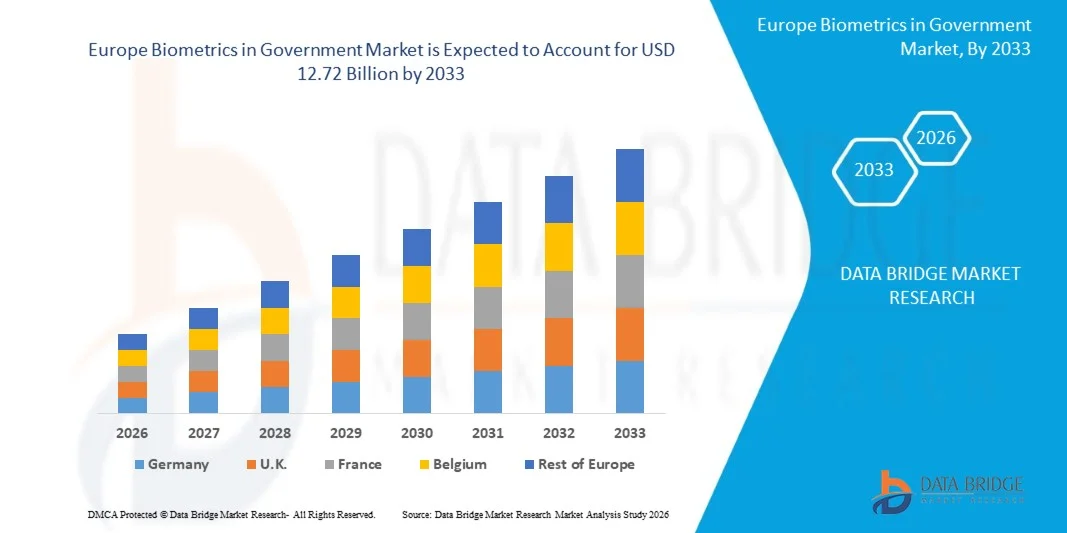
- Conformément à l'analyse de marché de Data Bridge, la biométrie de l'Europe dans la taille du marché public a été évaluée à4,27 milliards de dollars en 2025et devrait atteindre12,72 milliards de dollars en 2033, à unTCAC de 14,60%pendant la période de prévision
- La croissance du marché est en grande partie alimentée par le besoin croissant de systèmes de vérification d'identité sécurisés au-delà des frontières, des programmes nationaux d'identification et des organismes d'application de la loi
- Les préoccupations croissantes concernant les menaces à la cybersécurité, la fraude à l'identité et le terrorisme accélèrent l'adoption de technologies d'authentification biométrique de pointe telles que les empreintes digitales, la reconnaissance faciale, l'iris et les systèmes multimodal
Taille du marché et prévisions
- Valeur marchande mondiale (2025):4,27 milliards de dollars
- Valeur marchande prévue (2033) :12,72 milliards de dollars
- Prévisions CAGR (2026-2033):14.60%
Quelles sont les principales tendances de la biométrie en Europe sur le marché gouvernemental
- Le marché est en pleine expansion grâce aux investissements publics dans les systèmes nationaux d'identification, les passeports intelligents, les plates-formes d'inscription des électeurs et les bases de données sur la sécurité publique visant à améliorer la transparence et à réduire la fraude
- En outre, l'intégration de l'intelligence artificielle et des plateformes biométriques basées sur le cloud améliore la précision, l'évolutivité et les capacités d'authentification en temps réel, permettant aux gouvernements de renforcer la sécurité aux frontières et les systèmes de prestation de services aux citoyens.
- L'Allemagne a dominé la biométrie sur le marché gouvernemental en Europe, avec la plus grande part des revenus en 2025, grâce à la mise en œuvre de programmes nationaux d'identification, de systèmes de sécurité aux frontières et de bases de données avancées sur l'application de la loi.
- Le Royaume-Uni devrait connaître le taux de croissance annuel composé (TCAC) le plus élevé de laLa biométrie en Europe au gouvernementmarché en raison de l'expansion des initiatives d'identité numérique et de la modernisation des systèmes d'immigration et de contrôle des frontières. L'augmentation des investissements dans la reconnaissance faciale, les plateformes d'authentification sécurisées et l'infrastructure de surveillance intelligente permettent d'accélérer l'adoption de la biométrie dans les institutions gouvernementales
- En 2025, le segment de la reconnaissance des empreintes digitales détenait la plus grande part du marché grâce à son adoption de longue date dans les programmes nationaux d'identification, les systèmes de contrôle aux frontières et les bases de données d'application de la loi. Les systèmes d'empreintes digitales sont largement préférés en raison de leur précision, de leur rentabilité et de leur facilité d'intégration avec l'infrastructure gouvernementale existante.
Portée du rapport et biométrie en Europe dans la segmentation des marchés publics
|
Attributs |
L'Europe La biométrie dans l'économie de marché |
|
Segments couverts |
|
|
Pays couverts |
Europe
|
|
Principaux acteurs du marché |
• IDEMIE (France) |
|
Possibilités de marché |
• Extension des programmes nationaux d'identité numérique et de gouvernance électronique |
|
Infos sur la valeur ajoutée |
Outre les informations sur les scénarios du marché, tels que la valeur du marché, le taux de croissance, la segmentation, la couverture géographique et les principaux acteurs, les rapports de marché établis par Data Bridge Market Research comprennent également une analyse approfondie des experts, une production et une capacité géographiquement représentées par l'entreprise, des schémas de réseau des distributeurs et des partenaires, une analyse détaillée et actualisée des tendances des prix et une analyse du déficit de la chaîne d'approvisionnement et de la demande. |
Quelle est la tendance clé de la biométrie en Europe sur le marché gouvernemental
L'adoption croissante de solutions pour la sécurité de l'identité numérique et des frontières
• L'accent mis de plus en plus sur des systèmes de vérification d'identité sûrs et fiables façonne de manière significative la biométrie sur le marché public, les organismes du secteur public privilégiant de plus en plus les technologies d'authentification de pointe pour lutter contre la fraude à l'identité et l'accès non autorisé. Les systèmes biométriques tels que les empreintes digitales, la reconnaissance faciale, le balayage de l'iris et les plates-formes multimodales gagnent en traction en raison de leur précision, de leur efficacité et de leur capacité à renforcer les cadres nationaux de sécurité
• L'augmentation des investissements dans les programmes d'identité numérique, les passeports électroniques, les systèmes d'inscription des électeurs et la modernisation du contrôle aux frontières accélère le déploiement des technologies biométriques dans les institutions gouvernementales. Les autorités s ' attachent à améliorer la gestion des données des citoyens, à réduire les doubles emplois dans la distribution des services sociaux et à améliorer la transparence de l ' administration publique grâce à des bases de données biométriques sécurisées.
• Les initiatives gouvernementales en faveur de la gouvernance intelligente et de la transformation numérique influent sur les stratégies d'approvisionnement, les agences mettant l'accent sur les plates-formes cloud évolutives, l'analyse assistée par l'IA et les capacités d'authentification en temps réel. Ces progrès aident les institutions publiques à rationaliser leurs opérations, à améliorer leurs capacités de surveillance et à renforcer la confiance du public grâce à des systèmes sûrs et transparents.
• Par exemple, en 2024, de nombreux organismes gouvernementaux ont élargi à l'échelle mondiale les programmes nationaux de gestion des cartes d'identité et des frontières qui permettent d'améliorer la précision de l'authentification et de réduire la fraude à l'identité. Ces initiatives comprenaient la mise à niveau des algorithmes de reconnaissance faciale et l'intégration des bases de données biométriques multimodales, l'amélioration de l'efficacité opérationnelle et des processus de vérification des citoyens.
• Si la demande de solutions biométriques au sein du gouvernement augmente, la croissance soutenue du marché dépend de l'innovation technologique continue, du respect des normes de protection des données et du maintien de normes de précision élevées tout en tenant compte des préoccupations relatives à la protection de la vie privée et des risques de cybersécurité.
La biométrie en Europe dans la dynamique des marchés publics
Chauffeur
Demande croissante de vérification de l'identité sécurisée et d'amélioration de la sécurité publique
• Les préoccupations croissantes concernant le vol d'identité, la cybercriminalité et les menaces à la sécurité nationale sont les principaux moteurs de la biométrie sur le marché gouvernemental. Les autorités du secteur public déploient de plus en plus de systèmes d'authentification biométrique pour renforcer le contrôle aux frontières, les enquêtes policières et les programmes nationaux de gestion de l'identité
• Le développement de l'adoption de passeports biométriques, de systèmes de visas électroniques et de solutions de contrôle d'accès sécurisés influe sur la croissance du marché. Ces technologies améliorent la rapidité de la vérification et réduisent le recours aux méthodes d'identification traditionnelles, accroissent l'efficacité et minimisent les risques de fraude dans l'ensemble des opérations gouvernementales
• Les gouvernements encouragent activement l'intégration biométrique au sein des plateformes de gouvernance numérique afin d'améliorer la prestation des services, l'exactitude de la distribution du bien-être social et la sécurité de l'authentification des citoyens. Les investissements dans les technologies de reconnaissance faciale et d'identification des empreintes digitales par l'IA appuient davantage la fiabilité et l'évolutivité du système.
• Par exemple, en 2023, plusieurs administrations nationales ont amélioré les systèmes biométriques d'inscription des électeurs et de contrôle de l'immigration afin d'améliorer la transparence et de prévenir les doubles emplois. Ces améliorations ont contribué à renforcer l'infrastructure de sécurité publique et à améliorer la responsabilisation administrative.
• Bien que les exigences croissantes en matière de sécurité favorisent l'expansion du marché, une adoption plus large dépend de la conformité à la réglementation, de la résilience à la cybersécurité et de cadres efficaces de gestion des données pour assurer la protection de la vie privée et l'interopérabilité des systèmes;
Restriction/Défi
Préoccupations relatives à la protection de la vie privée et coûts de mise en œuvre élevés
• Les préoccupations relatives à la protection des données et les exigences réglementaires en matière de conformité demeurent des défis importants pour la biométrie du marché gouvernemental. La collecte et le stockage de données biométriques sensibles exigent le strict respect des lois sur la protection des données, ce qui peut retarder la mise en œuvre des projets et accroître la complexité administrative.
• Les coûts d'investissement initiaux élevés associés à l'installation du matériel biométrique, à l'intégration des bases de données et aux améliorations de l'infrastructure limitent l'adoption, en particulier dans les établissements publics dotés de ressources limitées. La maintenance, les garanties de cybersécurité et les mises à jour périodiques des systèmes ajoutent encore aux dépenses opérationnelles
• Les défis techniques tels que les faux positifs, les problèmes d'interopérabilité des systèmes et l'intégration aux bases de données gouvernementales existantes peuvent affecter l'efficacité et la confiance du public. Assurer une exactitude constante entre les diverses populations démographiques exige également un perfectionnement continu de l'algorithme.
• Par exemple, en 2024, certains projets de modernisation du gouvernement ont connu des retards de mise en œuvre en raison des examens de la protection des données et des contraintes en matière d'approvisionnement liées aux systèmes de surveillance biométrique. Ces défis ont souligné l'importance d'une réglementation équilibrée, de la transparence et de la communication publique dans les déploiements biométriques à grande échelle.
• Pour relever ces défis, il faudra des stratégies d'optimisation des coûts, des normes de chiffrement solides et des cadres juridiques complets pour protéger les données des citoyens. Renforcer la sensibilisation du public et investir dans des plateformes sûres et interopérables sera essentiel pour l'adoption à long terme et la croissance durable de la biométrie sur le marché gouvernemental
Comment la biométrie européenne est-elle segmentée sur le marché public
Le marché est segmenté en fonction du mode, des composants, du type, de l'authentification et de l'application.
• Par mode
Sur la base du mode, la biométrie du marché gouvernemental est segmentée en reconnaissance des empreintes digitales, reconnaissance faciale, reconnaissance des empreintes digitales, reconnaissance des empreintes digitales, reconnaissance des empreintes digitales, reconnaissance des empreintes digitales, reconnaissance des signatures, reconnaissance vocale, etc. En 2025, le segment de la reconnaissance des empreintes digitales détenait la plus grande part du marché grâce à son adoption de longue date dans les programmes nationaux d'identification, les systèmes de contrôle aux frontières et les bases de données d'application de la loi. Les systèmes d'empreintes digitales sont largement préférés en raison de leur précision avérée, de leur rentabilité et de leur facilité d'intégration à l'infrastructure gouvernementale existante.
Le segment de la reconnaissance faciale devrait connaître le taux de croissance le plus rapide de 2026 à 2033, grâce aux progrès de l'intelligence artificielle, aux capacités de surveillance en temps réel et au déploiement accru dans les initiatives de sécurité publique et de gouvernance intelligente. Les technologies de reconnaissance faciale permettent une identification sans contact et une authentification rapide, ce qui les rend adaptés aux applications gouvernementales à grande échelle.
• Par composants
Sur la base de composants, le marché est segmenté en Matériel et Logiciels. En 2025, le segment du matériel détenait la plus grande part du marché en raison du déploiement important de scanners biométriques, de caméras, de capteurs et de dispositifs d'inscription dans les installations gouvernementales. Les achats à grande échelle pour les postes de contrôle frontaliers, les centres d'inscription des électeurs et les projets nationaux d'identification continuent de soutenir la demande de matériel.
Le segment des logiciels devrait connaître le taux de croissance le plus rapide de 2026 à 2033 en raison de l'intégration croissante d'algorithmes alimentés par l'IA, de bases de données biométriques basées sur le cloud et de plateformes analytiques. Les gouvernements accordent la priorité aux solutions logicielles évolutives et interopérables pour améliorer la précision du système, la sécurité des données et les capacités de vérification en temps réel.
• Par type
Sur la base du type, le marché est segmenté en sans contact, basé sur contact et hybride/multimodal. En 2025, le segment de Contact détenait la plus grande part des revenus du marché grâce au déploiement généralisé de systèmes de reconnaissance des empreintes digitales et des signatures dans les opérations administratives et policières. Ces systèmes sont considérés comme fiables et rentables pour les processus d'identification structurés.
Le segment hybride/multimodal devrait connaître le taux de croissance le plus rapide entre 2026 et 2033 en raison de la demande croissante d'une plus grande précision d'authentification et de prévention de la fraude. La combinaison de multiples modalités biométriques améliore la fiabilité de la vérification et réduit les taux d'acceptation ou de rejet erronés dans les applications gouvernementales critiques.
• Par authentification
Sur la base de l'authentification, le marché est segmenté en authentification par facteur unique et authentification par facteur multiple. Le segment de l'authentification par facteur unique détenait la plus grande part de revenus du marché en 2025 en raison de son utilisation intensive dans les programmes d'identification de base et les systèmes d'enregistrement des faits d'état civil. Les gouvernements continuent de déployer des identificateurs biométriques uniques pour les tâches de vérification courantes en raison de la simplicité opérationnelle.
Le segment de l'authentification par facteurs multiples devrait connaître le taux de croissance le plus rapide de 2026 à 2033, en raison des exigences accrues en matière de sécurité et des préoccupations croissantes concernant la fraude à l'identité et les cybermenaces. L'intégration de la vérification biométrique avec des références supplémentaires améliore la sécurité globale du système et le respect des normes de protection des données.
• Par demande
Sur la base de l'application, le marché est segmenté en civil, militaire, d'application de la loi, e-passport, E-Visas, commercial, et autres. En 2025, le segment civil détenait la plus grande part des revenus du marché grâce à des programmes nationaux d'inscription à grande échelle, à des systèmes d'inscription des électeurs et à des plateformes de distribution de la protection sociale. Les applications civiles représentent une expansion importante de la base de données biométriques à l'échelle mondiale.
Le secteur de l'application de la loi devrait connaître le taux de croissance le plus rapide entre 2026 et 2033, grâce au déploiement croissant de systèmes d'identification biométrique pour les enquêtes criminelles, la surveillance et l'analyse médico-légale. L'investissement croissant dans des solutions d'authentification sécurisées et en temps réel renforce l'adoption dans les agences de sécurité publique.
Quelle est la région qui détient la plus grande part de la biométrie européenne sur le marché gouvernemental
• L'Allemagne a dominé la biométrie sur le marché de l'État en Europe avec la plus grande part des revenus en 2025, grâce à la mise en œuvre de programmes nationaux d'identification, de systèmes de sécurité aux frontières et de bases de données avancées sur l'application des lois.
• Les autorités publiques du pays accordent la priorité à la vérification de l'identité numérique sécurisée, au respect de la protection des données et à l'intégration de l'authentification biométrique dans les plates-formes d'administration publique
• Cette large adoption s'appuie en outre sur des cadres réglementaires solides, l'augmentation des investissements dans les infrastructures de cybersécurité et le déploiement croissant de technologies biométriques sans contact dans les applications civiles et de sécurité
La biométrie au Royaume-Uni dans le contexte des marchés publics
La biométrie britannique sur le marché gouvernemental devrait connaître le taux de croissance le plus rapide de 2026 à 2033, alimenté par l'expansion des initiatives d'identité numérique et la modernisation des systèmes d'immigration et de contrôle aux frontières. Les organismes gouvernementaux mettent de plus en plus l'accent sur les technologies avancées de reconnaissance faciale et de reconnaissance de l'iris pour améliorer la sécurité nationale et rationaliser les processus de vérification. L'accent de plus en plus mis sur l'infrastructure de surveillance intelligente, ainsi que les investissements accrus du secteur public dans les systèmes d'authentification alimentés par l'IA, accélère encore l'expansion du marché dans les domaines civil et policier.
Quelles sont les entreprises les plus performantes en Europe
La biométrie européenne dans l'industrie gouvernementale est principalement dirigée par des entreprises bien établies, notamment:
•IDEMIA (France)
• Groupe Thales (France)
• Identité et sécurité Safran (France)
• Gemalto N.V. (Pays-Bas)
• Dermalog Identification Systems GmbH (Allemagne)
•BioID GmbH (Allemagne)
• Biométrie précise AB (Suède)
• Cartes d'empreinte digitale AB (Suède)
• Zwipe AS (Norvège)
• iProov Limited (Royaume-Uni)
• Callsign, Inc. (Royaume-Uni)
•GBG Plc (Royaume-Uni)
• SOTI Ltd. (Royaume-Uni)
• Vision-Box S.A. (Portugal)
• Veridos GmbH (Allemagne)
SKU-
Accédez en ligne au rapport sur le premier cloud mondial de veille économique

- Tableau de bord d'analyse de données interactif
- Tableau de bord d'analyse d'entreprise pour les opportunités à fort potentiel de croissance
- Accès d'analyste de recherche pour la personnalisation et les requêtes
- Analyse de la concurrence avec tableau de bord interactif
- Dernières actualités, mises à jour et analyse des tendances
- Exploitez la puissance de l'analyse comparative pour un suivi complet de la concurrence
Méthodologie de recherche
La collecte de données et l'analyse de l'année de base sont effectuées à l'aide de modules de collecte de données avec des échantillons de grande taille. L'étape consiste à obtenir des informations sur le marché ou des données connexes via diverses sources et stratégies. Elle comprend l'examen et la planification à l'avance de toutes les données acquises dans le passé. Elle englobe également l'examen des incohérences d'informations observées dans différentes sources d'informations. Les données de marché sont analysées et estimées à l'aide de modèles statistiques et cohérents de marché. De plus, l'analyse des parts de marché et l'analyse des tendances clés sont les principaux facteurs de succès du rapport de marché. Pour en savoir plus, veuillez demander un appel d'analyste ou déposer votre demande.
La méthodologie de recherche clé utilisée par l'équipe de recherche DBMR est la triangulation des données qui implique l'exploration de données, l'analyse de l'impact des variables de données sur le marché et la validation primaire (expert du secteur). Les modèles de données incluent la grille de positionnement des fournisseurs, l'analyse de la chronologie du marché, l'aperçu et le guide du marché, la grille de positionnement des entreprises, l'analyse des brevets, l'analyse des prix, l'analyse des parts de marché des entreprises, les normes de mesure, l'analyse globale par rapport à l'analyse régionale et des parts des fournisseurs. Pour en savoir plus sur la méthodologie de recherche, envoyez une demande pour parler à nos experts du secteur.
Personnalisation disponible
Data Bridge Market Research est un leader de la recherche formative avancée. Nous sommes fiers de fournir à nos clients existants et nouveaux des données et des analyses qui correspondent à leurs objectifs. Le rapport peut être personnalisé pour inclure une analyse des tendances des prix des marques cibles, une compréhension du marché pour d'autres pays (demandez la liste des pays), des données sur les résultats des essais cliniques, une revue de la littérature, une analyse du marché des produits remis à neuf et de la base de produits. L'analyse du marché des concurrents cibles peut être analysée à partir d'une analyse basée sur la technologie jusqu'à des stratégies de portefeuille de marché. Nous pouvons ajouter autant de concurrents que vous le souhaitez, dans le format et le style de données que vous recherchez. Notre équipe d'analystes peut également vous fournir des données sous forme de fichiers Excel bruts, de tableaux croisés dynamiques (Fact book) ou peut vous aider à créer des présentations à partir des ensembles de données disponibles dans le rapport.











