


Global 3D Printing Market Segmentation, By Component (Hardware, Software, and Services), Type (Desktop 3D Printer, and Industrial 3D Printer), Technology (Stereolithography, Fuse Deposition Modeling, Selective Laser Sintering, Direct Metal Laser Sintering, Polyjet Printing, Inkjet printing, Electron Beam Melting, Laser Metal Deposition, Digital Light Processing, Laminated Object Manufacturing, and Others), Software (Design Software, Inspection Software, Printer Software, and Scanning Software), Application (Prototyping, Tooling, and Functional Parts), Vertical (Industrial 3D Printing, and Desktop 3D Printing), Material (Polymer, Metal, and Ceramic) - Industry Trends and Forecast to 2032
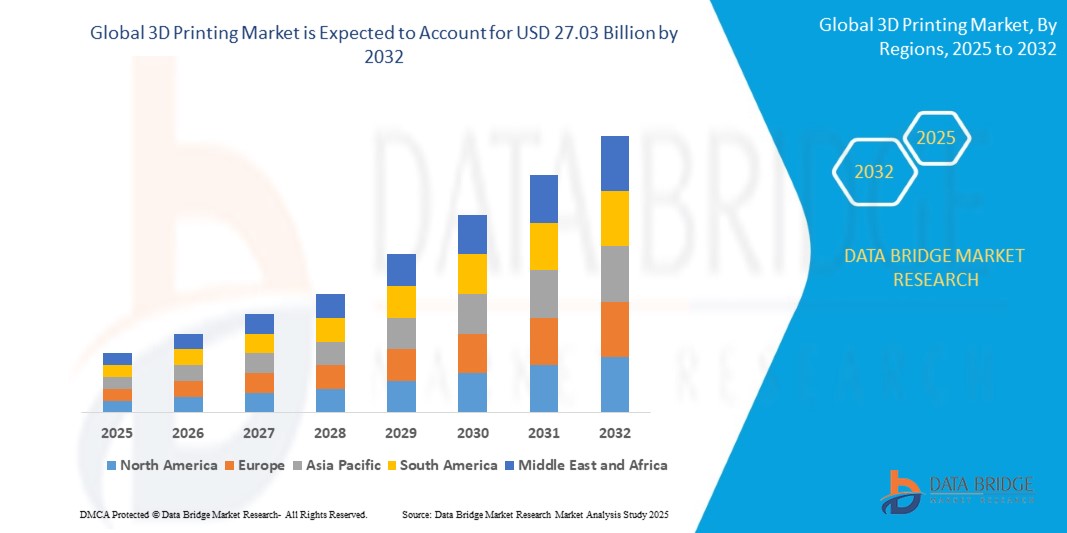
3D Printing Market Size
- The global 3D printing market size was valued at USD 8.54 billion in 2024 and is expected to reach USD 27.03 billion by 2032, at a CAGR of 15.50% during the forecast period
- This growth is driven by factors such as rapid industrial adoption, advancements in additive manufacturing technologies, and increasing demand for customized and complex components across various sectors including healthcare, aerospace, and automotive
3D Printing Market Analysis
- 3D printing, also known as additive manufacturing, is a transformative technology used to create three-dimensional objects layer by layer from digital models. It is widely applied in industries such as healthcare, aerospace, automotive, and construction for rapid prototyping and end-use part production
- The demand for 3D printing is significantly driven by the increasing need for customized products, reduction in manufacturing costs, and the ability to produce complex geometries with minimal material waste
- North America is expected to dominate the global 3D printing market with largest market share of 33.01%, due to early technology adoption, strong presence of key market players, and substantial investment in research and development
- Asia-Pacific is expected to be the fastest growing region in the 3D printing market during the forecast period due to expanding industrial sectors, government initiatives supporting digital manufacturing, and increased adoption in countries like China, Japan, and South Korea
- Industrial 3D printer segment is expected to dominate the market with a largest market share of 76.5% due to the extensive adoption of industrial printers in heavy industries, such as automotive, electronics, aerospace and defense, and healthcare. Prototyping, designing, and tooling are some of the most common industrial applications across these industry verticals
Report Scope and 3D Printing Market Segmentation
|
Attributes |
3D Printing Key Market Insights |
|
Segments Covered |
|
|
Countries Covered |
North America
Europe
Asia-Pacific
Middle East and Africa
South America
|
|
Key Market Players |
|
|
Market Opportunities |
|
|
Value Added Data Infosets |
In addition to the insights on market scenarios such as market value, growth rate, segmentation, geographical coverage, and major players, the market reports curated by the Data Bridge Market Research also include in-depth expert analysis, geographically represented company-wise production and capacity, network layouts of distributors and partners, detailed and updated price trend analysis and deficit analysis of supply chain and demand. |
3D Printing Market Trends
“Advancements in 3D Printing Technologies & Materials”
- One prominent trend in the evolution of the global 3D printing market is the continuous development of new materials and more advanced printing technologies
- These innovations are pushing the boundaries of what 3D printing can achieve, enabling the production of highly complex, durable, and functional parts across industries such as aerospace, automotive, healthcare, and consumer goods
- For instance, the development of metal 3D printing technology is revolutionizing industries that require high-strength, lightweight materials, such as aerospace and automotive manufacturing. Additionally, new biocompatible materials are significantly enhancing the potential for 3D printing in medical devices, prosthetics, and even tissue engineering
- These advancements are transforming manufacturing processes, reducing production costs, and allowing for greater design flexibility, thus driving the demand for next-generation 3D printers with enhanced capabilities
3D Printing Market Dynamics
Driver
“Growing Demand for Customization and Rapid Prototyping”
- The increasing demand for customized products and rapid prototyping across various industries, including healthcare, automotive, and aerospace, is significantly contributing to the growth of the 3D printing market
- As industries shift toward more personalized products, 3D printing provides a flexible, cost-effective solution for creating tailored designs with shorter lead times and minimal material waste
- Industries such as healthcare are increasingly utilizing 3D printing for creating customized implants, prosthetics, and surgical guides, which improve patient outcomes and reduce recovery times
For instance,
- In 2020, according to a report from the American Medical Association, the use of 3D printing in healthcare increased by 28%, with hospitals using the technology to create patient-specific models for surgical planning and implants
- As a result of the growing demand for personalized, high-performance products, 3D printing adoption is accelerating across multiple sectors, driving the market's growth
Opportunity
“Integration of Artificial Intelligence and Automation in 3D Printing”
- AI-powered 3D printing systems are enabling enhanced precision, optimized designs, and improved manufacturing efficiency, offering significant opportunities for industries such as healthcare, automotive, and aerospace
- AI algorithms can analyze complex design data and automatically adjust printing parameters in real-time to ensure better material utilization, improved part quality, and minimized errors during production
- AI can aid in the design optimization process by simulating various conditions and predicting the performance of printed parts, allowing manufacturers to achieve more efficient and reliable outcomes
For instance,
- In 2024, Siemens implemented AI in 3D printing to automate the design and manufacturing process for aerospace components. The system analyzes and optimizes designs for weight reduction while maintaining structural integrity, a critical need in aerospace industries
- The integration of AI in 3D printing presents substantial growth opportunities by enhancing production capabilities, reducing costs, and creating high-performance products for a range of industries
Restraint/Challenge
“High Equipment and Material Costs Hindering Market Growth”
- The high cost of 3D printing equipment, along with expensive specialized materials, poses a significant challenge for widespread adoption, especially in small and medium-sized businesses and developing regions
- Les imprimantes 3D avancées, en particulier celles utilisées pour les applications métalliques ou de qualité industrielle, peuvent coûter des centaines de milliers de dollars, tandis que les matériaux de haute qualité (tels que les métaux spécialisés, les composites et les biomatériaux) contribuent également aux dépenses globales.
- Cet obstacle financier peut empêcher les petits fabricants et les startups d’entrer sur le marché ou de mettre à niveau leur technologie existante, limitant ainsi l’innovation et l’évolutivité.
Par exemple,
- En 2023, McKinsey & Company a publié un rapport soulignant que le coût des systèmes et matériaux d'impression 3D haut de gamme demeure un obstacle majeur pour les industries souhaitant adopter la fabrication additive à grande échelle. Cela impacte des secteurs comme l'aérospatiale, où le besoin de matériaux haute performance est crucial, mais où les contraintes de coût retardent souvent la mise en œuvre à grande échelle.
- Par conséquent, ces limitations peuvent entraver la croissance globale du marché, en particulier dans les marchés émergents où les préoccupations en matière de coûts sont encore plus prononcées.
Portée du marché de l'impression 3D
Le marché est segmenté en fonction du composant, du type, de la technologie, du logiciel, de l'application, du secteur vertical et du matériau.
|
Segmentation |
Sous-segmentation |
|
Par composant |
|
|
Par type |
|
|
Par technologie |
|
|
Par logiciel |
|
|
Par application |
|
|
Par Vertical |
|
|
Par matériau |
|
En 2025, l' imprimante 3D industrielle devrait dominer le marché avec une part de marché plus importante dans le segment des caractères
Le segment des imprimantes 3D industrielles devrait dominer le marché de l'impression 3D avec une part de marché de 76,5 %, grâce à leur adoption massive dans les industries lourdes, telles que l'automobile, l'électronique, l'aérospatiale et la défense, ainsi que la santé. Le prototypage, la conception et l'outillage comptent parmi les applications industrielles les plus courantes dans ces secteurs.
Le matériel devrait représenter la plus grande part au cours de la période de prévision dans le segment des composants
En 2025, le segment du matériel devrait dominer le marché avec la plus grande part de marché de 63,01 % en raison de divers facteurs tels que l'industrialisation rapide, la pénétration croissante des produits électroniques grand public, le développement des infrastructures civiles, l'urbanisation rapide et l'optimisation des coûts de main-d'œuvre.
Analyse régionale du marché de l'impression 3D
« L'Amérique du Nord détient la plus grande part du marché de l'impression 3D »
- L'Amérique du Nord domine le marché mondial de l'impression 3D avec une part de marché de 33,5 %, grâce aux avancées technologiques, à la forte adoption des solutions d'impression 3D dans tous les secteurs et à une forte présence d'acteurs clés du marché.
- Les États-Unis détiennent la plus grande part de marché en raison de la demande croissante de prototypage rapide, de fabrication sur mesure et de production de composants complexes, en particulier dans des secteurs comme la santé, l'aérospatiale et l'automobile.
- La présence de pôles de recherche et développement bien établis, associée à des initiatives gouvernementales favorables et à un financement pour les technologies de fabrication avancées, renforce le marché dans la région
- Des secteurs comme celui de la santé bénéficient de la capacité de l'impression 3D à produire des dispositifs médicaux, des prothèses et des implants personnalisés, élargissant ainsi encore le marché en Amérique du Nord.
« L'Asie-Pacifique devrait enregistrer le TCAC le plus élevé du marché de l'impression 3D »
- La région Asie-Pacifique devrait connaître le taux de croissance le plus élevé du marché mondial de l'impression 3D, grâce à une industrialisation rapide, à l'adoption croissante des technologies de fabrication numérique et à des investissements importants dans le développement des infrastructures.
- Des pays comme la Chine, le Japon et l'Inde émergent comme des marchés clés en raison de la demande croissante de produits et de solutions personnalisés, de l'expansion des secteurs automobile et aérospatial et de l'importance croissante accordée aux processus de fabrication durables.
- La Chine, forte de ses capacités de production à grande échelle et des initiatives gouvernementales visant à promouvoir les technologies d'impression 3D, connaît une forte croissance de l'utilisation de cette technologie pour la production industrielle. L'expertise technologique avancée du Japon et son intérêt pour l'innovation dans des secteurs tels que l'électronique et la robotique contribuent également à la croissance du marché.
- Le secteur manufacturier indien en plein essor, conjugué à l'augmentation des investissements publics et privés, favorise l'adoption de l'impression 3D dans des secteurs comme l'automobile, la santé et les biens de consommation. Le développement des capacités de production locales et l'intérêt croissant pour la fabrication sur mesure stimulent également l'expansion du marché dans la région.
Part de marché de l'impression 3D
Le paysage concurrentiel du marché fournit des détails par concurrent. Il comprend la présentation de l'entreprise, ses données financières, son chiffre d'affaires, son potentiel de marché, ses investissements en recherche et développement, ses nouvelles initiatives commerciales, sa présence mondiale, ses sites et installations de production, ses capacités de production, ses forces et faiblesses, le lancement de nouveaux produits, leur ampleur et leur portée, ainsi que la domination de ses applications. Les données ci-dessus ne concernent que les activités des entreprises par rapport à leur marché.
Les principaux leaders du marché opérant sur le marché sont :
- Laser brillant (Chine)
- Xométrie (États-Unis)
- Farsoon (Chine)
- Protolabs (États-Unis)
- Stratasys (États-Unis/Israël)
- Nano Dimension (Israël)
- Systèmes 3D (États-Unis)
- Materialise (Belgique)
- Bureau en métal (États-Unis)
- Titomic (Australie)
- BigRep (Allemagne)
- Markforged (U.S.)
- AML3D (Australia)
- Massivit (Israel)
- Velo3D (U.S.)
- Freemelt (Sweden)
- Steakholder Foods (Israel)
- Sygnis (Germany)
- FATHOM (U.S.)
Latest Developments in Global 3D Printing Market
- In November 2023, Autodesk Inc. introduced Autodesk AI, a cutting-edge technology that integrates generative capabilities and intelligent assistance into their suite of products. This innovation is designed to enhance operational efficiency by automating repetitive tasks and minimizing errors, ultimately streamlining workflows and improving user experience. By leveraging AI-driven automation and generative design, Autodesk is enabling industries involved in 3D printing to accelerate prototyping, reduce material waste, and create more efficient and innovative products
- In April 2023, China unveiled plans to utilize 3D printing technology for the construction of lunar habitats during its Chang'e missions. This initiative represents a major milestone in efforts to establish a sustainable human presence on the moon, with a focus on using reusable resources to support long-term habitation. By leveraging 3D printing to build lunar habitats, China is not only advancing space technology but also demonstrating the potential of additive manufacturing for resource-efficient, scalable construction in extreme environments
- In March 2023, Optomec introduced KEWB, a production control software designed to optimize the manufacturing process of printed electronics. Featuring capabilities such as operator guidance and Industry 4.0 connectivity, KEWB is tailored to applications including 5G antennas and chip integration. The launch of KEWB underscores the growing integration of advanced software solutions within the 3D printing sector, particularly in the production of printed electronics
- In March 2023, 3D Systems, Inc. introduced NextDent Cast and NextDent Base, two advanced printing materials, along with the NextDent LCD1, an intuitive small-format printer. These innovations are designed to improve material performance and expedite the widespread adoption of additive manufacturing technologies. The launch of NextDent Cast, NextDent Base, and the NextDent LCD1 highlights significant advancements in material science and printer accessibility within the 3D printing industry. By enhancing the properties of printing materials and providing a user-friendly solution for small-scale production, these products are poised to drive growth in sectors such as healthcare, dental, and consumer goods
- In February 2022, Dassault Systèmes and Cadence Design Systems formed a strategic collaboration to provide integrated solutions for the development of electronic systems across various sectors, including high-tech and healthcare. By offering integrated design and simulation tools, the collaboration enables more efficient, precise, and innovative development of electronic components, which can be directly applied to 3D printing in industries like healthcare, automotive, and consumer electronics
SKU-
Accédez en ligne au rapport sur le premier cloud mondial de veille économique

- Tableau de bord d'analyse de données interactif
- Tableau de bord d'analyse d'entreprise pour les opportunités à fort potentiel de croissance
- Accès d'analyste de recherche pour la personnalisation et les requêtes
- Analyse de la concurrence avec tableau de bord interactif
- Dernières actualités, mises à jour et analyse des tendances
- Exploitez la puissance de l'analyse comparative pour un suivi complet de la concurrence
Méthodologie de recherche
La collecte de données et l'analyse de l'année de base sont effectuées à l'aide de modules de collecte de données avec des échantillons de grande taille. L'étape consiste à obtenir des informations sur le marché ou des données connexes via diverses sources et stratégies. Elle comprend l'examen et la planification à l'avance de toutes les données acquises dans le passé. Elle englobe également l'examen des incohérences d'informations observées dans différentes sources d'informations. Les données de marché sont analysées et estimées à l'aide de modèles statistiques et cohérents de marché. De plus, l'analyse des parts de marché et l'analyse des tendances clés sont les principaux facteurs de succès du rapport de marché. Pour en savoir plus, veuillez demander un appel d'analyste ou déposer votre demande.
La méthodologie de recherche clé utilisée par l'équipe de recherche DBMR est la triangulation des données qui implique l'exploration de données, l'analyse de l'impact des variables de données sur le marché et la validation primaire (expert du secteur). Les modèles de données incluent la grille de positionnement des fournisseurs, l'analyse de la chronologie du marché, l'aperçu et le guide du marché, la grille de positionnement des entreprises, l'analyse des brevets, l'analyse des prix, l'analyse des parts de marché des entreprises, les normes de mesure, l'analyse globale par rapport à l'analyse régionale et des parts des fournisseurs. Pour en savoir plus sur la méthodologie de recherche, envoyez une demande pour parler à nos experts du secteur.
Personnalisation disponible
Data Bridge Market Research est un leader de la recherche formative avancée. Nous sommes fiers de fournir à nos clients existants et nouveaux des données et des analyses qui correspondent à leurs objectifs. Le rapport peut être personnalisé pour inclure une analyse des tendances des prix des marques cibles, une compréhension du marché pour d'autres pays (demandez la liste des pays), des données sur les résultats des essais cliniques, une revue de la littérature, une analyse du marché des produits remis à neuf et de la base de produits. L'analyse du marché des concurrents cibles peut être analysée à partir d'une analyse basée sur la technologie jusqu'à des stratégies de portefeuille de marché. Nous pouvons ajouter autant de concurrents que vous le souhaitez, dans le format et le style de données que vous recherchez. Notre équipe d'analystes peut également vous fournir des données sous forme de fichiers Excel bruts, de tableaux croisés dynamiques (Fact book) ou peut vous aider à créer des présentations à partir des ensembles de données disponibles dans le rapport.











