



Global Agriculture Drone Market Segmentation, By Type (Fixed-Wing Drones, Multi-Rotor Drones, and Hybrid Drones), Product (Software and Hardware), Battery Life ( 100 Minutes), Components (Flight Controllers, Propulsion Systems, Camera System, Batteries, and Global Positioning System), Mode of Operation (Fully-Autonomous, Semi-Autonomous, and Remotely Operated), Range (Extended Visual Line of Sight, Beyond Line of Sight, and Visual Line of Sight), Technology (GNSS, Obstacle Detection and Collision Avoidance Technology, Drone Analytics, and Others), Application (Spraying, Field Mapping, Scouting, Soil and Field Analysis, Crop Monitoring, Health Assessment, Irrigation, Crop Spraying, Aerial Planting, Precision Agriculture, Livestock Monitoring, Agricultural Photography, Precision Fish Farming, and Others) - Industry Trends and Forecast to 2033
Quelle est la taille du marché agricole et le taux de croissance
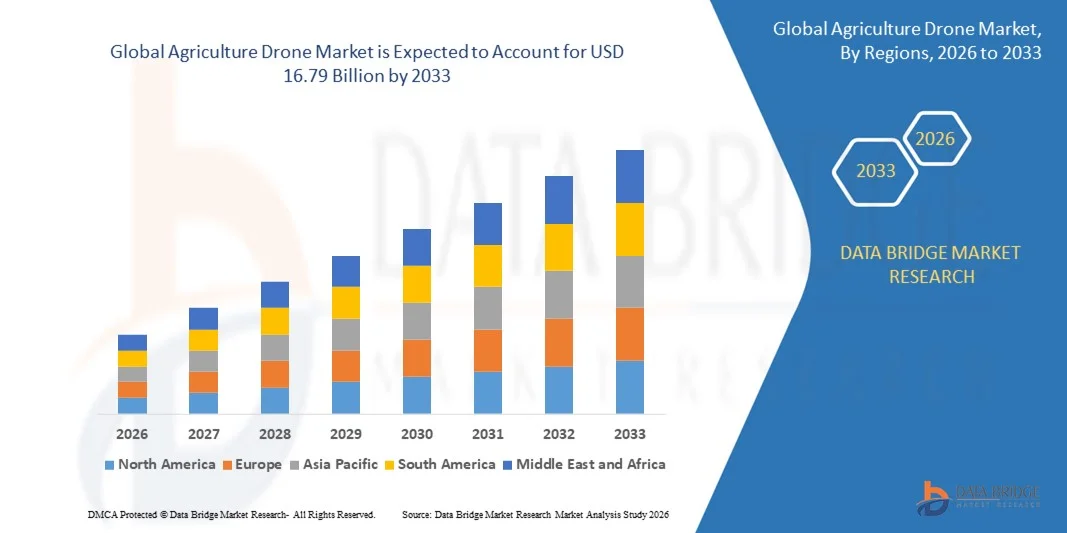
- Selon l'analyse de marché de Data Bridge, la taille du marché mondial des drones agricoles a été évaluée à3,88 milliards de dollars en 2025et devrait atteindre16,79 milliards de dollars en 2033, à unTCAC de 20,10 %pendant la période de prévision
- La croissance du marché est largement alimentée par l'adoption croissante de pratiques agricoles de précision et l'intégration rapide de technologies de pointe telles que l'IA, le GNSS et l'analyse des données dans les opérations agricoles, ce qui a permis d'améliorer la numérisation dans toutes les activités agricoles.
- En outre, l'augmentation de la demande pour des rendements plus élevés, une application efficace des pesticides et une réduction des coûts de main-d'oeuvre fait des drones agricoles des outils essentiels pour la gestion moderne des exploitations agricoles. Ces facteurs convergents accélèrent le déploiement de solutions basées sur les drones, ce qui stimule considérablement la croissance globale du marché des drones agricoles
Taille du marché et prévisions
- Valeur marchande mondiale (2025):3,88 milliards de dollars
- Valeur marchande prévue (2033) :16,79 milliards de dollars
- Prévisions CAGR (2026-2033): 20.10%
Quels sont les principaux débouchés du marché des drones agricoles
- Les drones agricoles, dotés de capteurs d'imagerie avancés, de systèmes de pulvérisation et de capacités de transmission de données en temps réel, deviennent des composantes essentielles des écosystèmes agricoles intelligents dans les petites, moyennes et grandes exploitations agricoles, en raison de leur capacité à améliorer l'efficacité opérationnelle, à surveiller la santé des cultures et à optimiser l'utilisation des ressources.
- L'augmentation de la demande de drones agricoles est principalement attribuable à l'augmentation de la demande alimentaire mondiale, à la réduction des terres arables, à l'augmentation des pénuries de main-d'oeuvre dans les zones rurales et au passage croissant à des pratiques agricoles automatisées et fondées sur des données visant à améliorer la productivité et la durabilité
- L'Amérique du Nord a dominé le marché des drones agricoles avec une part de34% en 2025, grâce à l'adoption rapide de technologies agricoles de précision et à la forte présence d'infrastructures agricoles avancées
- L'Asie-Pacifique devrait être la région qui connaît la croissance la plus rapide du marché des drones agricoles au cours de la période prévue en raison de l'urbanisation rapide, de l'expansion des activités agricoles et de l'augmentation des initiatives gouvernementales en faveur de l'agriculture numérique dans des pays comme la Chine, le Japon et l'Inde.
- Le segment des drones multirotors a dominé le marché avec une part de marché de 62,9 % en 2025, en raison de leur maniabilité supérieure, de leur capacité de décollage et d'atterrissage verticaux et de leur aptitude aux petites et moyennes exploitations. Les agriculteurs préfèrent largement les drones multi-rotors pour la pulvérisation de précision, la surveillance des cultures et le dépistage sur le terrain en raison de leur capacité à planer régulièrement sur des zones spécifiques
Portée du rapport et segmentation du marché des drones agricoles
|
Attributs |
Agriculture Drone Principales perspectives du marché |
|
Segments couverts |
|
|
Pays couverts |
Amérique du Nord
Europe
Asie-Pacifique
Moyen-Orient et Afrique
Amérique du Sud
|
|
Principaux acteurs du marché |
|
|
Possibilités de marché |
|
|
Infos sur la valeur ajoutée |
Outre les perspectives du marché telles que la valeur du marché, le taux de croissance, les segments de marché, la couverture géographique, les acteurs du marché et le scénario du marché, le rapport de marché préparé par l'équipe de recherche sur le marché de Data Bridge comprend une analyse approfondie des experts, une analyse des importations et des exportations, une analyse des prix, une analyse de la consommation de production et une analyse des ravageurs. |
Quelle est la tendance clé du marché des drones agricoles
Amélioration de l'adoption des drones agricoles de précision compatibles avec l'IA
- Une tendance importante sur le marché des drones agricoles est le déploiement croissant de drones équipés de capteurs multispectraux et d'analyses avancées pour améliorer la surveillance des cultures et la prise de décisions agricoles. Cette intégration renforce le rôle des drones en tant qu'outils essentiels dans les systèmes agricoles de précision visant à maximiser le rendement et à optimiser l'utilisation des ressources
- Par exemple, DJI a introduit des drones agricoles avancés tels que la série Agras intégrée à la planification intelligente du vol et à l'analyse des données en temps réel pour améliorer la précision de pulvérisation et l'efficacité opérationnelle. Ces systèmes permettent aux agriculteurs d'automatiser les tâches de pulvérisation à grande échelle tout en minimisant le gaspillage chimique et en améliorant la cohérence de la couverture
- L'adoption de solutions d'imagerie alimentées par l'IA se développe à mesure que les agriculteurs s'appuient de plus en plus sur les indices de végétation et l'analyse prédictive pour détecter le stress des cultures, les infestations par les ravageurs et les carences en nutriments au début. Il s'agit de positionner les drones agricoles comme des outils de gestion agricole proactifs plutôt que seulement des équipements de surveillance
- Les grandes entreprises agricoles intègrent les données sur les drones dans les plates-formes intégrées de gestion agricole où les informations aériennes appuient la planification de l'irrigation, l'analyse des sols et la prévision des rendements. Cette dépendance croissante à l'égard de la culture fondée sur les données renforce la transformation de l'agriculture traditionnelle en agriculture de précision technologique
- Les gouvernements des principales économies agricoles encouragent les initiatives d'agriculture numérique qui encouragent l'adoption de drones pour remédier aux pénuries de main-d'oeuvre et améliorer la productivité. Ce soutien politique contribue à renforcer la pénétration du marché et le déploiement structuré dans les exploitations commerciales.
- Le marché connaît une innovation accélérée en matière de navigation autonome, d'évitement des obstacles et d'analyse basée sur le cloud, qui améliore la fiabilité opérationnelle et l'évolutivité. Cette intégration croissante de l'IA et de l'automatisation renforce la transition plus large vers des écosystèmes agricoles intelligents, efficaces et durables
Dynamique du marché des drones agricoles
Chauffeur
Augmentation de la demande d'amélioration du rendement des cultures et de l'efficacité opérationnelle
- La demande mondiale croissante pour une productivité agricole accrue est à l'origine de l'adoption de drones capables de pulvériser avec précision, de surveiller les cultures et de cartographier les champs en temps réel. Ces technologies permettent aux agriculteurs d'optimiser l'application des engrais et des pesticides tout en réduisant le travail manuel et les inefficacités opérationnelles
- Par exemple, Yamaha Motor Co., Ltd. a déployé ses systèmes d'hélicoptères sans pilote RMAX pour la pulvérisation agricole au Japon et dans d'autres pays afin d'améliorer l'efficacité de la gestion des cultures à grande échelle. Ces plateformes UAV soutiennent une application uniforme et réduisent les processus manuels à long terme sur de vastes terres agricoles
- Les agriculteurs utilisent de plus en plus les drones pour surveiller la santé des cultures au moyen d'images aériennes à haute résolution, ce qui permet d'identifier rapidement les facteurs de stress et de réduire les pertes potentielles de rendement. Cette capacité proactive contribue directement à l'amélioration des résultats de la récolte et à une meilleure allocation des ressources.
- La pression croissante pour nourrir une population mondiale croissante tout en gérant des terres arables limitées encourage les investissements dans les technologies agricoles de précision. Les drones fournissent des solutions évolutives qui aident à maximiser la productivité sans accroître significativement l'utilisation des terres
- L'accent constamment mis sur l'amélioration de la productivité et l'optimisation opérationnelle renforce ce moteur sur les marchés agricoles développés et émergents. La nécessité de pratiques agricoles efficaces, étayées par des données et automatisées continue d'accélérer l'expansion du marché des drones agricoles
Restriction/Défi
Obstacles à l'investissement initial élevé et à la conformité réglementaire
- Le marché des drones agricoles est confronté à des défis liés au coût initial élevé associé aux systèmes de drones avancés, aux capteurs et aux plateformes d'analyse des données. Les petits et moyens agriculteurs rencontrent souvent des contraintes financières qui limitent l'adoption à grande échelle malgré les avantages opérationnels
- Par exemple, la Federal Aviation Administration impose des exigences opérationnelles et de certification strictes pour l'utilisation de drones agricoles aux États-Unis, ce qui accroît la complexité de la conformité pour les exploitants agricoles commerciaux. Ces procédures réglementaires peuvent allonger les délais de déploiement et ajouter des charges administratives aux stratégies de mise en œuvre des drones
- L'exigence relative aux pilotes autorisés, à la formation opérationnelle et au respect des restrictions de l'espace aérien augmente encore les coûts d'exploitation et limite l'accessibilité dans certaines régions. Le respect de l'évolution de la réglementation de l'aviation demeure un obstacle critique pour les nouveaux venus sur le marché.
- Les drones agricoles avancés équipés d'analyses de l'IA et de capteurs multispectraux entraînent des dépenses d'approvisionnement et d'entretien plus élevées, ce qui a des répercussions sur les marchés sensibles aux prix. Ce facteur de coût limite la pénétration généralisée des petits exploitants dans les économies en développement.
- L'incohérence des cadres réglementaires entre les pays crée des incertitudes pour les fabricants et les fournisseurs de services qui cherchent à se développer à l'échelle mondiale. Ces défis réglementaires et financiers limitent collectivement l'adoption plus rapide du marché en dépit des progrès technologiques importants et des avantages de productivité
Comment le marché des drones agricoles est-il segmenté
Le marché est segmenté selon le type, le produit, la durée de vie de la batterie, les composants, le mode de fonctionnement, la gamme, la technologie et l'application.
- Par type
Sur la base du type, le marché des drones agricoles est segmenté en drones à voilure fixe, drones multi-rotors et drones hybrides. Le segment des drones multi-rotors a dominé le marché avec la plus grande part de chiffre d'affaires de 62,9% en 2025, grâce à leur maniabilité supérieure, leur capacité de décollage et d'atterrissage verticaux et leur aptitude aux petites et moyennes exploitations. Les agriculteurs préfèrent largement les drones multi-rotors pour la pulvérisation de précision, la surveillance des cultures et le dépistage sur le terrain en raison de leur capacité à planer régulièrement sur des zones spécifiques. Leur complexité opérationnelle moindre et leur prix relativement abordable renforcent encore l'adoption par les agriculteurs et les agro-industries. Le segment continue de bénéficier de l'amélioration continue de la capacité de charge utile et de l'intégration des capteurs, ce qui accroît l'efficacité opérationnelle.
Le segment des drones hybrides devrait connaître le taux de croissance le plus rapide de 2026 à 2033, alimenté par le besoin croissant d'endurance de vol plus longue combinée à une capacité de décollage vertical. Les modèles hybrides intègrent les avantages de l'endurance à voilure fixe et de la flexibilité multi-rotor, ce qui les rend adaptés aux grandes exploitations nécessitant une couverture étendue. L'augmentation des investissements dans les technologies agricoles de pointe et la demande de solutions de cartographie aérienne à haut rendement accélèrent l'adoption. Leur capacité à couvrir une vaste superficie avec une consommation énergétique réduite les rend de plus en plus attrayants pour les exploitations agricoles commerciales.
- Par produit
Sur la base du produit, le marché des drones agricoles est segmenté en logiciels et matériels. Le segment du matériel a dominé le marché avec la plus grande part des revenus en 2025, sous l'impulsion d'une forte demande de plates-formes de drones, de capteurs, de caméras, de systèmes de propulsion et de batteries. L'adoption croissante de systèmes d'imagerie à haute résolution et de mécanismes de pulvérisation avancés contribue de façon significative aux ventes de matériel. Les agriculteurs et les fournisseurs de services investissent massivement dans des structures de drones durables et des composants de précision pour améliorer la productivité sur le terrain. Les progrès technologiques continus dans les matériaux légers et les systèmes de batterie améliorés soutiennent davantage la domination matérielle.
Le secteur des logiciels devrait connaître le taux de croissance le plus rapide de 2026 à 2033, grâce à l'utilisation accrue de l'analyse des données, à la surveillance des cultures basées sur l'IA et aux plateformes de gestion agricole basées sur le cloud. Des solutions logicielles avancées permettent de cartographier les champs en temps réel, d'évaluer la santé des cultures et de prédire les rendements en améliorant la précision des décisions. L'intégration de l'analyse des drones aux systèmes de gestion agricole améliore la transparence opérationnelle et l'optimisation des ressources. La sensibilisation croissante aux pratiques agricoles de précision accélère la demande de plateformes logicielles basées sur l'abonnement et les données.
- Par durée de vie des batteries
Sur la base de la durée de vie des batteries, le marché des drones agricoles est segmenté en < 30 minutes, 30 à 60 minutes, 60 à 100 minutes et > 100 minutes. Le segment des 30 à 60 minutes a dominé le marché avec la plus grande part de revenus en 2025, grâce à sa combinaison équilibrée d'endurance opérationnelle et d'efficacité économique. La plupart des drones agricoles commerciaux sont conçus dans cette plage de durée de vol pour supporter efficacement les tâches de pulvérisation et de cartographie. Le segment répond aux exigences des exploitations de taille moyenne tout en maintenant le poids et le temps de charge des batteries. Les fabricants continuent d'optimiser les systèmes de batteries au lithium pour améliorer la fiabilité dans cette gamme.
Le segment de > 100 minutes devrait connaître le taux de croissance le plus rapide de 2026 à 2033, alimenté par la demande croissante de surveillance sur le terrain à grande échelle et d'opérations de cartographie élargies. Les drones de longue durée réduisent la nécessité de remplacer fréquemment les batteries, améliorant ainsi la productivité des terres agricoles étendues. Les progrès technologiques dans les piles à haute densité et les solutions de puissance hybride soutiennent l'expansion de ce segment. Les agro-industries commerciales investissent de plus en plus dans les drones à vol prolongé pour maximiser l'efficacité opérationnelle.
- Par composants
Sur la base de composants, le marché des drones agricoles est segmenté en contrôleurs de vol, systèmes de propulsion, système de caméra, batteries et système de positionnement mondial. Le segment des systèmes de caméras a dominé le marché avec la plus grande part des revenus en 2025, en raison de la demande croissante d'imagerie multispectrale et thermique pour évaluer la santé des cultures et l'état des sols. Les systèmes d'imagerie à haute résolution permettent aux agriculteurs de détecter les infestations de ravageurs, les carences en nutriments et les problèmes d'irrigation dès les premières étapes. L'innovation continue dans la précision des capteurs et les capacités d'imagerie stimulent considérablement l'adoption. L'importance croissante des pratiques agricoles fondées sur les données renforce encore la domination des systèmes de caméras.
Le segment des contrôleurs de vol devrait connaître le taux de croissance le plus rapide de 2026 à 2033, alimenté par les progrès des technologies autonomes de navigation et de stabilisation de la précision des vols. Les contrôleurs de vol modernes intègrent les algorithmes AI et le traitement des données en temps réel pour améliorer la planification de la route et éviter les obstacles. L'importance croissante accordée à l'automatisation dans l'agriculture augmente la demande de systèmes de contrôle intelligents. Une meilleure compatibilité avec le GNSS et les plateformes analytiques accélère l'expansion du segment.
- Par mode de fonctionnement
Sur la base du mode d'exploitation, le marché des drones agricoles est segmenté en entièrement autonome, semi-autonome et à distance. Le segment entièrement autonome a dominé le marché avec la plus grande part de revenus en 2025, grâce à l'adoption croissante de la planification automatisée des vols et des systèmes d'intervention humaine minimaux. Les agriculteurs préfèrent les drones entièrement autonomes pour des modèles de pulvérisation cohérents et des cartes de terrain efficaces réduisant la dépendance à la main-d'oeuvre. L'intégration à l'analyse assistée par l'IA améliore la précision opérationnelle et la productivité. L'expansion de la transformation numérique dans l'ensemble de l'agriculture appuie davantage le leadership du segment.
Le segment semi-autonome devrait connaître le taux de croissance le plus rapide de 2026 à 2033, alimenté par la nécessité d'un contrôle flexible associé à l'automatisation. Les drones semi-autonomes permettent aux opérateurs d'intervenir au besoin tout en bénéficiant de systèmes de navigation automatisés. Cet équilibre opérationnel les rend adaptés aux exploitations agricoles en transition vers une automatisation avancée. L'augmentation des programmes de formation et des interfaces conviviales accélère l'adoption dans les économies agricoles en développement.
- Par domaine
Sur la base de la portée, le marché des drones agricoles est segmenté en ligne de vue étendue, au-delà de la ligne de vue, et ligne de vue visuelle. Le segment de la visibilité visuelle a dominé le marché avec la plus grande part des revenus en 2025, en raison des exigences de conformité réglementaires dans plusieurs pays et de la facilité d'approbation opérationnelle. La plupart des petits et moyens agriculteurs exploitent des drones à portée visible pour assurer la sécurité et le contrôle. Une complexité technique moindre et des obstacles réglementaires réduits renforcent encore l'adoption. Le segment demeure largement privilégié pour les activités de surveillance et de pulvérisation des cultures localisées.
Le segment au-delà de la ligne de visibilité devrait connaître le taux de croissance le plus rapide de 2026 à 2033, alimenté par les progrès de la réglementation et la demande croissante pour une couverture étendue. Les opérations BVLOS permettent une surveillance efficace des champs agricoles étendus réduisant le temps de fonctionnement. Les améliorations technologiques des systèmes de communication et l'évitement des collisions améliorent la sécurité et la fiabilité. La croissance des activités agricoles commerciales entraîne des investissements dans les capacités de drones à longue distance.
- Par technologie
Sur la base de la technologie, le marché des drones agricoles est segmenté en GNSS, la technologie de détection et d'évitement des obstacles, l'analyse des drones, etc. Le segment GNSS a dominé le marché avec la plus grande part des revenus en 2025, en raison de son rôle essentiel dans le positionnement et la navigation précis pendant les opérations de pulvérisation et de cartographie. L'agriculture de précision dépend fortement des systèmes de guidage par satellite pour optimiser l'utilisation des intrants. Une intégration GNSS fiable améliore la stabilité du vol et la précision de la couverture sur le terrain. Le déploiement croissant de modules GPS de haute précision renforce la domination du segment.
Le segment analytique des drones devrait connaître le taux de croissance le plus rapide de 2026 à 2033, alimenté par la demande croissante de données agricoles exploitables provenant de données aériennes. Les plates-formes d'analyse avancées convertissent l'imagerie de drones bruts en indices de santé des cultures et en prévisions de rendement appuyant la gestion stratégique des fermes. L'intégration aux technologies d'IA et d'apprentissage automatique améliore les capacités prédictives. L'adoption de modèles agricoles axés sur les données accélère la croissance au sein de ce segment.
- Par demande
Sur la base de l'application, le marché des drones agricoles est segmenté en pulvérisation, cartographie de terrain, scoutisme, analyse des sols et des champs, surveillance des cultures, évaluation de la santé, irrigation, pulvérisation des cultures, plantations aériennes, agriculture de précision, surveillance du bétail, photographie agricole, pisciculture de précision, etc. Le segment de la pulvérisation de cultures a dominé le marché avec la plus grande part des revenus en 2025, en raison du besoin croissant d'une application efficace de pesticides et d'engrais avec un gaspillage minimal. Les drones permettent une distribution chimique uniforme réduisant les coûts de main-d'oeuvre et l'impact environnemental. L'accent mis de plus en plus sur la gestion des entrées de précision stimule considérablement l'adoption dans ce segment. L'amélioration continue des systèmes de charge utile accroît encore l'efficacité opérationnelle.
Le secteur de l'agriculture de précision devrait connaître le taux de croissance le plus rapide de 2026 à 2033, alimenté par l'importance croissante accordée à l'agriculture durable et à l'optimisation des ressources. L'agriculture de précision intègre l'analyse basée sur les drones, la cartographie GNSS et la prise de décision automatisée pour maximiser le rendement et minimiser les coûts d'entrée. L'augmentation du soutien gouvernemental aux technologies agricoles intelligentes renforce l'expansion du marché. La sensibilisation croissante des agriculteurs à la gestion des cultures axée sur les données continue d'accélérer l'adoption dans les économies développées et émergentes.
Quelle région détient la plus grande part du marché des drones agricoles
- L'Amérique du Nord a dominé le marché des drones agricoles avec la plus grande part des revenus de 34 % en 2025, grâce à l'adoption rapide de technologies agricoles de précision et à la forte présence d'infrastructures agricoles de pointe.
- Les agriculteurs de la région accordent une grande valeur à la surveillance des cultures par drone, à la cartographie des champs et aux solutions de pulvérisation pour améliorer l'efficacité des rendements et réduire les coûts opérationnels
- Cette large adoption est soutenue par des cadres réglementaires favorables, une grande sensibilisation aux pratiques agricoles intelligentes et un investissement important dans l'innovation agro-technologique, la création de drones agricoles comme composante essentielle de la gestion agricole moderne.
U.S. Agriculture Drone Market Insight
Le marché américain des drones agricoles a remporté la plus grande part de revenus en 2025 en Amérique du Nord, alimentée par l'adoption précoce d'outils d'agriculture de précision et l'accroissement du regroupement des exploitations agricoles sur de grandes terres agricoles. Les agriculteurs privilégient de plus en plus la gestion des cultures axée sur les données et les systèmes automatisés de pulvérisation pour améliorer la productivité et optimiser l'utilisation des intrants. Un soutien gouvernemental fort pour des initiatives agricoles intelligentes, associé à la présence de grands fabricants de drones tels que DJI et AeroVironment opérant sur le marché, accélère encore l'expansion de l'industrie.
Europe Agriculture Drone Market Insight
Le marché européen des drones agricoles devrait s'étendre à un TCAC important tout au long de la période de prévision, principalement en mettant davantage l'accent sur l'agriculture durable et des réglementations environnementales strictes concernant l'utilisation des pesticides. La demande croissante d'outils agricoles de précision pour accroître le rendement des cultures tout en minimisant l'impact environnemental favorise l'adoption de drones. La région connaît une croissance régulière entre les pays qui investissent dans la transformation de l'agriculture numérique et dans les technologies avancées de surveillance agricole.
Royaume-Uni Agriculture Drone Market Insight
Le marché britannique des drones agricoles devrait croître à un TCAC remarquable au cours de la période de prévision, en raison de la numérisation croissante des activités agricoles et de la demande de systèmes efficaces de surveillance des cultures. Les agriculteurs adoptent des analyses basées sur des drones pour améliorer l'évaluation des sols et la surveillance de la santé des cultures. Les politiques agricoles de soutien et l'intérêt croissant pour les équipements agricoles autonomes devraient continuer à stimuler la croissance du marché dans le pays.
Allemagne Agriculture Drone Market Insight
Le marché allemand des drones agricoles devrait se développer à un TCAC considérable au cours de la période de prévision, alimenté par une forte concentration sur l'innovation technologique et les pratiques agricoles durables. Les capacités de fabrication avancées de l'Allemagne et l'accent mis sur l'ingénierie de précision favorisent l'intégration des drones dans la surveillance des cultures et la gestion du bétail. L'augmentation des investissements dans les solutions agricoles intelligentes et l'infrastructure numérique renforce encore le développement du marché.
Aperçu du marché de l'agriculture en Asie-Pacifique
Le marché des drones agricoles de l'Asie et du Pacifique est sur le point de croître au rythme le plus rapide pendant la période de prévision de 2026 à 2033, sous l'impulsion d'une urbanisation rapide, d'une expansion des activités agricoles et d'une intensification des initiatives gouvernementales soutenant l'agriculture numérique dans des pays comme la Chine, le Japon et l'Inde. La hausse de la demande alimentaire et les pénuries de main-d'œuvre encouragent les agriculteurs à adopter des solutions aériennes automatisées pour une gestion efficace des exploitations. De plus, la région joue un rôle croissant en tant que centre de fabrication de composants de drones, ce qui améliore l'accessibilité et l'accessibilité dans les économies émergentes.
Japon Agriculture Drone Market Insight
Le marché japonais des drones agricoles prend de l'ampleur en raison des pénuries de main-d'œuvre dans les zones rurales et de l'adoption de technologies robotiques et d'automatisation de pointe. Les agriculteurs japonais déploient de plus en plus de drones pour la pulvérisation de cultures et la surveillance de précision afin d'améliorer la productivité et de réduire l'effort manuel. L'intégration des systèmes de drones aux plates-formes agricoles intelligentes et aux outils de gestion agricole basés sur l'IoT contribue davantage à la croissance du marché.
Chine Agriculture Drone Market Insight
En 2025, le marché chinois des drones agricoles a représenté la plus grande part des revenus du marché en Asie-Pacifique, attribuable à une modernisation rapide des pratiques agricoles et à de solides capacités de fabrication nationales. Le pays a été témoin d'un déploiement généralisé de drones de pulvérisation de cultures dans les grandes exploitations agricoles afin d'améliorer l'efficacité et de réduire le gaspillage de produits chimiques. La présence de grands fabricants de drones tels que DJI et les politiques gouvernementales de soutien à la mécanisation agricole sont des facteurs clés de l'expansion du marché en Chine.
Quelles sont les meilleures entreprises du marché des drones agricoles
L'industrie des drones agricoles est principalement dirigée par des entreprises bien établies, notamment :
- AeroVironment Inc. (États-Unis)
- AGCO Corporation (États-Unis)
- AgEagle Aerial Systems Inc. (États-Unis)
- Delair (France)
- DroneDeploy (États-Unis)
- Trimble Inc. (États-Unis)
- Drone de perroquet SAS (France)
- Yamaha Motor Co., Ltd. (Japon)
- OPtiM Corp. (Japon)
- Sentera (États-Unis)
- Institu Pacific Pty Ltd (Australie)
- ALTI UAS (PTY) LTD (Afrique du Sud)
- senseFly (Suisse)
- AgEagle Sensor Systems Inc. (États-Unis)
- Pix4D SA (Suisse)
- DJI (Chine)
Quels sont les derniers développements en agriculture Drone Market
- En décembre 2025, Jyoti Global Plast a introduit le drone agricole AeroCrop UAS pour améliorer la précision, la sécurité opérationnelle et l'efficacité de pulvérisation pour les agriculteurs de toute l'Inde. Ce lancement marque l'expansion stratégique de l'entreprise de la moulure en plastique et en FRP dans le segment des systèmes aériens sans pilote, renforçant les capacités de fabrication nationales. Le développement devrait accélérer l'adoption de technologies agricoles de précision en Inde en s'attaquant aux pénuries de main-d'œuvre, en réduisant le gaspillage chimique et en améliorant la productivité des cultures, contribuant ainsi à la croissance globale du marché des drones agricoles.
- En décembre 2025, le Connecticut, aux États-Unis, a adopté la Public Act 25-152 autorisant l'utilisation accrue de drones agricoles pour l'ensemencement, la pulvérisation et l'arpentage des cultures. Le cadre réglementaire mis à jour rationalise les exigences de conformité conformément aux normes de l'Administration fédérale de l'aviation, ce qui permet aux exploitations agricoles d'intégrer plus efficacement les technologies de l'UAV. Ce soutien législatif devrait améliorer le déploiement de drones commerciaux dans l'ensemble de l'État, en encourageant l'investissement et l'innovation sur le marché régional des drones agricoles
- En août 2025, Terra Drone Corporation a conclu un partenariat de vente avec PT. Yanmar Diesel Indonesia, filiale de Yanmar Co., Ltd., pour distribuer ses drones agricoles G20 et E16 aux riziculteurs et aux cultivateurs de grandes cultures en Indonésie. Cette collaboration renforce l'empreinte de Terra Drone en Asie du Sud-Est en tirant parti du réseau de distribution agricole établi par Yanmar. Le partenariat devrait élargir l'accès des agriculteurs locaux aux drones, stimuler l'adoption régionale et renforcer la pénétration du marché dans les économies agricoles émergentes.
- En avril 2024, DJI a annoncé le lancement global des drones agricoles Agras T50 et T25, ciblant à la fois les grandes exploitations agricoles et les petites exploitations agricoles. Le T50 offre des performances à haut rendement pour une couverture agricole étendue, tandis que le T25 met l'accent sur la portabilité et la flexibilité opérationnelle. L'intégration à l'application SmartFarm améliore la gestion de la pulvérisation aérienne et la prise de décision axée sur les données, renforçant la position concurrentielle de DJI et faisant progresser les normes technologiques sur le marché mondial des drones agricoles
- En juillet 2023, Pix4D SA a lancé PIX4Dfields 2.4 avec un flux de travail amélioré conçu pour rationaliser les applications agricoles de précision. L'introduction d'opérations ciblées permet aux utilisateurs de générer des cartes de prescription personnalisées plus efficacement, améliorant l'optimisation des ressources et l'exactitude de la gestion des cultures. Cette innovation renforce la valeur logicielle au sein des écosystèmes de drones, favorisant l'adoption de solutions agricoles axées sur les données et renforçant la croissance dans le segment de l'analyse des drones agricoles
SKU-
Accédez en ligne au rapport sur le premier cloud mondial de veille économique

- Tableau de bord d'analyse de données interactif
- Tableau de bord d'analyse d'entreprise pour les opportunités à fort potentiel de croissance
- Accès d'analyste de recherche pour la personnalisation et les requêtes
- Analyse de la concurrence avec tableau de bord interactif
- Dernières actualités, mises à jour et analyse des tendances
- Exploitez la puissance de l'analyse comparative pour un suivi complet de la concurrence
Méthodologie de recherche
La collecte de données et l'analyse de l'année de base sont effectuées à l'aide de modules de collecte de données avec des échantillons de grande taille. L'étape consiste à obtenir des informations sur le marché ou des données connexes via diverses sources et stratégies. Elle comprend l'examen et la planification à l'avance de toutes les données acquises dans le passé. Elle englobe également l'examen des incohérences d'informations observées dans différentes sources d'informations. Les données de marché sont analysées et estimées à l'aide de modèles statistiques et cohérents de marché. De plus, l'analyse des parts de marché et l'analyse des tendances clés sont les principaux facteurs de succès du rapport de marché. Pour en savoir plus, veuillez demander un appel d'analyste ou déposer votre demande.
La méthodologie de recherche clé utilisée par l'équipe de recherche DBMR est la triangulation des données qui implique l'exploration de données, l'analyse de l'impact des variables de données sur le marché et la validation primaire (expert du secteur). Les modèles de données incluent la grille de positionnement des fournisseurs, l'analyse de la chronologie du marché, l'aperçu et le guide du marché, la grille de positionnement des entreprises, l'analyse des brevets, l'analyse des prix, l'analyse des parts de marché des entreprises, les normes de mesure, l'analyse globale par rapport à l'analyse régionale et des parts des fournisseurs. Pour en savoir plus sur la méthodologie de recherche, envoyez une demande pour parler à nos experts du secteur.
Personnalisation disponible
Data Bridge Market Research est un leader de la recherche formative avancée. Nous sommes fiers de fournir à nos clients existants et nouveaux des données et des analyses qui correspondent à leurs objectifs. Le rapport peut être personnalisé pour inclure une analyse des tendances des prix des marques cibles, une compréhension du marché pour d'autres pays (demandez la liste des pays), des données sur les résultats des essais cliniques, une revue de la littérature, une analyse du marché des produits remis à neuf et de la base de produits. L'analyse du marché des concurrents cibles peut être analysée à partir d'une analyse basée sur la technologie jusqu'à des stratégies de portefeuille de marché. Nous pouvons ajouter autant de concurrents que vous le souhaitez, dans le format et le style de données que vous recherchez. Notre équipe d'analystes peut également vous fournir des données sous forme de fichiers Excel bruts, de tableaux croisés dynamiques (Fact book) ou peut vous aider à créer des présentations à partir des ensembles de données disponibles dans le rapport.











