Global Aquagenic Pruritus Treatment Market, By Treatment (Medication, Phototherapies, Transcutaneous Electrical Nerve Stimulation (TENS), Others), Diagnosis (Physical Examination, Others), Dosage (Injection, Tablets, Ointments, Others), Route of Administration (Oral, Parenteral, Topical, Others), End-Users (Clinic, Hospital, Others), Distribution Channel (Hospital Pharmacy, Retail Pharmacy, Online Pharmacy), Country (U.S., Canada, Mexico, Brazil, Argentina, Peru, Rest of South America, Germany, France, U.K., Netherlands, Switzerland, Belgium, Russia, Italy, Spain, Turkey, Hungary, Lithuania, Austria, Ireland, Norway, Poland, Rest of Europe, China, Japan, India, South Korea, Singapore, Malaysia, Australia, Thailand, Indonesia, Philippines, Vietnam, Rest of Asia-Pacific, Saudi Arabia, U.A.E, Egypt, Israel, Kuwait, South Africa, Rest of Middle East and Africa) Industry Trends and Forecast to 2029.
Analyse et perspectives du marchéMarché mondial du traitement du prurit aquagénique
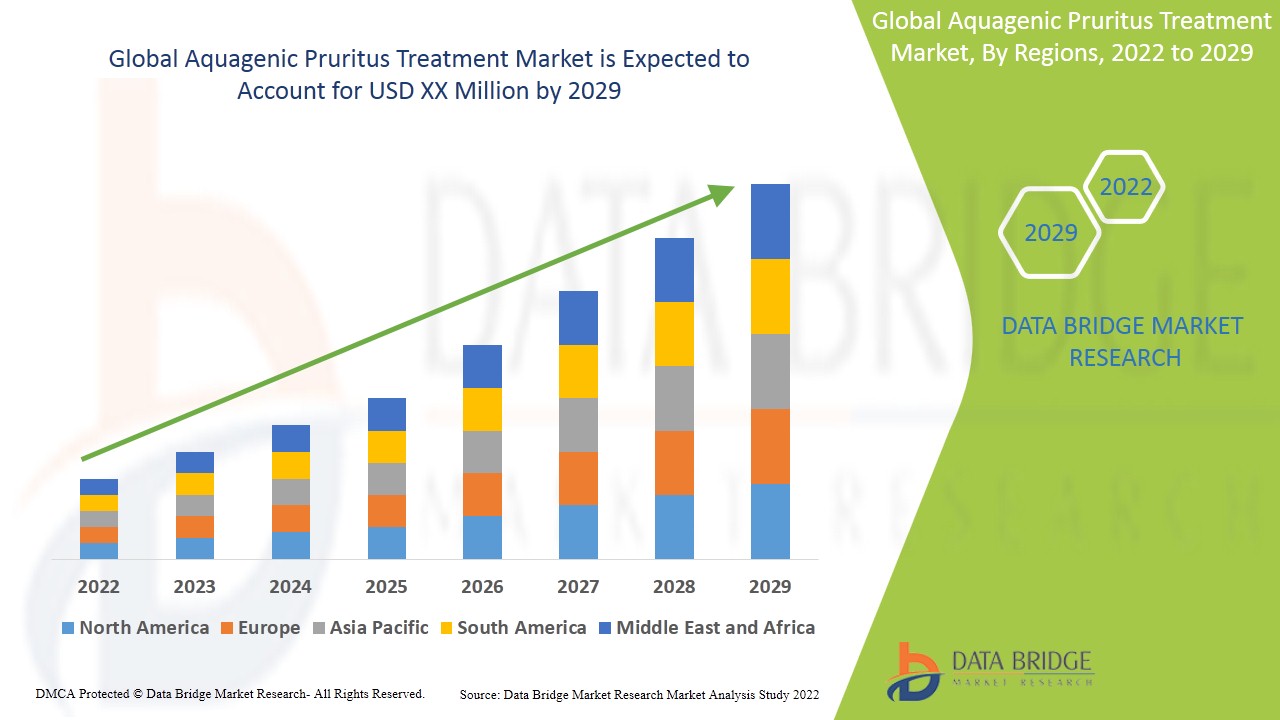
Le marché du traitement du prurit aquagénique devrait augmenter au cours de la période de prévision 2022-2029. Data Bridge Market Research analyse le marché pour tenir compte de la croissance d'un TCAC de 5,90 % au cours de la période de prévision susmentionnée.
Le prurit aquagénique est dirigé vers un trouble dermatologique rare qui provoque des démangeaisons intenses ou une sensation de piquant lorsqu'il est exposé à l'eau à n'importe quelle température. Il provoque de graves démangeaisons, des piqûres, des picotements ou des sensations brûlantes après être entré en contact avec l'eau, bien qu'il n'y ait aucun changement apparent sur la peau. Cette affection n'a pas d'étiologie reconnue, mais des occurrences familiales ont été signalées. La prurite aquagénique peut être un signe de diverses maladies, comme la polycythémie vera. Les symptômes et un examen clinique sont utilisés pour faire un diagnostic. Le traitement est symptomatique : lotions cutanées, antihistaminiques, photothérapie, ajustement du pH de l'eau et divers médicaments ont été tentés.
L'augmentation de la prévalence du prurit aquagénique jouera un rôle moteur important sur le marché et renforcera encore le taux de croissance du marché. Un autre facteur important qui influe sur le taux de croissance du marché du traitement du prurit aquagénique est l'augmentation des dépenses de santé. De plus, les progrès de la technologie médicale, les initiatives croissantes d'organisations publiques et privées visant à sensibiliser le public aux maladies et l'augmentation du financement public sont les facteurs qui permettront d'élargir le marché du traitement du prurit aquagénique. Autres facteurs tels que l'augmentation de l'incidencecanceret la croissance de la population gériatrique aura une incidence positive sur le taux de croissance du marché du traitement du prurit aquagénique. De plus, une forte demande pour les options de traitement efficaces entraînera l'expansion du marché du traitement du prurit aquagénique. L'augmentation du niveau de revenu disponible, le dépistage croissant et les facteurs de risque croissants sont les principaux facteurs qui propulseront le taux de croissance du marché.
De plus, l'augmentation des activités de recherche-développement et l'émergence d'un nouveau marché offriront des possibilités bénéfiques au marché du traitement du prurit aquagénique au cours de la période de prévision 2022-2029. En outre, les besoins élevés non satisfaits de traitement actuel et les développements de la technologie de soins de santé augmenteront le taux de croissance du marché du traitement du prurit aquagénique à l'avenir.
Toutefois, le coût élevé associé au traitement disponible et au manque d'infrastructures dans les pays à faible revenu entravera la croissance du marché du traitement du prurit aquagénique. Moins de sensibilisation et de complications ainsi que de risques liés à la maladie poseront de nouveaux défis au marché au cours de la période de prévision susmentionnée. L'absence de remède pour cette maladie agira comme un frein majeur du marché qui déraillera davantage le taux de croissance du marché.
Ce rapport sur le marché du traitement aquagénique du prurit fournit des détails sur les nouveaux développements récents, la réglementation commerciale, l'analyse des exportations d'importations, l'analyse de la production, l'optimisation de la chaîne de valeur, la part de marché, l'impact des acteurs du marché local et national, l'analyse des possibilités en termes de nouvelles poches de revenus, les changements dans la réglementation du marché, l'analyse stratégique de la croissance du marché, la taille du marché, la croissance du marché par catégorie, les niches d'application et la domination, les approbations de produits, les lancements de produits, les expansions géographiques, les innovations technologiques sur le marché. Pour obtenir plus d'informations sur le traitement du prurit aquagénique, contactez Data Bridge Market Research pour uneMémoire d'analyste, notre équipe vous aidera à prendre une décision de marché éclairée pour atteindre la croissance du marché.
Marché mondial du traitement du prurit aquagéniquePortée et taille du marché
Le marché du traitement du prurit aquagénique est segmenté en fonction du traitement, du diagnostic, de la posologie, de la voie d'administration, des utilisateurs finaux et du canal de distribution. La croissance de ces segments vous aidera à analyser les segments de croissance maigre dans les industries, et fournir aux utilisateurs une vue d'ensemble et des perspectives de marché précieuses pour les aider à prendre des décisions stratégiques pour l'identification des applications de base du marché.
- Sur la base du traitement, le marché du traitement du prurit aquagénique est segmenté en médicaments, photothérapies, stimulation du nerf électrique transcutané (STN) et autres. Le médicament est également sous-segmenté en antihistaminiques,corticoïdes, analgésiques, antagonistes des récepteurs opioïdes, interféron alpha-2b, cholestyramine, clonidine, inhibiteurs sélectifs de la recapture de la sérotonine (ISRS) et bêtabloquants.
- Sur la base du diagnostic, le marché du traitement du prurit aquagénique est segmenté en examen physique et autres.
- Sur la base de la posologie, le marché du traitement par prurit aquagénique est segmenté en injection,comprimés, onguents et autres.
- Sur la base de la voie d'administration, le marché du traitement par le prurit aquagénique est segmenté en voie orale, parentérale, topique et autres.
- Sur la base des utilisateurs finaux, le marché du traitement du prurit aquagénique est segmenté en clinique,hôpitalet d'autres.
Le marché du traitement du prurit aquagénique est également segmenté sur la base du canal de distribution en pharmacie hospitalière, pharmacie de détail et pharmacie en ligne.
Marché du traitement du prurit aquagéniqueAnalyse au niveau des pays
Le marché du traitement du prurit aquagénique est analysé et l'information sur la taille du marché est fournie par le pays, le traitement, le diagnostic, la posologie, la voie d'administration, les utilisateurs finaux et le canal de distribution, comme indiqué ci-dessus.
Les pays couverts par le rapport du marché du traitement du prurit aquagénique sont les États-Unis, le Canada, le Mexique, le Brésil, l'Argentine, le Pérou, le reste de l'Amérique du Sud, l'Allemagne, la France, le Royaume-Uni, les Pays-Bas, la Suisse, la Belgique, la Russie, l'Italie, l'Espagne, la Turquie, la Hongrie, la Lituanie, l'Autriche, l'Irlande, la Norvège, la Pologne, le reste de l'Europe, la Chine, le Japon, l'Inde, la Corée du Sud, Singapour, la Malaisie, l'Australie, la Thaïlande, l'Indonésie, les Philippines, le Vietnam, le reste de l'Asie-Pacifique, l'Arabie saoudite, les États-Unis, l'Égypte, Israël, le Koweït, l'Afrique du Sud, le reste du Moyen-Orient et l'Afrique.
L'Amérique du Nord domine le marché du traitement du prurit aquagénique en raison de la présence d'acteurs clés et du taux de prévalence élevé dans cette région. De plus, l'accroissement de la population gériatrique et le développement des infrastructures de soins de santé sont les principaux moteurs de la croissance du marché du traitement du prurit aquagénique dans cette région. L'Asie-Pacifique devrait croître au cours de la période de prévision 2022-2029 en raison de l'augmentation du bassin de patients, de l'augmentation des investissements dans le secteur des soins de santé et de l'augmentation du soutien gouvernemental.
La section de pays du rapport présente également les facteurs d'incidence sur le marché et les modifications de la réglementation sur le marché intérieur qui influent sur les tendances actuelles et futures du marché. Les points de données tels que les nouvelles ventes, les ventes de remplacement, la démographie du pays, l'épidémiologie des maladies et les tarifs à l'importation et à l'exportation sont quelques-uns des principaux indicateurs utilisés pour prévoir le scénario du marché pour chaque pays. En outre, la présence et la disponibilité des marques mondiales et les défis auxquels elles sont confrontées en raison de la concurrence importante ou rare des marques locales et nationales, l'impact des circuits de vente est pris en compte tout en fournissant une analyse prévisionnelle des données nationales.
Analyse épidémiologique des patients
Le marché du traitement du prurit aquagénique vous fournit également une analyse de marché détaillée pour l'analyse des patients, le pronostic et les traitements. Prévalence, incidence, mortalité, taux d'adhésion sont quelques-unes des variables de données disponibles dans le rapport. L'analyse de l'impact direct ou indirect de l'épidémiologie sur la croissance du marché est analysée afin de créer un modèle statistique multivarié de cohorte plus robuste pour prévoir le marché pendant la période de croissance.
Paysage concurrentiel etMarché mondial du traitement du prurit aquagéniqueAnalyse des parts
Le paysage concurrentiel du marché du traitement du prurit aquagénique fournit des détails par concurrent. Les détails inclus sont : aperçu de l'entreprise, finances de l'entreprise, revenus générés, potentiel du marché, investissement dans la recherche et le développement, nouvelles initiatives du marché, présence mondiale, sites et installations de production, forces et faiblesses de l'entreprise, lancement de produits, pipelines d'essais cliniques, approbations de produits, brevets, largeur et largeur du produit, domination de l'application, courbe de survie technologique. Les données ci-dessus fournies ne sont liées qu'à la concentration des entreprises sur les études de marché sur le traitement du prurit aquagénique.
Pfizer Inc., Merck Sharp & Dohme Corp., Lupin, Eli Lilly and Company, Abbott, F. Hoffmann-La Roche Ltd., GlaxoSmithKline plc, Bayer AG, Boehringer Ingelheim International GmbH., AstraZeneca, Johnson & Johnson Private Limited, Sanofi, Novartis AG, Aurobindo Pharma, Mylan N.V., Dr. Reddys Laboratories Ltd., BASF SE, Allergan, Teva Pharmaceutical Industries Ltd., Sun Pharmaceutical Industries Ltd., AbbVie Inc., Takeda Pharmaceutical Company Limited., Sumitomo Dainippon Pharma Co., Ltd., Cipla Inc., et Bristol-Myers Squibb Company, entre autres.
SKU-
Accédez en ligne au rapport sur le premier cloud mondial de veille économique
- Tableau de bord d'analyse de données interactif
- Tableau de bord d'analyse d'entreprise pour les opportunités à fort potentiel de croissance
- Accès d'analyste de recherche pour la personnalisation et les requêtes
- Analyse de la concurrence avec tableau de bord interactif
- Dernières actualités, mises à jour et analyse des tendances
- Exploitez la puissance de l'analyse comparative pour un suivi complet de la concurrence
Méthodologie de recherche
La collecte de données et l'analyse de l'année de base sont effectuées à l'aide de modules de collecte de données avec des échantillons de grande taille. L'étape consiste à obtenir des informations sur le marché ou des données connexes via diverses sources et stratégies. Elle comprend l'examen et la planification à l'avance de toutes les données acquises dans le passé. Elle englobe également l'examen des incohérences d'informations observées dans différentes sources d'informations. Les données de marché sont analysées et estimées à l'aide de modèles statistiques et cohérents de marché. De plus, l'analyse des parts de marché et l'analyse des tendances clés sont les principaux facteurs de succès du rapport de marché. Pour en savoir plus, veuillez demander un appel d'analyste ou déposer votre demande.
La méthodologie de recherche clé utilisée par l'équipe de recherche DBMR est la triangulation des données qui implique l'exploration de données, l'analyse de l'impact des variables de données sur le marché et la validation primaire (expert du secteur). Les modèles de données incluent la grille de positionnement des fournisseurs, l'analyse de la chronologie du marché, l'aperçu et le guide du marché, la grille de positionnement des entreprises, l'analyse des brevets, l'analyse des prix, l'analyse des parts de marché des entreprises, les normes de mesure, l'analyse globale par rapport à l'analyse régionale et des parts des fournisseurs. Pour en savoir plus sur la méthodologie de recherche, envoyez une demande pour parler à nos experts du secteur.
Personnalisation disponible
Data Bridge Market Research est un leader de la recherche formative avancée. Nous sommes fiers de fournir à nos clients existants et nouveaux des données et des analyses qui correspondent à leurs objectifs. Le rapport peut être personnalisé pour inclure une analyse des tendances des prix des marques cibles, une compréhension du marché pour d'autres pays (demandez la liste des pays), des données sur les résultats des essais cliniques, une revue de la littérature, une analyse du marché des produits remis à neuf et de la base de produits. L'analyse du marché des concurrents cibles peut être analysée à partir d'une analyse basée sur la technologie jusqu'à des stratégies de portefeuille de marché. Nous pouvons ajouter autant de concurrents que vous le souhaitez, dans le format et le style de données que vous recherchez. Notre équipe d'analystes peut également vous fournir des données sous forme de fichiers Excel bruts, de tableaux croisés dynamiques (Fact book) ou peut vous aider à créer des présentations à partir des ensembles de données disponibles dans le rapport.