


Global Automated Material Handling Equipment Market Segmentation, By Product (Robots, Automated Storage and Retrieval Systems (ASRS), Conveyor and Sortation Systems, Cranes, Autonomous Mobile Robots (AMR), Automated Guided Vehicle (AGV), Tow Vehicle, Unit Load Carrier, Pallet Truck, Forklift Truck, Hybrid Vehicles, Others, and Automated Guided Vehicles (AGV)), System Type (Unit Load Material Handling Systems, and Bulk Load Material Handling Systems), Software and Services (Software, and Services), Function (Assembly, Packaging, Transportation, Distribution, Storage, and Waste Handling), Industry (Automotive, Metals and Heavy Machinery, Food and Beverages, Chemicals, Semiconductor and Electronics, Healthcare, Aviation, E-Commerce, and Others) - Industry Trends and Forecast to 2032
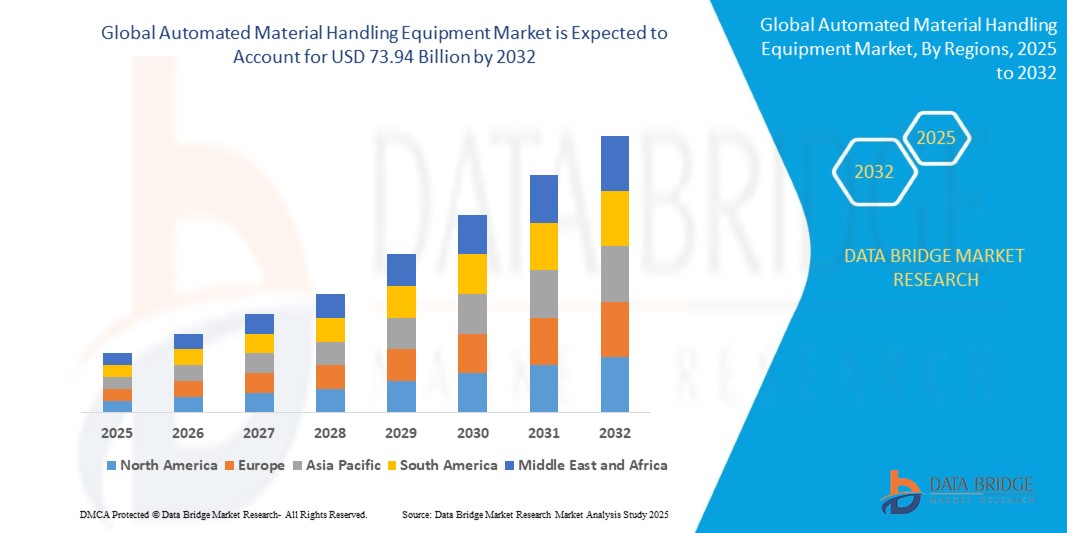
Automated Material Handling Equipment Market Size
- The global automated material handling equipment market size was valued at USD 34.77 billion in 2024 and is expected to reach USD 73.94 billion by 2032, at a CAGR of 9.89% during the forecast period
- This growth is driven by factors such as rising demand for automation in manufacturing, rapid expansion of e-commerce, and increasing focus on workplace safety and operational efficiency
Automated Material Handling Equipment Market Analysis
- Automated material handling equipment (AMHE) plays a crucial role in enhancing productivity, reducing labor costs, and improving safety across industries such as manufacturing, logistics, automotive, and e-commerce
- The demand for AMHE is significantly driven by the surge in e-commerce, need for efficient warehousing solutions, and increasing adoption of Industry 4.0 technologies
- Asia-Pacific is expected to dominate the automated material handling equipment market with largest market share of 39.4%, due to surging demand for cranes and hoists in the mining sector. This demand is further fueled by increased industrialization activities within the region, particularly in mining and construction industries
- North America is expected to be the fastest growing region in the automated material handling equipment market during the forecast period due to technological innovation, which is driving the development of new and more advanced automated material handling (AMH) equipment
- Robots segment is expected to dominate the market with largest market share of 22.01% due to the increasing demand for flexible, precise, and efficient handling solutions across various industries. Robots offer significant advantages in terms of speed, accuracy, and ability to operate continuously with minimal human intervention, making them ideal for applications in automotive, electronics, food and beverage, and e-commerce sectors
Report Scope and Automated Material Handling Equipment Market Segmentation
|
Attributes |
Automated Material Handling Equipment Key Market Insights |
|
Segments Covered |
|
|
Countries Covered |
North America
Europe
Asia-Pacific
Middle East and Africa
South America
|
|
Key Market Players |
|
|
Market Opportunities |
|
|
Value Added Data Infosets |
In addition to the insights on market scenarios such as market value, growth rate, segmentation, geographical coverage, and major players, the market reports curated by the Data Bridge Market Research also include in-depth expert analysis, geographically represented company-wise production and capacity, network layouts of distributors and partners, detailed and updated price trend analysis and deficit analysis of supply chain and demand. |
Automated Material Handling Equipment Market Trends
“Integration of AI, IoT, and Robotics in Material Handling Systems”
- One prominent trend in the automated material handling equipment market is the increasing integration of artificial intelligence (AI), Internet of Things (IoT), and robotics to create smart, adaptive handling systems
- These technologies enable real-time data analysis, predictive maintenance, and autonomous decision-making, significantly enhancing efficiency, throughput, and system reliability in warehouses and manufacturing environments
- For instance, AI-powered robotic systems can dynamically optimize picking routes and adapt to variable product flows, while IoT-enabled conveyors and storage systems provide continuous operational feedback to streamline supply chain operations
- This digital transformation is revolutionizing material handling processes, reducing downtime, improving resource utilization, and fueling the shift toward fully automated and intelligent logistics ecosystems
Automated Material Handling Equipment Market Dynamics
Driver
“Surging Demand for Automation Across Warehousing and Manufacturing”
- The growing need for operational efficiency, labor cost reduction, and enhanced productivity is driving the widespread adoption of automated material handling equipment across industries such as e-commerce, automotive, food & beverage, and pharmaceuticals
- As global supply chains become increasingly complex and demand for fast, accurate order fulfillment rises, companies are turning to automation to streamline processes, reduce errors, and improve safety in their operations
- The surge in e-commerce activities, especially post-pandemic, has placed immense pressure on warehouses and distribution centers to handle large volumes of inventory efficiently, further accelerating the adoption of automation
For instance,
- According to the International Federation of Robotics (IFR), the global installation of industrial robots reached 553,052 units in 2022, marking a 5% increase from the previous year—underscoring the rising reliance on automation in material handling and logistics
- As a result, the push for operational excellence and faster throughput is significantly increasing the demand for automated material handling equipment, making it a critical enabler of next-generation industrial and logistics infrastructure
Opportunity
“Growth in E-Commerce and Online Retailing Driving Demand for Automation”
- The rapid growth of e-commerce and online retailing is significantly fueling the demand for automated material handling solutions, as businesses seek faster, more efficient ways to manage large volumes of goods and ensure quick order fulfillment
- Automated systems like robotic pickers, conveyor belts, and automated storage and retrieval systems (AS/RS) are becoming essential to handle high order volumes, improve accuracy, and speed up processing times in distribution centers and warehouses
- The demand for real-time inventory management, faster shipping, and error-free order picking is driving the need for sophisticated automation technologies
For instance,
- In February 2024, according to a report by Statista, global e-commerce sales were projected to surpass USD 5 trillion in 2025, with more than 50% of these sales being processed through automated warehouses and fulfillment centers. This growth in online retailing creates a substantial market opportunity for AMHE providers to develop innovative solutions that can handle complex logistics and meet customer expectations for rapid delivery
- The continued expansion of the e-commerce sector is creating significant opportunities for automated material handling systems, particularly in last-mile delivery and warehouse automation, positioning the market for sustained growth in the coming years
Restraint/Challenge
“High Initial Investment and Maintenance Costs Hindering Market Growth”
- The high upfront cost of automated material handling equipment, along with ongoing maintenance and operational expenses, poses a significant challenge for businesses, particularly in emerging markets and small-to-medium enterprises (SMEs)
- Automated systems, which often require substantial capital investment in infrastructure, software, and integration, can range from tens of thousands to millions of dollars depending on the complexity and scale of the solution
- This financial burden can discourage smaller businesses from adopting automation, forcing them to rely on manual labor or outdated equipment, which hampers productivity and efficiency
For instance,
- In October 2024, according to a report by the International Federation of Robotics (IFR), the high initial costs and long payback periods of automated systems are some of the main barriers for companies in developing regions to adopt advanced material handling solutions. The reluctance to invest in these systems results in slower adoption rates, particularly among businesses with limited budgets and smaller operations
- As a result, such limitations can hinder the widespread adoption of automation, especially in price-sensitive sectors, ultimately restricting the overall growth of the AMHE market
Automated Material Handling Equipment Market Scope
The market is segmented on the basis of product, system type, software and services, function, and industry
|
Segmentation |
Sub-Segmentation |
|
By Product |
|
|
By System Type |
|
|
By Software and Services |
|
|
By Function |
|
|
By Industry |
|
In 2025, the robots is projected to dominate the market with a largest share in product segment
The robots segment is expected to dominate the automated material handling equipment market with the largest share of 22.01% due to the increasing demand for flexible, precise, and efficient handling solutions across various industries. Robots offer significant advantages in terms of speed, accuracy, and ability to operate continuously with minimal human intervention, making them ideal for applications in automotive, electronics, food and beverage, and e-commerce sectors
The e-commerce is expected to account for the largest share during the forecast period in industry segment
In 2025, the e-commerce segment is expected to dominate the market with the largest market share of 20.01% due to increased penetration of online shopping platforms, the existence of large online merchants, and rising logistics infrastructure are expected to drive the demand for this product in the e-commerce industry. Several grocery stores have evolved into convenience stores that provide fast-food-like services, including frozen food, ready-to-eat meals, and fresh items, which has led to the rise of the food industry
Automated Material Handling Equipment Market Regional Analysis
“Asia-Pacific Holds the Largest Share in the Automated Material Handling Equipment Market”
- Asia-Pacific is the dominant region in the global AMHE market with the largest market share of 35% of the market share in 2023
- China is a significant contributor to this growth with a largest market share of 23.3%, driven by its robust manufacturing sector, large-scale e-commerce operations, and government initiatives promoting automation
- India and Southeast Asian countries such as Thailand, Vietnam, and Indonesia are rapidly adopting automation technologies to enhance productivity and meet the demands of expanding industries such as automotive, electronics, and logistics
“North- America is Projected to Register the Highest CAGR in the Automated Material Handling Equipment Market”
- L'Amérique du Nord, et plus particulièrement les États-Unis, connaît une croissance significative du marché AMHE, les États-Unis devant croître à un TCAC de 10,5 % entre 2025 et 2032.
- La croissance de la région est alimentée par les progrès de l'IA, de la robotique et des technologies IoT, conduisant au développement de systèmes de manutention de matériaux plus efficaces et plus intelligents.
- Les secteurs de l'automobile et du commerce électronique aux États-Unis sont les principaux moteurs de cette croissance, les entreprises investissant massivement dans l'automatisation pour améliorer l'efficacité et réduire les coûts de main-d'œuvre.
Part de marché des équipements de manutention automatisés
Le paysage concurrentiel du marché fournit des détails par concurrent. Il comprend la présentation de l'entreprise, ses données financières, son chiffre d'affaires, son potentiel de marché, ses investissements en recherche et développement, ses nouvelles initiatives commerciales, sa présence mondiale, ses sites et installations de production, ses capacités de production, ses forces et faiblesses, le lancement de nouveaux produits, leur ampleur et leur portée, ainsi que la domination de ses applications. Les données ci-dessus ne concernent que les activités des entreprises par rapport à leur marché.
Les principaux leaders du marché opérant sur le marché sont :
- Daifuku Co., Ltd. (Japon)
- Dematic (Groupe KION) (Allemagne)
- Groupe SSI Schaefer (Allemagne)
- Honeywell Intelligrated (États-Unis)
- Vanderlande (Toyota Advanced Logistics Group) (Pays-Bas)
- Knapp AG (Autriche)
- Murata Machinery Ltd. (Japon)
- Systèmes de manutention de matériaux (MHS) (États-Unis)
- WITRON Logistique Intégrée (Allemagne)
- Interlake Mecalux (Mecalux) (Espagne)
- Beumer Group GmbH (Allemagne)
- Siemens Logistics (Allemagne)
- TGW Logistics Group GmbH (Autriche)
- Swisslog AG (KUKA Robotics) (Suisse)
- Fives Intralogistics (Groupe Fives) (France)
- Kardex AG (Suisse)
- Bastian Solutions (Toyota Advanced Logistics Group) (États-Unis)
- Elettric 80 (Italie)
- AutoStore AS (Norvège)
- System Logistics SpA (Italie)
Derniers développements sur le marché mondial des équipements de manutention automatisée
- En mars 2023, THiRARobotics Co., Ltd. a dévoilé ses robots mobiles autonomes de nouvelle génération, marquant une avancée majeure dans les domaines de la logistique, de l'entreposage, de la fabrication et de la santé. Ces robots de pointe représentent une avancée technologique majeure, offrant une efficacité, une adaptabilité et une polyvalence accrues dans de nombreux secteurs. Ce développement souligne la demande croissante de solutions intelligentes et autonomes pour rationaliser les processus de manutention et améliorer la productivité opérationnelle.
- En mars 2022, Toyota Industries Corporation a renforcé son portefeuille logistique en acquérant Viastore, un important fournisseur de systèmes de manutention. Cette acquisition stratégique renforce la capacité de Toyota Industries à proposer des solutions d'automatisation avancées, spécialement conçues pour les centres de distribution des petites et moyennes entreprises, consolidant ainsi son leadership dans le secteur. Cette opération illustre la tendance croissante à la consolidation du secteur et la demande croissante de solutions d'automatisation évolutives et performantes pour des entreprises de toutes tailles.
- En septembre 2020, Bohus s'est associé à Jungheinrich pour développer un entrepôt central ultramoderne près d'Oslo, à Lillestrøm. Le projet intègre une suite complète de solutions d'automatisation, comprenant des systèmes Miniload, des convoyeurs et des rayonnages à palettes haute capacité. Cette initiative reflète l'engagement de Bohus à optimiser ses opérations logistiques et à améliorer significativement l'efficacité de ses processus de manutention des marchandises. Ce développement illustre la demande croissante de technologies d'automatisation avancées pour les opérations d'entreposage et de logistique. L'intégration de ces solutions innovantes souligne la volonté du secteur d'améliorer l'efficacité opérationnelle, la rapidité des flux de production et la rentabilité, contribuant ainsi à l'expansion et à l'évolution continues du marché mondial de l'AMHE.
- En mars 2025, Bastian Solutions a fusionné avec Viastore North America, intégrant ainsi ses activités au sein du groupe Toyota Automated Logistics. Cette collaboration stratégique allie l'expertise de Bastian Solutions en intégration de systèmes à la spécialisation de Viastore dans les technologies de manutention automatisée de palettes, renforçant ainsi leurs compétences combinées en matière d'automatisation d'entrepôts et de solutions de stockage. Cette fusion illustre la tendance croissante à la consolidation au sein du secteur pour offrir des solutions d'automatisation plus complètes et plus avancées.
- En mars 2024, OTTO Motors, leader des robots mobiles autonomes (AMR), est devenu un acteur clé de la logistique de production autonome, un secteur pionnier de l'innovation industrielle. Avec l'intégration d'OTTO Motors à son portefeuille, Rockwell Automation a considérablement étendu ses capacités de manutention, offrant une solution complète pour optimiser les opérations sur l'ensemble de ses sites. Cette acquisition souligne la tendance croissante à l'intégration de la robotique autonome dans les systèmes de manutention afin d'améliorer l'efficacité, la flexibilité et l'évolutivité.
SKU-
Accédez en ligne au rapport sur le premier cloud mondial de veille économique

- Tableau de bord d'analyse de données interactif
- Tableau de bord d'analyse d'entreprise pour les opportunités à fort potentiel de croissance
- Accès d'analyste de recherche pour la personnalisation et les requêtes
- Analyse de la concurrence avec tableau de bord interactif
- Dernières actualités, mises à jour et analyse des tendances
- Exploitez la puissance de l'analyse comparative pour un suivi complet de la concurrence
Méthodologie de recherche
La collecte de données et l'analyse de l'année de base sont effectuées à l'aide de modules de collecte de données avec des échantillons de grande taille. L'étape consiste à obtenir des informations sur le marché ou des données connexes via diverses sources et stratégies. Elle comprend l'examen et la planification à l'avance de toutes les données acquises dans le passé. Elle englobe également l'examen des incohérences d'informations observées dans différentes sources d'informations. Les données de marché sont analysées et estimées à l'aide de modèles statistiques et cohérents de marché. De plus, l'analyse des parts de marché et l'analyse des tendances clés sont les principaux facteurs de succès du rapport de marché. Pour en savoir plus, veuillez demander un appel d'analyste ou déposer votre demande.
La méthodologie de recherche clé utilisée par l'équipe de recherche DBMR est la triangulation des données qui implique l'exploration de données, l'analyse de l'impact des variables de données sur le marché et la validation primaire (expert du secteur). Les modèles de données incluent la grille de positionnement des fournisseurs, l'analyse de la chronologie du marché, l'aperçu et le guide du marché, la grille de positionnement des entreprises, l'analyse des brevets, l'analyse des prix, l'analyse des parts de marché des entreprises, les normes de mesure, l'analyse globale par rapport à l'analyse régionale et des parts des fournisseurs. Pour en savoir plus sur la méthodologie de recherche, envoyez une demande pour parler à nos experts du secteur.
Personnalisation disponible
Data Bridge Market Research est un leader de la recherche formative avancée. Nous sommes fiers de fournir à nos clients existants et nouveaux des données et des analyses qui correspondent à leurs objectifs. Le rapport peut être personnalisé pour inclure une analyse des tendances des prix des marques cibles, une compréhension du marché pour d'autres pays (demandez la liste des pays), des données sur les résultats des essais cliniques, une revue de la littérature, une analyse du marché des produits remis à neuf et de la base de produits. L'analyse du marché des concurrents cibles peut être analysée à partir d'une analyse basée sur la technologie jusqu'à des stratégies de portefeuille de marché. Nous pouvons ajouter autant de concurrents que vous le souhaitez, dans le format et le style de données que vous recherchez. Notre équipe d'analystes peut également vous fournir des données sous forme de fichiers Excel bruts, de tableaux croisés dynamiques (Fact book) ou peut vous aider à créer des présentations à partir des ensembles de données disponibles dans le rapport.











