



Global Autonomous Wheelchair Market Segmentation, By Application (Neurologically Impaired Patients, Handicap Patients, and Others), End User (Rehab Centers, Hospitals, and Others), Distributional Channel (Retail and E-commerce) - Industry Trends and Forecast to 2032
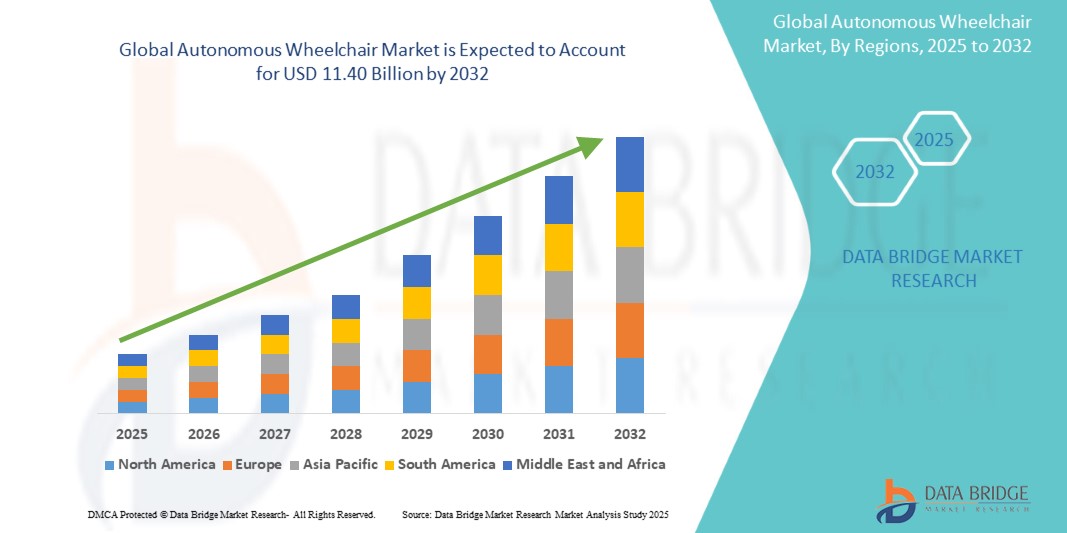
Autonomous Wheelchair Market Size
- The global Autonomous Wheelchair market was valued atUSD 6.34 billion in 2024and is expected to reachUSD 11.40 billion by 2032
- During the forecast period of 2025 to 2032 the market is likely to grow at aCAGR of 7.60%,primarily driven by rising demand for mobility solutions among the aging population
- This growth is driven by increasing prevalence of disabilities and neurological disorders, and advancements inAI-driven navigation systems
Autonomous Wheelchair Market Analysis
- Theautonomous wheelchairmarket has gained widespread acceptance due to the rising demand formobility solutions, increasing adoption inelderly care, and advancements inAI-powered navigation. Modern innovations, such assensor-based obstacle detectionandself-driving capabilities, have madeautonomous wheelchairsa preferred choice for individuals withlimited mobility, enhancingindependenceandaccessibility
- The market is primarily driven by thegrowing aging population, increasing cases ofdisabilities, and ongoingtechnological advancementsto improveuser safetyandnavigation efficiency. In addition,government initiativespromotinginclusive mobility solutionsand increasing investments inhealthcare roboticsare further accelerating market growth
- North Americadominates theautonomous wheelchairmarket due to its stronghealthcare infrastructure, rising adoption ofsmart assistive devices, and increasing presence ofleading medical technology firms
- For instance, in 2024,WHILL Inc. expanded its fleet ofAI-powered autonomous wheelchairsacross major U.S. airports, improving accessibility for passengers with mobility impairment
- Globally, theautonomous wheelchairmarket is witnessing rapid adoption, with innovations such asvoice-controlled navigation, IoT-enabled monitoring, andmachine-learning-driven route optimizationplaying a crucial role in market expansion
Report Scope and Autonomous Wheelchair Market Segmentation
|
Attributes |
Autonomous Wheelchair Key Market Insights |
|
Segments Covered |
|
|
Countries Covered |
North America
Europe
Asia-Pacific
Middle East and Africa
South America
|
|
Key Market Players |
|
|
Market Opportunities |
|
|
Value Added Data Infosets |
In addition to the insights on market scenarios such as market value, growth rate, segmentation, geographical coverage, and major players, the market reports curated by the Data Bridge Market Research also include depth expert analysis, patient epidemiology, pipeline analysis, pricing analysis, and regulatory framework. |
Autonomous Wheelchair Market Trends
“Growing Adoption of AI-Powered and Smart Mobility Solutions”
- The increasing demand forindependent mobility solutionsis driving the growth ofAutonomous Wheelchairs, widely recognized for their role inenhancing accessibilityandimproving quality of lifefor individuals withmobility impairments
- Healthcare andassistive technology companiesare integratingAI-driven navigation, real-time monitoring, andsensor-based safety featuresto offermore efficientanduser-friendly solutionsfor patients and the elderly
- The rising adoption ofIoT-enabled healthcareand awareness aboutsmart assistive devicesis accelerating the integration ofautonomous wheelchairsintohospitals, rehabilitation centers,andpublic spaces
For instance,
- For instance, in May 2024,WHILL Inc.launched anext-generation self-driving wheelchairwith AI-powered route optimization, enhancing accessibility in airports and shopping malls
- As the demand foradvanced mobility solutionsincreases,autonomous wheelchairswill continue to evolve, supportingelderly care, hospital mobility,andindependent livingon a global scale
Autonomous Wheelchair Market Dynamics
Driver
“Rising Demand for Smart and Assistive Mobility Solutions”
- The increasing globalaging populationand rising cases ofmobility impairmentsare driving demand forautonomous wheelchairs, offeringindependenceand improvedquality of lifefor users
- Advancements inAI-powered navigation, obstacle detection, andvoice-controlled assistanceare making these wheelchairs moreintuitive, safer,anduser-friendly
- Governments and healthcare institutions are increasingly investing insmart assistive devicesto enhanceaccessibilityinhospitals, public spaces,andelderly care facilities
For instance,
- in 2024,WHILL Inc.partnered withmultiple international airports to deploy AI-powered autonomous wheelchairs, improving mobility access for travelers with disabilities
- The increasing integration ofIoT, AI, and real-time trackinginautonomous wheelchairsis expected to further drive market growth, making them a vital part offuture mobility solutions
Opportunity
“Expansion of AI-Driven Mobility Solutions in Healthcare and Public Infrastructure”
- The growing adoption ofAI-powered assistive devicespresents a significant opportunity forautonomous wheelchairsinhospitals, rehabilitation centers,andpublic spacesto enhance mobility for individuals with disabilities
- Increasing investments insmart cityinfrastructureandaccessible transportation systemsare creating demand forself-driving wheelchairsin airports, shopping malls, and elderly care facilities
- The integration ofIoT, real-time tracking, andcloud-based remote monitoringoffers new business models such asrental services, on-demand mobility, and subscription-based assistive solutions
For instance,
- in 2024,SoftBank Roboticsannounced plans to deployAI-powered Autonomous Wheelchairsin major hospitals across Japan, enhancing patient mobility and healthcare efficiency
- As global accessibility regulations tighten, theautonomous wheelchairmarket is expected to expand rapidly, providinginnovative mobility solutionsfor the aging population and individuals with limited mobility
Restraint/Challenge
“High Cost of Advanced Mobility Solutions”
- Thehigh manufacturing costsassociated withAI-driven navigation, IoT integration,andsensor-based safety systemsmake autonomous wheelchairs expensive, limiting their adoption among middle- and low-income consumers
- Thehigh cost of maintenanceandfrequent software updatesrequired for AI-powered wheelchairs further restrict widespread adoption, particularly in developing regions
For instance,
- Despite technological advancements, the average cost of an AI-powered autonomous wheelchair remains over thousands of dollars making it inaccessible for many users without financial aid
- Addressing affordability challenges throughcost-effective production, government subsidies, andinsurance integrationwill be crucial for accelerating market growth
Autonomous Wheelchair Market Scope
The market is segmented on the basis of application, end users, and distribution channel.
|
Segmentation |
Sub-Segmentation |
|
By Application |
|
|
By End User |
|
|
By Distribution Channel |
|
Autonomous Wheelchair Market Regional Analysis
“North America is the Dominant Region in the Autonomous Wheelchair Market”
- North America leads the global Autonomous Wheelchair market, driven by the rising aging population, increasing demand for mobility assistance, and expanding healthcare infrastructure
- The U.S. dominates the region due to strong investments in assistive technology, the presence of key medical device manufacturers, and growing adoption of AI-powered wheelchairs in healthcare facilities
- Advancements in sensor-based navigation, increasing integration of IoT-enabled controls, and rising demand for personalized mobility solutions have further strengthened market growth
- In addition, government initiatives for disability inclusion, expanding rehabilitation centers, and growing consumer preference for autonomous mobility solutions contribute to the region’s market dominance
“Asia-Pacific is projected to register the Highest Growth Rate”
- Asia-Pacificis expected to witness the highest growth rate in theAutonomous Wheelchairmarket, driven by theincreasing aging population, rising demand forassistive mobility devices, and growing focus onhealthcare accessibility
- ChinaandJapanare emerging as key markets due to strong investments inrobotic mobility solutions, favorablegovernment policies, and the rapid adoption ofAI-powered wheelchairsin hospitals and rehabilitation centers
- Chinaleads the region inAutonomous Wheelchairproduction, with advancedsensor-based navigation technologiesand increasing adoption ofsmart mobility solutionsfor disabled individuals
- Japanis experiencing strong market growth due to itstechnological advancements, expandingelderly care facilities, and rising demand forpersonalized mobility assistance
- Supportiveregulatory frameworks, increasinghealthcare expenditures, and strategic collaborations betweenrobotics companiesand healthcare providers further contribute toAsia-Pacific’smarket expansion
Autonomous Wheelchair Market Share
The market competitive landscape provides details by competitor. Details included are company overview, company financials, revenue generated, market potential, investment in research and development, new market initiatives, global presence, production sites and facilities, production capacities, company strengths and weaknesses, product launch, product width and breadth, application dominance. The above data points provided are only related to the companies' focus related to market.
The Major Market Leaders Operating in the Market Are:
- Invacare Holdings Corporation (U.S.)
- Meyra Group GmbH (Germany)
- Sunrise Medical (Germany)
- Ottobock (Germany)
- Matia Mobility (U.S.)
- UPnRIDE (Israel)
- Pride Mobility Products Corp. (U.S.)
- Karman Healthcare, Inc. (U.S.)
- Levo AG (Switzerland)
Latest Developments in Global Autonomous Wheelchair Market
- In March 2022, Myera GmBh Nettiintroduced its latest product line,Netti Dynamic Adaptpro, featuring a fully dynamic configuration, enhanced maneuverability, and a 500mm turning radius without requiring leg support
- In December 2021, IRIS, a European SME specializing in innovative technologies, securedHORIZON EUfunding to develop an app designed to enable automatic driving for manual wheelchairs
- In October 2021, KARMA MedicalandPermobilsigned a memorandum of understanding (MOU) for the strategic distribution of products, utilizing their combined strengths to expand their market reach
- In April 2021, Permobilentered into an agreement to acquireProgeo, aiming to strengthen its presence in the Italian market and expand its portfolio of manual wheelchairs across Europe
- In June 2020, LUCIannounced the launch of its premier product,LUCI, a high-tech hardware and software platform that integrates with power wheelchairs to enhance stability, security, and connectivity
SKU-
Accédez en ligne au rapport sur le premier cloud mondial de veille économique

- Tableau de bord d'analyse de données interactif
- Tableau de bord d'analyse d'entreprise pour les opportunités à fort potentiel de croissance
- Accès d'analyste de recherche pour la personnalisation et les requêtes
- Analyse de la concurrence avec tableau de bord interactif
- Dernières actualités, mises à jour et analyse des tendances
- Exploitez la puissance de l'analyse comparative pour un suivi complet de la concurrence
Méthodologie de recherche
La collecte de données et l'analyse de l'année de base sont effectuées à l'aide de modules de collecte de données avec des échantillons de grande taille. L'étape consiste à obtenir des informations sur le marché ou des données connexes via diverses sources et stratégies. Elle comprend l'examen et la planification à l'avance de toutes les données acquises dans le passé. Elle englobe également l'examen des incohérences d'informations observées dans différentes sources d'informations. Les données de marché sont analysées et estimées à l'aide de modèles statistiques et cohérents de marché. De plus, l'analyse des parts de marché et l'analyse des tendances clés sont les principaux facteurs de succès du rapport de marché. Pour en savoir plus, veuillez demander un appel d'analyste ou déposer votre demande.
La méthodologie de recherche clé utilisée par l'équipe de recherche DBMR est la triangulation des données qui implique l'exploration de données, l'analyse de l'impact des variables de données sur le marché et la validation primaire (expert du secteur). Les modèles de données incluent la grille de positionnement des fournisseurs, l'analyse de la chronologie du marché, l'aperçu et le guide du marché, la grille de positionnement des entreprises, l'analyse des brevets, l'analyse des prix, l'analyse des parts de marché des entreprises, les normes de mesure, l'analyse globale par rapport à l'analyse régionale et des parts des fournisseurs. Pour en savoir plus sur la méthodologie de recherche, envoyez une demande pour parler à nos experts du secteur.
Personnalisation disponible
Data Bridge Market Research est un leader de la recherche formative avancée. Nous sommes fiers de fournir à nos clients existants et nouveaux des données et des analyses qui correspondent à leurs objectifs. Le rapport peut être personnalisé pour inclure une analyse des tendances des prix des marques cibles, une compréhension du marché pour d'autres pays (demandez la liste des pays), des données sur les résultats des essais cliniques, une revue de la littérature, une analyse du marché des produits remis à neuf et de la base de produits. L'analyse du marché des concurrents cibles peut être analysée à partir d'une analyse basée sur la technologie jusqu'à des stratégies de portefeuille de marché. Nous pouvons ajouter autant de concurrents que vous le souhaitez, dans le format et le style de données que vous recherchez. Notre équipe d'analystes peut également vous fournir des données sous forme de fichiers Excel bruts, de tableaux croisés dynamiques (Fact book) ou peut vous aider à créer des présentations à partir des ensembles de données disponibles dans le rapport.











