


Global Bactericides Market Segmentation, By Type (Copper-based, Dithiocarbamate, Amide, Antibiotic, and Others), Form (Liquid, Water Dispersible Granule, and Wettable Powder), Mode of Application (Foliar Spray, Soil Treatment, and Others), Crop Type (Cereals and Grains, Oilseeds and Pulses, Fruits and Vegetables, and Others) - Industry Trends and Forecast to 2033
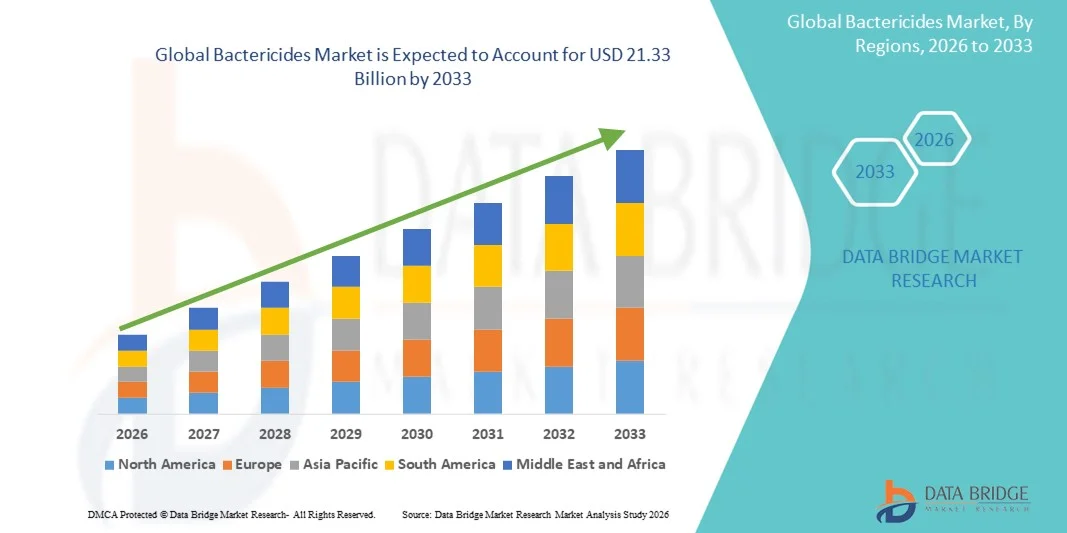
What is the Global Bactericides Market Size and Growth Rate?
- The global bactericides market size was valued at USD 14.86 billion in 2025 and is expected to reach USD 21.33 billion by 2033, at a CAGR of4.62% during the forecast period
- The increasing pressure to cater growing food demand among consumers because of the large population across the globe acts as one of the major factors driving the growth of bactericides market
- The rise in regulatory interventions for farming culture and safe farming, increase in need for food security and rise in need to ensure food quality in agricultural sector accelerate the market growth
What are the Major Takeaways of Bactericides Market?
- The increase in employment of the bactericide in order to reduce losses caused by bacterial infections and enhances yield and quality of crops and shift in farming techniques and technologies further influence the market
- In addition, reduction in arable land, acceptance of modern farming techniques, enhancement of agrochemical products, emerging technologies and high returns on investment positively affect the bactericides market. Furthermore, increase in demand for integrated management measures for bacterial plant pathogens extends profitable opportunities to the market players
- Europe dominated the bactericides market with a 41.8% revenue share in 2025, driven by stringent crop protection regulations, high adoption of advanced plant disease management practices, and strong emphasis on sustainable agriculture across major countries such as Germany, France, Spain, and Italy
- Asia-Pacific is projected to register the fastest CAGR of 11.2% from 2026 to 2033, driven by expanding agricultural output, rising food demand, and increasing awareness of crop disease management across China, India, Japan, South Korea, and Southeast Asia
- The Copper-based segment dominated the market with an estimated 44.2% share in 2025, as copper compounds remain the most widely used bactericides due to their broad-spectrum activity, cost-effectiveness, and proven efficacy against a wide range of bacterial diseases
Report Scope and Bactericides Market Segmentation
|
Attributes |
Bactericides Key Market Insights |
|
Segments Covered |
|
|
Countries Covered |
North America
Europe
Asia-Pacific
Middle East and Africa
South America
|
|
Key Market Players |
|
|
Market Opportunities |
|
|
Value Added Data Infosets |
In addition to the insights on market scenarios such as market value, growth rate, segmentation, geographical coverage, and major players, the market reports curated by the Data Bridge Market Research also include in-depth expert analysis, pricing analysis, brand share analysis, consumer survey, demography analysis, supply chain analysis, value chain analysis, raw material/consumables overview, vendor selection criteria, PESTLE Analysis, Porter Analysis, and regulatory framework. |
What is the Key Trend in the Bactericides Market?
Increasing Shift Toward Biological, Copper-Based, and Resistance-Management Bactericides
- The bactericides market is witnessing a growing shift toward biological and low-residue bactericides, driven by rising concerns over chemical residues, antimicrobial resistance, and environmental sustainability
- Manufacturers are increasingly developing copper-based formulations, plant-derived actives, and microbial bactericides that offer effective disease control while meeting stricter regulatory requirements
- Growing adoption of integrated pest management (IPM) practices is influencing demand for bactericides compatible with fungicides and bio-solutions
- For instance, companies such as Bayer, BASF, Syngenta, Corteva, and UPL are expanding bactericide portfolios focused on resistance management and sustainable crop protection
- Increasing incidence of bacterial diseases in fruits, vegetables, and high-value crops is accelerating adoption of targeted bactericide solutions
- As regulatory scrutiny intensifies, bactericides with improved safety profiles and reduced environmental impact are becoming central to modern agricultural disease management
What are the Key Drivers of Bactericides Market?
- Rising prevalence of bacterial plant diseases such as blights, spots, and wilts across cereals, fruits, vegetables, and ornamentals is a primary growth driver
- For instance, during 2024–2025, leading agrochemical companies launched new bactericide formulations targeting copper resistance and broader spectrum disease control
- Increasing global demand for high-quality crop yield and food security is boosting adoption of bactericides in commercial agriculture
- Expansion of high-value crop cultivation and protected farming practices increases the need for effective disease prevention solutions
- Technological advancements in formulation chemistry and delivery systems have improved bactericide efficacy and application efficiency
- Supported by investments in agricultural R&D and sustainable farming practices, the Bactericides market is expected to witness steady long-term growth
Which Factor is Challenging the Growth of the Bactericides Market?
- Stringent regulatory approvals and environmental restrictions on chemical bactericides limit product availability and innovation speed
- For instance, during 2024–2025, several active ingredients faced usage restrictions due to environmental and residue concerns in key agricultural regions
- Development of bacterial resistance reduces long-term effectiveness of traditional bactericides
- Limited availability of effective alternatives for certain bacterial diseases constrains treatment options for farmers
- High costs associated with product development, registration, and compliance increase barriers for new market entrants
- To address these challenges, companies are focusing on biological solutions, resistance-management strategies, and farmer education to support sustainable adoption of bactericides
How is the Bactericides Market Segmented?
The market is segmented on the basis of type, form, mode of application, and crop type.
- By Type
On the basis of type, the bactericides market is segmented into Copper-based, Dithiocarbamate, Amide, Antibiotic, and Others. The Copper-based segment dominated the market with an estimated 44.2% share in 2025, as copper compounds remain the most widely used bactericides due to their broad-spectrum activity, cost-effectiveness, and proven efficacy against a wide range of bacterial diseases. Copper-based bactericides are extensively applied in fruits, vegetables, and plantation crops, particularly in regions with high disease pressure. Their compatibility with integrated pest management (IPM) programs further supports dominance.
The Antibiotic bactericides segment is expected to grow at the fastest CAGR from 2026 to 2033, driven by rising need for targeted bacterial disease control, improved formulations with lower resistance risk, and increasing use in high-value horticultural crops under controlled application guidelines.
- By Form
On the basis of form, the bactericides market is segmented into Liquid, Water Dispersible Granule (WDG), and Wettable Powder (WP). The Liquid segment dominated the market with approximately 49.6% share in 2025, supported by ease of handling, uniform coverage, rapid absorption, and compatibility with modern spraying equipment. Liquid formulations enable precise dosage control and are widely preferred in large-scale commercial farming.
The Water Dispersible Granule segment is projected to grow at the fastest CAGR from 2026 to 2033, driven by advantages such as reduced dust formation, improved storage stability, safer handling, and growing adoption in mechanized and precision agriculture systems.
- By Mode of Application
On the basis of mode of application, the bactericides market is segmented into Foliar Spray, Soil Treatment, and Others. The Foliar Spray segment dominated the market with an estimated 57.8% share in 2025, as it provides direct and rapid control of bacterial infections affecting leaves, stems, and fruits. Foliar application is widely adopted due to its effectiveness, flexibility, and compatibility with existing crop protection practices.
The Soil Treatment segment is expected to grow at the fastest CAGR from 2026 to 2033, driven by increasing focus on preventing soil-borne bacterial diseases, improving root health, and protecting crops during early growth stages.
- By Crop Type
On the basis of crop type, the bactericides market is segmented into Cereals and Grains, Oilseeds and Pulses, Fruits and Vegetables, and Others. The Fruits and Vegetables segment dominated the market with a 46.5% share in 2025, driven by high susceptibility of horticultural crops to bacterial diseases and their high economic value. Growers invest heavily in bactericide applications to protect yield quality and market value.
The Oilseeds and Pulses segment is projected to grow at the fastest CAGR from 2026 to 2033, supported by expanding cultivation areas, rising global demand for protein-rich crops, and increased adoption of disease management solutions.
Which Region Holds the Largest Share of the Bactericides Market?
- Europe dominated the bactericides market with a 41.8% revenue share in 2025, driven by stringent crop protection regulations, high adoption of advanced plant disease management practices, and strong emphasis on sustainable agriculture across major countries such as Germany, France, Spain, and Italy. Widespread cultivation of high-value fruits, vegetables, and cereals, coupled with rising incidences of bacterial crop diseases, continues to fuel demand for bactericides across commercial farming operations
- Leading European agrochemical companies are focusing on low-toxicity formulations, copper optimization technologies, and bio-compatible bactericides to comply with regulatory standards, strengthening the region’s market leadership. Continuous investment in agricultural R&D and precision farming technologies supports long-term growth
- Strong regulatory frameworks, advanced farming infrastructure, and high farmer awareness further reinforce Europe’s dominant position in the global bactericides market
Germany Bactericides Market Insight
Germany is a major contributor within Europe, supported by advanced agricultural practices, strong agrochemical R&D capabilities, and widespread adoption of integrated pest management programs. Increasing focus on disease prevention in cereals, fruits, and specialty crops drives steady bactericide demand.
France Bactericides Market Insight
France shows strong market presence due to extensive horticulture and vineyard cultivation. Rising emphasis on crop quality, yield protection, and compliance with EU agricultural standards fuels consistent bactericide adoption.
Asia-Pacific Bactericides Market
Asia-Pacific is projected to register the fastest CAGR of 11.2% from 2026 to 2033, driven by expanding agricultural output, rising food demand, and increasing awareness of crop disease management across China, India, Japan, South Korea, and Southeast Asia. Large-scale cultivation of rice, fruits, vegetables, and pulses significantly boosts bactericide consumption. Rapid adoption of modern farming techniques, growing availability of cost-effective formulations, and government initiatives supporting crop productivity accelerate regional market growth. Expansion of agribusiness, rising farmer education programs, and increasing investment in sustainable crop protection solutions continue to strengthen long-term market prospects
China Bactericides Market Insight
China leads the Asia-Pacific market due to vast agricultural land, high disease pressure in intensive farming systems, and strong domestic production of agrochemicals. Government support for food security and crop protection further boosts demand.
Which are the Top Companies in Bactericides Market?
The bactericides industry is primarily led by well-established companies, including:
- ADAMA India Private Limited (India)
- Syngenta (Switzerland)
- LUMITOS AG (Germany)
- ADAMA Ltd. (Israel)
- Rainbow Agro (China)
- Oxon Italia S.p.A. (Italy)
- Marrone Bio Innovations (U.S.)
- Nissan Chemical Corporation (Japan)
- Arysta LifeScience Corporation (Japan)
- BASF SE (Germany)
- Nanjing Red Sun Co., Ltd. (China)
- Bayer AG (Germany)
- ChemChina (China)
- FMC Corporation (U.S.)
- Corteva (U.S.)
- Nufarm Global (Australia)
- UPL (India)
- Sumitomo Chemical Co., Ltd. (Japan)
- AMVAC Chemical Corporation (U.S.)
What are the Recent Developments in Global Bactericides Market?
- In November 2023, Bayer and Microsoft partnered to integrate agricultural data platforms to address data interoperability challenges across the farming ecosystem, enabling more connected and data-driven decision-making for growers and agribusiness stakeholders, which is expected to accelerate digital transformation in modern agriculture
- In November 2023, BASF, The Estée Lauder Companies, RSPO, and Solidaridad supported enhanced sustainable palm oil production initiatives in Lampung, Indonesia, focusing on responsible sourcing and improved agricultural practices, strengthening sustainability standards across global palm oil value chains
- In November 2023, Nufarm launched an innovative herbicide technology designed to help farmers manage hard-to-control weeds in cereal crops, improving weed resistance management and crop productivity, supporting more resilient and efficient cereal farming systems
- In October 2023, BASF announced plans to build a new fermentation facility for crop protection products at its Ludwigshafen site, expanding production capacity and innovation capabilities, reinforcing the company’s long-term commitment to advanced agricultural solutions
- In June 2022, Dhanuka Agritech Limited introduced Zanet in collaboration with Hokuko Chemical Industry Co., Ltd. and Nippon Soda Co., Ltd., combining fungicides and bactericides to control complex tomato diseases such as bacterial leaf spot and powdery mildew, enhancing integrated disease management and crop yield protection for farmers
SKU-
Accédez en ligne au rapport sur le premier cloud mondial de veille économique

- Tableau de bord d'analyse de données interactif
- Tableau de bord d'analyse d'entreprise pour les opportunités à fort potentiel de croissance
- Accès d'analyste de recherche pour la personnalisation et les requêtes
- Analyse de la concurrence avec tableau de bord interactif
- Dernières actualités, mises à jour et analyse des tendances
- Exploitez la puissance de l'analyse comparative pour un suivi complet de la concurrence
Méthodologie de recherche
La collecte de données et l'analyse de l'année de base sont effectuées à l'aide de modules de collecte de données avec des échantillons de grande taille. L'étape consiste à obtenir des informations sur le marché ou des données connexes via diverses sources et stratégies. Elle comprend l'examen et la planification à l'avance de toutes les données acquises dans le passé. Elle englobe également l'examen des incohérences d'informations observées dans différentes sources d'informations. Les données de marché sont analysées et estimées à l'aide de modèles statistiques et cohérents de marché. De plus, l'analyse des parts de marché et l'analyse des tendances clés sont les principaux facteurs de succès du rapport de marché. Pour en savoir plus, veuillez demander un appel d'analyste ou déposer votre demande.
La méthodologie de recherche clé utilisée par l'équipe de recherche DBMR est la triangulation des données qui implique l'exploration de données, l'analyse de l'impact des variables de données sur le marché et la validation primaire (expert du secteur). Les modèles de données incluent la grille de positionnement des fournisseurs, l'analyse de la chronologie du marché, l'aperçu et le guide du marché, la grille de positionnement des entreprises, l'analyse des brevets, l'analyse des prix, l'analyse des parts de marché des entreprises, les normes de mesure, l'analyse globale par rapport à l'analyse régionale et des parts des fournisseurs. Pour en savoir plus sur la méthodologie de recherche, envoyez une demande pour parler à nos experts du secteur.
Personnalisation disponible
Data Bridge Market Research est un leader de la recherche formative avancée. Nous sommes fiers de fournir à nos clients existants et nouveaux des données et des analyses qui correspondent à leurs objectifs. Le rapport peut être personnalisé pour inclure une analyse des tendances des prix des marques cibles, une compréhension du marché pour d'autres pays (demandez la liste des pays), des données sur les résultats des essais cliniques, une revue de la littérature, une analyse du marché des produits remis à neuf et de la base de produits. L'analyse du marché des concurrents cibles peut être analysée à partir d'une analyse basée sur la technologie jusqu'à des stratégies de portefeuille de marché. Nous pouvons ajouter autant de concurrents que vous le souhaitez, dans le format et le style de données que vous recherchez. Notre équipe d'analystes peut également vous fournir des données sous forme de fichiers Excel bruts, de tableaux croisés dynamiques (Fact book) ou peut vous aider à créer des présentations à partir des ensembles de données disponibles dans le rapport.











