



Marché mondial des dispositifs d'assistance pour salle de bains et toilettes : segmentation par type de produit (chaises percées, sièges et tabourets de douche, élévateurs de bain, rehausseurs de siège de toilette, aides au bain, barres d'appui et poignées), canal de distribution (en ligne et hors ligne) – Tendances du secteur et prévisions jusqu'en 2033
Taille du marché des dispositifs d'assistance aux toilettes
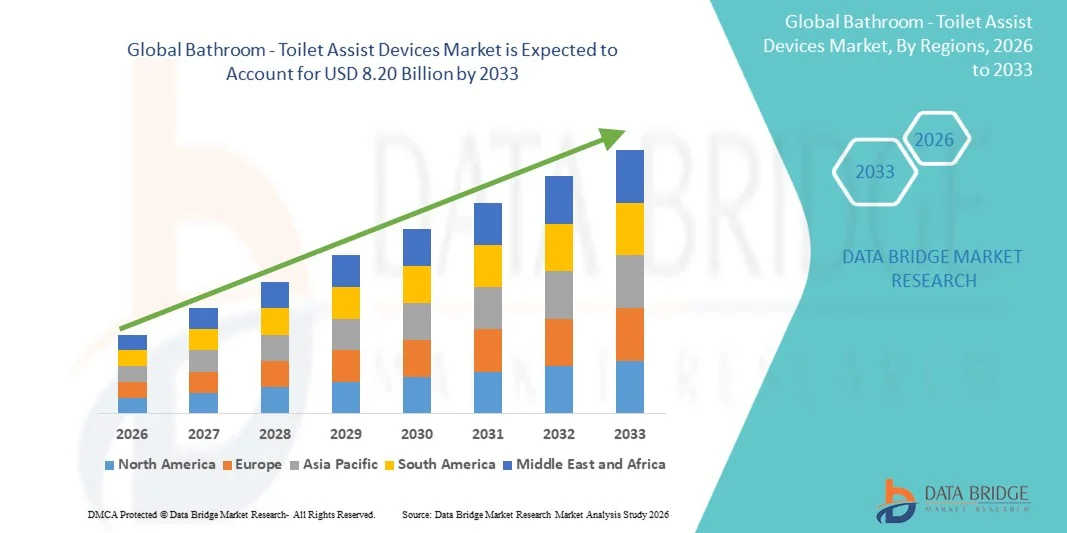
- Le marché mondial des dispositifs d'assistance à l'utilisation des toilettes était évalué à 4,92 milliards de dollars américains en 2025 et devrait atteindre 8,20 milliards de dollars américains d'ici 2033 , avec un taux de croissance annuel composé (TCAC) de 6,60 % au cours de la période de prévision.
- La croissance du marché est largement alimentée par une sensibilisation accrue aux soins aux personnes âgées et à la sécurité des patients, ainsi que par les progrès réalisés dans le domaine des technologies d'assistance ergonomiques et adaptées aux salles de bains, ce qui conduit à une adoption accrue dans les établissements résidentiels et de soins de santé.
- De plus, la demande croissante de solutions de salle de bains conviviales, sûres et accessibles pour les personnes âgées et les personnes handicapées stimule l'adoption des dispositifs d'assistance à l'utilisation des toilettes, contribuant ainsi de manière significative à la croissance du secteur.
Analyse du marché des dispositifs d'assistance aux toilettes pour salle de bain
- Les dispositifs d'aide à la salle de bain, notamment les cadres de soutien pour toilettes, les barres d'appui et les barres de sécurité, sont de plus en plus essentiels dans les environnements résidentiels et de soins de santé, offrant une sécurité, une accessibilité et une autonomie accrues aux personnes âgées et aux personnes handicapées.
- La demande croissante pour ces dispositifs est principalement alimentée par une meilleure prise de conscience des soins aux personnes âgées, des préoccupations croissantes en matière de sécurité des patients et une préférence pour des solutions ergonomiques et conviviales.
- L'Amérique du Nord a dominé le marché des dispositifs d'assistance pour la salle de bain et les toilettes avec la plus grande part de revenus (44,5 %) en 2025, grâce à une infrastructure de soins de santé avancée, à une forte adoption des solutions de sécurité et d'accessibilité et à une forte présence d'acteurs clés du secteur. Les États-Unis ont connu une croissance significative des installations dans les foyers, les résidences pour personnes âgées et les hôpitaux.
- La région Asie-Pacifique devrait connaître la croissance la plus rapide sur le marché des dispositifs d'assistance pour salle de bain et toilettes au cours de la période de prévision, avec un TCAC projeté de 12,8 %, alimentée par l'urbanisation croissante, la hausse des revenus disponibles et la sensibilisation accrue aux solutions d'accessibilité et de prise en charge des personnes âgées.
- Le segment des chaises percées a dominé le marché avec une part de 38,7 % en 2025, en raison de leur rôle essentiel pour assurer l'indépendance et la facilité d'utilisation des personnes âgées et des personnes à mobilité réduite.
Portée du rapport et segmentation du marché des dispositifs d'assistance aux toilettes
|
Attributs |
Dispositifs d'assistance aux toilettes pour salle de bain : principaux enseignements du marché |
|
Segments couverts |
|
|
Countries Covered |
North America
Europe
Asia-Pacific
Middle East and Africa
South America
|
|
Key Market Players |
• Drive DeVilbiss Healthcare (U.S.) |
|
Market Opportunities |
|
|
Value Added Data Infosets |
In addition to the insights on market scenarios such as market value, growth rate, segmentation, geographical coverage, and major players, the market reports curated by the Data Bridge Market Research also include in-depth expert analysis, patient epidemiology, pipeline analysis, pricing analysis, and regulatory framework. |
Bathroom - Toilet Assist Devices Market Trends
“Enhanced Convenience Through Ergonomic and Accessibility Features”
- A significant and accelerating trend in the global Bathroom - Toilet Assist Devices market is the increasing focus on ergonomics, accessibility, and safety for users, particularly the elderly, disabled, and post-operative patients. Manufacturers are developing products such as grab bars, raised toilet seats, shower chairs, and support frames that ensure stability, reduce the risk of falls, and enhance independence in daily hygiene routines
- For instance, some premium bathroom assistive devices offer adjustable heights and foldable designs, making them suitable for both residential and healthcare facility applications. Similarly, multi-functional shower chairs combine seating with handrails to improve safety and user comfort
- The emphasis on product durability, comfort, and ease of use is driving innovation in materials and designs, including lightweight but strong construction and anti-slip surfaces. Furthermore, growing awareness of home healthcare and rehabilitation needs is encouraging wider adoption of these devices in households, clinics, and assisted living facilities
- Manufacturers are also introducing aesthetically appealing designs that integrate seamlessly into modern bathrooms, enhancing user satisfaction while maintaining functional utility
- This trend toward more ergonomic, safe, and user-friendly bathroom assistive devices is fundamentally reshaping consumer expectations, prompting companies to invest in research, design, and customization for diverse user requirements
- The demand for accessible and reliable bathroom assistive devices is growing rapidly across both homecare and clinical sectors, as consumers increasingly prioritize safety, convenience, and quality in hygiene-related equipment
Bathroom - Toilet Assist Devices Market Dynamics
Driver
“Growing Need Due to Aging Population and Rising Homecare Awareness”
- The increasing elderly population worldwide, along with a growing emphasis on fall prevention and in-home rehabilitation, is driving strong demand for Bathroom - Toilet Assist Devices. Healthcare facilities, rehabilitation centers, and assisted living institutions are adopting these devices to enhance patient safety and comfort
- For instance, hospitals in Japan have begun installing shower chairs with integrated anti-slip surfaces and adjustable heights in patient bathrooms to reduce fall incidents and improve mobility during post-surgery recovery. Such initiatives demonstrate how ergonomic designs directly improve patient outcomes and stimulate market adoption
- Rising disposable incomes, coupled with government programs promoting accessible facilities in both residential and commercial spaces, further support market expansion
- The convenience, safety, and independence offered by grab bars, raised seats, and shower chairs are key factors driving adoption in households and healthcare environments alike
- In addition, the growing focus on preventive care and patient-centric homecare solutions encourages consumers and caregivers to integrate these devices into daily routines, expanding market penetration across both developed and emerging regions
Restraint/Challenge
“High Costs and Limited Awareness in Developing Regions”
- Concerns regarding the relatively high cost of advanced Bathroom - Toilet Assist Devices can limit adoption, particularly in developing countries or among price-sensitive consumers.
- For instance, in some rural areas of India, households often rely on traditional toilet designs without accessibility aids due to cost constraints, limiting awareness and adoption of ergonomic devices. This highlights the gap between availability and accessibility in emerging markets.
- Inconsistent product quality and insufficient adherence to safety standards may create consumer hesitation, especially for first-time buyers unfamiliar with certified devices.
- While basic devices are increasingly affordable, premium models with enhanced stability, multi-functionality, and ergonomic designs often carry higher price tags, restricting widespread use.
- Addressing these challenges through targeted consumer education, cost-effective product development, and standardization of safety certifications will be vital for sustained growth in the market.
Bathroom - Toilet Assist Devices Market Scope
The market is segmented on the basis of Product Type and Distribution Channel.
• By Product Type
On the basis of product type, the Bathroom - Toilet Assist Devices market is segmented into Commodes, Shower Chairs and Stools, Bath Lifts, Toilet Seat Raisers, Bath Aids, Handgrips, and Grab Bars. The Commodes segment dominated the market with a 38.7% share in 2025, due to their critical role in providing independence and ease of use for elderly and mobility-impaired individuals. Hospitals, rehabilitation centers, and homecare users heavily rely on commodes for patient comfort. Rising awareness of assisted living solutions enhances adoption. Designs with adjustable height, foldable options, and built-in safety features improve convenience. Clinical guidelines recommend commodes for post-surgery and long-term care. Healthcare facilities and homecare providers prioritize sturdy and easy-to-clean commodes. Urban and semi-urban adoption is higher due to accessibility and affordability. E-commerce channels increase product reach. Insurance coverage for mobility aids supports revenue. Technological enhancements, such as ergonomic designs, increase user compliance. Manufacturers focus on lightweight materials for ease of movement. Telehealth programs highlight home use for patient independence.
The Shower Chairs and Stools segment is expected to witness the fastest CAGR of 16.2% from 2026 to 2033, driven by growing awareness of fall prevention and safer bathing solutions for seniors. Homecare adoption increases due to the convenience of shower seating. Adjustable and foldable designs improve accessibility. Hospitals and rehabilitation centers recommend shower chairs for patient safety. E-commerce platforms expand reach to remote and semi-urban users. Occupational therapists and physiotherapists emphasize safe bathing practices. Integration with preventive care programs boosts awareness. Lightweight and water-resistant materials enhance comfort. Government initiatives promoting elderly care encourage adoption. Product innovation in ergonomic seating increases compliance. Caregivers prefer chairs that reduce strain during bathing. Rising elderly populations globally strengthen market growth. Insurance coverage in some regions supports purchases. Homecare rehabilitation programs increase recurring usage.
• By Distribution Channel
On the basis of distribution channel, the market is segmented into Online and Offline. The Offline segment dominated with a 62.3% share in 2025, owing to the preference of hospitals, clinics, and elderly care facilities for direct evaluation and purchase. Offline sales allow physical inspection for durability, stability, and comfort. Retailers and medical supply stores provide personalized guidance. Healthcare facilities prioritize immediate availability for patient care. Training and demonstrations at retail outlets increase adoption. Brand visibility through offline channels enhances trust. Bulk purchases by hospitals and rehab centers boost revenue. Urban adoption is higher due to accessibility. Repeat purchases are easier in retail channels. Staff recommendations at hospitals and care centers influence adoption. Insurance support facilitates affordability. Multi-brand availability at offline stores encourages choice.
The Online segment is expected to witness the fastest CAGR of 17.5% from 2026 to 2033, driven by increasing digital penetration, e-commerce growth, and home delivery convenience. Telehealth and virtual consultations recommend online purchases for homecare users. E-commerce platforms provide wide product variety and price comparisons. Subscription-based programs for mobility aids support recurring sales. Rural and semi-urban areas benefit from online availability. Product reviews and social media influence consumer decisions. Online platforms enable personalized recommendations for ergonomic and adjustable devices. Digital awareness campaigns promote safety and independence. Convenience and contactless delivery increase adoption during pandemic periods. Insurance coverage via digital pharmacies supports purchases. Integration with home rehabilitation programs encourages online adoption. Logistics improvements reduce delivery times. Online platforms also facilitate access to innovative designs not locally available.
Bathroom - Toilet Assist Devices Market Regional Analysis
- North America dominated the bathroom – toilet assist devices market with the largest revenue share of 44.5% in 2025, driven by advanced healthcare infrastructure, high adoption of safety and accessibility solutions, and a strong presence of key industry players
- The market growth is supported by increasing awareness of elderly care, rehabilitation needs, and accessibility standards in homes, assisted living facilities, and hospitals
- Consumers in the region prioritize devices that enhance independence, reduce the risk of falls, and improve overall hygiene and comfort. For instance, several assisted living centers in the U.S. have introduced ergonomic shower chairs and raised toilet seats with built-in support handles, ensuring safety and convenience for elderly residents while meeting regulatory requirements
U.S. Bathroom - Toilet Assist Devices Market Insight
The U.S. bathroom – toilet assist devices market captured the largest revenue share within North America, fueled by widespread adoption of in-home accessibility solutions and increasing investments in eldercare infrastructure. Hospitals, rehabilitation centers, and residential care facilities are increasingly incorporating grab bars, adjustable-height toilets, and shower seats into bathrooms to ensure patient safety and compliance with ADA standards. In addition, awareness campaigns and partnerships between healthcare providers and manufacturers have promoted the adoption of advanced assistive devices. For example, a major U.S. hospital network has implemented smart, adjustable-height toilets with anti-slip surfaces for post-operative patients, helping to reduce incidents of falls and improve recovery outcomes.
Europe Bathroom - Toilet Assist Devices Market Insight
The Europe bathroom – toilet assist devices market is projected to expand at a substantial CAGR throughout the forecast period, primarily driven by stringent safety regulations and the growing demand for accessible solutions in both homes and commercial facilities. Increasing urbanization and the desire for safe, independent living among elderly populations are further fueling growth. Consumers are attracted to products that combine functionality, hygiene, and energy efficiency. For instance, several residential renovation projects in Germany now include shower chairs with foldable handrails and anti-slip flooring, catering to elderly and mobility-impaired residents while maintaining aesthetic appeal.
U.K. Bathroom - Toilet Assist Devices Market Insight
The U.K. bathroom – toilet assist devices market is expected to grow at a noteworthy CAGR during the forecast period, driven by rising concerns about safety, burglary, and accessibility in residential and commercial properties. Both homeowners and institutions are increasingly adopting devices that enhance comfort and independence for elderly and differently-abled users. The growing e-commerce infrastructure in the U.K. also facilitates easy access to advanced assistive devices. For example, a leading U.K. rehabilitation clinic now offers custom-fitted raised toilet seats with padded armrests for patients recovering from orthopedic surgery, highlighting the trend toward personalized safety solutions.
Germany Bathroom - Toilet Assist Devices Market Insight
The Germany bathroom – toilet assist devices market is expected to expand at a considerable CAGR, fueled by increasing awareness of accessibility, digital safety, and technologically advanced solutions. Germany’s strong focus on sustainability and innovation promotes the adoption of eco-friendly materials and ergonomic designs. Residential and commercial buildings are increasingly integrating safety features into bathroom infrastructure. For instance, a German assisted-living facility recently installed lightweight, foldable shower chairs with corrosion-resistant coatings and built-in support rails, demonstrating a balance between durability, safety, and user convenience.
Asia-Pacific Bathroom - Toilet Assist Devices Market Insight
The Asia-Pacific bathroom – toilet assist devices market is poised to grow at the fastest CAGR of 12.8% during the forecast period, driven by rapid urbanization, rising disposable incomes, and growing awareness of elderly care and accessibility solutions. Government initiatives promoting aging-in-place and healthcare accessibility are boosting market adoption across the region. For instance, in Japan, smart, ergonomically designed toilet frames and shower chairs with adjustable heights are increasingly being adopted in both homes and senior care facilities, helping elderly users maintain independence and safety. In addition, the region is emerging as a manufacturing hub for bathroom assistive devices, making high-quality products more affordable and accessible.
Japan Bathroom - Toilet Assist Devices Market Insight
The Japan bathroom – toilet assist devices market is gaining momentum due to a combination of high-tech culture, an aging population, and increasing focus on safety and convenience. The demand for user-friendly, secure access solutions is growing in residential, hospital, and senior-care environments. For example, Japanese homecare providers are now offering adjustable shower stools with integrated safety handles, which allow elderly residents to safely bathe independently, reflecting the country’s commitment to accessibility and quality-of-life improvements.
China Bathroom - Toilet Assist Devices Market Insight
The China bathroom – toilet assist devices market accounted for the largest revenue share in Asia-Pacific in 2025, supported by a rapidly growing middle class, urbanization, and heightened awareness of eldercare and accessibility solutions. Smart and ergonomic assistive devices, such as raised toilet seats with padded handles and foldable shower chairs, are increasingly used in homes, hospitals, and rehabilitation centers. For instance, several urban residential complexes in Beijing have incorporated anti-slip shower chairs and adjustable-height toilets in common bathroom facilities, promoting safety and independence among elderly residents while reflecting the government’s smart home and urban healthcare initiatives.
Bathroom - Toilet Assist Devices Market Share
The Bathroom - Toilet Assist Devices industry is primarily led by well-established companies, including:
• Drive DeVilbiss Healthcare (U.S.)
• Etac AB (Sweden)
• Arjo AB (Sweden)
• Invacare Corporation (U.S.)
• Medline Industries (U.S.)
• Sunrise Medical (U.K.)
• Permobil AB (Sweden)
• Moen Incorporated (U.S.)
• Hugo Mobility (U.S.)
• Carex Health Brands (U.S.)
• Armedica (Australia)
• AquaSense (U.S.)
• Stander Inc. (U.S.)
• Drive Medical (U.S.)
• Essential Medical Supply (U.S.)
• ProMed Products (U.S.)
• Aqua Assist (Germany)
• Bathsafe Solutions (U.K.)
• Homecraft (U.K.)
• TOTO Ltd. (Japan)
Latest Developments in Global Bathroom - Toilet Assist Devices Market
- In January 2021, TOTO LTD introduced an innovative smart commode device at the Consumer Electronics Show (CES 2021) that could sense and analyze user body movements and interaction patterns, then provide personalized dietary and wellness insights via a connected smartphone app — marking an early step toward smart bathroom assistive technologies in the market
- In April 2023, TIDI Products LLC, a U.S. medical product manufacturer, launched the Posey Wireless Toilet Sensor, a battery‑powered sensor system that detects when an individual stands up from the toilet and sends alerts via sound or messages to caregivers to help prevent bathroom falls, improving safety in healthcare and home care environments
- In March 2023, Invacare Corporation launched a new line of raised toilet seats with adjustable height options to enhance user comfort and safety, specifically addressing the needs of the elderly and individuals with reduced mobility
- In October 2024, Sunrise Medical, a provider of mobility products, acquired Nuprodx Inc., a supplier of bathroom mobility aids such as bath transfer benches and shower/commode chairs. This acquisition expanded Sunrise Medical’s bathroom and toilet assist device portfolio to include additional products tailored for seniors and people with physical impairments
- In December 2024, Hollister Inc. announced the acquisition of Ostomy Supplies, broadening its product offerings in home‑care solutions including bathroom safety and continence care devices, supporting the holistic management of mobility and hygiene needs for disabled and elderly users
- In April 2025, Carex Health Brands launched a new raised toilet seat with integrated safety rails, offering enhanced stability and support for elderly users and individuals with limited mobility. The product aimed to promote safer and more independent bathroom use at home
- En mars 2025, Arjo a annoncé un partenariat stratégique avec Medline Industries pour co-développer et co-commercialiser des dispositifs d'accessibilité et de sécurité avancés pour les toilettes destinés aux personnes handicapées et aux personnes âgées, élargissant ainsi la portée des produits dans les secteurs des soins institutionnels et à domicile.
- En août 2025, Drive DeVilbiss Healthcare a annoncé la création d'une nouvelle usine de fabrication au Mexique afin de réduire les coûts de production et d'améliorer l'efficacité de sa chaîne d'approvisionnement pour sa gamme d'appareils d'assistance à la salle de bain et aux toilettes, renforçant ainsi sa réactivité à la demande du marché et sa position concurrentielle en Amérique du Nord et en Amérique latine.
SKU-
Accédez en ligne au rapport sur le premier cloud mondial de veille économique

- Tableau de bord d'analyse de données interactif
- Tableau de bord d'analyse d'entreprise pour les opportunités à fort potentiel de croissance
- Accès d'analyste de recherche pour la personnalisation et les requêtes
- Analyse de la concurrence avec tableau de bord interactif
- Dernières actualités, mises à jour et analyse des tendances
- Exploitez la puissance de l'analyse comparative pour un suivi complet de la concurrence
Méthodologie de recherche
La collecte de données et l'analyse de l'année de base sont effectuées à l'aide de modules de collecte de données avec des échantillons de grande taille. L'étape consiste à obtenir des informations sur le marché ou des données connexes via diverses sources et stratégies. Elle comprend l'examen et la planification à l'avance de toutes les données acquises dans le passé. Elle englobe également l'examen des incohérences d'informations observées dans différentes sources d'informations. Les données de marché sont analysées et estimées à l'aide de modèles statistiques et cohérents de marché. De plus, l'analyse des parts de marché et l'analyse des tendances clés sont les principaux facteurs de succès du rapport de marché. Pour en savoir plus, veuillez demander un appel d'analyste ou déposer votre demande.
La méthodologie de recherche clé utilisée par l'équipe de recherche DBMR est la triangulation des données qui implique l'exploration de données, l'analyse de l'impact des variables de données sur le marché et la validation primaire (expert du secteur). Les modèles de données incluent la grille de positionnement des fournisseurs, l'analyse de la chronologie du marché, l'aperçu et le guide du marché, la grille de positionnement des entreprises, l'analyse des brevets, l'analyse des prix, l'analyse des parts de marché des entreprises, les normes de mesure, l'analyse globale par rapport à l'analyse régionale et des parts des fournisseurs. Pour en savoir plus sur la méthodologie de recherche, envoyez une demande pour parler à nos experts du secteur.
Personnalisation disponible
Data Bridge Market Research est un leader de la recherche formative avancée. Nous sommes fiers de fournir à nos clients existants et nouveaux des données et des analyses qui correspondent à leurs objectifs. Le rapport peut être personnalisé pour inclure une analyse des tendances des prix des marques cibles, une compréhension du marché pour d'autres pays (demandez la liste des pays), des données sur les résultats des essais cliniques, une revue de la littérature, une analyse du marché des produits remis à neuf et de la base de produits. L'analyse du marché des concurrents cibles peut être analysée à partir d'une analyse basée sur la technologie jusqu'à des stratégies de portefeuille de marché. Nous pouvons ajouter autant de concurrents que vous le souhaitez, dans le format et le style de données que vous recherchez. Notre équipe d'analystes peut également vous fournir des données sous forme de fichiers Excel bruts, de tableaux croisés dynamiques (Fact book) ou peut vous aider à créer des présentations à partir des ensembles de données disponibles dans le rapport.











