


Global Battlefield Management Systems Market Segmentation, By Component (Communication Devices, Imaging Devices, Display Devices, Tracking Devices, Computer Hardware Devices, Data Distribution Unit, Night Vision Devices, Software, and Others), Solution (Hardware and Software), Platform (Armored Vehicle, Headquarter and Command Centers, and Soldier Systems), Installation Type (New Installation and Upgradation), System (Computing, Communication & Networking, Command & Control, Navigation, Imaging, and Mapping), End User (Army and Air Force)- Industry Trends and Forecast to 2033
Quelle est la taille du marché et le taux de croissance des systèmes de gestion des champs de bataille mondiaux
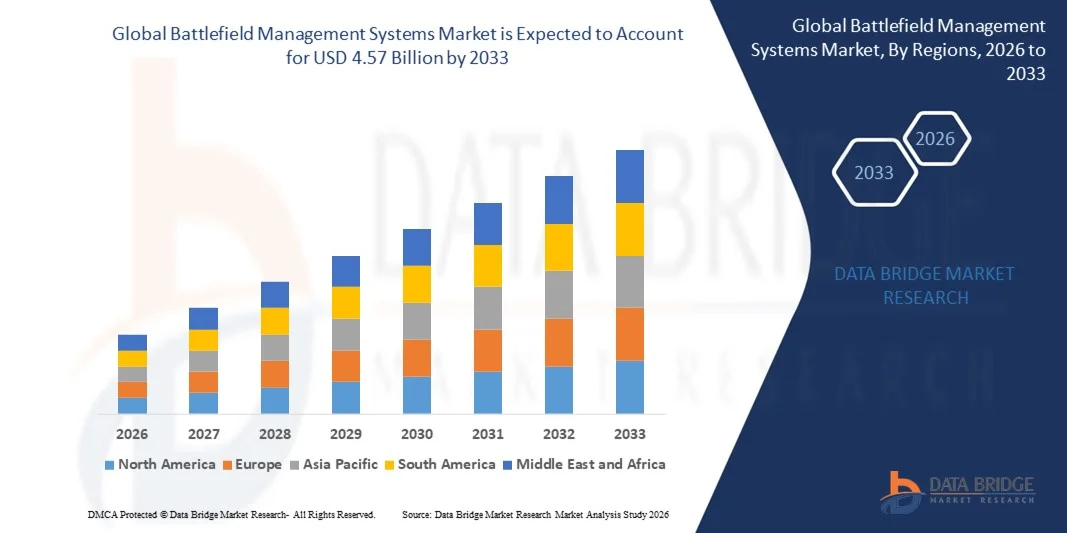
- La taille du marché des systèmes mondiaux de gestion des champs de bataille a été évaluée à3,18 milliards de dollars en 2025et devrait atteindre4,57 milliards de dollars en 2033, à unTCAC de 4,62 %pendant la période de prévision
- La croissance du marché est largement alimentée par la demande croissante de sensibilisation à la situation en temps réel et d'amélioration de la communication entre les opérations militaires modernes
- L'augmentation des programmes de modernisation de la défense et l'augmentation des investissements dans les technologies avancées de commandement et de contrôle soutiennent davantage l'expansion du marché
Quels sont les principaux débouchés du marché des systèmes de gestion des champs de bataille
- Le marché connaît une croissance régulière en raison de la nécessité croissante de coordonner les opérations, d'améliorer la prise de décisions et de gérer efficacement les ressources entre les forces terrestres, aériennes et navales.
- Les progrès technologiques tels que l'intelligence artificielle, les réseaux militaires basés sur le cloud et les systèmes de capteurs intégrés améliorent l'efficacité opérationnelle et la fiabilité des solutions de gestion des champs de bataille
- L'Amérique du Nord a dominé le marché des systèmes de gestion des champs de bataille avec la plus grande part des revenus de 39,56 % en 2025, grâce à des budgets de défense importants, à des programmes de modernisation militaire en cours et à l'accent mis sur les capacités de guerre axées sur le réseau
- La région Asie-Pacifique devrait connaître le taux de croissance le plus élevé du monde.systèmes de gestion des champs de bataillemarché, entraîné par des tensions géopolitiques croissantes, l'expansion des budgets de défense et l'adoption rapide de systèmes de surveillance et de communication avancés. Des pays comme la Chine, l'Inde, le Japon et la Corée du Sud investissent massivement dans les capacités de gestion du champ de bataille de la prochaine génération pour améliorer l'efficacité opérationnelle et la sensibilisation à la situation
- En 2025, le segment des appareils de communication détenait la plus grande part de revenu du marché en raison de la nécessité cruciale d'un échange de voix et de données sécurisé et en temps réel entre les unités militaires opérant dans des environnements dynamiques. Ces dispositifs assurent une communication cryptée entre les centres de commandement, les véhicules et les soldats, ce qui permet une exécution coordonnée des missions. L'augmentation des investissements dans les systèmes de radio de pointe, les modules de communication par satellite et les liaisons de données tactiques appuie la domination du segment. En outre, les exigences d'interopérabilité pour les opérations multidomaines renforcent la demande d'infrastructures de communication fiables
Portée du rapport et segmentation du marché des systèmes de gestion des champs de bataille
|
Attributs |
Systèmes de gestion des champs de bataille Principales perspectives du marché |
|
Segments couverts |
|
|
Pays couverts |
Amérique du Nord
Europe
Asie-Pacifique
Moyen-Orient et Afrique
Amérique du Sud
|
|
Principaux acteurs du marché |
|
|
Possibilités de marché |
|
|
Infos sur la valeur ajoutée |
Outre les perspectives du marché telles que la valeur du marché, le taux de croissance, les segments de marché, la couverture géographique, les acteurs du marché et le scénario du marché, le rapport de marché préparé par l'équipe de recherche sur le marché de Data Bridge comprend une analyse approfondie des experts, une analyse des importations et des exportations, une analyse des prix, une analyse de la consommation de production et une analyse des ravageurs. |
Tendances du marché des systèmes de gestion des champs de bataille
L'intégration croissante de l'IA et des technologies de guerre électronique en réseau
- L'accent croissant mis sur la sensibilisation à la situation en temps réel et la connectivité numérique sur le champ de bataille façonne de façon significative le marché mondial des systèmes de gestion du champ de bataille, les forces de défense privilégiant de plus en plus la communication sécurisée, l'intégration des données et l'exécution coordonnée des missions. Les systèmes de gestion des champs de bataille gagnent en traction en raison de leur capacité à fournir aux commandants une visibilité opérationnelle complète sans compromettre la rapidité ou l'exactitude de la prise de décisions. Cette tendance renforce l'adoption à travers les forces terrestres, aériennes et navales, encourageant les entrepreneurs de la défense à innover avec des solutions avancées et interopérables qui répondent à l'évolution des exigences de combat
- L'augmentation des investissements dans les programmes de modernisation militaire et de transformation numérique a accéléré la demande de plates-formes intégrées de gestion des champs de bataille. Les organismes de défense recherchent activement des systèmes qui combinent la communication par satellite, le suivi GPS, l'intégration des capteurs et l'échange de données chiffrées pour améliorer l'efficacité de la mission. Cela a également conduit à des collaborations entre les fournisseurs de technologies de défense et les organismes gouvernementaux pour améliorer l'interopérabilité et la résilience opérationnelle
- La guerre numérique et les priorités en matière de cybersécurité influencent les décisions d'approvisionnement, les organisations de défense mettant l'accent sur la transmission de données sécurisées, les centres de commandement en nuage et l'analyse axée sur l'IA. Ces facteurs aident les forces armées à mieux détecter les menaces, à optimiser le déploiement des troupes et à réduire les délais d'intervention dans des environnements opérationnels complexes. Les entreprises mettent de plus en plus en évidence ces capacités avancées pour renforcer le positionnement concurrentiel et sécuriser les contrats de défense à long terme
- Par exemple, en 2024, Lockheed Martin aux États-Unis et Thales Group en France a élargi leurs systèmes de gestion et de commande du champ de bataille en intégrant des modules d'analyse et de communication sécurisés. Ces développements ont été introduits en réponse à la demande croissante de renseignements en temps réel et d'opérations centrées sur le réseau, avec déploiement dans plusieurs programmes de défense. Les systèmes étaient également positionnés comme des solutions évolutives et cyberrésilientes, améliorant la fiabilité opérationnelle et l'efficacité de la mission.
- Bien que la demande de systèmes avancés de gestion du champ de bataille augmente, l'expansion soutenue du marché dépend de la R-D continue, du renforcement de la cybersécurité et de l'intégration rentable du système. Les sous-traitants de la Défense se concentrent également sur l'amélioration de l'évolutivité, de l'interopérabilité et de la compatibilité avec les systèmes existants afin d'appuyer l'adoption plus large de diverses infrastructures militaires.
Dynamique du marché des systèmes de gestion des champs de bataille
Chauffeur
Modernisation croissante de la défense et demande de sensibilisation à la situation en temps réel
- L'augmentation des budgets de défense et les initiatives de modernisation sont les principaux moteurs du marché mondial des systèmes de gestion des champs de bataille. Les gouvernements investissent de plus en plus dans des infrastructures de commandement et de contrôle avancées pour améliorer la coordination opérationnelle et renforcer la sécurité nationale. Cette tendance pousse également l'innovation dans les réseaux de communication intégrés et les technologies intelligentes de traitement de l'information, soutenant la diversification des systèmes
- L'expansion des applications dans les véhicules terrestres, les systèmes sans pilote et les centres de commandement influe sur la croissance du marché. Les systèmes de gestion des champs de bataille aident à améliorer la planification des missions, la coordination des troupes et la surveillance des menaces tout en maintenant des voies de communication sûres, permettant aux forces armées d'atteindre des objectifs opérationnels complexes. L'importance croissante accordée aux opérations multidomaines dans le monde renforce encore cette tendance
- Les organisations de défense encouragent activement l'adoption de plates-formes de commandement numériques au moyen de programmes d'approvisionnement, d'exercices militaires conjoints et de partenariats stratégiques. Ces efforts sont appuyés par la nécessité croissante d'une utilisation efficace des ressources et d'une meilleure préparation au combat, et ils encouragent également la collaboration entre les intégrateurs et les concepteurs de technologies pour améliorer les performances du système et réduire les risques opérationnels.
- Par exemple, en 2023, BAE Systems au Royaume-Uni et Northrop Grumman aux États-Unis ont signalé un déploiement élargi de solutions de gestion du champ de bataille dans les programmes de véhicules blindés et de centres de commandement. Cette expansion a fait suite à une demande accrue de capacités de guerre en réseau et à une intégration sûre des données, ce qui a permis d'améliorer la coordination des missions et l'efficacité des interventions. Les deux sociétés ont également mis l'accent sur l'interopérabilité du système et les caractéristiques de cybersécurité pour renforcer les capacités de défense et la confiance opérationnelle
- Bien que les programmes de modernisation appuient la croissance, une adoption plus large dépend de l'affectation du budget, de la complexité de l'intégration et de la planification de l'entretien à long terme. L'investissement dans des architectures évolutives, le cryptage avancé et des cadres d'essai robustes seront essentiels pour répondre à l'évolution des exigences de défense et maintenir l'avantage stratégique
Restriction/Défi
Coûts de développement élevés et risques pour la cybersécurité
- Le coût relativement élevé de la mise au point et du déploiement de systèmes avancés de gestion des champs de bataille demeure un défi clé, limitant l'adoption dans les environnements de défense limités par le budget. L'intégration matérielle complexe, la personnalisation des logiciels et les procédures d'essai extensives contribuent aux coûts élevés. En outre, la mise à niveau continue et les besoins d ' entretien peuvent avoir une incidence supplémentaire sur la planification des dépenses et des achats à long terme.
- La sensibilisation et l'état de préparation technique varient d'une région à l'autre, en particulier dans les pays en développement où l'infrastructure de défense numérique continue d'évoluer. Une expertise limitée dans l'intégration de systèmes de communication multiplateformes peut limiter la mise en œuvre rapide. Il en résulte également des cycles de déploiement plus lents dans les régions où la formation avancée et les ressources technologiques sont limitées.
- Les défis liés à la cybersécurité et à la protection des données ont également une incidence sur la croissance du marché, car les systèmes de gestion des champs de bataille dépendent fortement de réseaux de communication sécurisés et d'échanges de données en temps réel. Les vulnérabilités de l'architecture réseau peuvent présenter des risques pour les opérations critiques de la mission. Les organismes de défense doivent investir dans le cryptage avancé, la surveillance des menaces et des protocoles de communication sécurisés pour maintenir l'intégrité du système
- Par exemple, en 2024, les intégrateurs de défense en Asie du Sud-Est travaillant avec les forces armées régionales ont signalé des cycles d'approvisionnement plus lents en raison des coûts élevés du système et des préoccupations concernant la cyberrésilience. Les limites budgétaires et les défis d'interopérabilité avec les anciens systèmes constituaient des obstacles supplémentaires. Ces facteurs ont également entraîné des stratégies de mise en œuvre échelonnées, qui ont une incidence sur les taux de déploiement à court terme.
- Pour surmonter ces défis, il faudra adopter des stratégies de développement rentables, renforcer les cadres de cybersécurité et élargir les programmes de formation technique. La collaboration entre les organismes de défense, les fournisseurs de technologie et les experts en cybersécurité peut aider à libérer le potentiel de croissance à long terme du marché mondial des systèmes de gestion des champs de bataille. En outre, le développement de plates-formes modulaires et évolutives tout en renforçant les normes de sécurité numérique sera essentiel pour une large adoption.
Comment le marché des systèmes de gestion des champs de bataille est-il segmenté
Le marché est segmenté sur la base de composants, solution, plate-forme, type d'installation, système et utilisateur final.
- Par composante
Sur la base de la composante, le marché mondial des systèmes de gestion des champs de bataille est segmenté en appareils de communication, dispositifs d'imagerie, dispositifs d'affichage, dispositifs de suivi, appareils informatiques, unité de distribution de données, dispositifs de vision nocturne, logiciels, etc. En 2025, le segment des appareils de communication détenait la plus grande part de revenu du marché en raison de la nécessité cruciale d'un échange de voix et de données sécurisé et en temps réel entre les unités militaires opérant dans des environnements dynamiques. Ces dispositifs assurent une communication cryptée entre les centres de commandement, les véhicules et les soldats, ce qui permet une exécution coordonnée des missions. L'augmentation des investissements dans les systèmes de radio de pointe, les modules de communication par satellite et les liaisons de données tactiques appuie la domination du segment. De plus, les exigences en matière d'interopérabilité pour les opérations multidomaines renforcent la demande d'infrastructures de communication fiables.
Le segment des logiciels devrait connaître le taux de croissance le plus rapide de 2026 à 2033, grâce à l'intégration croissante de l'intelligence artificielle, de l'analyse des données et des plates-formes de commande en nuage. Les solutions logicielles permettent une visualisation en temps réel des données, une analyse prédictive des menaces et un soutien automatisé à la décision, améliorant ainsi l'efficacité du champ de bataille. L'importance croissante accordée aux architectures de cybersécurité et aux stratégies de guerre centrées sur le réseau accélère l'adoption. Les mises à niveau continues et les cadres logiciels modulaires améliorent également l'évolutivité et l'adaptabilité opérationnelle à long terme.
- Par solution
Sur la base de la solution, le marché est segmenté en Matériel et Logiciels. Le segment du matériel représentait la plus grande part du marché en 2025 en raison de l'acquisition élevée d'unités de calcul robustes, de capteurs avancés, de terminaux de communication et de systèmes d'affichage. Les composants matériels forment l'épine dorsale structurelle des systèmes de gestion du champ de bataille, assurant durabilité et performance dans des conditions opérationnelles difficiles. Les initiatives de modernisation de la défense dans les grandes économies contribuent grandement à la demande de matériel. De plus, le remplacement de l'équipement existant par des appareils de pointe technologique permet de générer des revenus uniformes.
Le segment des logiciels devrait connaître le taux de croissance le plus rapide de 2026 à 2033, soutenu par une demande croissante de tableaux de bord intégrés de commande, de couches de cybersécurité et d'outils de planification de mission pilotés par l'IA. Les plateformes logicielles améliorent la coordination entre plusieurs actifs de défense tout en assurant une prise de conscience de la situation en temps réel. La dépendance croissante à l'égard des simulations numériques et des stratégies opérationnelles axées sur les données stimule encore davantage la croissance.
- Par plateforme
Sur la base de la plate-forme, le marché est segmenté en véhicules blindés, siège et centres de commandement, et systèmes de soldat. Le segment des véhicules blindés détenait la plus grande part du marché en 2025, grâce au déploiement intensif de systèmes de communication, de navigation et de suivi au sein des véhicules de combat et tactiques. Ces intégrations améliorent la mobilité, la coordination et l'exactitude des missions sur des terrains complexes. Les gouvernements modernisent de plus en plus les flottes blindées avec des solutions numériques pour renforcer la supériorité opérationnelle. En outre, l'intégration avec les véhicules terrestres sans pilote élargit le champ d'application.
On s'attend à ce que le segment des systèmes de soldat enregistre une croissance rapide de 2026 à 2033, grâce à des programmes de modernisation axés sur l'équipement des soldats en dispositifs de communication portables, en dispositifs GPS et en unités d'affichage numériques. Ces systèmes améliorent la connaissance de la situation individuelle et la connectivité avec les unités de commandement. L'accent mis de plus en plus sur la sécurité des troupes et l'efficacité opérationnelle renforce l'adoption dans l'ensemble des forces de défense.
- Par type d'installation
Sur la base du type d'installation, le marché est segmenté en Nouvelle Installation et Modernisation. Le segment des nouvelles installations a dominé le marché en 2025 en raison de l'acquisition continue de plates-formes militaires de nouvelle génération et de réseaux de champs de bataille intégrés. Les pays qui investissent dans de nouvelles infrastructures de défense déploient des systèmes avancés au stade initial pour assurer une intégration numérique transparente. Les programmes de modernisation à grande échelle des économies développées renforcent encore ce segment.
Le segment de la modernisation devrait connaître le taux de croissance le plus rapide de 2026 à 2033, en raison de la nécessité croissante de moderniser les plates-formes existantes avec des modules de communication et de commande avancés. Les stratégies d'optimisation budgétaire encouragent les mises à niveau progressives plutôt que les remplacements complets. Cette approche permet aux forces armées de maintenir la pertinence technologique tout en contrôlant les dépenses.
- Par système
Sur la base du système, le marché est segmenté en Informatique, Communication & Réseautage, Commande & Contrôle, Navigation, Imagerie et Cartographie. En 2025, le segment de commandement et de contrôle a représenté la plus grande part des revenus du marché, car il sert de cadre central à la planification stratégique, au suivi opérationnel et à l'intervention coordonnée. Les systèmes de commande avancés permettent la consolidation de données à partir de sources multiples, améliorant la prise de décision en temps réel. L'adoption croissante de centres de commandement assistés par l'IA renforce la précision opérationnelle.
Le segment des communications et des réseaux devrait connaître une forte croissance de 2026 à 2033, en raison de la dépendance croissante à l'égard des canaux de communication numériques sécurisés et des réseaux de champs de bataille intégrés. L'amélioration de la capacité de bande passante, la transmission de données chiffrées et la connectivité par satellite soutiennent les opérations multidomaines.
- Par Utilisateur final
Sur la base de l'utilisateur final, le marché est segmenté en Armée de terre et Force aérienne. En 2025, le segment de l'Armée de terre détenait la plus grande part des revenus du marché grâce au déploiement intensif de systèmes de gestion du champ de bataille dans les opérations terrestres, les unités blindées et les divisions d'infanterie. Les missions terrestres nécessitent de solides cadres de coordination et de communication, contribuant ainsi à une adoption plus poussée des systèmes. Des exercices de formation continue et des initiatives de modernisation renforcent encore ce segment.
Le secteur de la Force aérienne devrait connaître le taux de croissance le plus rapide de 2026 à 2033, grâce à l'intégration accrue des systèmes avancés de navigation, de surveillance et de communication dans les opérations aériennes. L'intégration numérique du commandement entre les unités aériennes et terrestres améliore l'efficacité de la mission. L'augmentation des investissements dans les avions de défense avancés et les systèmes aériens sans pilote conduit à l'adoption de ce segment
Analyse régionale des systèmes de gestion des champs de bataille
- L'Amérique du Nord a dominé le marché des systèmes de gestion des champs de bataille avec la plus grande part des revenus de 39,56 % en 2025, grâce à des budgets de défense importants, à des programmes de modernisation militaire en cours et à l'accent mis sur les capacités de guerre axées sur le réseau
- Les organismes de défense de la région accordent une priorité élevée à la sensibilisation à la situation en temps réel, aux réseaux de communication sécurisés et aux plates-formes de commandement intégrées afin d'améliorer la coordination opérationnelle entre les forces terrestres, aériennes et navales.
- Cette adoption généralisée est appuyée par une infrastructure technologique avancée, la présence d'entrepreneurs de défense de premier plan et des investissements continus dans des systèmes militaires compatibles avec l'IA et la cybersécurité, établissant des systèmes de gestion des champs de bataille comme biens essentiels pour les forces armées modernes.
États-Unis Battlefield Management Systems Market Insight
Le marché américain des systèmes de gestion des champs de bataille a enregistré la plus grande part de revenus en 2025 en Amérique du Nord, alimentée par des dépenses de défense élevées et l'intégration rapide de technologies de commandement numérique de pointe. Les forces militaires se concentrent de plus en plus sur le renforcement des opérations conjointes par l'échange sécurisé de données, la communication par satellite et l'analyse axée sur l'IA. Le déploiement croissant de systèmes intégrés à travers des véhicules blindés, des centres de commandement et des plates-formes de soldats propulse la croissance du marché. De plus, les initiatives de recherche-développement continues et la collaboration avec les principaux entrepreneurs de la défense contribuent grandement à l'expansion des capacités de gestion du champ de bataille.
Europe Battlefield Management Systems Market Insight
Le marché européen des systèmes de gestion des champs de bataille devrait connaître le taux de croissance le plus rapide entre 2026 et 2033, principalement en raison de tensions géopolitiques croissantes et d'une collaboration accrue entre les nations régionales en matière de défense. L'accent mis sur le renforcement de la sécurité aux frontières et le renforcement de la coordination des opérations multidomaines accélère l'adoption. Les forces de défense européennes investissent dans des plateformes de communication et de commandement interopérables pour améliorer l'efficacité de la mission. La région connaît une croissance régulière dans les applications de défense terrestre et aérienne, les solutions de gestion des champs de bataille étant intégrées dans les nouveaux projets d'approvisionnement et de modernisation.
Royaume-Uni Battlefield Management Systems Market Insight
Le marché des systèmes de gestion des champs de bataille du Royaume-Uni devrait connaître le taux de croissance le plus rapide de 2026 à 2033, sous l'impulsion des initiatives de modernisation de la défense et du besoin croissant de structures de commandement sûres et efficaces. L'accent croissant mis sur la transformation numérique au sein des forces armées encourage l'adoption de systèmes de communication et de contrôle intégrés. De plus, l'engagement du Royaume-Uni à renforcer les opérations conjointes de la force et la résilience en matière de cybersécurité devrait continuer de stimuler l'expansion du marché.
Allemagne Battlefield Management Systems Market Insight
Le marché allemand des systèmes de gestion des champs de bataille devrait connaître le taux de croissance le plus rapide entre 2026 et 2033, alimenté par l'augmentation des investissements dans les technologies de défense de pointe et l'accent mis sur l'efficacité opérationnelle. L'Allemagne dispose d'une solide base industrielle et met l'accent sur l'innovation pour promouvoir l'adoption de plates-formes de gestion des champs de bataille sûres et interopérables dans toutes les divisions militaires. L'intégration des systèmes de commandement numérique au sein des plates-formes blindées et aériennes est de plus en plus répandue, en adéquation avec les objectifs nationaux de progrès technologique et de préparation à la défense.
Asia-Pacific Battlefield Management Systems Market Insight
Le marché des systèmes de gestion des champs de bataille en Asie-Pacifique devrait connaître le taux de croissance le plus rapide de 2026 à 2033, en raison de l'augmentation des budgets de défense, des préoccupations régionales en matière de sécurité et de la modernisation rapide des forces armées dans des pays comme la Chine, le Japon et l'Inde. L'accent mis de plus en plus sur le renforcement de la surveillance transfrontalière et des opérations conjointes accélère l'adoption de systèmes avancés de commandement et de communication. De plus, l'expansion des capacités de fabrication de défense nationale améliore l'accessibilité et le déploiement de solutions de gestion des champs de bataille dans toute la région.
Japan Battlefield Management Systems Market Insight
Le marché japonais des systèmes de gestion des champs de bataille devrait connaître le taux de croissance le plus rapide entre 2026 et 2033 en raison de l'accent mis par le pays sur le renforcement de la sécurité nationale et l'avancement de l'infrastructure de défense numérique. L'adoption de systèmes intégrés de communication, de navigation et de surveillance se développe sur les plates-formes de défense. Les investissements croissants dans des solutions militaires axées sur la technologie et l'accent mis sur l'interopérabilité avec les forces alliées alimentent la croissance régulière du marché au Japon.
China Battlefield Management Systems Market Insight
Le marché chinois des systèmes de gestion des champs de bataille a représenté la plus grande part des revenus du marché en Asie-Pacifique en 2025, attribuable à une modernisation militaire rapide, à un solide soutien gouvernemental à l'innovation en matière de défense et à l'expansion des capacités de guerre numérique. La Chine investit considérablement dans des réseaux de commandement intégrés et des plates-formes de communication avancées pour améliorer la coordination opérationnelle. La poussée vers une guerre intelligente et le développement de technologies de défense indigènes sont des facteurs clés qui propulsent le marché des systèmes de gestion des champs de bataille dans le pays.
Part de marché des systèmes de gestion des champs de bataille
L'industrie des systèmes de gestion de Battlefield est principalement dirigée par des entreprises bien établies, notamment :
- Rolta India Limited (Inde)
- Cobham Limited (Royaume-Uni)
- Collins aérospatiale(États-Unis)
- Atos SE(France)
- Rheinmetall AG(Allemagne)
- KONGSBERG (Norvège)
- Système(Danemark)
- General Dynamics Corporation (États-Unis)
- - Airbus SAS.(PaysBas)
- Rafael Advanced Defense Systems (Israël)
- Systèmes BAE (Royaume-Uni)
- Indra Sistemas (Espagne)
- Saab (Suède)
- Elbit Systems Ltd. (Israël)
- IAI (Israël)
- Leonardo S.p.A. (Italie)
- Lockheed Martin Corporation (États-Unis)
- Groupe Thales (France)
- ASELSAN A.S. (Turquie)
- L3Harris Technologies, Inc. (États-Unis)
- Northrop Grumman (États-Unis)
Les derniers développements du marché mondial des systèmes de gestion des champs de bataille
- En mars 2024, RTX Corporation a effectué avec succès des exercices de tir en direct pour son capteur de défense antiaérienne et antimissile (LTAMDS) de niveau inférieur, dans le cadre du programme d'essais de l'armée américaine. Les essais ont validé la performance radar et l'intégration transparente avec le système intégré de commandement de bataille. Ce développement améliore les capacités de défense aérienne et antimissile de la prochaine génération et renforce la position de l'entreprise dans la gestion du champ de bataille et le marché intégré de la défense aérienne.
- En mars 2024, Northrop Grumman, accord de partenariat, a signé un protocole d'entente avec Diehl Defence pour soutenir l'architecture de défense aérienne et de missiles en couches en Allemagne. La collaboration combine des capacités de commandement intégrées de défense antiaérienne et antimissile et des systèmes de défense au sol. Ce mouvement élargit la coopération internationale et renforce la compétitivité du marché en Europe.
- En janvier 2024, BAE Systems a livré la première variante de commande et de contrôle de véhicules de combat amphibies (ACV-C) au U.S. Marine Corps. La plate-forme fonctionne comme un centre de commandement mobile, améliorant la coordination opérationnelle et la sensibilisation à la situation dans les scénarios de combat. Cela renforce les initiatives de modernisation et soutient la demande de solutions de commandement et de contrôle avancées.
- En novembre 2023, Lockheed Martin Corporation, intégration du système, a intégré l'intercepteur Patriot Advanced Capacity-3 (PAC-3) au radar LTAMDS pour contrer les menaces de respiration aérienne. La solution améliore l'interopérabilité avec le système de commandement de combat intégré de l'armée américaine et améliore la précision de la défense antimissile. Cette progression renforce les écosystèmes de défense intégrés et stimule l'innovation sur le marché mondial des systèmes de gestion des champs de bataille.
SKU-
Accédez en ligne au rapport sur le premier cloud mondial de veille économique

- Tableau de bord d'analyse de données interactif
- Tableau de bord d'analyse d'entreprise pour les opportunités à fort potentiel de croissance
- Accès d'analyste de recherche pour la personnalisation et les requêtes
- Analyse de la concurrence avec tableau de bord interactif
- Dernières actualités, mises à jour et analyse des tendances
- Exploitez la puissance de l'analyse comparative pour un suivi complet de la concurrence
Méthodologie de recherche
La collecte de données et l'analyse de l'année de base sont effectuées à l'aide de modules de collecte de données avec des échantillons de grande taille. L'étape consiste à obtenir des informations sur le marché ou des données connexes via diverses sources et stratégies. Elle comprend l'examen et la planification à l'avance de toutes les données acquises dans le passé. Elle englobe également l'examen des incohérences d'informations observées dans différentes sources d'informations. Les données de marché sont analysées et estimées à l'aide de modèles statistiques et cohérents de marché. De plus, l'analyse des parts de marché et l'analyse des tendances clés sont les principaux facteurs de succès du rapport de marché. Pour en savoir plus, veuillez demander un appel d'analyste ou déposer votre demande.
La méthodologie de recherche clé utilisée par l'équipe de recherche DBMR est la triangulation des données qui implique l'exploration de données, l'analyse de l'impact des variables de données sur le marché et la validation primaire (expert du secteur). Les modèles de données incluent la grille de positionnement des fournisseurs, l'analyse de la chronologie du marché, l'aperçu et le guide du marché, la grille de positionnement des entreprises, l'analyse des brevets, l'analyse des prix, l'analyse des parts de marché des entreprises, les normes de mesure, l'analyse globale par rapport à l'analyse régionale et des parts des fournisseurs. Pour en savoir plus sur la méthodologie de recherche, envoyez une demande pour parler à nos experts du secteur.
Personnalisation disponible
Data Bridge Market Research est un leader de la recherche formative avancée. Nous sommes fiers de fournir à nos clients existants et nouveaux des données et des analyses qui correspondent à leurs objectifs. Le rapport peut être personnalisé pour inclure une analyse des tendances des prix des marques cibles, une compréhension du marché pour d'autres pays (demandez la liste des pays), des données sur les résultats des essais cliniques, une revue de la littérature, une analyse du marché des produits remis à neuf et de la base de produits. L'analyse du marché des concurrents cibles peut être analysée à partir d'une analyse basée sur la technologie jusqu'à des stratégies de portefeuille de marché. Nous pouvons ajouter autant de concurrents que vous le souhaitez, dans le format et le style de données que vous recherchez. Notre équipe d'analystes peut également vous fournir des données sous forme de fichiers Excel bruts, de tableaux croisés dynamiques (Fact book) ou peut vous aider à créer des présentations à partir des ensembles de données disponibles dans le rapport.











