



Global Capacity Management Market Segmentation, By Components (Solutions and Services), Organization Size (Small and Medium-Sized Enterprises (SMEs) and Large enterprises), Deployment Type (On-Premises and Cloud), Vertical (Telecom, Information Technology (IT), Healthcare, Manufacturing, BFSI, Retail, Hospitality, Government and Public, and Others) - Industry Trends and Forecast to 2033
What is the Global Capacity Management Market Size and Growth Rate?
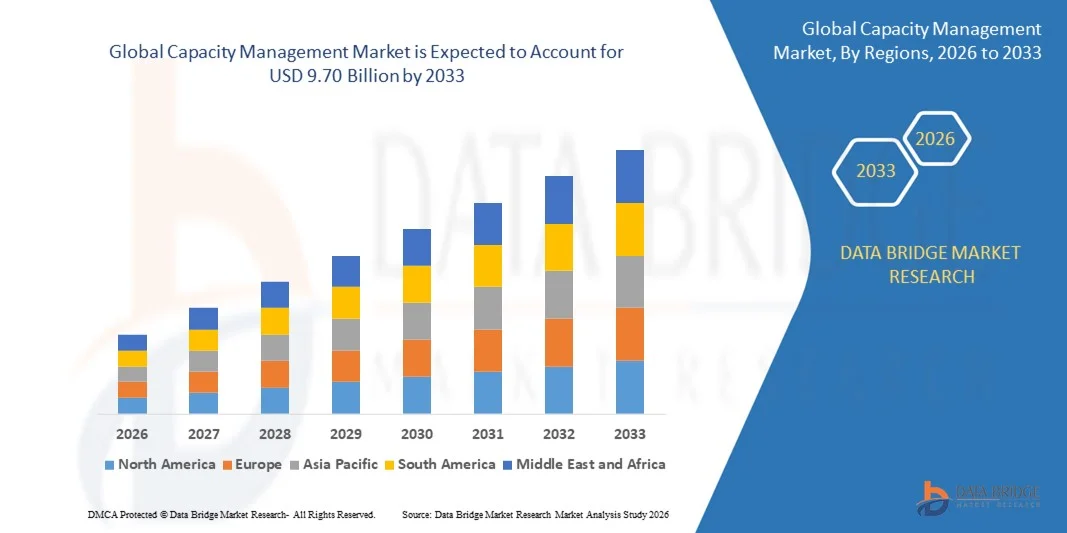
- The global capacity management market size was valued at USD 2.23 billion in 2025 and is expected to reach USD 9.70 billion by 2033, at a CAGR of20.13% during the forecast period
- Major factors that are expected to boost the growth of the capacity management market in the forecast period are the rise in the demand for price optimization and efficient usage of IT infrastructures. Furthermore, the increase in the demand for the business agility is further anticipated to propel the growth of the capacity management market
- The decrease in the acceptance of capacity management solution amongst the SMEs is further projected to impede the growth of the capacity management market in the timeline period
What are the Major Takeaways of Capacity Management Market?
- The rise in the difficulties in the IT infrastructures will further provide potential opportunities for the growth of the capacity management market in the coming years. However, the inadequate data gathering and the preservation for effective capacity management might further challenge the growth of the capacity management market in the near future
- North America dominated the capacity management market with a 39.97% revenue share in 2025, driven by rapid cloud adoption, large-scale data center expansion, and strong digital transformation initiatives across the U.S. and Canada
- Asia-Pacific is projected to register the fastest CAGR of 7.39% from 2026 to 2033, driven by rapid digitalization, expanding data center capacity, increasing 5G deployment, and accelerating enterprise cloud adoption across China, Japan, India, South Korea, and Southeast Asia
- The Solutions segment dominated the market with a 68.7% share in 2025, as enterprises increasingly deploy AI-enabled capacity planning software, real-time monitoring dashboards, and predictive analytics platforms to optimize IT infrastructure
Report Scope and Capacity Management Market Segmentation
|
Attributes |
Capacity Management Key Market Insights |
|
Segments Covered |
|
|
Countries Covered |
North America
Europe
Asia-Pacific
Middle East and Africa
South America
|
|
Key Market Players |
|
|
Market Opportunities |
|
|
Value Added Data Infosets |
In addition to the insights on market scenarios such as market value, growth rate, segmentation, geographical coverage, and major players, the market reports curated by the Data Bridge Market Research also include in-depth expert analysis, pricing analysis, brand share analysis, consumer survey, demography analysis, supply chain analysis, value chain analysis, raw material/consumables overview, vendor selection criteria, PESTLE Analysis, Porter Analysis, and regulatory framework. |
What is the Key Trend in the Capacity Management Market?
Integration of AI-Driven, Cloud-Based, and Real-Time Capacity Optimization Solutions
- The capacity management market is witnessing a strong shift toward cloud-native, AI-powered, and predictive analytics-based platforms that enable real-time infrastructure monitoring and proactive resource allocation
- Vendors are introducing advanced solutions integrated with automation, machine learning algorithms, and hybrid cloud visibility to optimize workload distribution and prevent performance bottlenecks
- Increasing adoption of multi-cloud environments, containerization, and virtualization is driving demand for intelligent capacity planning tools across enterprises, data centers, and telecom networks
- For instance, companies such as IBM, BMC Software, VMware, and Hewlett Packard Enterprise (HPE) have enhanced their platforms with AI-based forecasting, hybrid cloud monitoring, and automated performance optimization capabilities
- Rising focus on cost control, SLA compliance, and digital transformation initiatives is accelerating deployment of centralized and software-defined capacity management systems
- As IT ecosystems become more complex and data-intensive, capacity management solutions will remain essential for ensuring operational efficiency, scalability, and long-term infrastructure sustainability
What are the Key Drivers of Capacity Management Market?
- Growing need to optimize IT infrastructure costs and improve resource utilization across cloud, on-premise, and hybrid environments
- For instance, in 2025, leading vendors including IBM, NetApp, and Planview expanded their capacity planning portfolios with predictive analytics and workload automation capabilities to support enterprise digitalization
- Rapid expansion of data centers, 5G networks, edge computing, and enterprise cloud migration across the U.S., Europe, and Asia-Pacific is significantly boosting demand
- Increasing complexity of enterprise applications, big data workloads, and AI-driven operations is strengthening the requirement for real-time performance monitoring and forecasting tools
- Rising regulatory compliance requirements and service availability standards are encouraging organizations to adopt structured capacity planning frameworks
- Supported by continuous investments in IT modernization, automation, and cloud infrastructure, the Capacity Management market is expected to experience sustained long-term growth
Which Factor is Challenging the Growth of the Capacity Management Market?
- High implementation costs and integration complexities associated with advanced AI-enabled and enterprise-wide capacity management platforms limit adoption among SMEs
- For instance, during 2024–2025, rising cloud infrastructure expenses and cybersecurity investments increased overall IT operational budgets, reducing short-term spending flexibility for capacity management tools
- Lack of skilled professionals capable of interpreting predictive analytics models and configuring multi-cloud capacity environments presents operational challenges
- Data silos, legacy infrastructure, and compatibility issues with existing enterprise systems slow down seamless deployment
- Intense competition from built-in cloud provider monitoring tools and open-source performance management platforms creates pricing pressure
- To overcome these challenges, vendors are focusing on modular pricing models, SaaS-based deployment, AI simplification, and enhanced integration capabilities to expand global adoption of capacity management solutions
How is the Capacity Management Market Segmented?
The market is segmented on the basis of components, organization size, deployment type, and vertical.
- By Components
On the basis of components, the capacity management market is segmented into Solutions and Services. The Solutions segment dominated the market with a 68.7% share in 2025, as enterprises increasingly deploy AI-enabled capacity planning software, real-time monitoring dashboards, and predictive analytics platforms to optimize IT infrastructure. These solutions enable workload forecasting, automation, SLA compliance tracking, and hybrid cloud visibility, making them essential for digital transformation initiatives. Integration with virtualization, container orchestration, and multi-cloud management platforms further strengthens adoption across large enterprises and data centers.
The Services segment is expected to grow at the fastest CAGR from 2026 to 2033, driven by rising demand for consulting, system integration, managed services, and training support. As organizations face complex hybrid environments and skill gaps, service providers are playing a critical role in implementation, optimization, and long-term capacity strategy development.
- By Organization Size
On the basis of organization size, the market is segmented into Small and Medium-Sized Enterprises (SMEs) and Large Enterprises. The Large Enterprises segment dominated the market with a 64.3% share in 2025, supported by extensive IT infrastructure, multi-cloud deployments, and high data traffic volumes. Large organizations require advanced forecasting, automated resource allocation, and centralized visibility tools to manage complex digital ecosystems. Their higher IT budgets and strong focus on performance optimization further contribute to adoption.
The SMEs segment is projected to grow at the fastest CAGR from 2026 to 2033, driven by increasing cloud adoption, SaaS-based capacity tools, and subscription-based pricing models. As SMEs undergo digital transformation and migrate to cloud environments, the need for cost-efficient, scalable capacity planning solutions is accelerating across emerging economies.
- By Deployment Type
On the basis of deployment type, the capacity management market is segmented into On-Premises and Cloud. The On-Premises segment dominated the market with a 55.8% share in 2025, particularly among regulated industries such as BFSI, healthcare, and government that prioritize data control, compliance, and security. Established enterprises with legacy IT infrastructure continue to rely on in-house deployment models for performance monitoring and capacity forecasting.
The Cloud segment is expected to grow at the fastest CAGR from 2026 to 2033, fueled by rapid migration to hybrid and multi-cloud environments. Cloud-based capacity management solutions offer scalability, lower upfront investment, remote accessibility, and AI-driven analytics. Growing adoption of SaaS platforms, containerized workloads, and edge computing is further strengthening demand for cloud-native capacity optimization tools.
- By Vertical
On the basis of vertical, the capacity management market is segmented into Telecom, Information Technology (IT), Healthcare, Manufacturing, BFSI, Retail, Hospitality, Government and Public, and Others. The IT segment dominated the market with a 29.6% share in 2025, driven by high data center density, cloud service expansion, DevOps adoption, and digital infrastructure complexity. IT firms rely heavily on predictive capacity planning to ensure uptime, optimize workloads, and manage large-scale virtualized environments.
The Telecom segment is expected to grow at the fastest CAGR from 2026 to 2033, propelled by 5G deployment, network virtualization, edge computing, and rising data consumption. Telecom operators require advanced forecasting and real-time monitoring tools to manage bandwidth utilization, network scalability, and service reliability across global communication infrastructures.
Which Region Holds the Largest Share of the Capacity Management Market?
- North America dominated the capacity management market with a 39.97% revenue share in 2025, driven by rapid cloud adoption, large-scale data center expansion, and strong digital transformation initiatives across the U.S. and Canada. High adoption of hybrid IT environments, virtualization, AI-driven analytics, and enterprise workload automation continues to fuel demand for advanced capacity planning solutions across BFSI, telecom, healthcare, and IT sectors
- Leading technology providers in North America are integrating AI-powered forecasting, real-time monitoring dashboards, automation engines, and multi-cloud optimization tools, strengthening the region’s technological leadership. Continuous investment in hyperscale data centers, edge computing, and 5G infrastructure further supports long-term market expansion
- Strong presence of global cloud service providers, mature IT ecosystems, skilled workforce availability, and sustained enterprise IT spending reinforce North America’s market dominance
U.S. Capacity Management Market Insight
The U.S. is the largest contributor within North America, supported by large enterprise IT environments, advanced cloud infrastructure, and strong adoption of DevOps and automation practices. Organizations increasingly deploy AI-enabled capacity management platforms to optimize workloads, control cloud spending, and ensure SLA compliance. Rapid expansion of hyperscale data centers, AI workloads, SaaS platforms, and digital banking systems intensifies demand for predictive analytics and real-time resource optimization tools. Presence of leading software vendors, continuous IT modernization initiatives, and strong cybersecurity investments further drive market growth across industries including BFSI, telecom, healthcare, retail, and government.
Canada Capacity Management Market Insight
Canada contributes significantly to regional growth, driven by increasing cloud migration, digital government initiatives, and expansion of telecom and financial services infrastructure. Enterprises are adopting centralized capacity monitoring platforms to enhance operational visibility and reduce infrastructure costs. Growing investments in smart city projects, fintech platforms, and public cloud adoption further support demand. Skilled IT professionals, supportive regulatory frameworks, and rising adoption of hybrid cloud environments strengthen the country’s long-term market potential.
Asia-Pacific Capacity Management Market
Asia-Pacific is projected to register the fastest CAGR of 7.39% from 2026 to 2033, driven by rapid digitalization, expanding data center capacity, increasing 5G deployment, and accelerating enterprise cloud adoption across China, Japan, India, South Korea, and Southeast Asia. Growing e-commerce penetration, fintech expansion, AI integration, and smart manufacturing initiatives are increasing the need for scalable infrastructure optimization tools. Rising IT investments, government-led digital transformation programs, and expanding startup ecosystems are further accelerating adoption of advanced capacity management solutions across the region.
China Capacity Management Market Insight
China is the largest contributor in Asia-Pacific due to massive investments in cloud infrastructure, hyperscale data centers, and AI-driven industrial automation. Rapid growth in e-commerce, fintech platforms, and digital payment ecosystems drives demand for real-time infrastructure forecasting and performance optimization tools. Government-backed digital economy initiatives and strong domestic cloud providers further support sustained market expansion.
Japan Capacity Management Market Insight
Japan demonstrates steady growth supported by advanced IT infrastructure, 5G rollout, and strong enterprise automation initiatives. Organizations focus on operational efficiency, disaster recovery planning, and predictive IT resource management. Increasing adoption of AI-driven analytics and hybrid cloud systems strengthens long-term demand for capacity management platforms.
India Capacity Management Market Insight
India is emerging as a high-growth market, driven by expanding cloud adoption, rising startup ecosystems, fintech growth, and government digital programs. Increasing deployment of SaaS platforms, digital banking systems, and telecom infrastructure fuels demand for cost-efficient and scalable capacity planning tools. Growing IT outsourcing and data center investments further accelerate adoption.
South Korea Capacity Management Market Insight
South Korea contributes significantly due to strong 5G infrastructure, advanced semiconductor ecosystems, and rapid AI integration across enterprises. Increasing demand for real-time monitoring, automated workload balancing, and high-performance computing optimization drives adoption of modern capacity management platforms. Strong technological innovation and digital competitiveness support sustained market growth.
Which are the Top Companies in Capacity Management Market?
The capacity management industry is primarily led by well-established companies, including:
- IBM (U.S.)
- BMC Software, Inc. (U.S.)
- CA Technologies (U.S.)
- NetApp, Inc. (U.S.)
- Riverbed Technology (U.S.)
- Hewlett Packard Enterprise Development LP (U.S.)
- TEOCO. (U.S.)
- VMware, Inc. (U.S.)
- Sumerian (U.K.)
- Precisely. (U.S.)
- TeamQuest Corporation (U.S.)
- Nlyte (U.S.)
- CPT Global Limited (Australia)
- Neubrain, LLC (U.K.)
- Axway Software (France)
- Aspire Systems (India)
- HelpSystems. (U.S.)
- ASG Technologies Group, Inc. (U.S.)
- Zoho Corporation Pvt. Ltd. (India)
- Planview, Inc. (U.S.)
SKU-
Accédez en ligne au rapport sur le premier cloud mondial de veille économique

- Tableau de bord d'analyse de données interactif
- Tableau de bord d'analyse d'entreprise pour les opportunités à fort potentiel de croissance
- Accès d'analyste de recherche pour la personnalisation et les requêtes
- Analyse de la concurrence avec tableau de bord interactif
- Dernières actualités, mises à jour et analyse des tendances
- Exploitez la puissance de l'analyse comparative pour un suivi complet de la concurrence
Méthodologie de recherche
La collecte de données et l'analyse de l'année de base sont effectuées à l'aide de modules de collecte de données avec des échantillons de grande taille. L'étape consiste à obtenir des informations sur le marché ou des données connexes via diverses sources et stratégies. Elle comprend l'examen et la planification à l'avance de toutes les données acquises dans le passé. Elle englobe également l'examen des incohérences d'informations observées dans différentes sources d'informations. Les données de marché sont analysées et estimées à l'aide de modèles statistiques et cohérents de marché. De plus, l'analyse des parts de marché et l'analyse des tendances clés sont les principaux facteurs de succès du rapport de marché. Pour en savoir plus, veuillez demander un appel d'analyste ou déposer votre demande.
La méthodologie de recherche clé utilisée par l'équipe de recherche DBMR est la triangulation des données qui implique l'exploration de données, l'analyse de l'impact des variables de données sur le marché et la validation primaire (expert du secteur). Les modèles de données incluent la grille de positionnement des fournisseurs, l'analyse de la chronologie du marché, l'aperçu et le guide du marché, la grille de positionnement des entreprises, l'analyse des brevets, l'analyse des prix, l'analyse des parts de marché des entreprises, les normes de mesure, l'analyse globale par rapport à l'analyse régionale et des parts des fournisseurs. Pour en savoir plus sur la méthodologie de recherche, envoyez une demande pour parler à nos experts du secteur.
Personnalisation disponible
Data Bridge Market Research est un leader de la recherche formative avancée. Nous sommes fiers de fournir à nos clients existants et nouveaux des données et des analyses qui correspondent à leurs objectifs. Le rapport peut être personnalisé pour inclure une analyse des tendances des prix des marques cibles, une compréhension du marché pour d'autres pays (demandez la liste des pays), des données sur les résultats des essais cliniques, une revue de la littérature, une analyse du marché des produits remis à neuf et de la base de produits. L'analyse du marché des concurrents cibles peut être analysée à partir d'une analyse basée sur la technologie jusqu'à des stratégies de portefeuille de marché. Nous pouvons ajouter autant de concurrents que vous le souhaitez, dans le format et le style de données que vous recherchez. Notre équipe d'analystes peut également vous fournir des données sous forme de fichiers Excel bruts, de tableaux croisés dynamiques (Fact book) ou peut vous aider à créer des présentations à partir des ensembles de données disponibles dans le rapport.











