



Global Collagen Biomaterial Market Segmentation, By Product (Bovine, Porcine, Marine, and Others), Applications (Tissue Engineering, Drug Delivery System, and Others) - Industry Trends and Forecast to 2033
Collagen Biomaterial Market Size
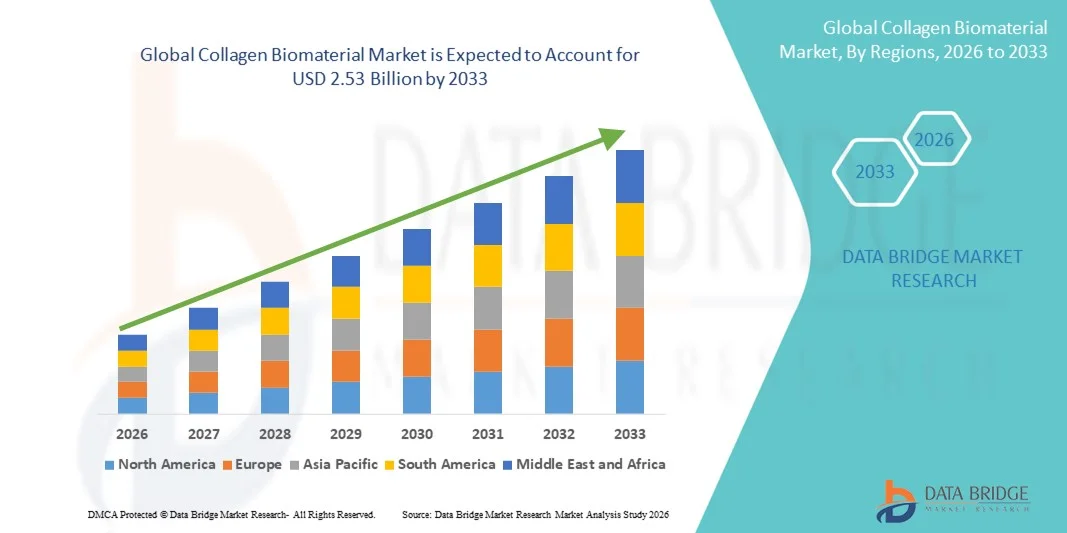
- The global collagen biomaterial market size was valued at USD 1.34 billion in 2025 and is expected to reach USD 2.53 billion by 2033, at a CAGR of 8.32% during the forecast period
- The market growth is largely driven by the increasing demand for collagen-based biomaterials across regenerative medicine, wound care, orthopedic, and cosmetic applications, supported by continuous advancements in biomaterial processing technologies and rising adoption in both clinical and research settings
- Furthermore, growing preference for biocompatible, bioresorbable, and naturally derived materials in medical treatments is positioning collagen biomaterials as a material of choice for tissue repair, drug delivery, and implantable medical devices. These converging factors are accelerating the uptake of collagen biomaterial solutions, thereby significantly boosting the overall growth of the Collagen Biomaterial market
Collagen Biomaterial Market Analysis
- Collagen biomaterials, derived from natural sources and widely used in wound healing, tissue engineering, orthopedic, cardiovascular, and cosmetic applications, have become essential components of modern regenerative medicine due to their excellent biocompatibility, biodegradability, and ability to support cell growth and tissue regeneration across both clinical and research settings
- The rising demand for collagen biomaterials is primarily driven by the increasing prevalence of chronic wounds and musculoskeletal disorders, growing adoption of minimally invasive surgical procedures, and a strong preference for natural and bioresorbable materials in medical implants and therapeutic solutions
- North America dominated the collagen biomaterial market with the largest revenue share of approximately 36.4% in 2025, supported by advanced healthcare infrastructure, high adoption of regenerative therapies, strong research funding, and the presence of leading biomaterial manufacturers and biotechnology companies, particularly in the U.S.
- Asia-Pacific is expected to be the fastest-growing region in the collagen biomaterial market during the forecast period, registering a CAGR of around 9.8%, driven by expanding healthcare expenditure, rapid growth in medical device manufacturing, increasing awareness of advanced wound care solutions, and rising demand for cosmetic and reconstructive procedures
- The tissue engineering segment held the largest market share, accounting for approximately 52.3% of total revenue in 2025
Report Scope and Collagen Biomaterial Market Segmentation
|
Attributes |
Collagen Biomaterial Key Market Insights |
|
Segments Covered |
|
|
Countries Covered |
North America
Europe
Asia-Pacific
Middle East and Africa
South America
|
|
Key Market Players |
|
|
Market Opportunities |
|
|
Value Added Data Infosets |
In addition to the insights on market scenarios such as market value, growth rate, segmentation, geographical coverage, and major players, the market reports curated by the Data Bridge Market Research also include in-depth expert analysis, patient epidemiology, pipeline analysis, pricing analysis, and regulatory framework. |
Collagen Biomaterial Market Trends
Rising Adoption of Collagen-Based Biomaterials in Regenerative Medicine and Aesthetic Applications
- A major and accelerating trend in the global collagen biomaterial market is the increasing use of collagen-based materials in regenerative medicine, tissue engineering, and aesthetic procedures. Collagen’s high biocompatibility, biodegradability, and structural similarity to natural extracellular matrix make it a preferred biomaterial for wound healing, bone grafts, cartilage repair, and skin regeneration applications
- For instance, collagen scaffolds and matrices are increasingly utilized in orthopedic and dental applications to support cell adhesion, proliferation, and tissue regeneration. These products are widely adopted in bone graft substitutes, guided tissue regeneration membranes, and cartilage repair solutions, particularly in advanced healthcare markets
- The growing demand for minimally invasive cosmetic and aesthetic procedures has further boosted the use of collagen biomaterials in dermal fillers, skin rejuvenation treatments, and anti-aging therapies. Collagen-based injectables and implants are favored for their natural appearance, safety profile, and ability to promote tissue regeneration
- Continuous advancements in collagen extraction, purification, and cross-linking technologies are improving product performance, durability, and application versatility. Manufacturers are increasingly developing collagen biomaterials derived from bovine, porcine, marine, and recombinant sources to meet regulatory standards and address concerns related to disease transmission and immunogenicity
- The expanding application scope of collagen biomaterials across wound care, cardiovascular repair, ophthalmology, and drug delivery systems is reshaping market dynamics and reinforcing collagen’s position as a foundational biomaterial in modern medical and aesthetic practices
- As healthcare providers and researchers continue to prioritize biologically derived, patient-friendly materials, the demand for advanced collagen biomaterial solutions is expected to grow steadily across both clinical and commercial settings
Collagen Biomaterial Market Dynamics
Driver
Growing Demand for Regenerative Medicine, Wound Care, and Aesthetic Procedures
- The rising global burden of chronic wounds, orthopedic disorders, cardiovascular diseases, and age-related degenerative conditions is a key driver fueling demand for collagen biomaterials. Collagen-based products play a critical role in accelerating healing, supporting tissue regeneration, and improving clinical outcomes
- For instance, collagen wound dressings are widely used in the management of diabetic foot ulcers, pressure ulcers, and surgical wounds due to their ability to maintain a moist healing environment and promote cell migration and tissue repair
- The rapid growth of the aesthetic and cosmetic medicine industry is further driving market expansion, as collagen biomaterials are extensively used in dermal fillers, skin repair treatments, and reconstructive procedures. Rising disposable incomes, increasing awareness of appearance-related treatments, and growing acceptance of cosmetic procedures are supporting this trend
- In addition, increasing investments in regenerative medicine research, coupled with favorable regulatory approvals for collagen-based medical devices and implants, are encouraging manufacturers to expand product portfolios and scale production capabilities.
- The growing preference for natural, biocompatible, and bioresorbable materials over synthetic alternatives continues to position collagen biomaterials as a key component in next-generation medical solutions
Restraint/Challenge
High Production Costs and Regulatory Complexity
- One of the major challenges restraining the growth of the Collagen Biomaterial market is the high cost associated with raw material sourcing, purification, and processing. The extraction and refinement of medical-grade collagen require stringent quality control measures, advanced manufacturing technologies, and compliance with strict regulatory standards, which significantly increase overall production costs
- For instance, in July 2022, CollPlant Biotechnologies highlighted the high cost and technical complexity associated with producing recombinant human collagen at commercial scale, citing the need for specialized bioprocessing infrastructure and extensive validation to meet medical-grade regulatory requirements. Such cost-intensive processes can limit scalability and delay product commercialization, particularly for smaller manufacturers
- Variability in collagen sources, such as bovine, porcine, and marine-derived collagen, can also impact product consistency, supply stability, and pricing. Additionally, concerns related to disease transmission, ethical considerations, and religious restrictions may limit acceptance in certain regions and increase compliance costs
- Furthermore, collagen biomaterials intended for medical and aesthetic use are subject to rigorous regulatory approvals and clinical validation processes. Extended timelines for clinical studies and regulatory review can slow market entry and increase financial risk for manufacturers
- Addressing these challenges through advancements in recombinant collagen technologies, improved purification methods, and streamlined regulatory pathways will be essential to support sustained market growth and broader adoption
Collagen Biomaterial Market Scope
The market is segmented on the basis of product and application.
- By Product
On the basis of product, the Global Collagen Biomaterial Market is segmented into bovine, porcine, marine, and others. The bovine collagen segment dominated the market, accounting for approximately 46.5% of the global revenue share in 2025. This dominance is primarily attributed to the wide availability of bovine raw materials, well-established extraction processes, and cost-effectiveness compared to alternative sources. Bovine collagen is extensively used in medical devices, wound dressings, tissue scaffolds, and cosmetic applications due to its high biocompatibility and structural similarity to human collagen. Regulatory familiarity and long-standing clinical usage further support its widespread adoption. Additionally, strong demand from orthopedic, dental, and reconstructive surgery applications continues to reinforce the segment’s leading position. Large-scale manufacturing capabilities and consistent supply chains also contribute to sustained market penetration across both developed and emerging regions.
The marine collagen segment is expected to witness the fastest growth, registering a CAGR of around 11.8% from 2026 to 2033. Growth is driven by increasing preference for non-mammalian collagen sources due to lower risk of disease transmission and fewer religious or cultural restrictions. Marine collagen offers superior bioavailability, higher absorption rates, and improved solubility, making it highly suitable for biomedical, nutraceutical, and cosmetic applications. Rising demand for sustainable and eco-friendly biomaterials further accelerates adoption, particularly in Asia-Pacific and Europe. Advances in extraction technologies and growing investments in marine-based biomaterials are also supporting rapid expansion of this segment.
- By Application
On the basis of application, the Global Collagen Biomaterial Market is segmented into tissue engineering, drug delivery systems, and others. The tissue engineering segment held the largest market share, accounting for approximately 52.3% of total revenue in 2025. This dominance is driven by the extensive use of collagen as a scaffold material due to its excellent biocompatibility, biodegradability, and ability to promote cell adhesion and proliferation. Collagen biomaterials are widely applied in regenerative medicine, wound healing, bone graft substitutes, cartilage repair, and skin regeneration. Increasing prevalence of chronic wounds, orthopedic disorders, and aging-related conditions has significantly boosted demand. Continuous advancements in 3D bioprinting and regenerative therapies further strengthen the segment’s leadership. Strong funding support for tissue engineering research and growing clinical adoption globally contribute to sustained market dominance.
The drug delivery system segment is projected to grow at the fastest rate, with a CAGR of approximately 12.6% from 2026 to 2033. Rapid growth is fueled by the rising need for targeted, controlled, and sustained drug release solutions. Collagen-based drug delivery systems offer enhanced drug stability, reduced toxicity, and improved therapeutic efficacy. Increasing applications in oncology, wound care, and localized drug administration are driving adoption. Technological innovations enabling collagen-based hydrogels, microspheres, and nanoparticles further expand clinical potential. Growing pharmaceutical R&D investments and increasing focus on personalized medicine are expected to accelerate growth throughout the forecast period.
Collagen Biomaterial Market Regional Analysis
- North America dominated the collagen biomaterial market with the largest revenue share of approximately 36.4% in 2025, supported by advanced healthcare infrastructure, high adoption of regenerative and reconstructive therapies, strong research funding, and the presence of leading biomaterial manufacturers and biotechnology companies
- The region benefits from widespread use of collagen-based products across wound care, orthopedic applications, dental procedures, and cosmetic and aesthetic treatments, driven by a growing aging population and increasing incidence of chronic conditions requiring tissue repair
- This strong market position is further reinforced by favorable reimbursement policies, robust clinical research activity, and close collaboration between academic institutions, biotechnology firms, and healthcare providers, establishing North America as a key hub for collagen biomaterial innovation and commercialization
U.S. Collagen Biomaterial Market Insight
The U.S. collagen biomaterial market accounted for the largest revenue share within North America in 2025, driven by the country’s strong focus on regenerative medicine, advanced surgical procedures, and aesthetic treatments. High investment in biomedical research, early adoption of novel collagen-based scaffolds and matrices, and the presence of major players specializing in wound care and orthopedic biomaterials continue to propel market growth. In addition, the rising demand for minimally invasive cosmetic procedures and advanced wound management solutions is further supporting the expansion of collagen biomaterials across clinical settings.
Europe Collagen Biomaterial Market Insight
The Europe collagen biomaterial market is projected to expand at a steady CAGR during the forecast period, primarily driven by growing demand for advanced wound care products, increasing orthopedic and dental procedures, and strong regulatory oversight ensuring high product quality and safety. The region’s emphasis on evidence-based medicine and rising healthcare expenditure is fostering the adoption of collagen-based implants, dressings, and tissue engineering solutions across hospitals and specialty clinics.
U.K. Collagen Biomaterial Market Insight
The U.K. collagen biomaterial market is expected to grow at a notable CAGR, supported by increasing awareness of regenerative therapies, expanding use of collagen in wound healing and reconstructive surgeries, and strong academic research capabilities. Government-backed healthcare initiatives and collaborations between universities and biotech companies are accelerating innovation and clinical adoption of collagen biomaterials across the country.
Germany Collagen Biomaterial Market Insight
The Germany collagen biomaterial market is anticipated to witness considerable growth during the forecast period, driven by the country’s advanced medical device industry, strong emphasis on research and development, and rising demand for high-quality biomaterials in orthopedic, dental, and cosmetic applications. Germany’s focus on precision medicine and strict quality standards further supports the adoption of premium collagen-based products.
Asia-Pacific Collagen Biomaterial Market Insight
The Asia-Pacific collagen biomaterial market is expected to be the fastest-growing region during the forecast period, registering a CAGR of around 9.8%, driven by expanding healthcare expenditure, rapid growth in medical device manufacturing, and increasing awareness of advanced wound care and regenerative solutions. Rising demand for cosmetic and reconstructive procedures, particularly in emerging economies, is further accelerating market expansion across the region.
Japan Collagen Biomaterial Market Insight
The Japan collagen biomaterial market is gaining traction due to the country’s aging population, high demand for advanced wound care products, and strong adoption of regenerative medicine technologies. Collagen biomaterials are increasingly utilized in orthopedic treatments, dental applications, and cosmetic procedures, supported by Japan’s technologically advanced healthcare system and emphasis on innovation.
China Collagen Biomaterial Market Insight
China collagen biomaterial market accounted for a significant share of the Asia-Pacific collagen biomaterial market in 2025, driven by rapid expansion of healthcare infrastructure, increasing surgical procedures, and strong domestic manufacturing capabilities. Growing investments in biomedical research, rising awareness of collagen-based wound care and aesthetic products, and supportive government initiatives for medical innovation are key factors propelling market growth in China.
Collagen Biomaterial Market Share
The Collagen Biomaterial industry is primarily led by well-established companies, including:
- Integra LifeSciences (U.S.)
- DSM Biomedical (Netherlands)
- Collagen Solutions Plc (U.K.)
- Medtronic (Ireland)
- Johnson & Johnson (U.S.)
- Baxter International (U.S.)
- B. Braun S.E. (Germany)
- Advanced BioMatrix (U.S.)
- Botiss Biomaterials GmbH (Germany)
- Geistlich Pharma AG (Switzerland)
- Collagen Matrix Inc. (U.S.)
- Kensey Nash Corporation (U.S.)
- Nitta Gelatin Inc. (Japan)
- Rousselot (France)
- Viscofan BioEngineering (Spain)
- Weishardt Group (France)
- GELITA AG (Germany)
- Stryker Corporation (U.S.)
- Orthocell Ltd. (Australia)
- Zimmer Biomet (U.S.)
Latest Developments in Global Collagen Biomaterial Market
- In January 2021, Rousselot introduced its Peptan Marine collagen peptides sourced from wild-caught marine fish, designed to support beauty, health, and nutrition brands with an MSC-certified ingredient for improved bioavailability and sustainability. This launch expanded collagen peptide applications beyond traditional bovine and porcine sources, helping manufacturers diversify product portfolios in functional foods and nutraceuticals
- In June 2023, Gelita commissioned a second hydrolysis line in Quebec, Canada, adding 75 kilotonnes of annual collagen peptide capacity and strengthening global production capabilities to meet rising demand across pharmaceuticals, nutraceuticals, and biomaterials. The expansion supported enhanced supply for high-volume applications and helped Gelita maintain its lead in the hydrolyzed collagen segment
- In September 2023, Rousselot launched its Peptan® marine collagen range marketed for enhanced skin hydration and elasticity, which attracted significant uptake in cosmetic and dermaceutical markets and highlighted the growing appeal of marine collagen in premium applications. The introduction expanded collagen offerings in the beauty and personal care segment
- In March 2024, PB Gelatins opened a new marine collagen extraction plant in Norway with an annual capacity of 10,000 metric tons, aimed at scaling production for fish-derived collagen peptides in nutraceutical and cosmetic markets. This development reinforced infrastructure investment in marine collagen sources across Europe
- In January 2024, Neocell acquired a 25,000 ft² facility in California to double U.S. collagen gummy output to 3 million units monthly, targeting increased production of consumer-oriented collagen peptide products for health and wellness. The expansion highlighted growing consumer demand and commercial scale-up in the direct-to-consumer collagen segment
- In May 2024, Nitta Gelatin India Ltd announced a ₹60 crore expansion project in Kerala, India, to increase collagen peptide production capacity in response to accelerating global demand for joint health and beauty applications, with commissioning expected by mid-2025. This investment signifies regional capacity growth in Asia for collagen biomaterials
- In June 2024, Gelita AG acquired a strategic stake in a Scandinavian marine collagen producer to broaden its portfolio of premium hydrolyzed marine peptides and enhance its supply chain presence, particularly in the high-bioavailability nutraceutical market. This move reflects strategic diversification beyond traditional sources toward marine collagen innovations
- In April 2025, Gelita AG showcased its comprehensive Bioactive Collagen Peptides (BCP) portfolio, including products such as VERISOL and FORTIGEL, at Vitafoods Europe 2025, emphasizing advancements in functional collagen ingredients for beauty-from-within, joint health, and sports nutrition applications. This promotional effort underscored industry commitment to science-backed peptide innovation
- In May 2025, Rousselot’s Peptan collagen peptides received Upcycled Certified® status from Where Food Comes From, reflecting a commitment to sustainability by transforming animal-derived raw materials into high-value functional ingredients aligned with increasing consumer and regulatory focus on environmental stewardship
- In May 2025, Tessenderlo Group announced a strategic partnership with Darling Ingredients to form Nextida, a new company combining PB Leiner and Rousselot collagen and gelatin businesses with expected annual revenue of approximately USD1.5 billion and a combined production capacity of around 200,000 metric tons across 23 global facilities, pending regulatory approval. This merger is poised to reshape global supply dynamics in collagen biomaterial
SKU-
Accédez en ligne au rapport sur le premier cloud mondial de veille économique

- Tableau de bord d'analyse de données interactif
- Tableau de bord d'analyse d'entreprise pour les opportunités à fort potentiel de croissance
- Accès d'analyste de recherche pour la personnalisation et les requêtes
- Analyse de la concurrence avec tableau de bord interactif
- Dernières actualités, mises à jour et analyse des tendances
- Exploitez la puissance de l'analyse comparative pour un suivi complet de la concurrence
Méthodologie de recherche
La collecte de données et l'analyse de l'année de base sont effectuées à l'aide de modules de collecte de données avec des échantillons de grande taille. L'étape consiste à obtenir des informations sur le marché ou des données connexes via diverses sources et stratégies. Elle comprend l'examen et la planification à l'avance de toutes les données acquises dans le passé. Elle englobe également l'examen des incohérences d'informations observées dans différentes sources d'informations. Les données de marché sont analysées et estimées à l'aide de modèles statistiques et cohérents de marché. De plus, l'analyse des parts de marché et l'analyse des tendances clés sont les principaux facteurs de succès du rapport de marché. Pour en savoir plus, veuillez demander un appel d'analyste ou déposer votre demande.
La méthodologie de recherche clé utilisée par l'équipe de recherche DBMR est la triangulation des données qui implique l'exploration de données, l'analyse de l'impact des variables de données sur le marché et la validation primaire (expert du secteur). Les modèles de données incluent la grille de positionnement des fournisseurs, l'analyse de la chronologie du marché, l'aperçu et le guide du marché, la grille de positionnement des entreprises, l'analyse des brevets, l'analyse des prix, l'analyse des parts de marché des entreprises, les normes de mesure, l'analyse globale par rapport à l'analyse régionale et des parts des fournisseurs. Pour en savoir plus sur la méthodologie de recherche, envoyez une demande pour parler à nos experts du secteur.
Personnalisation disponible
Data Bridge Market Research est un leader de la recherche formative avancée. Nous sommes fiers de fournir à nos clients existants et nouveaux des données et des analyses qui correspondent à leurs objectifs. Le rapport peut être personnalisé pour inclure une analyse des tendances des prix des marques cibles, une compréhension du marché pour d'autres pays (demandez la liste des pays), des données sur les résultats des essais cliniques, une revue de la littérature, une analyse du marché des produits remis à neuf et de la base de produits. L'analyse du marché des concurrents cibles peut être analysée à partir d'une analyse basée sur la technologie jusqu'à des stratégies de portefeuille de marché. Nous pouvons ajouter autant de concurrents que vous le souhaitez, dans le format et le style de données que vous recherchez. Notre équipe d'analystes peut également vous fournir des données sous forme de fichiers Excel bruts, de tableaux croisés dynamiques (Fact book) ou peut vous aider à créer des présentations à partir des ensembles de données disponibles dans le rapport.











