



Global Dermatology Treatment Devices Market Segmentation, By Product Type (Diagnostic Devices and Treatment Devices), Application (Skin Resurfacing, Skin Rejuvenation, Hair Removal, Psoriasis, Scar, Warts and Skin Tags, Skin Lesions, Pigmented and Vascular, Lesion Removal, Acne, Tattoo Removal, and Hyperhidrosis), End User (Hospitals, SPA Clinics, Dermatology Clinics, and Surgical Centres)- Industry Trends and Forecast to 2032
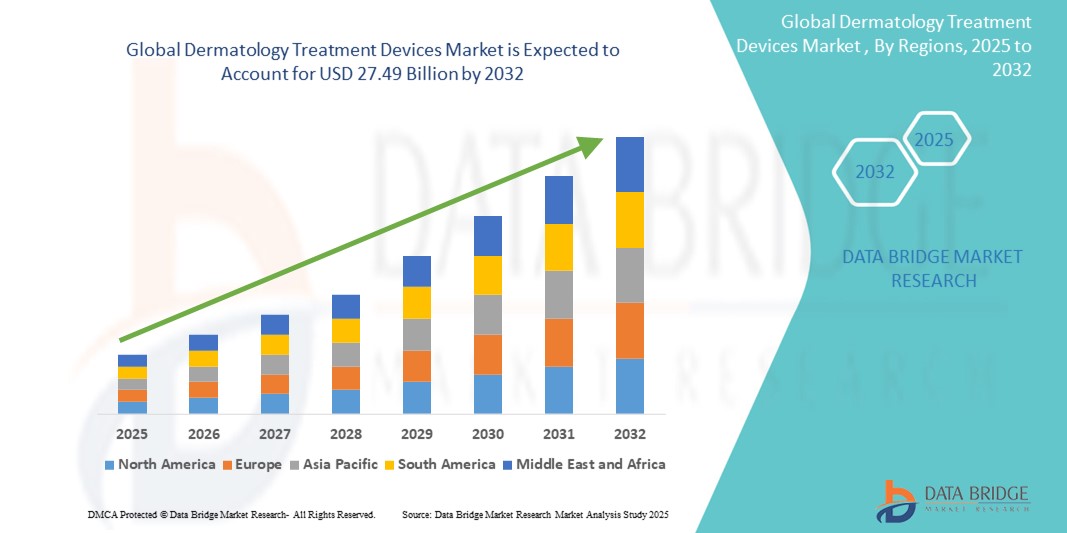
Dermatology Treatment Devices Market Size
- The global dermatology treatment devices market size was valued atUSD 8.60 billion in 2024and is expected to reachUSD 27.49 billion by 2032, at aCAGR of 15.63%during the forecast period
- This growth is driven by factors such as the aging population, rising prevalence of skin conditions, increasing demand for aesthetic procedures, and advancements in dermatology technology
Dermatology Treatment Devices Market Analysis
- Dermatology treatment devices are essential tools used in the treatment of various skin conditions, including acne, psoriasis, and skin cancers. These devices provide advanced, non-invasive treatments for improving skin health and appearance
- The demand for these devices is primarily driven by the increasing prevalence of skin conditions, rising awareness of aesthetic treatments, and advancements in non-invasive technologies
- North America is expected to dominate the dermatology treatment devices market with a market share of 33.1%, due to its advanced healthcare infrastructure, high adoption of cosmetic treatments, and growing demand for dermatological procedures
- Asia-Pacific is expected to be the fastest growing region in the dermatology treatment devices market during the forecast period due to increasing disposable income, rising awareness of skincare, and a growing aging population
- Treatment devices segment is expected to dominate the market with a market share of 79.78% due to the availability of wide applications of dermatology treatment. In addition, the launch of novel technologies in the laser device category is also attributed to the high segment growth
Report Scope and Dermatology Treatment Devices Market Segmentation
|
Attributes |
Dermatology Treatment Devices Key Market Insights |
|
Segments Covered |
|
|
Countries Covered |
North America
Europe
Asia-Pacific
Middle East and Africa
South America
|
|
Key Market Players |
|
|
Market Opportunities |
|
|
Value Added Data Infosets |
In addition to the insights on market scenarios such as market value, growth rate, segmentation, geographical coverage, and major players, the market reports curated by the Data Bridge Market Research also include in-depth expert analysis, patient epidemiology, pipeline analysis, pricing analysis, and regulatory framework. |
Dermatology Treatment Devices Market Trends
“Advancements in Laser Technology & Non-invasive Dermatology Treatments”
- One prominent trend in the global dermatology treatment devices market is the increasing adoption of advanced laser technologies and non-invasive treatments for skin rejuvenation, acne, and hair removal
- These innovations enhance treatment effectiveness and patient comfort, offering high precision and minimal downtime, which is particularly beneficial for aesthetic dermatology procedures
- For instance, modern laser systems provide targeted treatment for a variety of skin conditions such as pigmentation, wrinkles, and vascular lesions, with improved outcomes and reduced side effects
- These advancements are revolutionizing the dermatology landscape, increasing patient satisfaction, and driving the demand for next-generation dermatology devices equipped with state-of-the-art technology
Dermatology Treatment Devices Market Dynamics
Driver
“Growing Demand Due to Rising Prevalence of Skin Conditions”
- The increasing prevalence of skin conditions such as acne, eczema, psoriasis, and skin cancer is significantly driving the demand for dermatology treatment devices
- As the global population grows and ages, the incidence of skin-related issues continues to rise, with many individuals seeking effective treatment options to manage both medical and aesthetic concerns
- As more individuals seek treatments for these conditions, the demand for advanced dermatology devices rises, improving treatment outcomes and enhancing the quality of care in dermatology
For instance,
- In 2020, according to the World Health Organization, skin diseases, including acne and eczema, affect millions of people worldwide, with a notable increase in cases attributed to urbanization and changing lifestyle factors. These trends are fueling demand for more advanced and efficient dermatology treatment devices
- As a result, the rising prevalence of skin conditions is driving a significant increase in the demand for dermatology treatment devices, which are becoming essential in both medical and aesthetic dermatology practices
Opportunity
“Leveraging Artificial Intelligence for Enhanced Dermatology Treatments”
- AI-powered dermatology treatment devices are transforming the way skin conditions are diagnosed and treated, enhancing treatment precision, automating routine tasks, and improving patient outcomes
- AI algorithms can analyze real-time patient data and images, providing instant feedback to dermatologists, helping them identify and track skin conditions more accurately
- Additionally, AI-powered devices can assist in image analysis, enabling dermatologists to review and compare images, assess treatment progress, and make more informed decisions during procedures
For instance,
- In December 2024, according to a study published in the Journal of Dermatology, AI systems, especially those based on deep learning, are increasingly being used to detect early signs of melanoma and other skin cancers with high accuracy. These AI systems can process large volumes of images quickly, improving early detection and increasing the chances of successful treatment
- The integration of AI in dermatology treatment devices offers a significant opportunity for improving diagnostic accuracy, reducing treatment times, and enhancing patient satisfaction, making it a key driver in the market’s growth
Restraint/Challenge
“High Equipment Costs Hindering Market Penetration”
- The high cost of dermatology treatment devices poses a significant challenge for the market, especially for smaller clinics and practices, as well as healthcare facilities in developing regions
- These advanced devices, which are crucial for procedures such as laser treatments, acne therapy, and hair removal, can often range from thousands to tens of thousands of dollars, making them a substantial financial investment
- The high upfront cost can deter many smaller healthcare providers or clinics with limited budgets from upgrading their equipment or investing in new technologies, resulting in continued reliance on outdated devices
For instance,
- In January 2024, according to an article published by Global Healthcare Insights, the significant cost associated with dermatology treatment devices limits their accessibility, particularly in developing countries where budget constraints are common. This can prevent healthcare facilities from adopting the latest advancements in dermatological care, thereby impacting the quality of treatment provided to patients
- Consequently, such financial barriers can contribute to disparities in access to advanced dermatology treatments, restricting market growth and innovation
Dermatology Treatment Devices Market Scope
The market is segmented on the basis of product type, application, and end user
|
Segmentation |
Sub-Segmentation |
|
By Product Type |
|
|
By Application |
|
|
By End User |
|
In 2025, the treatment devices is projected to dominate the market with a largest share in product type segment
The treatment devices segment is expected to dominate the dermatology treatment devices market with the largest share of 79.78% due to the availability of wide applications of dermatology treatment. In addition, the launch of novel technologies in the laser device category is also attributed to the high segment growth
The lasers is expected to account for the largest share during the forecast period in product type market
In 2025, the lasers segment is expected to dominate the market with the largest market share of 46.1% due to the widespread adoption of laser-based treatments for various skin conditions. Lasers offer high precision, minimal invasiveness, and faster recovery times, making them the preferred choice for treating a range of dermatological issues, including acne, pigmentation, hair removal, and skin rejuvenation.
Dermatology Treatment Devices Market Regional Analysis
“North America Holds the Largest Share in the Dermatology Treatment Devices Market”
- North America dominates the dermatology treatment devices market with a market share of 33.1%, driven by advanced healthcare infrastructure, high demand for aesthetic treatments, and the strong presence of key market players in the region
- The U.S. holds a significant market share of approximately 37.8% due to the growing prevalence of skin conditions, rising demand for non-invasive cosmetic procedures such as laser treatments and hair removal, and continuous innovations in dermatology technologies
- The availability of well-established reimbursement policies for dermatological procedures and increasing investments in research & development by leading companies further strengthen the market
- Additionally, the expanding number of dermatology clinics, the increasing focus on skin health, and the rising popularity of aesthetic treatments contribute to the region's dominance in the market
“Asia-Pacific is Projected to Register the Highest CAGR in the Dermatology Treatment Devices Market”
- The Asia-Pacific region is expected to witness the highest growth rate in the dermatology treatment devices market, fueled by rapid advancements in healthcare infrastructure, increasing awareness about skin health, and rising disposable incomes
- Countries such as China, India, and Japan are emerging as key markets due to their large populations, growing prevalence of skin conditions, and the increasing demand for cosmetic and medical dermatology procedures
- Japan, with its well-established healthcare system and high adoption of advanced medical technologies, remains a critical market for dermatology devices, particularly in the aesthetic dermatology sector
- China and India, with their expanding middle class and rising demand for both medical and cosmetic dermatology services, are experiencing increased investments in advanced dermatology treatment devices. The presence of global medical device manufacturers and improving access to dermatological care further fuel market growth in this region.
Dermatology Treatment Devices Market Share
The market competitive landscape provides details by competitor. Details included are company overview, company financials, revenue generated, market potential, investment in research and development, new market initiatives, global presence, production sites and facilities, production capacities, company strengths and weaknesses, product launch, product width and breadth, application dominance. The above data points provided are only related to the companies' focus related to market.
The Major Market Leaders Operating in the Market Are:
- AbbVie Inc. (U.S.)
- Lumenis (Israel)
- Syneron Candela (Israel)
- Johnson & Johnson (U.S.)
- Hologic, Inc. (U.S.)
- Cynosure, Inc. (U.S.)
- Sciton, Inc. (U.S.)
- Fotona (Slovenia)
- Bausch Health Companies, Inc. (Canada)
- Cutera, Inc. (U.S.)
- Revance Therapeutics, Inc. (U.S.)
- Merz Pharmaceuticals (Germany)
- Zimmer Biomet (U.S.)
- Medtronic (Ireland)
- Air Liquide Medical Systems (France)
- Alma Lasers (Israel)
- Quanta System S.p.A. (Italy)
- Beurer GmbH (Germany)
- Medytox, Inc. (South Korea)
- Evolus, Inc. (U.S.)
Latest Developments in Global Dermatology Treatment Devices Market
- In August 2023, Lumenis received FDA clearance for its PiQo4 picosecond laser, a state-of-the-art device designed for tattoo removal, pigmentation treatment, and wrinkle reduction. This regulatory approval underscores the growing advancements in non-invasive aesthetic treatments, providing precise and highly effective solutions for various dermatological concerns. The approval of the PiQo4 laser is particularly relevant to the global dermatology treatment devices market, as it reflects the increasing demand for advanced technologies that offer enhanced treatment outcomes with minimal patient downtime
- In July 2023, Canfield Scientific unveiled its latest dermatology innovations at the 25th World Congress of Dermatology held in Singapore from July 4th to 7th. The showcased products included IntelliStudio, VEOS, DermaGraphix, and VECTRA WB360, which highlight the company’s commitment to advancing imaging and diagnostic technologies designed to improve clinical outcomes in dermatological practices. These innovations are highly relevant to the global dermatology treatment devices market, as they reflect the increasing emphasis on precision diagnostics and personalized treatment solutions
- In April 2023, Canfield Scientific attained ISO 9001:2015 and ISO 13485:2016 certifications for its quality management systems. This dual certification emphasizes Canfield's ongoing dedication to upholding rigorous standards in product quality and regulatory compliance for its medical imaging and software solutions within the dermatology sector. The achievement of these certifications is highly significant for the global dermatology treatment devices market, as it reflects the increasing importance of quality assurance and regulatory adherence in the development of advanced dermatology technologies
- In February 2023, Candela Corporation received Health Canada’s licensing for its dual-wavelength Frax Pro non-ablative fractional laser platform and the Nordlys multi-application platform. These advanced technologies, which integrate Selective Waveband Technology (SWT), are designed to broaden treatment options in medical aesthetics, providing versatile solutions for a variety of skin conditions while enhancing safety and efficacy. This regulatory approval is highly relevant to the global dermatology treatment devices market, as it reflects the increasing demand for innovative, non-invasive treatments that offer customizable, effective solutions for a range of dermatological concerns
- In February 2023, Candela Corporation, a global leader in medical aesthetic devices, announced that its dual-wavelength Frax Pro non-ablative fractional laser platform and the Nordlys multi-application platform, featuring Selective Waveband Technology (SWT), were granted licensing by Health Canada and are now available for use. The availability of these innovative platforms in the global dermatology treatment devices market highlights the ongoing shift towards non-invasive aesthetic solutions that provide customizable and effective treatments for diverse dermatological concerns
SKU-
Accédez en ligne au rapport sur le premier cloud mondial de veille économique

- Tableau de bord d'analyse de données interactif
- Tableau de bord d'analyse d'entreprise pour les opportunités à fort potentiel de croissance
- Accès d'analyste de recherche pour la personnalisation et les requêtes
- Analyse de la concurrence avec tableau de bord interactif
- Dernières actualités, mises à jour et analyse des tendances
- Exploitez la puissance de l'analyse comparative pour un suivi complet de la concurrence
Méthodologie de recherche
La collecte de données et l'analyse de l'année de base sont effectuées à l'aide de modules de collecte de données avec des échantillons de grande taille. L'étape consiste à obtenir des informations sur le marché ou des données connexes via diverses sources et stratégies. Elle comprend l'examen et la planification à l'avance de toutes les données acquises dans le passé. Elle englobe également l'examen des incohérences d'informations observées dans différentes sources d'informations. Les données de marché sont analysées et estimées à l'aide de modèles statistiques et cohérents de marché. De plus, l'analyse des parts de marché et l'analyse des tendances clés sont les principaux facteurs de succès du rapport de marché. Pour en savoir plus, veuillez demander un appel d'analyste ou déposer votre demande.
La méthodologie de recherche clé utilisée par l'équipe de recherche DBMR est la triangulation des données qui implique l'exploration de données, l'analyse de l'impact des variables de données sur le marché et la validation primaire (expert du secteur). Les modèles de données incluent la grille de positionnement des fournisseurs, l'analyse de la chronologie du marché, l'aperçu et le guide du marché, la grille de positionnement des entreprises, l'analyse des brevets, l'analyse des prix, l'analyse des parts de marché des entreprises, les normes de mesure, l'analyse globale par rapport à l'analyse régionale et des parts des fournisseurs. Pour en savoir plus sur la méthodologie de recherche, envoyez une demande pour parler à nos experts du secteur.
Personnalisation disponible
Data Bridge Market Research est un leader de la recherche formative avancée. Nous sommes fiers de fournir à nos clients existants et nouveaux des données et des analyses qui correspondent à leurs objectifs. Le rapport peut être personnalisé pour inclure une analyse des tendances des prix des marques cibles, une compréhension du marché pour d'autres pays (demandez la liste des pays), des données sur les résultats des essais cliniques, une revue de la littérature, une analyse du marché des produits remis à neuf et de la base de produits. L'analyse du marché des concurrents cibles peut être analysée à partir d'une analyse basée sur la technologie jusqu'à des stratégies de portefeuille de marché. Nous pouvons ajouter autant de concurrents que vous le souhaitez, dans le format et le style de données que vous recherchez. Notre équipe d'analystes peut également vous fournir des données sous forme de fichiers Excel bruts, de tableaux croisés dynamiques (Fact book) ou peut vous aider à créer des présentations à partir des ensembles de données disponibles dans le rapport.











