



Global Fuel Capacitance Test Equipment Market Segmentation, By Equipment Technology (Automated Fuel Capacitance Test Equipment, and Manual Fuel Capacitance Test Equipment), Service (Rental Services, Maintenance Services, Sales Services, Pre-owned Fuel Capacitance Test Equipment, and Brand-New Fuel Capacitance Test Equipment)- Industry Trends and Forecast to 2033
Fuel Capacitance Test Equipment Market Size
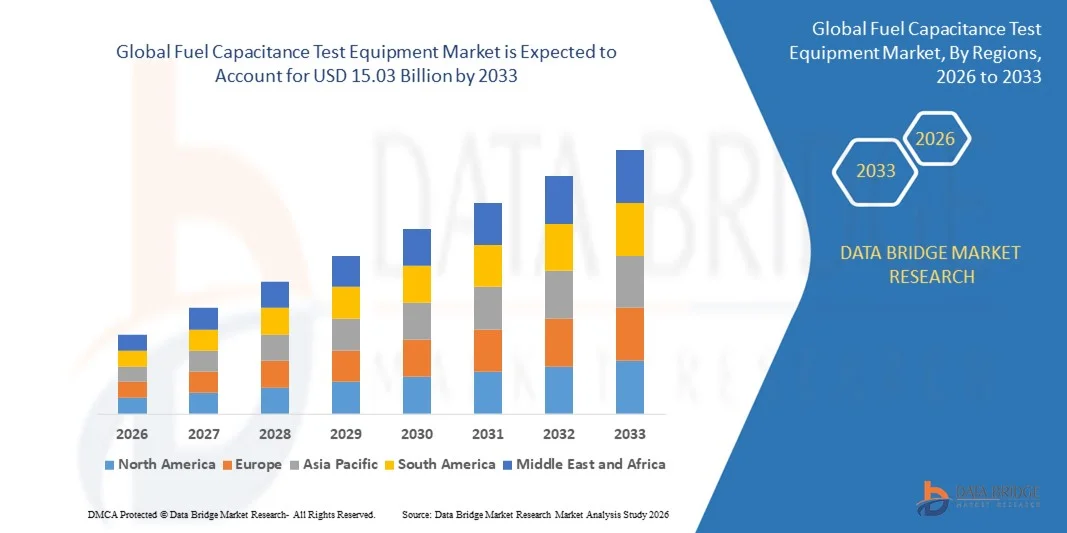
- The global fuel capacitance test equipment market size was valued at USD 7.82 billion in 2025 and is expected to reach USD 15.03 billion by 2033, at a CAGR of 8.50% during the forecast period
- The market growth is largely fuelled by the increasing demand for accurate fuel measurement systems in commercial and military aircraft to enhance operational safety and efficiency
- Rising aircraft production, fleet expansion, and stringent aviation safety regulations are further accelerating the adoption of advanced fuel capacitance testing equipment
Fuel Capacitance Test Equipment Market Analysis
- The market is witnessing steady growth driven by technological advancements in digital testing systems, improved calibration accuracy, and integration of automated diagnostic solutions in aviation fuel management systems
- Increasing focus on preventive maintenance, compliance with international aviation standards, and expansion of aerospace manufacturing capabilities are strengthening demand for fuel capacitance test equipment across global markets
- North America dominated the fuel capacitance test equipment market with the largest revenue share in 2025, driven by strong aircraft manufacturing activity, extensive MRO infrastructure, and significant defense aviation investments across the region
- Asia-Pacific region is expected to witness the highest growth rate in the global fuel capacitance test equipment market, driven by rapid aviation infrastructure development, increasing aircraft procurement, expanding aerospace manufacturing activities, and supportive government initiatives promoting the aviation sector
- The Automated Fuel Capacitance Test Equipment segment held the largest market revenue share in 2025, driven by the increasing demand for precision, efficiency, and reduced human error in aircraft fuel system calibration. Automated systems offer advanced diagnostics, digital data logging, and integration with maintenance software platforms, making them highly suitable for modern aircraft fleets and large MRO facilities
Report Scope and Fuel Capacitance Test Equipment Market Segmentation
|
Attributes |
Fuel Capacitance Test Equipment Key Market Insights |
|
Segments Covered |
|
|
Countries Covered |
North America
Europe
Asia-Pacific
Middle East and Africa
South America
|
|
Key Market Players |
|
|
Market Opportunities |
|
|
Value Added Data Infosets |
In addition to the market insights such as market value, growth rate, market segments, geographical coverage, market players, and market scenario, the market report curated by the Data Bridge Market Research team includes in-depth expert analysis, import/export analysis, pricing analysis, production consumption analysis, and pestle analysis. |
Fuel Capacitance Test Equipment Market Trends
Rising Aircraft Production And Focus On Aviation Safety
- The growing production of commercial and military aircraft is significantly shaping the fuel capacitance test equipment market, as manufacturers increasingly prioritize accurate fuel measurement and monitoring systems. Fuel capacitance test equipment plays a critical role in ensuring precise calibration of aircraft fuel systems, improving operational safety and efficiency. This trend strengthens adoption across aircraft manufacturing and maintenance facilities, encouraging innovation in advanced diagnostic and testing solutions
- Increasing emphasis on aviation safety standards and regulatory compliance has accelerated demand for high-precision fuel testing systems. Airlines and defense operators are actively investing in reliable testing equipment to prevent fuel system inaccuracies and operational disruptions. This has led to greater integration of automated calibration tools and digital monitoring technologies in maintenance workflows
- Technological advancements such as portable digital testers, automated fault detection systems, and integrated data logging capabilities are influencing purchasing decisions. Manufacturers are focusing on developing compact, user-friendly, and highly accurate testing equipment to support next-generation aircraft platforms. These innovations help improve turnaround time during maintenance while ensuring compliance with global aviation standards
- For instance, in 2024, Boeing in the U.S. and Airbus in Europe expanded aircraft production programs, driving increased demand for advanced fuel system calibration and testing solutions across assembly and MRO facilities. These developments supported equipment suppliers in strengthening partnerships with OEMs and service providers, enhancing market growth prospects
- While demand for fuel capacitance test equipment is increasing, sustained market expansion depends on continuous technological upgrades, cost optimization, and compatibility with evolving aircraft fuel management systems. Manufacturers are also focusing on improving product reliability, digital integration, and global distribution networks to meet rising industry requirements
Fuel Capacitance Test Equipment Market Dynamics
Driver
Increasing Investments In Aircraft Maintenance And Fleet Modernization
- Rising investments in aircraft maintenance, repair, and overhaul activities are a major driver for the fuel capacitance test equipment market. Airlines and defense agencies are prioritizing preventive maintenance and system accuracy to enhance operational efficiency and safety. This trend is encouraging procurement of advanced fuel testing equipment to support regular calibration and inspection procedures
- Expanding global air passenger traffic and fleet modernization initiatives are influencing market growth. As airlines upgrade existing fleets and introduce fuel-efficient aircraft models, the demand for compatible and high-precision testing equipment continues to rise. The integration of digital avionics and automated fuel systems further reinforces this requirement
- Aerospace manufacturers and service providers are actively promoting advanced testing solutions through technological innovation and strategic partnerships. These efforts are supported by increasing regulatory scrutiny and emphasis on reducing operational risks associated with fuel system inaccuracies. Investment in training and digital maintenance platforms is also strengthening equipment adoption
- For instance, in 2023, Lockheed Martin Corporation and Northrop Grumman enhanced modernization programs for military aircraft, contributing to higher demand for reliable fuel system calibration tools. These initiatives improved operational readiness and supported the expansion of specialized testing infrastructure across defense facilities
- Although rising maintenance investments support growth, broader adoption depends on affordability, standardization, and integration with diverse aircraft platforms. Continuous R&D and collaboration with aviation authorities will be critical to sustaining long-term market expansion
Restraint/Challenge
High Equipment Costs And Technical Complexity
- The relatively high cost of advanced fuel capacitance test equipment compared to conventional testing tools remains a significant challenge, limiting adoption among smaller maintenance providers. Sophisticated components, precision calibration requirements, and compliance with aviation standards contribute to elevated pricing. Fluctuating raw material costs can further affect overall equipment affordability
- Technical complexity and the requirement for skilled personnel also hinder widespread adoption. Operating advanced digital testing systems requires specialized training and certification, which may increase operational expenses for maintenance facilities. Limited availability of trained technicians in certain regions further restricts market penetrations
- Integration challenges with legacy aircraft systems and varied fuel management architectures also impact market growth. Ensuring compatibility across different aircraft models demands customization and additional validation procedures. These factors increase implementation timelines and operational costs for end users
- For instance, in 2024, regional MRO providers collaborating with Embraer and Bombardier Inc. reported higher upfront investment and calibration complexity when upgrading to advanced digital fuel testing systems. These challenges influenced procurement decisions and slowed adoption among smaller operators
- Overcoming these challenges will require cost-effective product development, enhanced technical training programs, and streamlined certification processes. Strengthening partnerships with OEMs and aviation authorities will be essential to ensure compatibility, scalability, and sustained growth in the global fuel capacitance test equipment market
Fuel Capacitance Test Equipment Market Scope
The market is segmented on the basis of equipment technology and service.
- By Equipment Technology
On the basis of equipment technology, the global fuel capacitance test equipment market is segmented into Automated Fuel Capacitance Test Equipment and Manual Fuel Capacitance Test Equipment. The Automated Fuel Capacitance Test Equipment segment held the largest market revenue share in 2025, driven by the increasing demand for precision, efficiency, and reduced human error in aircraft fuel system calibration. Automated systems offer advanced diagnostics, digital data logging, and integration with maintenance software platforms, making them highly suitable for modern aircraft fleets and large MRO facilities.
The Manual Fuel Capacitance Test Equipment segment is expected to witness steady growth from 2026 to 2033, supported by its cost-effectiveness and suitability for smaller maintenance providers and regional operators. Manual systems are widely adopted in facilities with limited automation infrastructure, as they provide reliable performance for routine testing and calibration while requiring lower initial investment.
- By Service
On the basis of service, the global fuel capacitance test equipment market is segmented into Rental Services, Maintenance Services, Sales Services, Pre-owned Fuel Capacitance Test Equipment, and Brand-New Fuel Capacitance Test Equipment. The Brand-New Fuel Capacitance Test Equipment segment accounted for the largest market share in 2025, primarily due to increasing aircraft production and modernization programs requiring technologically advanced and regulation-compliant testing solutions. Airlines and defense operators prefer new equipment to ensure reliability, warranty coverage, and compatibility with next-generation aircraft systems.
The Rental Services segment is expected to witness steady growth from 2026 to 2033, driven by cost optimization strategies among small and mid-sized MRO providers. Rental models offer flexibility, reduced upfront capital expenditure, and access to advanced testing equipment without long-term investment commitments, making them an attractive option in emerging aviation markets.
Fuel Capacitance Test Equipment Market Regional Analysis
- North America dominated the fuel capacitance test equipment market with the largest revenue share in 2025, driven by strong aircraft manufacturing activity, extensive MRO infrastructure, and significant defense aviation investments across the region
- Operators in the region highly prioritize precision testing, regulatory compliance, and advanced calibration technologies to ensure aircraft safety and operational efficiency
- This widespread adoption is further supported by the presence of major aerospace OEMs, high defense expenditure, and continuous fleet modernization programs, establishing advanced fuel testing systems as critical tools for both commercial and military aviation sectors
U.S. Fuel Capacitance Test Equipment Market Insight
The U.S. fuel capacitance test equipment market captured the largest revenue share in 2025 within North America, fueled by rising aircraft production, expanding maintenance activities, and strong defense modernization initiatives. Aviation operators are increasingly focusing on accurate fuel system calibration and preventive maintenance to enhance safety and reduce operational risks. The growing integration of digital avionics and automated fuel management systems further propels demand for advanced testing solutions. Moreover, the presence of leading aircraft manufacturers and defense contractors significantly contributes to market expansion.
Europe Fuel Capacitance Test Equipment Market Insight
The Europe fuel capacitance test equipment market is expected to witness steady growth from 2026 to 2033, primarily driven by increasing aircraft fleet expansion and stringent aviation safety regulations. The region’s strong emphasis on technological innovation and sustainable aviation practices is fostering the adoption of advanced testing equipment. Growth is observed across commercial airlines, defense aviation, and independent MRO providers, with modernization of aging fleets supporting equipment upgrades.
U.K. Fuel Capacitance Test Equipment Market Insight
The U.K. fuel capacitance test equipment market is expected to witness notable growth from 2026 to 2033, driven by ongoing investments in aerospace engineering, defense programs, and aircraft maintenance infrastructure. The country’s focus on maintaining high aviation safety standards and upgrading military aircraft fleets is encouraging adoption of precise fuel calibration systems. In addition, collaboration between aerospace manufacturers and service providers supports technological advancement in testing equipment.
Germany Fuel Capacitance Test Equipment Market Insight
The Germany fuel capacitance test equipment market is expected to witness significant growth during the forecast period, fueled by strong aerospace manufacturing capabilities and demand for high-performance testing solutions. Germany’s emphasis on engineering excellence and compliance with European aviation safety standards promotes the integration of advanced diagnostic and calibration systems. Increasing participation in commercial aircraft production programs further strengthens market demand.
Asia-Pacific Fuel Capacitance Test Equipment Market Insight
The Asia-Pacific fuel capacitance test equipment market is expected to witness the fastest growth rate from 2026 to 2033, driven by rising air passenger traffic, expanding airline fleets, and increasing defense budgets in countries such as China, India, and Japan. Rapid growth in aviation infrastructure and MRO facilities is supporting higher adoption of fuel testing equipment. In addition, the region’s expanding aerospace manufacturing base enhances accessibility and cost competitiveness of advanced testing systems.
Japan Fuel Capacitance Test Equipment Market Insight
The Japan fuel capacitance test equipment market is expected to witness steady growth from 2026 to 2033 due to the country’s advanced aerospace sector and focus on precision engineering. Growing investments in aircraft modernization and maintenance activities are driving the need for reliable fuel calibration solutions. Integration of automated testing systems with digital maintenance platforms further supports market development across both commercial and defense aviation segments.
China Fuel Capacitance Test Equipment Market Insight
The China fuel capacitance test equipment market accounted for the largest market revenue share in Asia Pacific in 2025, attributed to rapid expansion of domestic aircraft production, increasing airline fleets, and rising investments in defense aviation. China’s focus on strengthening its aerospace manufacturing capabilities and expanding MRO infrastructure is accelerating demand for advanced fuel testing equipment. The growing emphasis on aviation safety standards and technological self-reliance continues to propel market growth in the country.
Fuel Capacitance Test Equipment Market Share
The Fuel Capacitance Test Equipment industry is primarily led by well-established companies, including:
- MERATRONIK S.A. (Poland)
- Barfield Inc. (U.S.)
- Ultra Electronics Holdings plc (U.K.)
- Gull Airborne Instruments Inc. (U.S.)
- EDMO Distributors, Inc. (U.S.)
- Shenzhen Times HongYuan Technology Co., Ltd. (China)
- Moog Inc. (U.S.)
- Crane Aerospace & Electronics (U.S.)
- AMETEK, Inc. (U.S.)
- Safran S.A. (France)
- Cobham Limited (U.K.)
- Meggitt PLC (U.K.)
SKU-
Accédez en ligne au rapport sur le premier cloud mondial de veille économique

- Tableau de bord d'analyse de données interactif
- Tableau de bord d'analyse d'entreprise pour les opportunités à fort potentiel de croissance
- Accès d'analyste de recherche pour la personnalisation et les requêtes
- Analyse de la concurrence avec tableau de bord interactif
- Dernières actualités, mises à jour et analyse des tendances
- Exploitez la puissance de l'analyse comparative pour un suivi complet de la concurrence
Méthodologie de recherche
La collecte de données et l'analyse de l'année de base sont effectuées à l'aide de modules de collecte de données avec des échantillons de grande taille. L'étape consiste à obtenir des informations sur le marché ou des données connexes via diverses sources et stratégies. Elle comprend l'examen et la planification à l'avance de toutes les données acquises dans le passé. Elle englobe également l'examen des incohérences d'informations observées dans différentes sources d'informations. Les données de marché sont analysées et estimées à l'aide de modèles statistiques et cohérents de marché. De plus, l'analyse des parts de marché et l'analyse des tendances clés sont les principaux facteurs de succès du rapport de marché. Pour en savoir plus, veuillez demander un appel d'analyste ou déposer votre demande.
La méthodologie de recherche clé utilisée par l'équipe de recherche DBMR est la triangulation des données qui implique l'exploration de données, l'analyse de l'impact des variables de données sur le marché et la validation primaire (expert du secteur). Les modèles de données incluent la grille de positionnement des fournisseurs, l'analyse de la chronologie du marché, l'aperçu et le guide du marché, la grille de positionnement des entreprises, l'analyse des brevets, l'analyse des prix, l'analyse des parts de marché des entreprises, les normes de mesure, l'analyse globale par rapport à l'analyse régionale et des parts des fournisseurs. Pour en savoir plus sur la méthodologie de recherche, envoyez une demande pour parler à nos experts du secteur.
Personnalisation disponible
Data Bridge Market Research est un leader de la recherche formative avancée. Nous sommes fiers de fournir à nos clients existants et nouveaux des données et des analyses qui correspondent à leurs objectifs. Le rapport peut être personnalisé pour inclure une analyse des tendances des prix des marques cibles, une compréhension du marché pour d'autres pays (demandez la liste des pays), des données sur les résultats des essais cliniques, une revue de la littérature, une analyse du marché des produits remis à neuf et de la base de produits. L'analyse du marché des concurrents cibles peut être analysée à partir d'une analyse basée sur la technologie jusqu'à des stratégies de portefeuille de marché. Nous pouvons ajouter autant de concurrents que vous le souhaitez, dans le format et le style de données que vous recherchez. Notre équipe d'analystes peut également vous fournir des données sous forme de fichiers Excel bruts, de tableaux croisés dynamiques (Fact book) ou peut vous aider à créer des présentations à partir des ensembles de données disponibles dans le rapport.











