


Global Gray Foam Glass Market Segmentation, By Type (Closed Cell and Open Cell), Application (Cryogenic Systems, Heat Transfer Fluid Systems, Chemical Processing Systems, Commercial Piping and Building and Others)- Industry Trends and Forecast to 2033
Gray Foam Glass Market Size
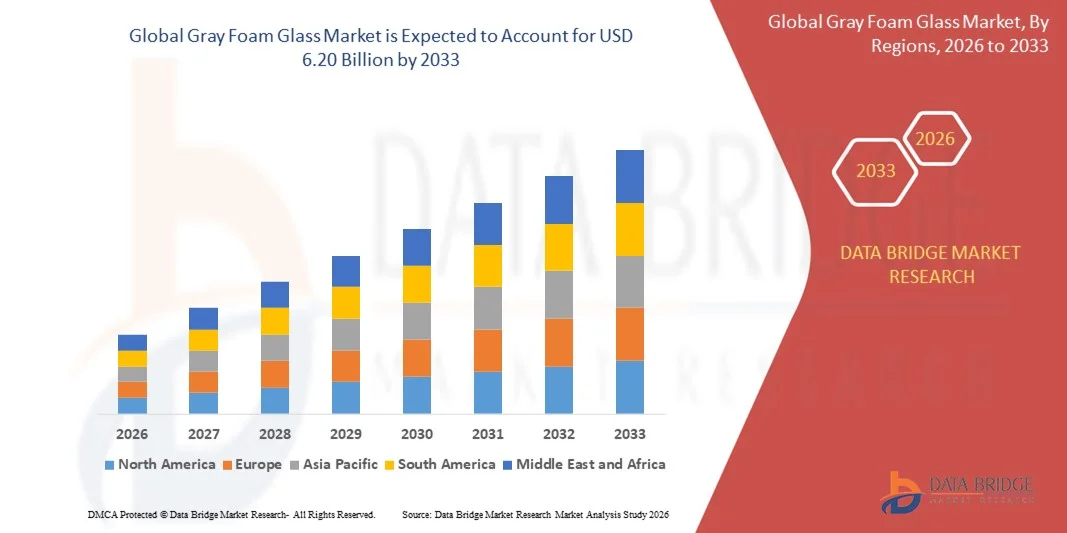
- The global gray foam glass market size was valued at USD 2.65 billion in 2025 and is expected to reach USD 6.20 billion by 2033, at a CAGR of 11.20% during the forecast period
- The market growth is largely fuelled by the increasing demand for energy-efficient and sustainable insulation materials in building and construction applications, driven by stricter environmental regulations and green building initiatives
- The rising adoption of gray foam glass in industrial insulation, cryogenic systems, and infrastructure projects due to its superior properties such as fire resistance, moisture resistance, and long service life is further supporting market expansion
Gray Foam Glass Market Analysis
- The market is witnessing strong growth due to the growing focus on sustainable construction and the shift toward recyclable and eco-friendly insulation materials, positioning gray foam glass as a preferred solution across residential, commercial, and industrial sectors
- In addition, increasing infrastructure development, expansion of oil and gas and chemical industries, and rising investment in energy-efficient buildings are contributing significantly to the demand for gray foam glass globally
- North America dominated the gray foam glass market with the largest revenue share of 39.12% in 2025, driven by increasing demand for energy-efficient insulation and the strong presence of advanced construction and industrial infrastructure
- Asia-Pacific region is expected to witness the highest growth rate in the global gray foam glass market, driven by expanding construction projects, rising disposable incomes, government initiatives supporting energy-efficient buildings, and increasing adoption of advanced insulation materials
- The Closed Cell segment held the largest market revenue share in 2025 driven by its superior moisture resistance, high compressive strength, and excellent thermal insulation performance. Closed cell gray foam glass is widely used in building insulation and industrial applications where durability and resistance to water penetration are essential, making it a preferred choice for long-term infrastructure projects
Report Scope and Gray Foam Glass Market Segmentation
|
Attributes |
Gray Foam Glass Key Market Insights |
|
Segments Covered |
|
|
Countries Covered |
North America
Europe
Asia-Pacific
Middle East and Africa
South America
|
|
Key Market Players |
|
|
Market Opportunities |
|
|
Value Added Data Infosets |
In addition to the insights on market scenarios such as market value, growth rate, segmentation, geographical coverage, and major players, the market reports curated by the Data Bridge Market Research also include import export analysis, production capacity overview, production consumption analysis, price trend analysis, climate change scenario, supply chain analysis, value chain analysis, raw material/consumables overview, vendor selection criteria, PESTLE Analysis, Porter Analysis, and regulatory framework. |
Gray Foam Glass Market Trends
Rising Demand for Sustainable and Energy-Efficient Insulation Materials
- The growing focus on energy efficiency and environmentally sustainable construction is significantly shaping the gray foam glass market, as builders and developers increasingly prefer recyclable and non-toxic insulation materials. Gray foam glass is gaining traction due to its ability to provide excellent thermal insulation, fire resistance, and moisture protection without degrading over time. This trend strengthens its adoption across residential, commercial, and industrial construction, encouraging manufacturers to expand production capacity and develop advanced insulation solutions
- Increasing awareness regarding carbon emission reduction and green building standards has accelerated the demand for gray foam glass in infrastructure, industrial plants, and commercial buildings. Environmentally conscious organizations and governments are actively promoting the use of eco-friendly insulation materials, prompting contractors and project developers to prioritize sustainable alternatives. This has also led to collaborations between insulation manufacturers and construction firms to improve building performance and environmental compliance
- Sustainability and lifecycle performance trends are influencing purchasing decisions, with manufacturers emphasizing recyclability, durability, and low environmental impact. These factors are helping companies differentiate their products in a competitive insulation market and build long-term partnerships with construction firms. Companies are increasingly highlighting environmental certifications and energy-saving benefits in marketing strategies to strengthen brand positioning and expand their customer base
- For instance, in 2024, Owens Corning in the U.S. and Saint‑Gobain in France expanded their sustainable insulation portfolios, including foam glass materials for commercial and industrial applications. These product expansions were introduced in response to rising demand for energy-efficient construction materials, with distribution across infrastructure and industrial projects. The solutions were also promoted for their environmental benefits, improving customer adoption and long-term project integration
- While demand for gray foam glass is increasing, sustained market expansion depends on improving production efficiency, reducing manufacturing costs, and ensuring consistent quality. Manufacturers are also focusing on enhancing product performance, optimizing supply chains, and investing in recycling technologies to support wider adoption
Gray Foam Glass Market Dynamics
Driver
Increasing Adoption of Fire-Resistant and Durable Insulation Solutions
- Rising demand for fire-resistant and long-lasting insulation materials is a major driver for the gray foam glass market. Manufacturers and construction companies are increasingly selecting foam glass due to its non-combustible properties and structural strength, which enhance building safety and longevity. This trend is also encouraging innovation in insulation technologies to meet evolving safety and performance requirements
- Expanding applications in oil and gas, chemical processing, and cryogenic insulation are influencing market growth. Gray foam glass helps maintain temperature stability and prevents moisture penetration, enabling industries to improve operational efficiency and reduce maintenance costs. The increasing number of industrial infrastructure projects globally further supports the adoption of foam glass insulation
- Construction and industrial companies are actively promoting foam glass-based insulation through infrastructure modernization projects and sustainable construction initiatives. These efforts are supported by growing regulatory emphasis on fire safety and energy efficiency. Partnerships between insulation manufacturers and engineering firms are also helping improve product performance and expand application areas
- For instance, in 2023, Pittsburgh Corning in the U.S. and GLAPOR in Germany reported increased demand for foam glass insulation in LNG facilities and commercial construction. This growth was driven by rising safety requirements and the need for durable insulation solutions, strengthening their market presence and expanding global project involvement
- Although increasing industrial and construction demand supports growth, broader adoption depends on improving cost competitiveness and ensuring availability across regions. Investment in advanced manufacturing technologies and distribution networks will be essential for long-term market expansion
Restraint/Challenge
High Production Cost and Limited Awareness in Emerging Markets
- The relatively high production cost of gray foam glass compared to conventional insulation materials remains a key challenge, limiting its adoption among cost-sensitive construction projects. Energy-intensive manufacturing processes and specialized raw material requirements contribute to higher product pricing. In addition, fluctuations in raw material availability can impact production consistency and cost stability
- Contractor and developer awareness remains uneven, particularly in developing regions where traditional insulation materials dominate the market. Limited understanding of long-term performance benefits restricts adoption in price-driven construction sectors. This also slows the transition toward sustainable insulation solutions in emerging economies
- Supply chain and logistics challenges also impact market growth, as foam glass insulation requires specialized handling and transportation due to its rigid structure. Distribution limitations and lack of local manufacturing facilities in certain regions increase overall project costs. Companies must invest in regional production and efficient logistics networks to improve accessibility
- For instance, in 2024, construction contractors and distributors in India and Brazil reported slower adoption of foam glass insulation due to higher upfront costs and limited product awareness. Availability constraints and competition from lower-cost insulation materials also affected purchasing decisions. These factors influenced project budgets and slowed widespread adoption in cost-competitive markets
- Overcoming these challenges will require cost-efficient manufacturing, improved awareness among construction stakeholders, and expanded regional production facilities. Collaboration between manufacturers, contractors, and regulatory bodies can help improve adoption. In addition, promoting long-term performance and sustainability benefits will be critical for unlocking the full growth potential of the global gray foam glass market
Gray Foam Glass Market Scope
The market is segmented on the basis of type and application.
- By Type
On the basis of type, the gray foam glass market is segmented into Closed Cell and Open Cell. The Closed Cell segment held the largest market revenue share in 2025 driven by its superior moisture resistance, high compressive strength, and excellent thermal insulation performance. Closed cell gray foam glass is widely used in building insulation and industrial applications where durability and resistance to water penetration are essential, making it a preferred choice for long-term infrastructure projects.
The Open Cell segment is expected to witness the fastest growth rate from 2026 to 2033, driven by its lightweight structure and increasing use in applications requiring effective insulation with lower material density. Open cell gray foam glass is gaining popularity in commercial construction and non-load-bearing insulation applications due to its cost-effectiveness and ease of installation, supporting its growing adoption.
- By Application
On the basis of application, the gray foam glass market is segmented into Cryogenic Systems, Heat Transfer Fluid Systems, Chemical Processing Systems, Commercial Piping and Building, and Others. The Commercial Piping and Building segment held the largest market revenue share in 2025 driven by rising construction activities and increasing demand for energy-efficient insulation materials. Gray foam glass is extensively used in commercial buildings for thermal insulation, fire protection, and moisture control, supporting long-term structural performance.
The Cryogenic Systems segment is expected to witness the fastest growth rate from 2026 to 2033, driven by increasing demand for reliable insulation in LNG facilities, industrial gas storage, and low-temperature processing environments. Gray foam glass provides excellent thermal stability and prevents condensation, making it highly suitable for cryogenic applications requiring consistent performance and safety.
Gray Foam Glass Market Regional Analysis
- North America dominated the gray foam glass market with the largest revenue share of 39.12% in 2025, driven by increasing demand for energy-efficient insulation and the strong presence of advanced construction and industrial infrastructure
- End users in the region highly value the durability, fire resistance, and moisture protection offered by gray foam glass, making it suitable for commercial buildings, oil and gas facilities, and industrial piping systems
- This widespread adoption is further supported by strict building energy regulations, growing investment in sustainable construction, and rising focus on reducing long-term operational and maintenance costs, establishing gray foam glass as a preferred insulation material
U.S. Gray Foam Glass Market Insight
The U.S. gray foam glass market captured the largest revenue share in 2025 within North America, fueled by rising adoption of high-performance insulation in commercial construction and industrial applications. Industries are increasingly prioritizing insulation solutions that provide fire safety and long service life. The growing development of LNG facilities, chemical plants, and modern commercial buildings further supports market growth. Moreover, strong regulatory emphasis on energy efficiency and sustainable building practices is significantly contributing to the expansion of the gray foam glass market.
Europe Gray Foam Glass Market Insight
The Europe gray foam glass market is expected to witness the fastest growth rate from 2026 to 2033, primarily driven by strict environmental regulations and increasing focus on green building construction. The rise in infrastructure modernization and industrial efficiency requirements is encouraging the use of advanced insulation materials. European industries are also focusing on reducing carbon emissions and improving energy performance. The region is experiencing strong growth across industrial insulation and commercial construction, with gray foam glass increasingly used in renovation and new projects.
U.K. Gray Foam Glass Market Insight
The U.K. gray foam glass market is expected to witness the fastest growth rate from 2026 to 2033, driven by rising construction of energy-efficient buildings and increasing focus on fire-safe insulation materials. In addition, stringent building safety regulations are encouraging the use of non-combustible insulation. The country’s expanding commercial infrastructure and renovation activities are further expected to stimulate market demand.
Germany Gray Foam Glass Market Insight
The Germany gray foam glass market is expected to witness the fastest growth rate from 2026 to 2033, fueled by strong demand for sustainable and high-quality insulation solutions. Germany’s advanced industrial sector and emphasis on energy-efficient construction are supporting adoption. The increasing use of foam glass insulation in chemical plants, commercial buildings, and industrial facilities is also contributing to market expansion, supported by the country’s focus on environmental sustainability.
Asia-Pacific Gray Foam Glass Market Insight
The Asia-Pacific gray foam glass market is expected to witness the fastest growth rate from 2026 to 2033, driven by rapid urbanization, expanding infrastructure projects, and increasing industrialization in countries such as China, Japan, and India. The region’s growing focus on energy efficiency and industrial safety is supporting adoption of advanced insulation materials. Furthermore, rising construction activities and expanding manufacturing industries are improving accessibility and demand for gray foam glass.
Japan Gray Foam Glass Market Insight
The Japan gray foam glass market is expected to witness the fastest growth rate from 2026 to 2033 due to increasing demand for high-performance and fire-resistant insulation materials. The country’s strong emphasis on advanced construction technologies and industrial efficiency supports market growth. The increasing use of foam glass in commercial buildings and industrial facilities is contributing to expansion. Moreover, Japan’s focus on disaster-resistant and durable infrastructure is encouraging adoption.
China Gray Foam Glass Market Insight
The China gray foam glass market accounted for the largest market revenue share in Asia Pacific in 2025, attributed to rapid infrastructure development, expanding industrial base, and strong government investment in construction. China represents one of the largest construction markets globally, with increasing demand for energy-efficient insulation solutions. The presence of domestic manufacturers and growing industrial insulation requirements are key factors driving market growth in China.
Gray Foam Glass Market Share
The Gray Foam Glass industry is primarily led by well-established companies, including:
- Corning (U.S.)
- GLAPOR Schaumglasdämmstoffe (Germany)
- Earthstone International LLC (U.S.)
- Refaglass (U.K.)
- Zhejiang Dehe Insulation Technology Co., Ltd. (China)
- Anhui Huichang New Material Co., Ltd. (China)
- ZHEJIANG ZHENSHEN INSULATION TECHNOLOGY CORP.LTD. (China)
- Zhong Tai Tian Cheng (China)
- ShouBang (China)
- YONGLI (China)
- Hebei Shenzhou Thermal Insulation Building Material Group Co., Ltd. (China)
- Hebei Baimei Latex Products Co., Ltd. (China)
- ZHONG TAI TIAN CHENG HOLDINGS LIMITED (China)
- Jiangsu Zhenghe (China)
- Misapor AG (Switzerland)
- POLYDROS, S.A. (Portugal)
- Anglitemp Limited (U.K.)
- Sun Refractories (India)
SKU-
Accédez en ligne au rapport sur le premier cloud mondial de veille économique

- Tableau de bord d'analyse de données interactif
- Tableau de bord d'analyse d'entreprise pour les opportunités à fort potentiel de croissance
- Accès d'analyste de recherche pour la personnalisation et les requêtes
- Analyse de la concurrence avec tableau de bord interactif
- Dernières actualités, mises à jour et analyse des tendances
- Exploitez la puissance de l'analyse comparative pour un suivi complet de la concurrence
Méthodologie de recherche
La collecte de données et l'analyse de l'année de base sont effectuées à l'aide de modules de collecte de données avec des échantillons de grande taille. L'étape consiste à obtenir des informations sur le marché ou des données connexes via diverses sources et stratégies. Elle comprend l'examen et la planification à l'avance de toutes les données acquises dans le passé. Elle englobe également l'examen des incohérences d'informations observées dans différentes sources d'informations. Les données de marché sont analysées et estimées à l'aide de modèles statistiques et cohérents de marché. De plus, l'analyse des parts de marché et l'analyse des tendances clés sont les principaux facteurs de succès du rapport de marché. Pour en savoir plus, veuillez demander un appel d'analyste ou déposer votre demande.
La méthodologie de recherche clé utilisée par l'équipe de recherche DBMR est la triangulation des données qui implique l'exploration de données, l'analyse de l'impact des variables de données sur le marché et la validation primaire (expert du secteur). Les modèles de données incluent la grille de positionnement des fournisseurs, l'analyse de la chronologie du marché, l'aperçu et le guide du marché, la grille de positionnement des entreprises, l'analyse des brevets, l'analyse des prix, l'analyse des parts de marché des entreprises, les normes de mesure, l'analyse globale par rapport à l'analyse régionale et des parts des fournisseurs. Pour en savoir plus sur la méthodologie de recherche, envoyez une demande pour parler à nos experts du secteur.
Personnalisation disponible
Data Bridge Market Research est un leader de la recherche formative avancée. Nous sommes fiers de fournir à nos clients existants et nouveaux des données et des analyses qui correspondent à leurs objectifs. Le rapport peut être personnalisé pour inclure une analyse des tendances des prix des marques cibles, une compréhension du marché pour d'autres pays (demandez la liste des pays), des données sur les résultats des essais cliniques, une revue de la littérature, une analyse du marché des produits remis à neuf et de la base de produits. L'analyse du marché des concurrents cibles peut être analysée à partir d'une analyse basée sur la technologie jusqu'à des stratégies de portefeuille de marché. Nous pouvons ajouter autant de concurrents que vous le souhaitez, dans le format et le style de données que vous recherchez. Notre équipe d'analystes peut également vous fournir des données sous forme de fichiers Excel bruts, de tableaux croisés dynamiques (Fact book) ou peut vous aider à créer des présentations à partir des ensembles de données disponibles dans le rapport.











