


Segmentation du marché mondial de l'agriculture sous serre, par type de structure (serres en verre, en polycarbonate, en polyéthylène et autres), par type de culture (fruits et légumes, fleurs et plantes ornementales et autres) et par technologie (hydroponie, aquaponie, aéroponie et autres) - Tendances du secteur et prévisions jusqu'en 2033
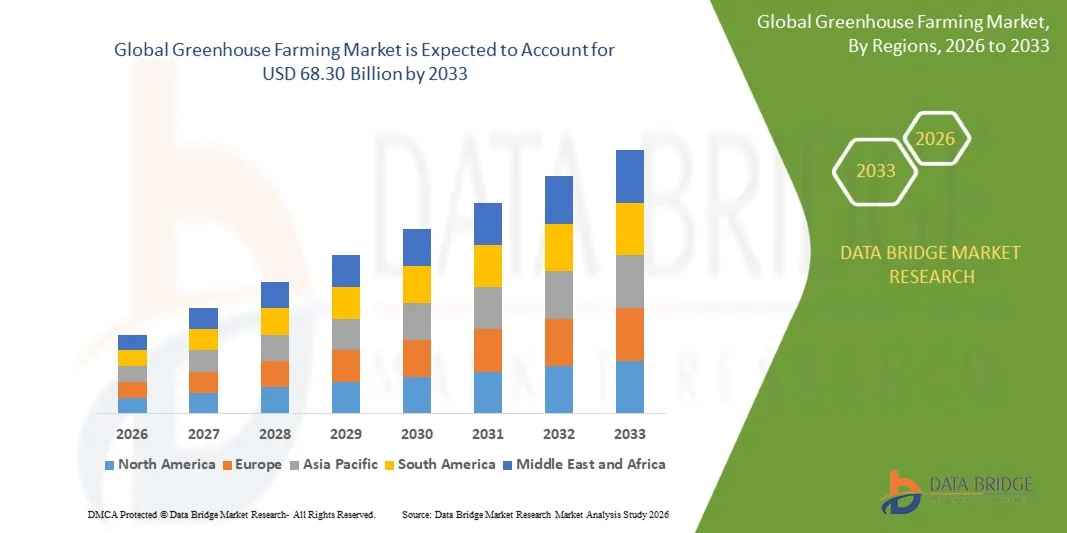
Taille du marché de l'agriculture en serre
- Le marché mondial de l'agriculture sous serre était évalué à 35,40 milliards de dollars américains en 2025 et devrait atteindre 68,30 milliards de dollars américains d'ici 2033 , avec un TCAC de 8,20 % au cours de la période de prévision.
- La croissance du marché est largement alimentée par la demande croissante de production agricole tout au long de l'année et par le besoin de rendements plus élevés sur des terres agricoles limitées.
- L'adoption croissante de technologies de pointe telles que l'hydroponie, l'aéroponie et les systèmes à climat contrôlé soutient davantage l'expansion du marché
Analyse du marché de l'agriculture en serre
- Le marché connaît des avancées technologiques significatives, notamment la climatisation automatisée, l'irrigation de précision et les systèmes d'éclairage LED, qui améliorent la qualité et la productivité des cultures.
- L'augmentation des initiatives et des subventions gouvernementales en faveur de l'agriculture durable, conjuguée à l'accent mis sur la sécurité alimentaire, encourage davantage l'adoption des serres.
- L'Amérique du Nord a dominé le marché de l'agriculture sous serre en 2025, avec la plus grande part de revenus, grâce à l'adoption rapide de l'agriculture en environnement contrôlé (AEC) et à la transition croissante vers une agriculture durable et à haut rendement.
- La région Asie-Pacifique devrait connaître le taux de croissance le plus élevé du marché mondial de l'agriculture sous serre , sous l'effet d'une urbanisation rapide, de l'adoption croissante des technologies agricoles durables et de l'augmentation des investissements dans les infrastructures modernes de serres.
- Le segment des serres en polyéthylène a représenté la plus grande part de revenus du marché en 2025, grâce à son faible coût d'installation, sa flexibilité et sa grande adaptabilité à diverses conditions climatiques. Les structures en polyéthylène sont largement utilisées dans les pays développés et émergents en raison de leur facilité d'installation et de leur capacité à permettre une culture à grande échelle à moindre coût.
Portée du rapport et segmentation du marché de l'agriculture en serre
|
Attributs |
Culture en serre : principaux enseignements du marché |
|
Segments couverts |
• Par type de structure : Serres en verre, serres en polycarbonate, serres en polyéthylène et autres • Par type de culture : Fruits et légumes, Fleurs et plantes ornementales, et Autres • Par technologie : hydroponie, aquaponie, aéroponie et autres |
|
Pays couverts |
Amérique du Nord
Europe
Asie-Pacifique
Moyen-Orient et Afrique
Amérique du Sud
|
|
Acteurs clés du marché |
|
|
Opportunités de marché |
• Développement des infrastructures de serres de haute technologie |
|
Ensembles d'informations de données à valeur ajoutée |
Outre les informations sur les scénarios de marché tels que la valeur du marché, le taux de croissance, la segmentation, la couverture géographique et les principaux acteurs, les rapports de marché élaborés par Data Bridge Market Research comprennent également une analyse des importations et des exportations, un aperçu de la capacité de production, une analyse de la consommation de production, une analyse des tendances des prix, un scénario de changement climatique, une analyse de la chaîne d'approvisionnement, une analyse de la chaîne de valeur, un aperçu des matières premières/consommables, les critères de sélection des fournisseurs, une analyse PESTLE, une analyse de Porter et le cadre réglementaire. |
Tendances du marché de l'agriculture en serre
« L’essor de l’agriculture en serre de haute technologie et à climat contrôlé »
L’adoption croissante de serres de haute technologie à climat contrôlé transforme le paysage agricole en permettant la culture tout au long de l’année, l’amélioration des rendements et la protection contre les intempéries. Ces systèmes permettent un contrôle précis de la température, de l’humidité et de la lumière, ce qui se traduit par une productivité accrue et une réduction des pertes de récoltes. De plus, l’intégration de la surveillance des cultures basée sur l’IA et de l’analyse prédictive aide les agriculteurs à détecter précocement les maladies et les carences nutritionnelles, améliorant ainsi la production et la qualité.
La forte demande en agriculture efficace et durable dans les zones urbaines et périurbaines accélère le recours à l'hydroponie, à l'aéroponie et aux serres intelligentes. Ces solutions sont particulièrement performantes dans les régions où les terres arables sont limitées, permettant aux agriculteurs d'optimiser leurs ressources et d'accroître leur production. Les gouvernements et les investisseurs privés soutiennent ces initiatives par des incitations, des subventions et des aides, favorisant ainsi leur adoption sur les marchés émergents et développés.
L'accessibilité, l'adaptabilité et la facilité d'utilisation des serres modernes les rendent attractives tant pour les producteurs commerciaux que pour les petits exploitants agricoles. Les utilisateurs bénéficient d'une consommation d'eau réduite, de besoins moindres en pesticides et de produits de meilleure qualité, ce qui améliore la rentabilité des exploitations. Les systèmes de climatisation avancés permettent également une diversification vers des cultures à haute valeur ajoutée telles que les baies, les tomates et les légumes-feuilles, générant ainsi des revenus supplémentaires.
Par exemple, en 2023, plusieurs exploitations sous serre aux Pays-Bas et en Inde ont constaté une augmentation des rendements de légumes et une réduction des infestations de ravageurs après la mise en place de systèmes automatisés de contrôle climatique et de culture hydroponique. Ces innovations ont amélioré la qualité des récoltes et l'efficacité opérationnelle tout en réduisant les coûts de production. Une meilleure traçabilité et une conformité accrue aux normes de qualité ont également permis aux agriculteurs de respecter les normes d'exportation et de se développer sur les marchés internationaux.
Si l’adoption des serres de haute technologie accélère l’agriculture durable, la croissance du marché dépend de la poursuite des efforts de R&D, des investissements dans l’automatisation et des solutions écoénergétiques. Les fabricants doivent privilégier le développement de produits adaptés aux marchés locaux et les solutions agricoles intégrées pour tirer pleinement parti de cette demande croissante. La collaboration avec les jeunes entreprises agro-technologiques et les instituts de recherche devient essentielle pour créer des solutions de serres innovantes et rentables.
Dynamique du marché de l'agriculture en serre
Conducteur
« Besoin croissant de pratiques agricoles durables et à haut rendement »
L’augmentation de la population mondiale et de la demande alimentaire favorise l’adoption de l’agriculture sous serre afin d’assurer une productivité agricole accrue et un approvisionnement continu. Les environnements contrôlés contribuent à atténuer les risques liés aux changements climatiques, aux ravageurs et aux maladies. Les agriculteurs sont également incités à adopter des solutions de serres avancées pour réduire les pertes après récolte et améliorer l’efficacité de l’utilisation des ressources.
Les gouvernements et les organismes de recherche encouragent les pratiques agricoles durables par le biais de subventions, d'aides et d'un soutien technique pour les infrastructures de serres. Cela a permis d'accroître la disponibilité et l'adoption des technologies de serres avancées, tant dans les pays développés que dans les pays émergents. Les partenariats public-privé et les programmes de formation permettent également aux agriculteurs de mettre en œuvre efficacement des systèmes sophistiqués.
Les progrès technologiques en matière de capteurs, de surveillance via l'Internet des objets (IoT) et de systèmes d'irrigation automatisés permettent aux agriculteurs d'optimiser leurs intrants et d'améliorer la qualité de leurs récoltes. Ces innovations contribuent à réduire la consommation d'eau et d'engrais tout en maximisant les rendements. L'intégration avec les plateformes mobiles et cloud permet une surveillance en temps réel et une maintenance prédictive, améliorant ainsi l'efficacité opérationnelle.
Par exemple, en 2022, plusieurs exploitations agricoles en Chine et au Brésil ont adopté des systèmes de serres automatisés avec contrôle climatique intégré, ce qui a permis d'accroître les rendements, d'améliorer l'utilisation des ressources et de réduire les coûts d'exploitation. Cette adoption a également permis aux agriculteurs de cultiver des produits hors saison et de se développer sur des marchés haut de gamme, augmentant ainsi leur rentabilité et leur compétitivité.
• Si la demande en agriculture durable stimule la croissance du marché, l'innovation continue, la formation des agriculteurs et des solutions abordables sont essentielles pour maintenir l'adoption de ces pratiques et maximiser les bénéfices. Les acteurs du marché se concentrent également sur des systèmes de serres économes en énergie et alimentés par des énergies renouvelables afin de réduire les coûts d'exploitation et l'impact environnemental.
Retenue/Défi
« Investissement initial élevé et complexité opérationnelle »
Le coût élevé de la construction et de l'entretien des serres modernes, incluant la climatisation, l'hydroponie et la surveillance automatisée, limite leur adoption par les petits exploitants agricoles et dans les régions en développement. Le coût demeure un obstacle majeur à leur généralisation. De plus, les longs délais de retour sur investissement dissuadent les investisseurs réticents au risque d'adopter des solutions de haute technologie.
Dans de nombreuses régions, le manque d'expertise technique et de personnel qualifié limite le bon fonctionnement des serres. Il en résulte une utilisation sous-optimale des ressources, des rendements agricoles inférieurs et un retard dans l'adoption des techniques modernes. Le développement continu des compétences et les programmes de formation sur site sont essentiels pour remédier à ces inefficacités opérationnelles.
Les contraintes liées à la chaîne d'approvisionnement, notamment l'accès à des intrants de qualité, à des équipements et à des prestataires de services qualifiés, freinent davantage le développement de l'agriculture sous serre. La dépendance aux technologies importées peut également accroître les coûts et réduire la pénétration du marché. Une logistique peu fiable et un service après-vente limité dans les zones reculées aggravent encore les difficultés opérationnelles.
Par exemple, en 2023, plusieurs petits exploitants de serres en Afrique subsaharienne ont signalé des difficultés à mettre en œuvre des systèmes automatisés en raison d'importants investissements initiaux et d'un manque de soutien technique. Les retards de maintenance, les temps d'arrêt des équipements et l'irrégularité de la qualité des récoltes ont été des problèmes majeurs qui ont affecté la rentabilité et les taux d'adoption.
• Si les technologies de l'agriculture sous serre continuent de progresser, il demeure essentiel de relever les défis liés aux coûts, aux aspects techniques et à la chaîne d'approvisionnement. Les acteurs du marché doivent privilégier des solutions modulaires et abordables, le renforcement des capacités et un soutien localisé afin de libérer le potentiel de croissance à long terme. Les partenariats avec les fabricants et les institutions financières locales peuvent également faciliter l'accès au crédit et réduire les obstacles à l'entrée sur le marché pour les nouveaux producteurs.
Champ d'application de l'agriculture en serre
Le marché est segmenté en fonction du type de structure, du type de culture et de la technologie.
• Par type de structure
Selon le type de structure, le marché de l'agriculture sous serre se divise en serres en verre, serres en polycarbonate, serres en polyéthylène et autres. Le segment des serres en polyéthylène détenait la plus grande part de revenus en 2025, grâce à son faible coût d'installation, sa flexibilité et sa grande adaptabilité à diverses conditions climatiques. Les structures en polyéthylène sont largement utilisées dans les pays développés comme dans les pays émergents en raison de leur facilité d'installation et de leur capacité à permettre une culture à grande échelle à moindre coût.
Le segment des serres en polycarbonate devrait connaître la croissance la plus rapide entre 2026 et 2033, grâce à leur isolation supérieure, leur durabilité et leur diffusion lumineuse optimisée, qui améliorent considérablement la productivité des cultures. Les serres en polycarbonate sont de plus en plus plébiscitées pour la culture de plantes à haute valeur ajoutée et les installations à climat contrôlé de pointe, ce qui en fait un choix populaire auprès des producteurs commerciaux recherchant une efficacité opérationnelle à long terme.
• Par type de culture
Le marché de l'agriculture sous serre est segmenté, selon le type de culture, en trois catégories : fruits et légumes, fleurs et plantes ornementales, et autres. Le segment des fruits et légumes détenait la plus grande part de chiffre d'affaires en 2025, porté par la demande mondiale croissante de produits frais et sans pesticides, ainsi que par la capacité des serres à assurer une production tout au long de l'année. Ce segment bénéficie d'une forte préférence des consommateurs pour les cultures de haute qualité, ce qui en fait la priorité des petits exploitants et des exploitants de serres commerciales.
Le segment des fleurs et plantes ornementales devrait connaître la croissance la plus rapide entre 2026 et 2033, portée par la demande croissante du secteur de la floriculture et la nécessité de maîtriser les environnements pour garantir la qualité des produits. Les serres modernes permettent une régulation climatique précise des espèces ornementales délicates, favorisant ainsi des rendements plus élevés et un approvisionnement constant sur les marchés nationaux et internationaux.
• Par la technologie
Selon la technologie utilisée, le marché de l'agriculture sous serre se divise en hydroponie, aquaponie, aéroponie et autres. En 2025, l'hydroponie détenait la plus grande part de revenus, grâce à son système d'apport de nutriments performant, sa faible consommation d'eau et sa capacité à générer des rendements nettement supérieurs aux méthodes de culture traditionnelles. Les systèmes hydroponiques sont largement adoptés en agriculture urbaine et dans les exploitations commerciales en raison de leur adaptabilité et de leur compatibilité avec les serres modernes à environnement contrôlé.
Le segment de l'aéroponie devrait connaître la croissance la plus rapide entre 2026 et 2033, grâce à une oxygénation optimale, des besoins en eau minimaux et une forte adoption dans les projets de serres de haute technologie. La technologie aéroponique favorise une croissance plus rapide des cultures et une productivité accrue, ce qui explique sa popularité croissante auprès des agriculteurs à la recherche de solutions agricoles innovantes et économes en ressources.
Analyse régionale du marché de l'agriculture en serre
• L’Amérique du Nord a dominé le marché de l’agriculture sous serre en 2025, générant la plus grande part de revenus, grâce à l’adoption rapide de l’agriculture en environnement contrôlé (AEC) et à la transition croissante vers une agriculture durable et à haut rendement.
• Les producteurs de la région apprécient particulièrement l'efficacité, l'optimisation des ressources et la production à l'année permises par les systèmes de serres avancés tels que l'hydroponie, l'aéroponie et la climatisation automatisée.
Cette adoption généralisée est également favorisée par une forte capacité d'investissement, une infrastructure technologique solide et le besoin d'une production constante et de haute qualité, faisant de l'agriculture sous serre une solution essentielle pour l'agriculture commerciale.
Aperçu du marché américain de l'agriculture en serre
En 2025, le marché américain de l'agriculture sous serre a généré la plus grande part de revenus en Amérique du Nord, porté par la demande croissante de produits frais et locaux et par le recours accru aux technologies agricoles intelligentes. Les producteurs commerciaux privilégient les systèmes à climat contrôlé afin d'obtenir de meilleurs rendements et de réduire leur dépendance à l'égard des cultures saisonnières. La popularité grandissante de l'hydroponie et des serres verticales, conjuguée à d'importants investissements dans l'innovation agro-technologique, continue de stimuler la croissance du marché. Par ailleurs, le développement de l'agriculture urbaine et de la production alimentaire en environnement contrôlé contribue significativement à la dynamique du secteur.
Aperçu du marché européen de l'agriculture sous serre
Le marché européen de l'agriculture sous serre devrait connaître une forte croissance entre 2026 et 2033, portée par des normes de durabilité strictes et la nécessité d'accroître la production alimentaire nationale. Les agriculteurs européens adoptent de plus en plus des solutions de serres économes en énergie, des lampes horticoles LED et des systèmes d'automatisation pour améliorer leur productivité. La priorité accordée à la réduction de l'empreinte carbone et au renforcement de la sécurité alimentaire dans la région accélère la demande, tant dans les exploitations agricoles commerciales que dans les installations horticoles modernes. L'agriculture sous serre se développe également rapidement dans les pays qui investissent dans des systèmes agricoles alimentés par des énergies renouvelables.
Aperçu du marché britannique de l'agriculture en serre
Le marché britannique de l'agriculture sous serre devrait connaître une forte croissance entre 2026 et 2033, soutenu par la hausse des coûts des importations alimentaires et la nécessité d'une production agricole autosuffisante. L'intérêt croissant pour des méthodes agricoles durables et résilientes face au changement climatique incite les producteurs à adopter des serres modernes équipées de technologies écoénergétiques. Le développement de l'agriculture urbaine, conjugué à la demande croissante des consommateurs pour des fruits et légumes locaux, continue de stimuler l'expansion du marché au Royaume-Uni.
Aperçu du marché allemand de l'agriculture sous serre
Le marché allemand de l'agriculture sous serre devrait connaître une croissance significative entre 2026 et 2033, portée par de solides capacités technologiques et un engagement en faveur d'une agriculture durable. L'automatisation avancée, les technologies de capteurs et l'accent mis sur les énergies renouvelables jouent un rôle clé dans la modernisation des exploitations sous serre. La préférence croissante pour des produits de haute qualité, sans pesticides, encourage également l'adoption de l'agriculture en environnement contrôlé. L'intégration de solutions d'agriculture de précision continue d'améliorer la productivité des serres, tant commerciales que de recherche.
Aperçu du marché de l'agriculture en serre en Asie-Pacifique
Le marché de l'agriculture sous serre en Asie-Pacifique devrait connaître la croissance la plus rapide entre 2026 et 2033, porté par l'urbanisation rapide, l'expansion démographique et l'adoption croissante des technologies agricoles modernes dans des pays comme la Chine, le Japon et l'Inde. Les programmes gouvernementaux encourageant l'agriculture à haut rendement, associés à des investissements accrus dans les infrastructures d'agriculture en environnement contrôlé (CEA), soutiennent une forte expansion du marché. L'Asie-Pacifique devenant un pôle de production majeur pour les composants de serres et les systèmes hydroponiques, l'accessibilité et le déploiement à grande échelle accélèrent l'adoption de ces technologies par les producteurs commerciaux.
Aperçu du marché japonais de l'agriculture sous serre
Le marché japonais de l'agriculture sous serre devrait connaître une forte croissance entre 2026 et 2033, portée par la sophistication technologique du pays et la rareté des terres arables. Les agriculteurs japonais adoptent rapidement des systèmes de serres automatisés et pilotés par l'intelligence artificielle afin d'optimiser la production de légumes et de cultures spécialisées. L'intégration de la robotique, des systèmes de contrôle par capteurs et des structures de serres verticales contribue à une productivité accrue. Par ailleurs, la nécessité de pallier la pénurie de main-d'œuvre et de garantir un approvisionnement alimentaire national fiable continue d'alimenter la demande du marché.
Aperçu du marché chinois de l'agriculture sous serre
En 2025, le marché chinois de l'agriculture sous serre représentait la plus grande part des revenus en Asie-Pacifique, grâce à d'importants investissements publics dans l'agriculture moderne et à la forte demande du pays en produits frais. La Chine est l'un des pays ayant le plus adopté l'hydroponie, les serres de haute technologie et les systèmes agricoles intelligents. Ses solides capacités de production nationale permettent une construction de serres rentable, favorisant ainsi leur adoption à grande échelle par les exploitations agricoles commerciales. La volonté de garantir la sécurité alimentaire, de développer les villes intelligentes et d'accroître les rendements agricoles continue d'accélérer la croissance du marché des serres en Chine.
Part de marché de l'agriculture en serre
Le secteur de l'agriculture en serre est principalement dominé par des entreprises bien établies, notamment :
- Priva (Pays-Bas)
- Certhon (Pays-Bas)
- Groupe Ridder (Pays-Bas)
- Serres géantes (États-Unis)
- Heliospectra AB (Suède)
- Poly-Tex Inc. (États-Unis)
- Groupe Richel (France)
- Logiqs BV (Pays-Bas)
- Serres Luminosa (Royaume-Uni)
- Stuppy Greenhouse (États-Unis)
SKU-
Accédez en ligne au rapport sur le premier cloud mondial de veille économique

- Tableau de bord d'analyse de données interactif
- Tableau de bord d'analyse d'entreprise pour les opportunités à fort potentiel de croissance
- Accès d'analyste de recherche pour la personnalisation et les requêtes
- Analyse de la concurrence avec tableau de bord interactif
- Dernières actualités, mises à jour et analyse des tendances
- Exploitez la puissance de l'analyse comparative pour un suivi complet de la concurrence
Méthodologie de recherche
La collecte de données et l'analyse de l'année de base sont effectuées à l'aide de modules de collecte de données avec des échantillons de grande taille. L'étape consiste à obtenir des informations sur le marché ou des données connexes via diverses sources et stratégies. Elle comprend l'examen et la planification à l'avance de toutes les données acquises dans le passé. Elle englobe également l'examen des incohérences d'informations observées dans différentes sources d'informations. Les données de marché sont analysées et estimées à l'aide de modèles statistiques et cohérents de marché. De plus, l'analyse des parts de marché et l'analyse des tendances clés sont les principaux facteurs de succès du rapport de marché. Pour en savoir plus, veuillez demander un appel d'analyste ou déposer votre demande.
La méthodologie de recherche clé utilisée par l'équipe de recherche DBMR est la triangulation des données qui implique l'exploration de données, l'analyse de l'impact des variables de données sur le marché et la validation primaire (expert du secteur). Les modèles de données incluent la grille de positionnement des fournisseurs, l'analyse de la chronologie du marché, l'aperçu et le guide du marché, la grille de positionnement des entreprises, l'analyse des brevets, l'analyse des prix, l'analyse des parts de marché des entreprises, les normes de mesure, l'analyse globale par rapport à l'analyse régionale et des parts des fournisseurs. Pour en savoir plus sur la méthodologie de recherche, envoyez une demande pour parler à nos experts du secteur.
Personnalisation disponible
Data Bridge Market Research est un leader de la recherche formative avancée. Nous sommes fiers de fournir à nos clients existants et nouveaux des données et des analyses qui correspondent à leurs objectifs. Le rapport peut être personnalisé pour inclure une analyse des tendances des prix des marques cibles, une compréhension du marché pour d'autres pays (demandez la liste des pays), des données sur les résultats des essais cliniques, une revue de la littérature, une analyse du marché des produits remis à neuf et de la base de produits. L'analyse du marché des concurrents cibles peut être analysée à partir d'une analyse basée sur la technologie jusqu'à des stratégies de portefeuille de marché. Nous pouvons ajouter autant de concurrents que vous le souhaitez, dans le format et le style de données que vous recherchez. Notre équipe d'analystes peut également vous fournir des données sous forme de fichiers Excel bruts, de tableaux croisés dynamiques (Fact book) ou peut vous aider à créer des présentations à partir des ensembles de données disponibles dans le rapport.











